Fulltext
The body of the article can be found in the PDF file.
Journal of Medical Education for Future Demands
Former Title: Journal of Medical Education | The Official Journal of School of Medical Education and Learning Technologies
Image Credit:J Med Edu
Authors
Background: Growing national concern about distortions in the size, specially composition, and availability of the physician workforce -especially after "cultural revolution n- has evoked challenges in Iran.Purpose: To determine various factors that influence medical graduates choices for residency program.Methods: All applicants for residency program in Mazandaran university of Medical Sciences and Health Services completed the Medical School Graduation Questionnaire, and rated each factor using 0 to 4 Likert-type scale. Factors' ratings were also compared across applicants of different residency program, and demographic variables.Results: The top two factors rated as having strong influences were ones related to interest in helping peop1e (rated 3.07), and intellectual content of the specially (rated 3). Malpractice insurance cost has the least influence (rated 0.98). Most of men preferred independence, whereas most of women preferred predictable working hours. Opportunity to make differences in people's l(fe influenced the specially choices of usual participants. whereas those who used war veterans quota paid more attention to independence and exercise of social responsibility. Patientcontact factors were less important to graduates who chose diagnostic speciafties. Also, there was a significant association between the participants' age and four factors.Conclusion: These graduates based their specially preference heavily on the opportunity that the specially affords to help people, and intellectual content of the specially. Knowing the hierarchy of influences on graduates' motivations should help education strategists determine what experiences and perceptions must change if a different mix of specially decision is to result.
© 2003, Author(s). This open-access article is available under the Creative Commons Attribution 4.0 (CC BY 4.0) International License (https://creativecommons.org/licenses/by/4.0/), which allows for unrestricted use, distribution, and reproduction in any medium, provided that the original work is properly cited.
Mehrdad R, Nikzad M, Alavi S, Gorji A. How Graduates from Medicine Choose their Residency Program in Iran?. J Med Edu. 2005;8(1):e105244. doi: https://doi.org/10.22037/jme.v8i1.757
Soltanipour S, Khoshrang H, Zakeri A, Hamidi Madani Z, Mahdipour S, et al. Specialty Preferences and Influencing Factors Among Guilan Medical Sciences Students. Educ Res Med Sci. 2025;14(2):e166484. doi: https://doi.org/10.69107/ermsj-166484
Hajizadeh S, Mahmoodian H. Factors Affecting the Choice of Specialty in Medical Students in Iran. J Med Edu. 2018;17(2):e105613. doi: https://doi.org/10.22037/jme.v17i2.21377
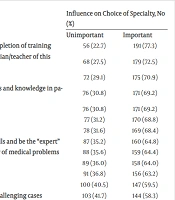
Said Al Hadhrami R, Khalfan Al Mamari AS, Hamed Al Omrani S, Hummod Al Rumaidhi S, Mohammed Al Busaidi T, et al. Factors Predicting the Choice of Specialization Among Medical Students and Junior Doctors in Oman: A Cross-Sectional Study. J Med Edu. 2024;23(1):e145508. doi: https://doi.org/10.5812/jme-145508
Dehghani M, Fata L, Amini M, Mir F, Ghanavati S, et al. A Competence-Based Study of Academic and Specialty Career Selection in Medical Students: Elective Experience. Educ Res Med Sci. 2017;6(1):e79647. doi:
Last Update: 3 weeks ago
Last Update: 3 weeks ago
Last Update: 3 weeks ago
Last Update: 6 days ago
Last Update: 8 hours ago
Last Update: 4 days ago