Fulltext
The body of the article can be found in the PDF file.
Journal of Medical Education for Future Demands
Former Title: Journal of Medical Education | The Official Journal of School of Medical Education and Learning Technologies
Image Credit:J Med Edu
Authors
Background and Purpose: In an era of increasing professional accountability, there is a need for both medical educators and licensing bodies to identify the exit competencies expected from medical graduates. Pediatrics department of Isfahan University of medical sciences has defined learning outcomes that should be achieved in pediatric ambulatory setting and both learners and teachers were informed about these outcomes. The aim of this study is to compare faculties’ expectation and interns’ self-assessment about their achievement of learning outcomes at pediatric out-patient clinics.Methods: In this cross-sectional study conducted in October and November 2005 a list of 63 learning outcomes was prepared. In the first phase, all faculty members were asked to specify desired level of achievement on 0-3 analogue scale for each outcome. In second phase, interns were acquired to selfevaluate their level of achievement in these competencies based on the above scale.Results: In this study 53 interns and 6 faculty members participated. Interns were expected to be fully competent with respect to eleven learning outcomes. There was a significant difference between faculties’ expectations and interns’ self assessment in 6 of full competency requiring outcomes and in 13 of high competency requiring outcomes.Conclusion: Interns’ achievement seems unsatisfactory regarding outcomes requiring full and high competency achievement and pediatrics department can revised its curriculum based on the results of this study and improve teaching and learning in the outpatient services.
© 2006, Author(s). This open-access article is available under the Creative Commons Attribution 4.0 (CC BY 4.0) International License (https://creativecommons.org/licenses/by/4.0/), which allows for unrestricted use, distribution, and reproduction in any medium, provided that the original work is properly cited.
Yazdani S, Arab M, Noghabaei G, Ghavami B. Medical school graduates' self-evaluations of expected learning outcomes. J Med Edu. 2016;15(2):e105493. doi: https://doi.org/10.22037/jme.v15i2.8002
Mohammadi A, Mojtahedzadeh R, Enzevaei A. Qualitative and Quantitative Evaluation of Clinical Education in Medical Schools of Iran: A Cross Sectional Study. J Med Edu. 2006;10(1):e105312. doi: https://doi.org/10.22037/jme.v10i1.706
FakhrMosavi A, Ahadi F. Internal evaluation of pediatric nursing department in Semnan university of medical sciences in year 2002.. koomesh. 2004;5(2):e152007. doi:
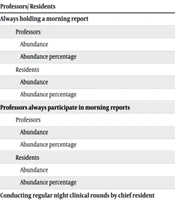
Arbaghaei M, Vasheghani Farahani M, Vasighi Pirayesh H, Asadi ZS. Attitude of Students and Professors Toward Quality of Residency Medical Education at the Selected University of Medical Sciences in Tehran in 2023. Ann Mil Health Sci Res. 2024;22(3):e148869. doi: https://doi.org/10.5812/amh-148869
Dashti S, Pedramfar P, Amini M, Sagheb M. A self-assessment of Residents in Neurology Department of Shiraz Medical School. J Med Edu. 2009;13(1 & 2):e105395. doi: https://doi.org/10.22037/jme.v13i1,2.1132
Last Update: 3 weeks ago
Last Update: 3 weeks ago
Last Update: 3 weeks ago
Last Update: 37 minutes ago
Last Update: 11 hours ago
Last Update: 4 days ago