Fulltext
The body of the article can be found in the PDF file.
Journal of Medical Education for Future Demands
Former Title: Journal of Medical Education | The Official Journal of School of Medical Education and Learning Technologies
Image Credit:J Med Edu
Authors
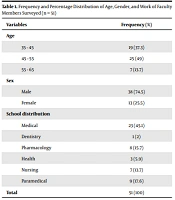
Background and Purpose: The quality of residency promotion tests is effective in resident’s knowledge and learning quality. We aimed to investigate the methods of writing questions for the residency promotion test by the faculty members of Shiraz University of Medical Sciences.Methods: In this cross-sectional study, we designed questionnaires to assess the faculty member’s goals, purpose and interests in writing questions.Results: 50% of the faculty members wanted to evaluate what residents learn when they write questions. Also, 60% of them focus on of what is expected from residents in practice. The priority of 82.5% of the faculty members was the first line management of common diseases.Conclusions: We found no significant difference between questions made by faculty members and questions written by those who have no specific academic education. Faculty members with more experience assess the ability of residents to solve complicated questions more than those with less experience.
© 2016, Author(s). This open-access article is available under the Creative Commons Attribution 4.0 (CC BY 4.0) International License (https://creativecommons.org/licenses/by/4.0/), which allows for unrestricted use, distribution, and reproduction in any medium, provided that the original work is properly cited.
Pourmirza Kalhori R, Roshanpour F, Rezaei M, Naderipour A. Academic member’s knowledge improvement effect on the results of multiple choice questions in residency exams analysis (2009). J Kermanshah Univ Med Sci. 2011;15(2):e79376. doi:
Arab M, Davaloo S, Nasrolahi S, Nadi E, Emdadi M. Final Test Analysis Of Post Graduate Medical Residents. J Med Edu. 2005;7(2):e105219. doi: https://doi.org/10.22037/jme.v7i2.834
Shiani A, Ahmadi SM, Ramezani G, Darabi F, Zanganeh F, et al. The Role of Qualitative and Quantitative Feedback on Faculties’ Quality of Writing Multiple Choice Questions. Educ Res Med Sci. 2022;11(2):e119114. doi: https://doi.org/10.5812/erms-119114
Pourmirza Kalhori R, Rezaie M, Shojee Moghadam AR, Sepahi V, Memar Eftekhari L. Correlation of quality and quantity index of multiple choice questions exams of residency promotion in Kermanshah University of medical sciences, 2013. J Clin Res Paramed Sci. 2015;4(1):e81958. doi:
Meshkani Z, Hossein Abadie F. The Effect Of Contextual Factors On Results Of Teaching Evaluation In College Of Medicine, Tehran University Of Medical Sciences (2003). J Med Edu. 2004;6(1):e105141. doi: https://doi.org/10.22037/jme.v6i1.813
Last Update: 3 days ago
Last Update: 3 days ago
Last Update: 3 days ago
Last Update: 6 days ago
Last Update: 10 hours ago
Last Update: 4 days ago