Fulltext
The body of the article can be found in the PDF file.
Journal of Medical Education for Future Demands
Former Title: Journal of Medical Education | The Official Journal of School of Medical Education and Learning Technologies
Image Credit:J Med Edu
Authors
Background: Studies have shown that ignoring burnout in medical students lead to worsened disease condition and paying less attention to its progression. We aimed to determine the prevalence of burnout and its relationship with demographic factors in medical students during internship in Qazvin University, during 2014-2015.Methods: 130 medical students participated in this study. They completed demographic questionnaire and Maslach Burnout Inventory at the beginning and end of their internship course. The relationship between each of the three components of burnout and demographic characteristics were analyzed. Job burnout scores were compared between the beginning and end of the internship course.Results: in this study, a significant relationship was not observed between the prevalence of burnout and demographic variables (age, sex, marital status, place of residence, and smoking). The prevalence of burnout was significantly more at the end of internship course (P<0.05, X2=24.09). With respect to the components of burnout, we found that the participants’ scores in the three subscales of the burnout questionnaire was significantly higher after the internship course compared to before it (emotionalexhaustion t=-3.25, P=0.01; depersonalization t=-3.98, P<0.05; personal accomplishment t=-2.11,P=0.036).Conclusion: the study showed that the prevalence of burnout syndrome and its components among medical students was high during internship. Due to the high cost of burnout, implementing appropriate strategies for reducing it is essential.
© 2018, Author(s). This open-access article is available under the Creative Commons Attribution 4.0 (CC BY 4.0) International License (https://creativecommons.org/licenses/by/4.0/), which allows for unrestricted use, distribution, and reproduction in any medium, provided that the original work is properly cited.
Talaei A, Mokhbar N, MohammadNezhad M, Samri A. Burnout and its related factors in staffs of university hospitals in Mashhad in 2006. koomesh. 2008;9(3):e152197. doi:
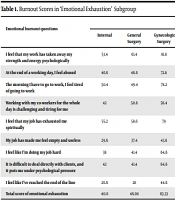
Atabaki P, Garkaz O, Paryab S, Hamednia S, Mehmanfar S, et al. Prevalence of Burnout Syndrome in Medical Assistants Working in Hospitals Affiliated with Urmia University of Medical Sciences. J Arch Mil Med. 2022;10(1):e118827. doi: https://doi.org/10.5812/jamm-118827
Akhyani S, Mirmohammadkhani M, Pahlevan D. Examining the frequency of job burnout in nurses working in the hospitals of Semnan University of Medical Sciences: a cross-sectional study. koomesh. 2023;25(6):e152868. doi:
Goodarzi A, Ezzati E, Sabour B, Pourmirza Kalhori R, Naderipour A, et al. Prevalence and affecting factors on burnout in nurses in selected hospitals of Kermanshah University of Medical Sciences, 2012. J Clin Res Paramed Sci. 2013;1(4):e82323. doi:
Moghadassi J, Aslani Y, Etemadifar S, Masoudi R, Ravaghi K. Nursing burnout in Medical and Educational centers in Shahrekord, Iran. Jundishapur J Chronic Dis Care. 2012;1(1):e94243. doi:
Last Update: 1 month ago
Last Update: 1 month ago
Last Update: 1 month ago
Last Update: 1 hour ago
Last Update: 12 hours ago
Last Update: 4 days ago