
1. Background
Asthma is a common obstructive lung disorder affecting more than 339 million people worldwide (1). Approximately 8.3% of US children had asthma in 2017, which was lower than the rates in 2010 (9.4%) and 2001 (8.7%) (2). However, asthma prevalence continues to increase in developing countries with an average of 13.14% (3, 4). Numerous risk factors for asthma have been identified. The most well-documented risk factors include the patient’s gender, airway hyperreactivity, atopy, obesity, perinatal factors, exposure to allergens, infection, and tobacco smoke (5). The successful management of asthma is based on regular monitoring of patients and their lung function, controlling environmental factors, and pharmacologic treatment. Inhalers have been identified as the cornerstone of asthma management and the safest and most effective way to treat and control asthma, as they reach the lungs directly (6, 7). Broadly speaking, inhaler drugs (IDs) can be classified into four categories: Metered dose inhalers (MDIs), dry powder inhalers (DPIs), breath actuated inhalers (BAIs), and nebulizers (NBs) (8). MDIs, the most commonly used inhaler devices, are propellant-based and deliver a specific amount of medication to the lungs in the form of an aerosol spray (9). DPIs, the second type of inhalers, deliver asthma medication in a dry powder form.
New MDIs are BAIs, which depend on the inhalation starting to release the medication from the device (10). Compared to the MDIs, DPIs are easier to use as they do not need propellants and coordination (11). BAI, an advanced version of the MDIs technology, combines the advantages of MDIs and DPIs. The BAI senses the inhalation through an actuator and releases the medication automatically (12). Furthermore, NBs convert the liquid form of medications into suitable aerosol droplets, which are best suited for inhalation. NBs do not require coordination and deliver the medication quickly and effectively to the lungs in the form of a mist. However, the wasted nebulized drugs are its most significant problem (13). Despite new guidelines and treatment approaches, many asthma patients still do not achieve adequate asthma control (14). The cause of the poorly controlled disease is mainly attributed to inadequate drug prescription, long-duration asthma, high airflow limitation, and inhaler mishandling (14-17). It is observed that most patients, even after proper training on how to use MDIs, still struggle to coordinate the proper usage (18, 19). Since many upcoming non-traditional IDs are emerging, the healthcare provider’s responsibility is to educate patients on using each inhaler device correctly.
2. Objectives
This study aimed to evaluate the knowledge and skills of medical students (MSs) and pediatric residents (PRs) in using different IDs.
3. Methods
This cross-sectional study included 243 MSs and PRs at Shiraz University of Medical Science, Iran from 21 March 2018 to 20 March 2019. This university has a seven-year general practitioner course system. The participants were PRs, junior medical students (JMSs) in the fifth year of their course, and senior medical students (SMSs) in the sixth or seventh year of their course educating rotations at the division of pediatric pulmonary medicine. The participants had been educated both theoretically and practically during their courses prior to this study. A checklist containing the participants’ age, medical degree, previous medical practice, and working background was obtained. Each participant underwent a two-step assessment. The first step was done with an interview questionnaire evaluating the demographic information, the level of knowledge of IDs, and assessing how to use appropriate techniques. The interviewer assessed their performance and filled the pre-obtained checklist of each device inspired by the National Asthma Education and Prevention Programs of America (NAEPP), confirmed by the respiratory research center of Shiraz University of Medical Sciences. They were given the three basic inhaler systems, including MDIs, DPIs, and NBs. Participants were instructed to specify inhaler type, name the device, and then they were asked to demonstrate the correct use of each device stepwise.
The correct steps for using MDIs were as follows: shaking the inhaler, taking the cap off the inhaler mouthpiece, breathing out as much air as possible, placing the inhaler between lips and triggering while taking a deep, slow breath until the lungs become full, and holding the breath for 10 seconds before breathing out. The steps for using DPIs were: taking the cap off, twisting the turbohaler anticlockwise, twisting it back to the left until it clicks, breathing out as much air as possible, and placing the inhaler between lips and inhaling, and then slowly breathing out. In terms of using NBs, the steps were: Attaching the hose and mouthpiece to the cup, opening the medicine cup and filling it with the prescription drug, and putting on the mouthpiece or mask and breathing.
The second step was a self-assessment questionnaire evaluating the knowledge of necessary asthma management, asthma medications and mechanism of action, common drug side effects, and the color of conventional inhaled medication. Eventually, after the initial evaluation, we held a face-to-face training session to teach the ways of using different IDs, common side effects, and the importance of patient education on using the techniques correctly.
3.1. Data Analysis
Frequency (N), percent of frequency, mean ± standard deviation (SD), median, and range were used for descriptive analysis. The Chi-square test was used for bivariant analysis. A P-value less than 0.05 was considered statistically significant. Statistical Package for the Social Sciences (SPSS) software version 23 was used for statistical analysis.
4. Results
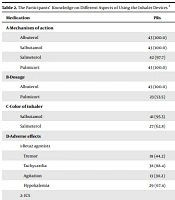
Out of 243 participants in this study, 87 (35.8%) were JMSs, 113 (46.5%) were SMSs, and 43 (17.7%) were PRs. The mean age of participants was 26.20 ± 4.25 years (range: 22 - 61 years). The median age was 23.67 ± 0.91 years in JMSs, 25.58 ± 0.83 years in SMSs, and 32.98 ± 6.27 years in PRs. Of the 43 PRs, 13 (30.2%) were in the first year of their residency program, 15 (34.9%) in the second year, and 15 (34.9%) in the third year. Of the 43 PRs, 32 had a previous medical practice as a general practitioner with a mean duration of 5.57 ± 3.02 years (range: 1 - 30 years). In addition, all the 43 PRs, 108 (95.6%) SMSs, and 68 (78.2%) JMSs had a history of dealing with asthmatic patients. There was no significant difference between the studied groups regarding MDI device recognition (P = 0.072). PRs were more familiar with the DPIs than MSs (P < 0.001). They also could recognize the NBs better than MSs (P < 0.001). In terms of shaking the inhaler, PRs had significantly better performance compared to the MSs (P < 0.001). Regarding breathing out before triggering, SMSs had a better performance compared to PRs and JMSs (P = 0.007). All participants had the same amount of knowledge regarding the last two steps of using MDI devices. In terms of using DPIs correctly, PRs executed all the steps better than the MSs (P < 0.001) except for the third step in which all the participants had the same knowledge (P = 0.13). Regarding the correct use of the NBs, PRs had a better performance in all the steps (P < 0.001) (Table 1). Based on our survey, PRs had significantly better knowledge of the drug’s mechanism of action than MSs (Table 2). Almost all PRs knew the mechanism of action of common inhaler medications (Salbutamol, Salmeterol, Pulmicort). In terms of correct Albuterol dosage, all PRs answered correctly, followed by SMSs (41.6%) and JMSs (12.6%), which was statistically significant (P < 0.001). Furthermore, 53.5% of PRs, 15.9% of SMSs, and 4.6% of JMSs knew the correct dosage of Budesonide (Pulmicort). (P < 0.001). Furthermore, 41 (95.3%) PRs knew the color of the Salbutamol inhaler, followed by 101 (89.4%) SMSs, and 41 (58.6%) JMSs (P < 0.001). Also, PRs knew the color of Salmeterol better than MSs, which was statistically significant (P = 0.002).
Table 1.
Steps for Using the Inhaler Devices in Different Groups a
| PRs | SMSs | JMSs | P-Value | |
|---|---|---|---|---|
| Steps of MDIs | ||||
| 1-Shake the inhaler | 38 (88.4) | 73 (64.6) | 41 (47.1) | < 0.001 |
| 2-Take the cap off the inhaler’s mouthpiece | 43 (100.0) | 108 (95.6) | 74 (85.1) | 0.002 |
| 3-Breath out as much air as possible | 8 (18.6) | 52 (46.0) | 36 (41.4) | 0.007 |
| 4-Place the inhaler between lips, trigger while taking a deep slow breath until lungs are full | 43 (100.0) | 110 (97.3) | 84 (96.6) | 0.49 |
| 5-Hold the breath for 10 seconds and breath out | 28 (65.1) | 86 (76.1) | 58 (66.7) | 0.23 |
| Steps of DPIs | ||||
| 1-Take the cap off and twist the turbohaler anticlockwise | 33 (76.7) | 16 (14.2) | 18 (20.7) | < 0.001 |
| 2- Twist it back to the left until it clicks | 10 (23.3) | 7 (6.2) | 1 (1.1) | < 0.001 |
| 3-Breath out as much air as possible | 11 (25.6) | 15 (13.3) | 11 (12.6) | 0.13 |
| 4-Place the inhaler between lips, inhale and breath out | 28 (65.1) | 18 (15.9) | 16 (18.4) | < 0.001 |
| Steps of NBs | ||||
| 1-Attach the hose and mouthpiece to the cup | 33 (76.7) | 1614.2) | 18 (20.7) | < 0.001 |
| 2-Open the medicine cup and fill with the prescription | 10 (23.3) | 7 (6.2) | 1 (1.1) | < 0.001 |
| 3-Put on the mouthpiece or mask and breath | 28 (65.1) | 18 (15.9) | 16 (18.4) | < 0.001 |
Abbreviations: PRs, pediatric residents; SMSs, senior medical students; JMSs, junior medical students.
aValues are expressed as No. (%).
Table 2.
The Participants’ Knowledge on Different Aspects of Using the Inhaler Devices a
| Medication | PRs | SMSs | JMSs | P-Value |
|---|---|---|---|---|
| A-Mechanism of action | ||||
| Albuterol | 43 (100.0) | 86 (76.1) | 46 (52.9) | < 0.001 |
| Salbutamol | 43 (100.0) | 109 (96.5) | 65 (74.7) | < 0.001 |
| Salmeterol | 42 (97.7) | 106 (93.8) | 62 (71.3) | < 0.001 |
| Pulmicort | 43 (100.0) | 89 (78.8) | 29 (33.3) | < 0.001 |
| B-Dosage | ||||
| Albuterol | 43 (100.0) | 47 (41.6) | 11 (12.6) | < 0.001 |
| Pulmicort | 23 (53.5) | 18 (15.9) | 4 (4.6) | < 0.001 |
| C-Color of inhaler | ||||
| Salbutamol | 41 (95.3) | 101 (89.4) | 51 (58.6) | < 0.001 |
| Salmeterol | 27 (62.8) | 43 (38.1) | 27 (31.0) | 0.002 |
| D-Adverse effects | ||||
| 1-Beta2 agonists | ||||
| Tremor | 19 (44.2) | 47 (43.1) | 13 (14.9) | < 0.001 |
| Tachycardia | 38 (88.4) | 61 (56.0) | 29 (33.3) | < 0.001 |
| Agitation | 13 (30.2) | 16 (14.7) | 8 (9.2) | 0.007 |
| Hypokalemia | 29 (67.4) | 27 (24.8) | 15 (17.2) | < 0.001 |
| 2- ICS | ||||
| Oral candidiasis | 33 (76.7) | 87 (79.8) | 41 (47.1) | < 0.001 |
| Mucositis | 19 (44.2) | 26 (23.9) | 8 (9.2) | < 0.001 |
| URI | 7 (16.3) | 8 (7.3) | 12 (13.8) | 0.19 |
| Hoarseness | 6 (14.0) | 27 (24.8) | 1 (1.1) | < 0.001 |
Abbreviations: PRs, pediatric residents; SMSs, senior medical students; JMSs, junior medical students; ICS, inhaled corticosteroids; URI, upper respiratory infections.
aValues are expressed as No. (%).
In the interview sessions, we asked about the four most common adverse effects of long-acting beta2-agonist (LABA) and inhaled corticosteroid (ICS); in general, PRs had better knowledge than MSs, which was statistically significant (P < 0.001). Tachycardia was the most recognized adverse effect of LABA by all groups, yet agitation was the least known adverse drug effect. Oral candidiasis was mentioned by 33 (76.7%) PRs, followed by 87 (79.8%) and 41 (47.1%) of SMSs and JMSs, respectively (P < 0.001). Also, hoarseness was the least known adverse effect of ICS by all groups. Table 2 shows the participants’ knowledge of the mechanism of action, dosage, and color of different inhalers and the adverse effects of LABA and ICS. As can be seen, PRs had a better performance in most of the categories.
5. Discussion
According to the evidence, IDs are the key medications to treat chronic respiratory diseases like asthma and chronic obstructive lung disorder (COPD) (7). Exacerbation of these diseases is a matter of concern, followed by hospitalization and sometimes death (20). One of the main reasons for poor control of the diseases and consequent hospitalization is incorrect use of inhaler devices. There are several steps in using each form of inhaler correctly. If only one step is missed, the disease will not be appropriately controlled due to decreased overall drug effectiveness. Studies have shown that the overall error rates regarding IDs among asthma and COPD patients range from 46 to 100% (21-23). It is also estimated that up to 92% of patients have at least one critical error that reduces the drug’s effectiveness (23). This could be due to a lack of sufficient patient education by healthcare workers on how to use the IDs correctly. Basheti et al. reported that healthcare professionals except specialists did not have enough knowledge about using the IDs (especially DPIs) correctly (24). Also, we support the fact that almost all participants enrolled in our study did not have adequate information on proper ID usage. Alismail et al. investigated the techniques of using IDs correctly among respiratory therapists (RTs), pharmacists, physicians, and registered nurses (RNs). The mean scores at theoretical and practical tests, was significantly higher than RNs and physicians. Also, they claimed that the suboptimal number of medical practitioners had the proper knowledge and technical skills regarding different IDs (25).
In this study, we evaluated the knowledge of PRs, SMSs, and JMSs on how to use IDs correctly. Regarding MDIs, the most frequent gap in knowledge in all groups was related to the third step (breathing out as much air as possible before using the device). In terms of DPIs, most of the participants were not familiar with the second step, twisting the turbuhaler back to the left until it clicked. They also did not have sufficient knowledge about the breathing out phase. Regarding NBs, most SMSs and JMSs had a low level of knowledge in all the steps. Although the PRs were more familiar with NBs than MSs, they also lacked knowledge in the second step, opening the cup and filling it with the prescribed drug. Similar studies have also shown the lack of knowledge among medical practitioners regarding the correct use of IDs. Chopra et al. (26) investigated handling two IDs, including MDIs and DPIs, and reported that only 53.8% of the internal medicine residents performed the complete steps and stated that the most common errors in using MDIs were related to the steps shaking the inhaler (30%) and breathing out before using (36%). However, based on our study, although PRs had the best performance, the most common error in using MDIs was related to breathing out before using (18.6% of PRs, 46.0% of SMSs, and 41.4% of JMSs performed correctly) followed by a breath-hold after usage, and shaking the inhaler. Using turbuhaler, we noticed that turning the bottom anticlockwise was the most common error in all groups (23.3% of PRs, 6.2% of SMSs, and 1.1% of JMSs performed correctly). The second most missed step was the breath out before use. According to Chopra et al., turning the bottom clockwise until it clicks (80%), turning the bottom anticlockwise (98%), and breathing out as much air as possible (54%) were the most frequently missed steps (26). A study conducted by Plaza et al. showed that only 46.1% of physicians in Spain knew the correct techniques for using DPIs, and only 27.7% of them rechecked the inhaler technique by the patients (27). According to our study, PRs performed significantly better than SMSs and JMSs, which can be attributed to the continuous educational programs and dealing with more asthmatic patients throughout their medical careers.
Our study also revealed that 32 (16%) MSs were unaware of the mechanism of action of Salbutamol and Albuterol. They even did not know that these names were different terms for the same drug. On the other hand, only 41.6% of SMSs and 12.6% of JMSs knew the correct dosage of Albuterol. Moreover, 53.5% of PRs, 15.9% of SMSs, and 4.6% of JMSs knew the correct dosage of nebulized budesonide (Pulmicort) in the pediatrics age group. Regarding the side effects of inhaled drugs, participants had more information about the side effects of BAs, which may be due to the more common use of this drug in the treatment of pediatric asthma. Therefore, physicians must know the different brands and dosages of IDs.
5.1. Conclusions
Based on our survey, although the PRs had a better performance in most fields compared to MSs, almost all participants had at least one critical error in using IDs. Many students enrolled in our study lacked adequate information on drug dosage, correct use, and adverse effects of IDs. This lack of knowledge leads to ID mishandling by patients and poorly controlled asthma, worsening the quality and quantity of life in asthmatic patients. This must be considered as an essential step in designing the educational curriculum in medical schools. Improving and enriching the knowledge of the proper methods in handling the inhaler devices by MSs and PRs will lead to better control of the disease, improve outcomes and life expectancy, and decrease the financial burden on patients.