
1. Background
It is become harder and harder to persuade talented medical students to choose careers in any of the medical specialties. According to studies, the majority of medical students make their final career decisions while still in college. Various student and institution-related aspects are crucial to the decision on specialization. Gender, age, marital status, prestige influence, surgical mentors, career potential, intellectual challenge, and clerkship experience are among the variables recognized as having a major impact on the decision to choose surgery as a career. Some aspects of the clerkship experience are shown to have a positive influence on the choice of surgery, such as active involvement in operations, residents’ interaction, and surgeon/faculty interactions. On the other hand, some aspects have a negative impact on the choice of surgery, such as long hours spent on calls and/or rounds.
Currently, the decrease of interest in surgery as a career among medical students has raised concern (1, 2). The surgical profession’s failure to give medical students enough role models might be a major factor in the apparent decline in interest in general surgery. The student’s view of the specialty and its practitioners is a recurring theme among these elements that are known to affect specialty selection. Before beginning a general surgery clerkship, medical students’ perceptions of surgeons and surgical careers might already exist. The most concentrated environment for the development of these perceptions, nevertheless, is the clerkship itself. Clinical clerkships are the main time when medical students form their perceptions of specialty. Additionally, the third year of medical school is when medical student specialization choices change the most frequently (3). This study aimed to evaluate the factors influencing medical students when choosing a career in surgery and to identify the impact of a surgical clerkship on student attitudes toward surgery as a future career.
1.1. Justification
There is a dearth of research that explores the factors that influence the decision to pursue surgery as a future career. It is also known that many factors influence students’ interest in pursuing surgery as a career, such as prestige, income potential, and overall lifestyle. Given that many of these factors are rooted in bias, and although the perceptions of surgical careers might begin before enrollment in clerkship, clerkship itself provides the most concentrated environment for the development of perceptions. Therefore, this cross-sectional was conducted to find out the effect of surgery before and after clerkship on the attitude of medical students toward surgery as a future career in Saudi Arabia.
2. Objectives
2.1. General Objective
To determine the effect of surgery before and after clerkship on the attitude of medical students toward surgery as a future career in Saudi Arabia
2.2. Special Objectives
(1) To evaluate the factors influencing medical students when choosing a career in surgery.
(2) To identify the impact of a surgical clerkship on student attitudes toward surgery as a future career.
2.3. Literature Review
A study conducted between 2019 - 2022 mentioned that the preclinical immersion experiences significantly improve medical students’ perceptions of surgery. These programs address misconceptions and limited exposure to surgical specialties. Hands-on experiences, observation of surgeries, and interaction with surgical teams positively impact students’ interest, confidence, and understanding of surgery. The immersion experience influences students’ career decisions, with many showing a greater inclination toward pursuing surgical specialties. Incorporating these programs into medical curricula equips aspiring surgeons with knowledge, skills, and enthusiasm. They contribute to the growth of the surgical field by nurturing skilled and dedicated surgeons. Overall, preclinical immersion programs have a transformative effect on students’ perceptions and career trajectories in surgery (4).
A study carried out in Japan in 2022 investigated the attitudes of 132 medical students who underwent preclinical clerkships in surgical departments. Out of these students, 125 took part in the survey, and it was observed that 66% of them expressed an interest in pursuing a surgical career. Following the completion of the clerkship, a post-clerkship survey revealed that 79% of the students, including those who had initially shown interest, displayed an increased interest in a surgical career. Additionally, approximately 77% of the students expressed satisfaction with the practical skill training they received. These findings suggest that involving medical students early on in a preclinical clerkship for general surgery can effectively foster their interest in pursuing a surgical career (5).
A cross-sectional study conducted in 2007 on a German-speaking Swiss medical student showed that a surgical clerkship might positively influence a student’s decision to pursue a career in surgery. Lifestyle should be considered the primary barrier to choosing a surgical career because there might be a future shortage of surgeons (1).
Compared to the other clinical clerkships in our environment, the undergraduate surgery clerkship received a low rating. This poor grade might be explained by a few areas of the clerkship that could be changed. In addition to the students’ clerkship experiences, other factors might also have an impact on their decision to pursue a career in surgery. However, initiatives aimed at improving the curriculum and faculty-student interaction during the surgical clerkship and the creation of a more structured clerkship program might help to increase interest in surgery as a vocation, according to a cross-sectional assessment of the University of Nigeria’s graduating medical classes (2).
A general surgical clerkship has an impact on medical students’ future careers in surgery, according to a cross-sectional survey of final-year students in Nigeria. Students’ negative perceptions of teachers should be changed through focused and effective mentoring and early exposure to good role models (6).
A prospective cohort study conducted in 2019 demonstrated that early exposure to surgery through the Surgical Exploration and Discovery (SEAD) Program modifies students’ impressions of surgical specialties; nevertheless, it has little to no impact on students’ decisions to pursue careers in surgery. However, participation in the SEAD program still helps medical students make career decisions (7).
Another study conducted pre- and post-clerkship surveys mentioned that during the surgical clerkship, medical students’ opinions of surgeons and surgical professions often change for the better. The surgical clerkship, however, considerably worsens students’ perceptions of doctors’ professional conduct and dedication to teaching (3).
3. Methods
3.1. Data Collection Method
This study was conducted in Saudi Arabia with 835 participants. The data were collected through an online self-administered questionnaire. The questionnaire was distributed on different online platforms; therefore, the data could be collected from different regions of Saudi Arabia.
3.2. Study Design
The study was a questionnaire-based cross-sectional study.
3.3. Study Populations
The target population of this study included medical students in the fourth year and above in Saudi Arabia from different regions (i.e., central, southern, eastern, western, and northern).
3.4. Inclusion Criteria
(1) Male or female
(2) Aged 21 to 30 years
(3) Residence in Saudi Arabia
(4) Agree to participate
3.5. Exclusion Criteria
(1) Less than 21 years
(2) More than 30 years
(3) Incomplete questionnaire
3.6. Sample Size
The sample required was calculated with the following formula:
Where n is the sample size, z = 1.96; p is the estimated proportion = 0.5.
According to the desired marginal error = of 5%, the confidence level of 95%, and the nonresponse rate of 10%, based on this formula, the minimum sample size needed was 600; therefore, the sample size was increased to 1000 for increasing power and validity.
3.7. Data Presentation and Statistical Analysis
During the data analysis process, utmost care was taken to ensure the confidentiality of participants’ data. Personally identifiable information was not included in the online self-administered questionnaire to protect the privacy of participants. The ethical approval of the process was obtained by IRP before starting the data collection phase.
A self-administered survey was used in this study to collect information from participants. An informed consent form was provided to all the subjects who agreed to participate in the study. The survey was provided electronically using Google Forms. After finishing filling out the surveys, they were checked for completeness and any missing information. Then, the data were entered in Microsoft Excel. Confidentiality was maintained by not using the participant’s name or number or any other identifiers. The collected data were coded and secured through password protection and were maintained in a safe place. Only the research team will have access to the data.
The collected data were first entered into a Microsoft Excel file and later transferred to SPSS software (version 24) for further analysis. The mean ± standard deviation (SD) was reported for continuous variables, such as age; however, categorical variables, such as gender, were described using frequencies and percentages. The chi-square test was used to compare categorical variables, such as gender. A P-value < 0.05 was considered statistically significant.
3.8. Statistical Design
The questionnaire responses were collected anonymously and analyzed by SPSS software (version 24), which was used to conduct statistical analyses. The data were summarized using descriptive statistics: Quantitative data as mean and SD and qualitative data as frequencies and percentages. The statistical significance of differences between groups was explored using the chi-square test, and for the comparison between the main outcome variables and age, a t-test was used.
3.9. Duration
The study duration was about 12 months. The study was carried out within December 2022 to December 2023.
3.10. Ethical Considerations
The ethical approval was obtained from Jazan University and the Jazan Committee. All information was confidential and was only used for the purpose of scientific research, and participation in this study was voluntary and optional, with informed consent on the first page. No personal sensitive data were collected except for the purpose of data collection. The data analysis and publication process did not require any identifiable personal data.
During the data analysis process, utmost care was taken to ensure the confidentiality of participants’ data. Personally identifiable information was not included in the online self-administered questionnaire to protect the privacy of participants. The ethical approval of the process was obtained by IRP before starting the data collection phase.
3.11. Utilization
This study aimed to provide evidence for decision-makers to implement an intervention, such as screening and educational programs, and we are looking to publish it in national and international journals and present the result of the study at national and international conferences.
3.12. Budget
This study received no external funding.
4. Results
4.1. Sociodemographic and Other Features of Respondents
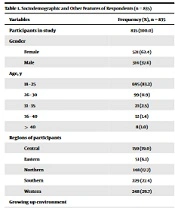
The study "Effect of Surgery Before and After Clerkship on the Attitude of Medical Students toward Surgery as a Future Career in Saudi Arabia” included 835 participants. Table 1 provides a comprehensive overview of the sociodemographic and other characteristics of the respondents who participated in a study conducted in Saudi Arabia. Regarding gender, 62.4% of the participants were identified as female; however, 37.6% identified as male. In terms of age, the majority of the respondents fell within the age range of 18 - 25 years, comprising 83.2% of the sample. Further information is shown in Table 1. Regarding the region of participants, the largest representation was from the western region, accounting for 29.7% of the respondents. This was followed by the southern region with 27.4%, the central region with 19.0%, the northern region with 17.7%, and the eastern region with 6.1%.
Table 1.
Sociodemographic and Other Features of Respondents (n = 835)
| Variables | Frequency (%), n = 835 |
|---|---|
| Participants in study | 835 (100.0) |
| Gender | |
| Female | 521 (62.4) |
| Male | 314 (37.6) |
| Age, y | |
| 18 - 25 | 695 (83.2) |
| 26 - 30 | 99 (11.9) |
| 31 - 35 | 21 (2.5) |
| 36 - 40 | 12 (1.4) |
| > 40 | 8 (1.0) |
| Regions of participants | |
| Central | 159 (19.0) |
| Eastern | 51 (6.1) |
| Northern | 148 (17.7) |
| Southern | 229 (27.4) |
| Western | 248 (29.7) |
| Growing up environment | |
| Countryside | 35 (4.2) |
| Major city | 324 (38.8) |
| Small city | 293 (35.1) |
| University town | 37 (4.4) |
| Village | 146 (17.5) |
| Academic year | |
| 4th | 236 (28.3) |
| 5th | 216 (25.9) |
| 6th | 247 (29.6) |
| Intern | 81 (9.7) |
| Resident | 55 (6.5) |
| Consider general surgery as a career | |
| No | 330 (39.5) |
| Yes | 505 (60.5) |
| Career aspirations | |
| Academic career | 63 (7.5) |
| Hospital career | 452 (54.1) |
| Private practice | 92 (11.0) |
| Other | 42 (5.0) |
| Do not know | 186 (22.3) |
The participants’ growing up environment varied, with the majority (38.8%) coming from major cities, followed by small cities (35.1%) and villages (17.5%). A smaller percentage grew up in university towns (4.4%) or the countryside (4.2%).
Regarding surgery as a career, the majority (60.5%) responded positively, indicating their willingness to pursue a career in surgery. On the other hand, 39.5% of the respondents expressed a negative inclination toward general surgery.
Table 1 also presents the career aspirations of the participants. The largest proportion (54.1%) expressed a desire for a hospital career; however, 11.0% aspired to have a private practice. A smaller percentage (7.5%) aimed for an academic career, and 5.0% had other career aspirations. Additionally, 22.3% of the participants indicated uncertainty about their future career plans.
4.2. Distribution of Academic Years of Respondents
Most of the students who entered the survey were in the fourth to sixth years of study.
4.3. Impact of a Surgical Clerkship on Student Attitudes Toward Surgery as a Future Career
Table 2 shows the impact of a surgical clerkship on student attitudes toward surgery as a future career and their changing attitudes toward other medical specialties. Among the various surgical fields, general surgery showed no significant change in student attitudes before and after the clerkship, with 58.3% of students considering it as a future career before the clerkship and 58.5% after the clerkship (P = 0.969). Similarly, ophthalmology surgery, orthopedic surgery, urology surgery, surgical subspecialties, anesthesiology, dermatology, ENT (ear, nose, and throat), and radiology did not show significant changes in student attitudes before and after the clerkship. These findings suggest that the clerkship did not have a substantial impact on students’ inclinations toward these surgical fields or specialties. However, before the clerkship, 3.2% of students preferred a career as a general physician; nevertheless, after the clerkship, none of the participants indicated this preference (P < 0.001). This finding suggests that the clerkship might have influenced students to shift away from considering general physicians as a future career. Further attitudes are shown in Table 2.
Table 2.
Impact of a Surgical Clerkship on Student Attitudes Toward Surgery as a Future Career and Changing Attitude Toward Other Careers (n = 699) a
| Variables | Clerkship | P-Value | |
|---|---|---|---|
| Before | After | ||
| General surgery | 408 (58.3) | 409 (58.5) | 0.969 |
| Ophthalmology surgery | 69 (9.8) | 68 (9.7) | 0.933 |
| Orthopedic surgery | 99 (14.1) | 84 (12.1) | 0.290 |
| Urology surgery | 36 (5.1) | 39 (5.5) | 0.792 |
| Surgical subspecialty | 323 (46.2) | 340 (48.6) | 0.472 |
| Anesthesiology | 38 (5.4) | 32 (4.5) | 0.547 |
| Dermatology | 85 (12.1) | 78 (11.1) | 0.632 |
| ENT (ear, nose, and throat) | 94 (13.4) | 97 (13.8) | 0.825 |
| General physician | 23 (3.2) | 0 (0) | < 0.001 |
| Internal medicine | 459 (64.5) | 448 (64.1) | 0.708 |
| Obstetrics and gynecology | 51 (7.2) | 55 (7.8) | 0.695 |
| Pediatrics | 88 (12.5) | 96 (13.7) | 0.548 |
| Psychiatry | 63 (9.1) | 55 (7.8) | 0.513 |
| Radiology | 91 (13.1) | 92 (13.2) | 0.940 |
| Did not prefer any field | 170 (24.3) | 203 (29.1) | 0.074 |
a Values are expressed as No. (%).
4.4. Factors Influencing Medical Students When Choosing a Career in Surgery
Table 3 presents the results of a study examining the factors that influence medical students when choosing a career in surgery. A significant factor with a negative impact on the choice of surgery is the perception of prolonged working hours during the training period, compared to other specialties (coefficient = -0.248, P = 0.004). Among professional factors, prestige among colleagues and in society positively influenced the decision to pursue surgery (coefficient = 0.170, P = 0.021). The factor “Manual Activity” also showed a significant positive association with the choice of a career in surgery. The coefficient for “Manual Activity” was 0.243, with a P-value of 0.002. The opportunity for research and an academic career positively influenced the likelihood of choosing surgery (coefficient = 0.193, P = 0.008). The perception of students that “Surgery is a Prestigious Profession”’ demonstrates a positive and significant association with the decision to pursue a career in surgery.
Table 3.
Factors Influencing Medical Students When Choosing a Career in Surgery (n = 699)
| Factors | B | P-Value | Expo (B) |
|---|---|---|---|
| Personal and Lifestyle Factors | |||
| Expected lifestyle during the training period | -0.141 | 0.054 | 0.869 |
| Expected lifestyle as a consultant | -0.043 | 0.571 | 0.958 |
| The planned duration of the training period | 0.046 | 0.545 | 1.047 |
| Prolonged working hours during the training period compared to others | -0.248 | 0.004 | 0.781 |
| Number of services during nights or weekends | 0.043 | 0.591 | 1.044 |
| Gender distribution | -0.071 | 0.290 | 0.931 |
| Surgeons are often single and more childless | -0.031 | 0.683 | 0.970 |
| Professional Factors | |||
| Expected income | 0.029 | 0.719 | 1.029 |
| Prestige among colleagues and in society | 0.170 | 0.021 | 1.185 |
| Interaction with patients | -0.060 | 0.447 | 0.942 |
| Possibility to monitor the course of the patient’s Disease over time | -0.102 | 0.198 | 0.903 |
| Manual activity | 0.243 | 0.002 | 1.275 |
| Intellectual challenge | 0.146 | 0.062 | 1.157 |
| Career opportunities | -0.067 | 0.417 | 0.935 |
| Research opportunities and the possibility of an academic career | 0.193 | 0.008 | 1.213 |
| Role models | -0.013 | 0.854 | 0.987 |
| Surgery is a prestigious profession | 0.234 | 0.006 | 1.264 |
| Surgeons work more than most other physicians | 0.118 | 0.133 | 1.125 |
| Work-Life Balance Factors | |||
| Difficulties in combining career and family | -0.264 | 0.001 | 0.768 |
| The surgical training allows a combination of professional and personal life | 0.047 | 0.564 | 1.048 |
| The surgical training allows an engagement in hobbies | 0.097 | 0.243 | 1.102 |
| Career Perception Factors | |||
| Surgery is a challenging career | 0.071 | 0.394 | 1.074 |
| Surgery brings high professional satisfaction | 0.126 | 0.144 | 1.135 |
| Surgeons often combine their clinical careers with clinical research | 0.053 | 0.508 | 1.055 |
| Surgeons are predestined for medical malpractice | -0.139 | 0.075 | 0.870 |
| Surgeons are more health-conscious than most other physicians | 0.156 | 0.040 | 1.168 |
| Surgeons work more than 50 hours per week | 0.110 | 0.157 | 1.117 |
| Manual skills needed to perform a surgical operation | -0.175 | 0.022 | 0.840 |
| Financial and patient perception factors | |||
| Surgeons earn a lot of money | -0.248 | 0.003 | 0.780 |
| Patient admire their surgeon more than their general practitioners | 0.009 | 0.911 | 1.009 |
| Motivational Factors | |||
| New working conditions with 50 hours work week increase my motivation | 0.097 | 0.188 | 1.101 |
| Surgeons are daring and driven by Adrenaline | 0.008 | 0.925 | 1.008 |
| Constant | -0.763 | 0.067 | 0.466 |
Work-life balance factors showed significant associations with career choice. Difficulties in combining a surgical career with family life had a negative impact (coefficient = -0.264, P = 0.001). Regarding the perception of students that “Surgeons Are More Health Conscious than Most Other Physicians”, a positive association was observed with a coefficient of 0.156 and a p-value of 0.040. The factor “Manual Skills Needed to Perform Surgical Operation” showed a negative significant relationship with the decision to choose a career in surgery (P = 0.022). Financial and patient perception factors also played a role in this regard. The belief that surgeons earn a significant amount of money had a negative impact on career choice (coefficient = -0.248, P = 0.003).
5. Discussion
The present study investigated the sociodemographic characteristics of participants. A total of 835 participants were included in the study. Gender distribution showed that 62.4% (n = 521) of the participants were identified as female. The study population was predominantly young, with 83.2% (n = 695) falling within the age range of 18 - 25 years. The 26 - 30 age group accounted for 11.9% (n = 99); nevertheless, smaller percentages were observed in the 31 - 35 (2.5%), 36 - 40 (1.4%), and over 40 (1.0%) age groups. In terms of the participants’ regional distribution, the largest representation was from the western region, comprising 29.7% (n = 248) of the respondents. The participants had diverse backgrounds in terms of their growing-up environment. The majority (38.8%) came from major cities; however, 35.1% grew up in small cities and 17.5% in villages. A smaller percentage of participants grew up in university towns (4.4%) or the countryside (4.2%).
When considering the participants’ academic year, the largest proportion (29.6%) consisted of students in their sixth year, followed closely by students in their fourth year (28.3%). The students in their fifth year accounted for 25.9% of the respondents; nevertheless, smaller percentages were observed among interns (9.7%) and residents (6.5%). The majority of respondents (60.5%) expressed a positive inclination toward general surgery as a potential career path. However, a significant proportion (39.5%) expressed a negative inclination toward pursuing a career in general surgery. Regarding participants’ career aspirations, the largest proportion (54.1%) expressed a desire for a hospital-based career, indicating their preference for working within a hospital setting. Additionally, 11.0% aspired to have a private practice; nonetheless, 7.5% aimed for an academic career.
In terms of the impact of the surgical clerkship on students’ attitudes toward surgery as a future career, the findings revealed that there were no significant changes in students’ inclinations toward general surgery, ophthalmology surgery, orthopedic surgery, urology surgery, surgical subspecialties, anesthesiology, dermatology, ENT, and radiology. These results are consistent with the results of previous studies conducted by Al-Heeti et al. and Marshall et al., which also reported minimal changes in students’ attitudes toward these surgical fields after clerkship experiences (8, 9).
However, a noteworthy finding emerged regarding students’ preferences for a career as a general physician. The study showed a significant decrease in the number of students considering being a general physician as a future career after the surgical clerkship. This finding aligns with the findings of a study conducted by Hao et al., which highlighted the impact of clinical experiences on medical students’ specialty choices and the potential influence of surgical rotations on their career decisions (10).
When examining non-surgical medical specialties, the study demonstrated no significant changes in students’ attitudes toward internal medicine, obstetrics and gynecology, pediatrics, psychiatry, and radiology after the surgical clerkship. However, there was a slight increase in the percentage of students who did not prefer any specific field after the clerkship, although this change was not statistically significant.
Regarding the factors influencing medical students’ career choices in surgery, the study identified various personal, professional, work-life balance, and financial factors that played a significant role in shaping students' preferences. These findings align with the existing literature on career decision-making in medicine (11, 12).
Personal and lifestyle factors were observed to influence students’ career choices in surgery. Concerns about the lifestyle during the training period were associated with a decreased likelihood of choosing surgery; nonetheless, the expected lifestyle as a consultant did not significantly impact their career decision. These findings corroborate the findings of a study by Keith et al. and highlight the importance of considering the perceived lifestyle during the early stages of career planning (13).
Perceptions of working hours and the manual activity involved in surgery also influenced students’ career choices. This finding is consistent with the findings of previous studies by Susanto et al. and Gragnano et al., emphasizing the role of work-life balance considerations in career decision-making (14, 15).
Professional factors, such as prestige among colleagues and society, manual activity, intellectual challenge, research opportunities, and the perception of surgery as a prestigious profession, positively influenced students’ likelihood of choosing surgery. These findings align with the findings of studies conducted by Hicks et al. and St Hilaire et al., highlighting the importance of professional fulfillment and perceived reputation in attracting students to surgical careers (7, 16).
Furthermore, work-life balance factors played a significant role in career choices. Difficulties in balancing family life with a surgical career negatively impacted students’ decision to pursue surgery; however, the perception that surgical training allows a combination of professional and personal life did not significantly influence the decision. This finding is consistent with the findings of previous research by Najam et al., emphasizing the importance of achieving a satisfactory work-life balance in career decision-making (17).
Financial factors and patient perception also had an impact on students’ career choices in surgery. This finding aligns with the findings of studies conducted by Gilbert et al., highlighting that although financial considerations might play a role in career decisions, they are not the sole determining factor (18). They contribute to the growth of the surgical field by nurturing skilled and dedicated surgeons. Overall, preclinical immersion programs have a transformative effect on students’ perceptions and career trajectories in surgery (5). These findings suggest that involving medical students early on in a preclinical clerkship for general surgery can effectively foster their interest in pursuing a surgical career (4).
5.1. Conclusions
The present study indicated that a significant percentage of participants expressed a positive inclination toward pursuing a career in surgery. However, a surgical clerkship did not significantly influence the attitudes of medical students toward general surgery or other specialties. Factors such as lifestyle concerns, working hours, prestige, intellectual challenge, and financial considerations played crucial roles in shaping career choices among medical students.
5.2. Limitations
The present study had some limitations. It was impossible to achieve the first goal. The authors will ensure that this method is included in future research projects on the same topic.