
1. Context
Primary healthcare is a comprehensive approach to promoting well-being by addressing health needs and reducing inequities, even amid challenges such as COVID-19 (1, 2). It encompasses health promotion, disease prevention, treatment, rehabilitation, and palliative care, and integrates diverse services and policies that address social determinants of health (3, 4). As the main entry point for patients, primary healthcare must remain accessible and affordable (5).
Mobile learning (mLearning) has become an increasingly valuable component of medical education (6). Lessons from COVID-19 highlighted the need for resilient education systems during crises (7, 8). In primary healthcare, mLearning offers flexibility by enabling HCWs to access training despite irregular schedules and geographical barriers (9). Mobile platforms also facilitate peer-to-peer learning and expert consultation through apps, forums, and social media (10, 11).
However, barriers remain, including device costs, limited technological literacy, and software compatibility issues. Microlearning formats and offline features can help address these challenges. Tailored mLearning programs for different populations and contexts are critical (12). Evidence demonstrates its effectiveness; in Peru, HCWs using mobile modules for HIV/AIDS care reported improved knowledge, access to resources, and patient outcomes (11).
This review summarizes current evidence on mLearning in primary healthcare, highlights benefits and challenges, and proposes strategies for effective implementation. We present this article in accordance with the narrative review reporting checklist.
2. Evidence Acquisition
2.1. Search Strategy
A comprehensive search strategy was used to identify relevant literature on the role of mLearning in primary healthcare. The search was conducted across multiple academic databases, including Web of Science, ERIC, PubMed, and Scopus. The keywords included "mobile learning," "primary healthcare," "healthcare education," "healthcare workers," "mLearning," and "medical training." The search was performed on August 10, 2025, and was designed to capture studies examining the impact of mobile learning on healthcare professionals and medical students. The overall search strategy is summarized in Table 1, and an example PubMed search string combining MeSH and free-text terms is presented in Table 2.
Table 1.
Search Strategy Summary
| Items | Specification |
|---|---|
| Date of search | August 10, 2025 |
| Databases and other sources searched | Web of Science; ERIC; PubMed; Scopus |
| Search terms used | "mobile learning"; "primary healthcare"; "healthcare education"; "healthcare workers"; "mLearning"; "medical training" |
| Time frame | Studies published within the last 10 years (January 1, 2015, to August 10, 2025) |
| Inclusion and exclusion criteria | Inclusion criteria: articles specifically discussing the application of mobile learning in primary healthcare settings; English-language publications; peer-reviewed research articles; and studies published within the last 10 years. Exclusion criteria: articles not focused on mLearning or primary healthcare; non-peer-reviewed literature; and studies lacking empirical data or clear methodology. |
| Selection process | Relevant articles were screened systematically after the criteria were applied by multiple reviewers. |
Table 2.
Example PubMed Search Combination of MeSH and Free-Text Terms
| Concept | Search Terms (MeSH and Free Text) | Search Field Applied |
|---|---|---|
| Mobile learning | "Mobile Applications"[MeSH] OR "Cell Phone"[MeSH] OR "mLearning" OR "mobile learning" OR "smartphone*" OR "tablet*" | Title/Abstract and MeSH |
| Primary healthcare | "Primary Health Care"[MeSH] OR "primary healthcare" OR "primary care" | Title/Abstract and MeSH |
| Healthcare workers | "Health Personnel"[MeSH] OR "healthcare worker*" OR "HCW*" OR "medical staff" OR "nurse*" OR "physician*" OR "medical student*" | Title/Abstract and MeSH |
| Education/training | "Education, Medical"[MeSH] OR "medical training" OR "healthcare education" OR "continuing professional development" OR "learning" | Title/Abstract and MeSH |
| Final combination | #1 AND #2 AND #3 AND #4 | - |
2.2. Inclusion and Exclusion Criteria
The inclusion criteria were: 1) articles addressing mLearning in primary healthcare; 2) English-language, peer-reviewed publications; and 3) studies published from 2015 to 2025. The exclusion criteria were: 1) studies unrelated to mLearning or primary healthcare; 2) non-peer-reviewed literature; and 3) studies lacking empirical data or a clear methodology. Eligible articles were screened by multiple reviewers.
2.3. Screening and Selection Process
A total of 149 records were identified through database searching. After 41 duplicates were removed, 108 records underwent title and abstract screening. Of these, 72 were excluded because they were unrelated to mLearning or not relevant to primary healthcare. The remaining 36 articles were assessed in full text, resulting in 8 studies that met all inclusion criteria.
A PRISMA-style flow description summarizing this process is included in Figure 1.
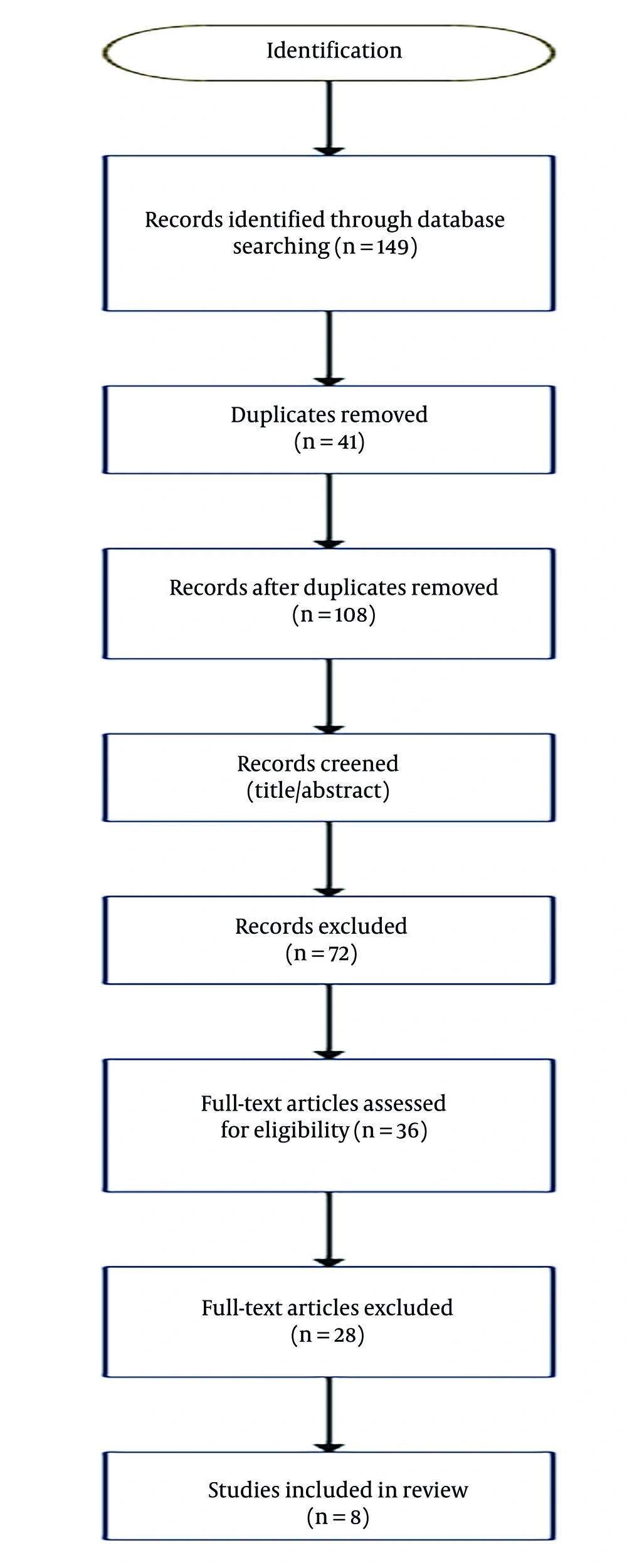
Figure 1.
PRISMA-style flow diagram illustrating the study selection process, including identification, screening, eligibility assessment, and final inclusion of studies.
3. Results
Of 149 recent articles discussing the beneficial effects of mLearning in primary healthcare, 8 studies were selected for inclusion in this review. These studies highlight diverse aspects of mLearning.
3.1. Knowledge and Skills Improvement
Across multiple contexts, mLearning interventions effectively enhanced HCWs' clinical knowledge, procedural skills, and communication abilities.
3.2. Learner Engagement and Satisfaction
Studies involving nursing, pharmacy, and medical students reported increased engagement, positive perceptions, and a preference for mobile-based modules.
3.3. Operational Challenges and Infrastructure Barriers
Limited connectivity, the cost of mobile devices, and low smartphone ownership were identified as the main barriers, particularly in low-resource settings.
3.4. Impact on Patient Management and Public Health
mLearning supported improved patient education, decision-making support, and mental health tools for both patients and healthcare workers. Figure 2 synthesizes the key methodologies, contexts, target groups, applications, outcomes, and tools reported across the included studies. The key steps of mLearning toward strengthening primary healthcare, as reported in recent investigations, are summarized in Table 3.
Table 3.
Important Steps of mLearning Toward Primary Healthcare Revolution Reported by Recent Investigations
| Study | Design | Population | Intervention | Key findings | Ref |
|---|---|---|---|---|---|
| PsyCovidApp Study | Randomized controlled trial | HCWs treating COVID-19 patients | Psychoeducational mobile health intervention | Reduced mental stress among HCWs; lower anxiety levels; improved overall mental health indicators | (13) |
| WhatsApp-based Intervention (2022) | Intervention study | Nurses | 12-week training on infection control and communication | Improved infection control knowledge; strengthened communication and leadership skills; enhanced engagement during a 12-week mobile training program | (14) |
| TESLA Study (2022) | Qualitative study | Medical students | Development of Telegram Education for Surgery Learning and Application (TESLA) | Supported surgical learning during COVID-19 restrictions; useful for review and reinforcement of academic content; high acceptance among medical students | (15) |
| WhatsApp Discussion Group (2015) | Qualitative study | Undergraduate nursing students | Social media application for learning | Facilitated integration of clinical and theoretical learning; encouraged peer discussion and collaborative learning; improved understanding through mobile-based dialogue | (16) |
| Point-of-Care Tools Study (2012) | Observational study | Resident clinicians | Use of smartphones for accessing medical information at the bedside | Enabled quick access to bedside clinical information; supported independent, self-directed learning; improved decision-making efficiency for residents | (17) |
| Pharmacy and Medical Students Study (2020) | Cross-sectional survey | Pharmacy and medical students | Interprofessional communication module | 98% reported improved communication skills; enhanced clinical reasoning; strengthened knowledge of systemic lupus erythematosus | (18) |
| A Descriptive Study on Nursing Students (2024) | Cross-sectional survey | Nursing students | Use of mobile devices for theoretical learning and educational videos | 89.4% owned smartphones; 99.3% used mobile devices for learning; high perceived usefulness of mLearning; challenges included technical issues and distractions | (19) |
| Resource-Revised Environment Study (2023) | Cross-sectional survey | HCWs | mLearning implementation in resource-restricted settings | 97% viewed mLearning as beneficial; limited smartphone access (48%) posed challenges; highlighted opportunities and constraints in resource-poor settings | (20) |
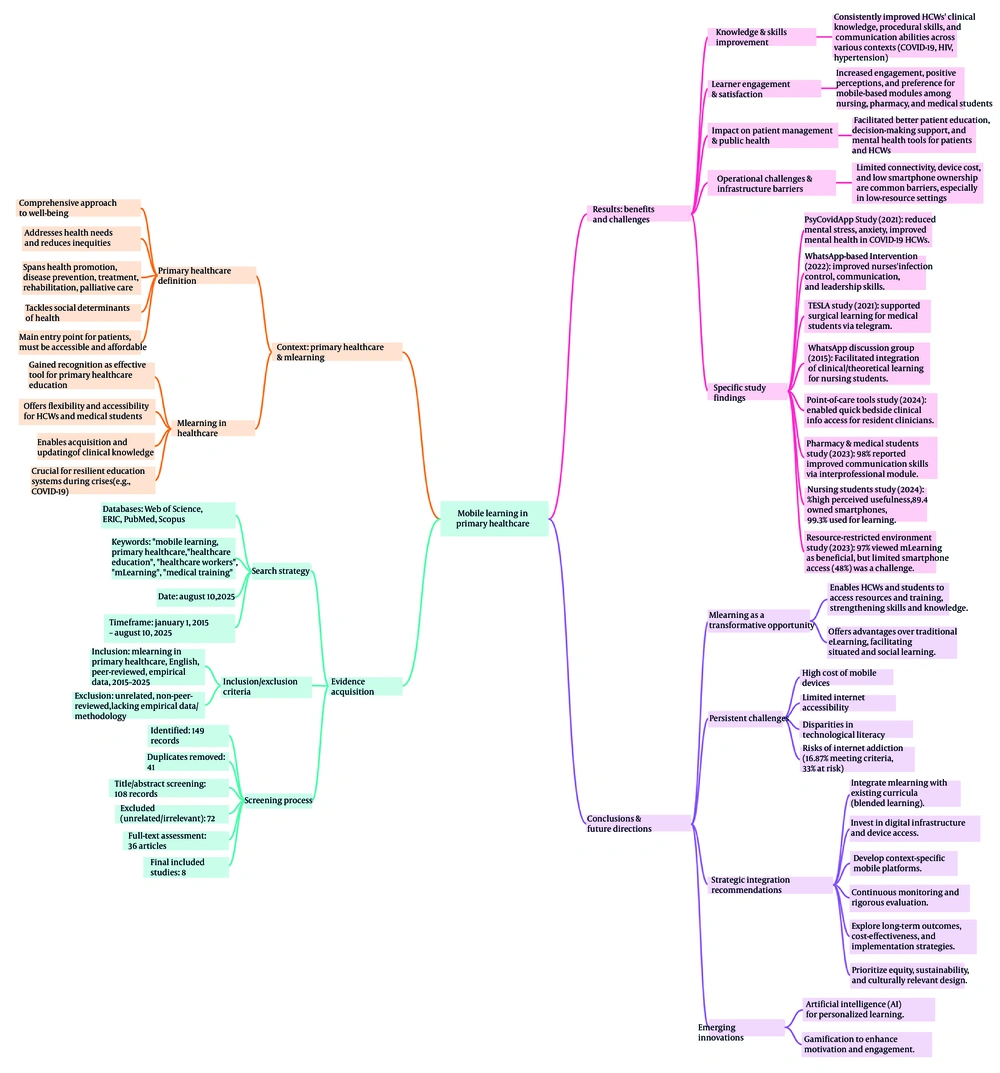
Figure 2.
Visual representation of the key methodologies, contexts, target groups, applications, outcomes, and tools/platforms in mLearning for primary healthcare based on selected studies.
In this review, mLearning is defined specifically as educational interactions delivered through mobile devices such as smartphones and tablets. This definition excludes broader eLearning formats, such as desktop web-based courses and telemedicine activities, unless a clear mobile-based learning component is present. Remote learning, which includes both eLearning and its subset, mLearning, has gained substantial importance because of its flexibility and accessibility. eLearning provides a broad framework through digital platforms, whereas mLearning enhances this experience by offering microlearning nuggets via mobile devices, thereby enabling learning "on the move" (21-23). mLearning uses tablets and smartphones to promote educational experiences that are accessible anytime and anywhere (24). It overcomes geographical barriers, which is vital for underserved areas (25), and often incorporates interactive elements, such as gamification, videos, simulations, infographics, and quizzes, which enhance learner motivation and retention compared with traditional approaches (26, 27). Moreover, mLearning personalizes education by allowing learners to proceed at their own pace (28) and reduces costs associated with traditional education, such as printed materials and travel, because many platforms provide low-cost or free resources (29). In addition to these advantages, mLearning has transformed the educational landscape by enabling both formal and informal learning and by keeping learners engaged in structured classrooms and unstructured environments (30). Educators can enhance the learning experience by offering collaborative learning opportunities that promote group projects, forums, and peer-to-peer knowledge exchange (31), delivering real-time feedback through mobile applications that enable immediate correction and deeper comprehension, and fostering continuous lifelong learning, which is particularly critical for healthcare professionals requiring ongoing development (32). The 2015 WhatsApp group study among nursing students demonstrated that social media fosters the integration of clinical and theoretical practice (16). Similarly, the Stroke eLearning Module improved Malaysian doctors' knowledge of advanced stroke management, although its effect on general knowledge and hyperacute management was limited (33). In 2025, Heidarian et al. showed that eLearning modules on postpartum care and labor for substance-dependent mothers enhanced midwives' knowledge and clinical skills, although knowledge declined one month after training; nevertheless, clinical performance remained improved (34). The COVID-19 pandemic further reinforced the role of mLearning in ensuring continuity of education during lockdowns (35, 36). For instance, medical students reported a preference for Telegram as a platform for surgical review and knowledge reinforcement, as demonstrated in the TESLA initiative (15). Beyond clinical learning, mLearning platforms also provided mental health support via mobile applications, mitigating the psychological effects of quarantine on students and HCWs (37), with the PsyCovidApp trial in Spain confirming improvements in anxiety, stress, and insomnia among frontline HCWs (13). Large-scale initiatives, such as the mass online training program evaluated, showed that participation by more than 10,000 HCWs improved clinical skills, knowledge (83.5%), and confidence (89.4%) (38), whereas WhatsApp-based training for nurses was effective in improving infection control, leadership, and communication skills (14). Although this intervention was categorized as eLearning, only components delivered via mobile devices were considered relevant to mLearning in this review. Additional supporting evidence comes from a 2024 survey of 212 participants, which highlighted the importance of integrating mLearning into professional nursing education, with digital technologies enabling innovative approaches to clinical training (38). Similarly, 98% of pharmacy and medical students in another study agreed that interprofessional communication modules enhanced clinical reasoning and knowledge of systemic lupus erythematosus (18). Resident clinicians in low-resource environments also benefited from using smartphones with point-of-care tools to access medical information at the bedside and engage in self-directed learning (17, 20). Additionally, the Chest Tube Study validated mLearning as an effective just-in-time training approach, showing that a short three-minute video markedly enhanced procedural performance among healthcare trainees (39).
3.5. Theoretical Framework
The Technology Acceptance Model (TAM) provides a useful lens for interpreting why mLearning interventions are effective. TAM posits that perceived usefulness and perceived ease of use are the primary determinants of technology adoption. The reviewed studies align with this model, showing that HCWs adopt mobile platforms when they perceive clear clinical relevance, intuitive interfaces, and improved workflow efficiency.
Evidence indicates that mLearning enables healthcare professionals to access training remotely, ensuring up-to-date knowledge and skills even when in-person sessions are not feasible (40, 41). In primary healthcare, this supports HCWs' continuing education on emerging health concerns, best practices, and patient engagement, which is critical for chronic disease management and preventive care (42-44). Moreover, mLearning complements telemedicine by preparing HCWs to use telehealth platforms effectively (45, 46). In South Africa, Anstey Watkins et al. found that both patients and HCWs often used their personal mobile phones for healthcare purposes despite financial limitations. Patients relied on phones for reminders, medication adherence, and informal health information. Resource constraints and usability issues, such as vision impairment, shaped their engagement (47). A study by Swabri et al. assessed the impact of mobile health clinics (MHCs) on homeless populations in Dublin. Although the study was limited by sample size (n = 42), the results suggested improved access to primary healthcare, underscoring the need to optimize MHC strategies (48).
In Nigeria, Odu et al. developed 12 hypertension training modules and trialed them via smartphones with HCWs in primary health centers. The intervention significantly improved knowledge of hypertension management and showed promise for scaling to broader chronic disease management in low-resource settings (49). In South Africa, Chamane et al. evaluated an mLearning curriculum for HIV rapid testing services across 18 clinics. Although compliance improved modestly, the curriculum's impact was limited by unreliable internet access and a lack of devices. The authors stressed the need for infrastructure improvements to maximize outcomes (50). A randomized controlled trial compared simulation, QuizTime, and experiential approaches to extracorporeal membrane oxygenation training among 44 physicians. Simulation-based mLearning led to higher immediate examination scores and faster response times in simulated emergencies, although long-term differences were not significant (51).
These findings emphasize both the opportunities and limitations of mLearning. Although it is effective for skill enhancement and knowledge delivery, its success depends on supportive infrastructure, affordability, and context-sensitive implementation.
Technology plays an increasingly critical role in healthcare, and its integration into the daily work of HCWs is essential. Although mLearning offers offline training options that are particularly valuable in regions with limited internet connectivity, the high cost of mobile devices remains a substantial barrier (52). To maximize its potential, mLearning should be integrated with traditional curricula to enable blended learning approaches. In addition, unified professional apps tailored to hospital needs could support patient follow-up, reduce emergencies, and empower patients through health education. Such apps could alleviate the financial burden of training, expand patient awareness, and improve outcomes. In primary healthcare, mLearning demonstrates clear advantages over traditional eLearning. Unlike formal eLearning platforms that sometimes lack engagement, students and residents naturally embrace mobile technologies for informal learning. mLearning facilitates situated learning by linking theory to real-world practice and encouraging cross-contextual learning through multimedia documentation. It also enhances social learning networks and fosters collaboration among peers (53). However, risks also exist. Internet addiction negatively affects remote learning. Excessive use of online platforms can reduce motivation and engagement among both HCWs and students. One study found that 16.87% of students met the criteria for Internet addiction, while another 33% were at risk. Moreover, addiction was inversely correlated with willingness to engage in mLearning and emotional intelligence. Researchers stressed the need for screening and preventive measures (54).
Emerging innovations, such as artificial intelligence (AI) and gamification, offer opportunities to overcome adoption barriers. AI personalizes learning by adapting content to user progress, whereas gamification enhances motivation through rewards and challenges. These approaches create engaging, customized learning environments that may substantially improve outcomes for both HCWs and patients. Ultimately, further large-scale studies are needed to refine strategies for mLearning in healthcare, particularly in resource-limited settings. Through deliberate implementation and technological support, mLearning can transform education and patient care and create more resilient healthcare systems worldwide.
4. Conclusions
mLearning represents a transformative opportunity to advance education and training in primary healthcare by enabling healthcare workers and medical students to access essential resources and training materials that strengthen their clinical skills and knowledge. Although challenges such as the high cost of mobile devices, limited internet access, and disparities in technological literacy remain significant, the integration of mobile-based education into conventional frameworks shows substantial promise. To maximize impact, stakeholders should prioritize integrating mLearning with existing curricula, investing in digital infrastructure and device access, developing context-specific mobile platforms, and continuously monitoring implementation using rigorous evaluation frameworks. In addition, future research should examine long-term learning outcomes, cost-effectiveness, and implementation strategies across diverse primary healthcare settings. Greater attention to equity, sustainability, and culturally relevant design will also be essential. Collectively, these priorities can guide the strategic advancement of mLearning and ensure its meaningful contribution to strengthening primary healthcare.