Fulltext
Full-text is available in PDF format.
Journal of Nursing and Midwifery Sciences
The Official Journal of Mazandaran University of Medical Sciences
Authors
Context: Ethics education in midwifery leads to professionalism and good clinical practice. Lack of standards related to ethical education cause differences in implementation.
Aims: This study aims to collect comprehensive data about ethics education in undergraduate midwifery
programs in Turkey.
Settings and Design: In the cross-sectional descriptive study, the sample of study was consisted of faculty members who gave ethics education in midwifery schools and undergraduate final year midwifery students in 29 universities in Turkey between 2017 and 2018.
Materials and Methods: This study was conducted on 17 faculty members and 1138 midwifery students recruited by simple random sampling. Data collection forms consisted of demographic characteristics and questionnaire of knowledge and opinions about the ethics courses. Statistical Analysis Used: Descriptive statistics including mean, standard deviation, frequencies and percentages, and Chi-square were used.
Results: It was observed that ethics education was given as a 2-h theoretical course in all midwifery undergraduate schools, and ethics course was compulsory in 87.5% of them. There was statistically significant difference between the views of faculty members and students about necessity of ethics education (P = 0.000), sufficiency of content (P = 0.002), and the expertise of educators (P = 0.000).
Conclusions: According to the opinion of participants, there are lacks in ethics education for midwifery students in Turkey. Regarding the difference between opinions of faculty members and students, contents and the aims of the ethics education should be co-determined by the ethics experts, the midwifery teachers, and the midwives.
© 2022, Author(s). This open-access article is available under the Creative Commons Attribution 4.0 (CC BY 4.0) International License (https://creativecommons.org/licenses/by/4.0/), which allows for unrestricted use, distribution, and reproduction in any medium, provided that the original work is properly cited.
Kiani M, Bazmi S. Teaching Medical Ethics in Iran: A Quantitative Study. J Med Edu. 2016;15(3):e105521. doi: https://doi.org/10.22037/jme.v15i3.11266
Ahmady S, Yazdi L. Exploring the Midwifery Training Challenges in Iran from the Viewpoint of Faculty Members and Graduates of this Field: Content Analysis. J Med Edu. 2016;15(2):e105489. doi: https://doi.org/10.22037/jme.v15i2.11272
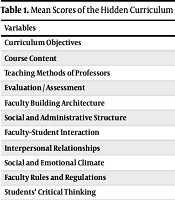
Rafiee H, Vahedi H, Vahedi H, Mehryar HR, Jafarisani M, et al. Perceptions of the Hidden Curriculum and Professional Ethics Among Medical Interns: A Cross-Sectional Study at Shahroud University of Medical Sciences. Educ Res Med Sci. 2026;15(2):e173609. doi: https://doi.org/10.69107/ermsj-173609
Niromand E, Sadeghi M, Ataei S, Khazaei MM, Khazaei MR. Factors Affecting the Learning of Medical Ethics and Etiquette from the Perspective of Medical Teachers and Students of Kermanshah Medical School in 2019. Educ Res Med Sci. 2022;11(2):e126427. doi: https://doi.org/10.5812/erms-126427

Nemati MA, Taghizade S. Adaptation of Ethical Components of Education in Medical Universities of Iran and the World (2018). Educ Res Med Sci. 2018;7(1):e81729. doi: https://doi.org/10.5812/erms.81729
Last Update: 1 month ago
Last Update: 1 month ago
Last Update: 1 month ago
Last Update: 6 days ago
Last Update: 1 day ago
Last Update: 4 days ago

