Fulltext
The body of the article can be found in the PDF file.
Journal of Medical Education for Future Demands
Former Title: Journal of Medical Education | The Official Journal of School of Medical Education and Learning Technologies
Image Credit:J Med Edu
Authors
Background and Purpose: Practice of good medicine raises many ethical issues. Teaching medical ethics is essential for medical students, but it seems that the content of the core curriculum, delivery resources, and the teaching and assessment methods, do not address this need. Our study assessed undergraduate medical and dentistry students’ opinion of a presented course on medical ethics as a basic research in order to evaluate the content and presentation method of this course.Methods: This study was a cross-sectional descriptive study on 244 students, including 146 medical and 98 dentistry students. Data were gathered using a questionnaire and analyzed by SPSS software,version 18. Results: Of the 244 students, 59.8% were medical and 40.2% were dentistry students, and 72.3% were female. The mean±SD age was 23.1±2.68 years. 52.87% of the students stated that the clinical periodwas the ideal time for presenting this type of course, 42.21% stated no more than 20 students as the acceptable size for a class, and 59.4% suggested case presentation as the best teaching method. Medicaland dentistry students had different opinions regarding the capability induced by this course such as: The ability of course to empower students in recognition of the professional obligations and increasing the students’ ability to communicate with patients, their relatives and other members of the medical staff.Conclusions: According to the results of this study, it is necessary to establish an appropriate, content evaluated program with educated teachers for teaching medical ethics, especially to medical students.
© 2016, Author(s). This open-access article is available under the Creative Commons Attribution 4.0 (CC BY 4.0) International License (https://creativecommons.org/licenses/by/4.0/), which allows for unrestricted use, distribution, and reproduction in any medium, provided that the original work is properly cited.
Niromand E, Sadeghi M, Ataei S, Khazaei MM, Khazaei MR. Factors Affecting the Learning of Medical Ethics and Etiquette from the Perspective of Medical Teachers and Students of Kermanshah Medical School in 2019. Educ Res Med Sci. 2022;11(2):e126427. doi: https://doi.org/10.5812/erms-126427
Afshar L. Comparative Study of Medical Ethics Curriculum in General Medicine Course in 10Selected Universities in the World. J Med Edu. 2019;18(1):e105661. doi: https://doi.org/10.22037/jme.v18i1.23781
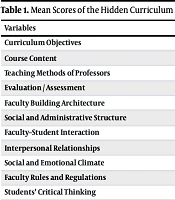
Rafiee H, Vahedi H, Vahedi H, Mehryar HR, Jafarisani M, et al. Perceptions of the Hidden Curriculum and Professional Ethics Among Medical Interns: A Cross-Sectional Study at Shahroud University of Medical Sciences. Educ Res Med Sci. 2026;15(2):e173609. doi: https://doi.org/10.69107/ermsj-173609
Kholghipour H, Dehshahri A, Mahmoodian H, Nabeiei P. Shiraz Pharmaceutical Students’ Knowledge about Pharmacy Professional Ethics. J Med Edu. 2018;17(3):e105643. doi: https://doi.org/10.22037/jme.v17i3.21877
Özdemir S, Aydin Er R. The evaluation of ethics education in midwifery undergraduate programs in Turkey. J Nurs Midwifery Sci. 2022;9(1):e140687. doi: https://doi.org/10.4103/jnms.jnms_138_20
Last Update: 4 days ago
Last Update: 4 days ago
Last Update: 4 days ago
Last Update: 6 days ago
Last Update: 7 hours ago
Last Update: 4 days ago