Cover image of the article: Perceptions of the Hidden Curriculum and Professional Ethics Among Medical Interns: A Cross-Sectional Study at Shahroud University of Medical Sciences

Image Credit:Educ Res Med Sci

Perceptions of the Hidden Curriculum and Professional Ethics Among Medical Interns: A Cross-Sectional Study at Shahroud University of Medical Sciences

Authors

Hosein RafieeHosein Rafiee ORCID1, Hamid VahediHamid Vahedi ORCID2, Hooman VahediHooman Vahedi ORCID1, Hamid Reza MehryarHamid Reza Mehryar ORCID3, Moslem JafarisaniMoslem Jafarisani ORCID4, Omid GarkazOmid Garkaz ORCID5,*
1Student Research Committee, School of Medicine, Shahroud University of Medical Sciences, Shahroud, Iran
2Department of Internal Medicine, School of Medicine, Shahroud University of Medical Sciences, Shahroud, Iran
3Faculty of Medicine, Urmia University of Medical Sciences, Urmia, Iran
4Department of Biochemistry and Nutrition, School of Medicine, Shahroud University of Medical Sciences, Shahroud, Iran
5Department of Epidemiology, School of Public Health, Shahroud University of Medical Sciences, Shahroud, Iran
*Corresponding Author: Department of Epidemiology, School of Public Health, Shahroud University of Medical Sciences, Shahroud, Iran. Email: omid.garkaz23@gmail.com

Educational Research in Medical Sciences:Vol. 15, issue 2; e173609
Published online:Sep 13, 2026
Article type:Research Article
Received:Jul 17, 2026
Accepted:Sep 12, 2026
How to Cite:Rafiee H, Vahedi H, Vahedi H, Mehryar HR, Jafarisani M, et al. Perceptions of the Hidden Curriculum and Professional Ethics Among Medical Interns: A Cross-Sectional Study at Shahroud University of Medical Sciences. Educ Res Med Sci. 2026;15(2):e173609. doi: https://doi.org/10.69107/ermsj-173609

Abstract

Background:

The hidden curriculum plays an important role in shaping professional identity, values, and ethical development among medical trainees.

Objectives:

This study aimed to examine the relationship between the hidden curriculum and professional ethics among medical interns at the Shahroud University of Medical Sciences.

Methods:

This descriptive-analytical cross-sectional study was conducted among 92 internal medicine medical interns at Shahroud University of Medical Sciences. Data were collected using a demographic information checklist, the Hidden Curriculum Questionnaire (HCQ), and the Professional Ethics Questionnaire (PEQ). Higher PEQ scores indicate greater professional ethics, whereas higher HCQ scores indicate greater alignment with the hidden curriculum. Data were analyzed using SPSS version 18 with descriptive statistics and inferential analyses, including t tests, analysis of variance (ANOVA), and correlation analyses, as appropriate.

Results:

Among 92 interns, 59.8% were female, and 46.7% were aged 24 - 25 years. The mean HCQ score was 176.30 ± 27.25, with the highest domain scores in critical thinking, evaluation, faculty architecture, curriculum objectives, and socio-emotional atmosphere. The mean PEQ score was 75.56 ± 7.32, with the highest domain scores in teaching and research, collegial relationships, physician–community relations, financial relationships, and confidentiality. Gender was not significantly associated with HCQ or PEQ scores (P = 0.607 and P = 0.527, respectively), whereas age showed significant differences in both HCQ and PEQ scores (P = 0.001 for both). A negative but non-significant correlation was observed between HCQ and PEQ scores (r = -0.221, P = 0.68).

Conclusions:

Although the mean scores for both the hidden curriculum and professional ethics were above average, targeted educational planning and ongoing monitoring are essential to sustain these strengths and to further enhance professional ethical standards among medical interns.

1. Background

Universities play a major role in developing human resources and preparing a skilled workforce to meet societal needs. This role is especially critical in medical universities, which are responsible for training healthcare professionals and supporting the health system. Therefore, educating competent students with appropriate professional characteristics is essential for improving the quality, dignity, and effectiveness of healthcare professions (1-4).
In medical education, learners acquire knowledge not only through the formal curriculum but also through the hidden curriculum. The hidden curriculum encompasses the implicit messages, values, and attitudes conveyed through the educational environment, organizational culture, evaluation systems, interpersonal interactions, and even physical spaces. These unspoken influences can strongly shape medical interns’ professional identity, emotional development, empathy, values, and behaviors, sometimes supporting and sometimes contradicting the formal curriculum (5-13).
Professional ethics is a fundamental component of medical practice and should be integrated into clinical education rather than taught solely as theoretical content. Ethical and professional development during the university years is particularly important because interns form patterns of behavior and decision-making that influence their future clinical practice. Studies have shown that role modeling, clinical experience, and the educational context contribute to the development of professional ethics, and that strengthening ethics education can substantially improve the quality of healthcare services (14-23).

2. Objectives

Given the close relationship between the hidden curriculum and professional ethics, examining trainees’ perceptions of these concepts may help improve educational quality and ethical development in clinical settings. Although previous research has explored various aspects of medical education, evidence regarding the relationship between the hidden curriculum and professional ethics among medical interns at Shahroud University of Medical Sciences remains limited. Therefore, the present study aimed to determine the relationship between the perceived hidden curriculum and professional ethics among medical interns at Shahroud University of Medical Sciences (24).

3. Methods

3.1. Study Design and Participants

This descriptive–analytical study was conducted among all medical interns at Shahroud University of Medical Sciences during the 2023 - 2024 academic year using a census sampling method. The inclusion criteria were being a medical intern at the study site and providing informed consent to participate.

3.2. Data Collection and Instruments

Data were collected using three validated instruments: a demographic checklist (age and gender), the Hidden Curriculum Questionnaire (HCQ) developed by Tahmasebzadeh et al., which consists of 66 items across 11 dimensions and is scored on a five-point Likert scale (higher scores indicate a stronger presence of the hidden curriculum; Cronbach’s alpha = 0.97) (25), and the Professional Ethics Questionnaire (PEQ), which consists of 20 items across five subscales and is scored on a five-point Likert scale (higher scores indicate greater adherence to professional ethics; Cronbach’s alpha = 0.84) (26).

3.3. Statistical Analysis

Statistical analyses were performed using SPSS version 18. Descriptive statistics, including frequencies, percentages, means, and standard deviations, were used to summarize the data. Inferential statistics, including independent t tests, one-way analysis of variance (ANOVA), paired t tests, and Pearson correlation coefficients, were used to examine the relationships between variables.

4. Results

A total of 92 medical interns participated in this study. Most participants were female (n = 55; 59.8%) and were in the 24 - 25-year age group (n = 43; 46.7%).
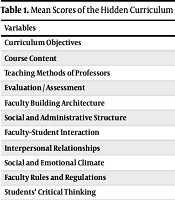
The highest mean scores for the hidden curriculum dimensions were related to students’ critical thinking (20.59 ± 5.47), evaluation (18.04 ± 3.34), faculty building architecture (17.79 ± 4.51), curriculum objectives (17.28 ± 4.74), and the faculty’s social and emotional climate (16.44 ± 4.10). The overall mean hidden curriculum score was 176.30 ± 27.25 (Table 1).
Table 1.
Mean Scores of the Hidden Curriculum Among Medical Interns by Subscales
VariablesMeanSDMinMax
Curriculum Objectives17.284.74727
Course Content12.693.39519
Teaching Methods of Professors13.672.34518
Evaluation / Assessment18.043.34624
Faculty Building Architecture17.794.51626
Social and Administrative Structure16.282.85821
Faculty–Student Interaction15.034.02625
Interpersonal Relationships15.783.55723
Social and Emotional Climate16.444.10726
Faculty Rules and Regulations12.673.60521
Students’ Critical Thinking20.595.47735
Overall Score176.3027.25106231
The highest mean scores among the professional ethics subscales were related to education and research (21.92 ± 3.04), communication with colleagues (16.60 ± 2.48), physician and society (12.83 ± 1.68), financial relationships between physician and patient (12.38 ± 2.39), and confidentiality (11.73 ± 1.51). The overall mean professional ethics score was 75.56 ± 7.32 (Table 2).
Table 2.
Mean Scores of Professional Ethics Among Medical Interns by Subscales
VariablesMeanSDMinMax
Physician and Society12.831.68815
Professional Communication with Colleagues16.602.481220
Confidentiality11.731.51815
Education and Research21.923.041130
Financial Relationships Between Physician and Patient12.382.39620
Overall Score75.567.3252100
The highest mean hidden curriculum score was observed among female participants (176.40 ± 29.98) and those aged 25 - 26 years (177.90 ± 19.91) (Table 3).
Table 3.
Mean Scores of the Hidden Curriculum Among Medical Interns by Demographic Variables (Age and Gender)
VariablesMeanSD
Gender
Male176.1622.98
Female176.4029.98
Age
24 - 25175.4533.06
26 - 27177.9019.91
Above 27172.3729.88
The highest mean professional ethics score was observed among female students (76.24 ± 8.63) and those aged 24 - 25 years (77.95 ± 7.48) (Table 4).
Table 4.
Mean Scores of Professional Ethics Among Medical Interns by Demographic Variables (Age and Gender)
VariablesMeanSD
Gender
Male74.564.76
Female76.248.63
Age
24 - 2577.957.48
25 - 2674.006.10
Above 2771.509.19
No statistically significant differences were observed between male and female medical interns in the mean hidden curriculum score (P = 0.607) or professional ethics score (P = 0.527). However, statistically significant differences were observed across age groups for both the hidden curriculum and professional ethics (P = 0.001 for both) (Table 5).
Table 5.
Differences in Mean Scores of Hidden Curriculum and Professional Ethics by Demographic Variables Among Medical Interns
VariablesHidden Curriculum (P-Value)Professional Ethics (P-Value)
Gender0.6070.527
Age0.0010.001
Correlation analysis revealed a weak negative correlation between professional ethics and the hidden curriculum (r = -0.221); however, this relationship was not statistically significant (P = 0.68), suggesting no predictable linear association between the two variables (Table 6).
Table 6.
Pearson Correlation Coefficients Between Professional Ethics and the Hidden Curriculum
VariablesProfessional EthicsHidden Curriculum
Professional Ethics1-0.221 (P = 0.68)
Hidden Curriculum-1

5. Discussion

Universities, as the primary institutions of higher education, play a central role in developing human resources and preparing the specialized workforce required for societal progress. This role is particularly important in medical universities, which are responsible for educating future healthcare professionals and supporting the health system. Accordingly, higher education is expected not only to provide scientific and professional training but also to align learners with the values, ideals, and ethical expectations of society (1, 3, 27, 28).
In the present study, 92 medical interns participated; most were female (59.8%) and aged 24 - 25 years (46.7%). The overall mean score for the hidden curriculum was 176.30 ± 27.25. Among its dimensions, the highest mean scores were related to critical thinking, evaluation, faculty infrastructure, curriculum objectives, and the faculty’s social and emotional atmosphere. The overall mean score for professional ethics was 75.56 ± 7.32, with the highest scores observed in education and research, communication with colleagues, physician-society relationships, financial relationships between physicians and patients, and confidentiality. No statistically significant differences were found between male and female interns in hidden curriculum or professional ethics scores (P = 0.607 and P = 0.527, respectively). However, statistically significant differences were observed across age groups for both measures (P = 0.001). In addition, Pearson correlation analysis revealed a weak negative correlation between the hidden curriculum and professional ethics (r = -0.221) that was not statistically significant (P = 0.68), indicating no predictable linear relationship between the two variables.
These findings may reflect the complex and multidimensional nature of the hidden curriculum. The hidden curriculum comprises the implicit values, norms, and messages conveyed through educational structures, interpersonal relationships, evaluation systems, the physical environment, and organizational culture, all of which can influence students’ professional identity and ethical development. Therefore, professional ethics in medical education is shaped not only by formal teaching but also by the broader learning environment in which students are trained (5-13).
The findings of the present study are consistent with previous research. Khoshrang et al. emphasized the role of professors, organizational climate and culture, managerial structure, and learning situations in shaping students’ learning experiences and professional ethics through the hidden curriculum (29). Tahmasebzadeh et al. found significant relationships between most hidden curriculum components and professional adaptation, although not all dimensions were strong predictors (25). Abbaspour et al. also showed that the hidden curriculum should be consciously considered in universities to promote inquiry, scientific identity, and ethical orientation (30). Likewise, Momtazian et al. reported a positive and significant relationship between the hidden curriculum and research ethics (31), while Yazdkhasti et al. demonstrated its positive association with emotional intelligence (32). Similar findings were reported by Yeganeh et al. regarding engineering ethics (33), by Nazari Zare et al. regarding professional ethics among medical interns (34), and by Arab Baferani et al. regarding moral intelligence (35). Collectively, these studies support the view that the hidden curriculum can significantly affect ethical, emotional, and professional dimensions of student development.

5.1. Strengths and Limitations

One strength of the present study is that it addressed an important topic that had not previously been examined at this university, while also assessing multiple dimensions of both the hidden curriculum and professional ethics. However, several limitations should be noted, including the cross-sectional design and the use of self-administered questionnaires, which may be subject to reporting bias.

5.2. Conclusions

Although the mean scores for both the hidden curriculum and professional ethics were above average, targeted educational planning and ongoing monitoring are essential to maintain strengths and further enhance professional ethical standards among medical interns.
Acknowledgments

Footnotes

  • AI Use Disclosure:The authors declare that no generative AI tools were used in the creation of this article.

  • Authors' Contribution:Study Concept and Design: H. R. M. and H. R.; Analysis and Interpretation of Data: H. V. and O. G.; Drafting of the Manuscript: H. R. M.; Critical Revision of the Manuscript for Important Intellectual Content: H. R. M. and O. G.; Statistical Analysis: H. V.

  • Conflict of Interests Statement:The authors declare that there is no conflict of interest regarding the publication of this study.

  • Data Availability:The dataset presented in the study is available on request from the corresponding author during submission or after publication.

  • Ethical Approval:This article is part of a General Medicine thesis approved by Shahroud University of Medical Sciences with the ethics code IR.SHMU.REC.1402.111, approved at Shahroud University of Medical Sciences.

  • Funding/Support:This research was conducted without financial supportfrom any institution or organization.

  • Informed Consent:Written informed consent was obtained from all participating medical interns prior to study enrolment. Participation was entirely voluntary, and participants were assured of the confidentiality and anonymity of their response data.

References

  • 1.
    KazemPour E, Ghafari K. An evaluation of the implemented curriculum for the social studies lesson in secondary education. Journal of New Approaches in Educational Administration. 2010;1(1):87-106.
  • 2.
    National Academies Press. Research Universities and the Future of America. Washington, DC: National Academies Press; 2012. https://doi.org/10.17226/13396.
  • 3.
    Karimi H, Ahanchian M. Knowledge management in medical education. Journal of Medical Education Development. 2014;7(16):94-106.
  • 4.
    Holloway K, Arcus K, Orsborn G. Training needs analysis-the essential first step for continuing professional development design. Nurse Education in Practice. 2018;28:7-12. [PubMed ID: 28926754]. https://doi.org/10.1016/j.nepr.2017.09.001.
  • 5.
    Hopkins L, Saciragić L, Kim J, Posner E, Posner GD. The hidden curriculum: exposing the unintended lessons of medical education. Cureus. 2016;8(10):e-pub. [PubMed ID: 27909633]. [PubMed Central ID: PMC5120972]. https://doi.org/10.7759/cureus.845.
  • 6.
    Bredicean C, Tamasan SC, Lungeanu D, Giurgi-Oncu C, Stoica IP, Panfil AL, et al. Burnout toll on empathy: mediates the missing professional support in the COVID-19 outbreak. Risk Management and Healthcare Policy. 2021;Volume 14:2231-2244. [PubMed ID: 34104014]. [PubMed Central ID: PMC8180265]. https://doi.org/10.2147/RMHP.S300578.
  • 7.
    Tekian A. Must the hidden curriculum be the 'black box' for unspoken truth? Malden, MA. 43(9). Wiley-Blackwell; 2009. p. 822-823. [PubMed ID: 19709005]. https://doi.org/10.1111/j.1365-2923.2009.03443.x.
  • 8.
    Ludwig B, Turk B, Seitz T, Klaus I, Löffler-Stastka H. The search for attitude-a hidden curriculum assessment from a central European perspective. Wiener Klinische Wochenschrift. 2018;130(3 - 4):134-40. [PubMed ID: 29356896]. [PubMed Central ID: PMC5816099]. https://doi.org/10.1007/s00508-018-1312-5.
  • 9.
    Pourbairamian G, Bigdeli S, Soltani Arabshahi SK, Yamani N, Sohrabi Z, Ahmadi F, et al. Hidden curriculum in medical residency programs: a scoping review. J Adv Med Educ Prof. 2022;10(2):69-82. [PubMed ID: 35434154]. [PubMed Central ID: PMC9005762]. https://doi.org/10.30476/JAMP.2021.92478.1486.
  • 10.
    İpekel I, Şahin H. Hidden curriculum scale in teacher education: a scale development study. European Journal of Education Studies. 2019.
  • 11.
    Monrouxe LV, Rees CE. Theoretical perspectives on identity: researching identities in healthcare education. Chichester: Wiley; 2015. p. 129-140. https://doi.org/10.1002/9781118838983.ch12.
  • 12.
    Brown MEL, Coker O, Heybourne A, Finn GM. Exploring the hidden curriculum's impact on medical students: professionalism, identity formation and the need for transparency. Medical Science Educator. 2020;30(3):1107-21. [PubMed ID: 34457773]. [PubMed Central ID: PMC8368648]. https://doi.org/10.1007/s40670-020-01021-z.
  • 13.
    Vinson AH, Underman K. Clinical empathy as emotional labor in medical work. Abingdon: Routledge; 2025. p. 165-186. https://doi.org/10.4324/9781003515104-12.
  • 14.
    Ghoorchiani F, Barati MA, Ghorgi H, Khatami F, Haghani H, Gholdust MF. Observance of nursing ethics from the perspective of nurse and patient in a teaching hospital in Tehran University of Medical Sciences: 1391. Med Ethic. 2013;7.
  • 15.
    Hawkins RE, Katsufrakis PJ, Holtman MC, Clauser BE. Assessment of medical professionalism: who, what, when, where, how, and why? Medical Teacher. 2009;31(4):348-61. [PubMed ID: 19404894]. https://doi.org/10.1080/01421590902887404.
  • 16.
    Ebrahimi S, Alinejad N. The impact of ethics workshop on the ethical knowledge and competency of fourth-year medical students of Shiraz University of Medical Sciences. Iranian Journal of Medical Ethics and History of Medicine. 2017;10:55-66.
  • 17.
    Nasiri V, Navidi P. Relationship between professional ethics and organizational agility: empowerment cognitive as mediator. Journal of Ethics in Science and Technology. 2016.
  • 18.
    Abdollahzadeh E, Heidarzadeh A, Yazdani S, Taheri E. Identification of top medical schools' educational structure in the world. RESEARCH MED EDUC. 2015;6.
  • 19.
    Yamani N, Rahimi M. The core curriculum and integration in medical education. Research and Development in Medical Education. 2016;5(2):50-4. https://doi.org/10.15171/rdme.2016.011.
  • 20.
    Lynch DC, Surdyk PM, Eiser AR. Assessing professionalism: a review of the literature. Medical Teacher. 2004;26(4):366-73. [PubMed ID: 15203852]. https://doi.org/10.1080/01421590410001696434.
  • 21.
    Hosseinzadegan F, Shahbaz A, Shahbaz E. The principles of professional ethics and its relationship with demographic characteristics of nurses. Education and Ethics in Nursing. 2017;6(1 - 2):1-9.
  • 22.
    Marco CA, Lu DW, Stettner E, Sokolove PE, Ufberg JW, Noeller TP. Ethics curriculum for emergency medicine graduate medical education. The Journal of Emergency Medicine. 2011;40(5):550-6. [PubMed ID: 20888722]. https://doi.org/10.1016/j.jemermed.2010.05.076.
  • 23.
    Duquette LM. Effects of nursing education on the formation of professional values [dissertation]. University of Toronto; 2004.
  • 24.
    Hejazi M, Hedayati A. The impact of the hidden curriculum on the development of ethics in education. Iranian Journal of Medical Ethics and History of Medicine. 2013;5(9):117-26.
  • 25.
    Tahmasebzadeh Sheikhlar D, Mahmoodi F, Farajpor F. The relationship between hidden curriculum components and student professional adaptability at Tabriz University of Medical Sciences. Iranian Journal of Medical Education. 2019;19:10-21.
  • 26.
    Mohammad AB, Mohammad AP, Maryam D. The effect of students' perception of faculty-patient communication on their professional ethics at Birjand University of Medical Sciences. Iranian Journal of Medical Education. 2019.
  • 27.
    Tavakoli S. The role of university and research in national development. Journal of Research Planning and Education. 1994;7(8):21-50.
  • 28.
    Wexley KN, Latham GP. Developing and training human resources in organizations. New York, NY: HarperCollins; 1991.
  • 29.
    Khoshrang H, Dadgaran A, Taheri Azbarami Z. Explaining the concept of the hidden curriculum from the perspective of faculty members at. 7th Annual Iranian Congress of Medical Ethics: Transformation of Medical Ethics in the Second Step of the Revolution. 2019.
  • 30.
    Abbaspour Hadi, Karimi Moonaghi H, Kareshki H. Hidden curriculum and its role in medical sciences education: a review article (beneath the skin of the curriculum). JOURNAL OF NORTH KHORASAN UNIVERSITY OF MEDICAL SCIENCES. 2020.
  • 31.
    Momtazian A, Rajabdorri H. The effect of hidden curriculum on research ethics in accounting students. Empirical Research in Accounting. 2023;13(2):235-60.
  • 32.
    Yazdkhasti A, Rahimi H. Relation of hidden curriculum situation and students' emotional intelligence. Kashan University of Medical Sciences & Kashan University. Education Strategies in Medical Sciences. 2014;6(4):229-34.
  • 33.
    Yeganeh S, Samadi P, Ahmadi P. Explaining the influencing process of the hidden curriculum in the formation of professional ethics of engineering students. Karafan Scientific Quarterly. 2022;19(Special Issue):231-254. https://doi.org/10.48301/kssa.2021.254374.1246.
  • 34.
    Nazari Zarei S, Montazer Ataei M, Hashemiannejad F. The moderating role of Karozan's research on the relationship between hidden curriculum and professional ethics: a case study of Mashhad University of Medical Sciences. Novel Explorations in Computational Science and Behavioral Management. 2024.
  • 35.
    Arab Baferani F, Mosadegh H, Rafiee M. The study of the role of hidden curriculum in students' moral intelligence reinforcement. Journal of Managing Education in Organizations. 2022;10(4):95-116. https://doi.org/10.52547/meo.10.4.95.

Copyright

Copyright © 2026, Educational Research in Medical Sciences. This open-access article is available under the Creative Commons Attribution 4.0 (CC BY 4.0) International License (https://creativecommons.org/licenses/by/4.0/), which allows for the copying and redistribution of the material only for noncommercial purposes, provided that the original work is properly cited.

Similar Articles

7
Dec
2016
Teaching Medical Ethics in Iran: A Quantitative Study

Teaching Medical Ethics in Iran: A Quantitative Study

Mehrzad Kiani,
Shabnam Bazmi

Kiani M, Bazmi S. Teaching Medical Ethics in Iran: A Quantitative Study. J Med Edu. 2016;15(3):e105521. doi: https://doi.org/10.22037/jme.v15i3.11266

18
Feb
2023
Factors Affecting the Learning of Medical Ethics and Etiquette from the Perspective of Medical Teachers and Students of Kermanshah Medical School in 2019

Factors Affecting the Learning of Medical Ethics and Etiquette from the Perspective of Medical Teachers and Students of Kermanshah Medical School in 2019

Elham Niromand,
Masoud Sadeghi,
Siroos Ataei,
Mohammad Mehdi Khazaei,
Mohammad Rasool Khazaei

Niromand E, Sadeghi M, Ataei S, Khazaei MM, Khazaei MR. Factors Affecting the Learning of Medical Ethics and Etiquette from the Perspective of Medical Teachers and Students of Kermanshah Medical School in 2019. Educ Res Med Sci. 2022;11(2):e126427. doi: https://doi.org/10.5812/erms-126427

23
Jun
2019
Comparative Study of Medical Ethics Curriculum in General Medicine Course in 10Selected Universities in the World

Comparative Study of Medical Ethics Curriculum in General Medicine Course in 10Selected Universities in the World

Leila Afshar

Afshar L. Comparative Study of Medical Ethics Curriculum in General Medicine Course in 10Selected Universities in the World. J Med Edu. 2019;18(1):e105661. doi: https://doi.org/10.22037/jme.v18i1.23781

9
Jul
2024
The State of Moral Intelligence of Medical Students of Kermanshah University of Medical Sciences in 2022

The State of Moral Intelligence of Medical Students of Kermanshah University of Medical Sciences in 2022

Mohammad Mehdi Khazaei,
Reza Shamoradiy,
Elham Niromand,
Mohammad Rasool Khazaei

Khazaei MM, Shamoradiy R, Niromand E, Khazaei MR. The State of Moral Intelligence of Medical Students of Kermanshah University of Medical Sciences in 2022. Educ Res Med Sci. 2023;12(2):e138729. doi: https://doi.org/10.5812/ermsj-138729

16
Feb
2022
The evaluation of ethics education in midwifery undergraduate programs in Turkey

The evaluation of ethics education in midwifery undergraduate programs in Turkey

Suzi Özdemir,
Rahime Aydin Er

Özdemir S, Aydin Er R. The evaluation of ethics education in midwifery undergraduate programs in Turkey. J Nurs Midwifery Sci. 2022;9(1):e140687. doi: https://doi.org/10.4103/jnms.jnms_138_20

More by these authors

Hosein RafieePubMedScholar
Hamid VahediPubMedScholar
Hooman VahediPubMedScholar
Hamid Reza MehryarPubMedScholar
Moslem JafarisaniPubMedScholar
Omid GarkazPubMedScholar
Share
Cited by
Metrics