
1. Background
Digital English language learning has recently gained primary importance in the extensive field of education and assessment as the best option to prevent epidemics (1). Furthermore, traditional education has changed to educational technologies, where teaching and assessments are conducted online. Most users of e-learning platforms believe that e-learning platforms can be easily managed. The student can easily access the instructors and teaching materials (2). The online platforms seem influential in English for specific purposes (ESP) courses. Medical sciences, as one branch of ESP, faced various difficulties during the COVID-19 pandemic in terms of instruction. Medical students are similar to other learners who should experience distance and digital learning. Some studies have been conducted in this era, and there has been growing interest in digital English language learning and individual learner factors such as self-regulation, self-concept, and motivation (3, 4). Scholars believe that such issues could have desirable roles in preparing online resources for English language skill learning and enhancing students’ affective and personality traits (5, 6). These resource-based innovations offered new avenues in curriculum design to incorporate updated forms of communicative digital learning tools (7, 8). Adobe Connect software is a digital learning platform that enhances learners’ skill performance and improves their self-regulation and self-concept in English classes. This platform has been more centralized during the COVID-19 pandemic as a reaction to the absence of conventional face-to-face classrooms. Adobe Connect has several unique features, such as users’ ability to engage with various audiences worldwide. This internet-based platform was a suitable cure for worries regarding online learning instruments and settings to proceed with second language (L2) education. Interestingly, such online applications satisfy students’ key needs and help improve their autonomy, voice, and genre awareness (3, 9).
Self-concept is closely related to educational aspects among learner factors. Generally, self-concept is an individual’s perception of themselves and how knowledge is developed and evaluated based on personal experiences (10). Moreover, self-concept and academic achievement are mutually supportive, so each modification changes the other (11).
The literature has considered self-concept and self-esteem synonymous. This study assessed self-concept as the cognitive and knowledge-based views on one’s experiences (12). Typically, self-concept develops at eight years old in humans. Primarily, a child tries to make sense of their mental operations, emotions, and capacities, followed by interpreting surrounding feedback (13). This process occurs due to social communications and comparisons (14). Although considerable research has been conducted on students’ academic self-concept, motivation, and academic achievement (15-19), self-concept has not received adequate attention, especially in a digital learning context.
In addition to self-concept, self-regulation has been well-recognized in previous studies. Self-regulated learning (SRL) is one of the domains of self-regulation, which is aligned most closely with educational aims and refers to learning guided by metacognition (thinking about one’s thinking), strategic action (planning, monitoring, and evaluating personal progress against a standard), and motivation to learn. Creating active and efficient learners has been considered an important educational goal. This goal is accomplished through using SRL strategies by learners (20). Self-regulation plays a crucial role in L2 learning flourish. Dörnyei stated that self-regulation includes an array of cognitive, metacognitive, motivational, behavioral, and environmental aspects that academically help learners improve across contexts (21). Psychologically, SRL involves learners in a goal-oriented process of managing, fostering, and evaluating their learning (22). In L2 education, a bulk of research reveals the primary role of SR strategies in promoting students’ language proficiency (23-25).
English for specific purposes contexts, however, have not paid much attention to developing digital tools to promote self-regulation in learners. Incorporating computer-based instruction or digital learning is critical as learners respond positively to this teaching context regarding cognitive and social aspects. There are more instances of this issue when traditional classrooms are unavailable, such as in the COVID-19 era. Computer-assisted language learning (CALL) has significantly changed the learning-teaching cycle due to technological advancements, such as modern digital devices and extensive learner network connections. In recent years, the popularity of CALL resulted in an increased number of online course offerings by schools and colleges (26). In addition, technological advancement and student demand for online classes have influenced colleges and universities to implement online courses for the students (27).
2. Objectives
This study examined the impact of teaching technical medical vocabularies through Adobe Connect on medical students’ learner factors, including self-concept and self-regulation in an ESP context.
3. Methods
The target sample in this quasi-experimental study was students of medicine studying at Kashan University of Medical Sciences, Kashan, Iran. As explained in the published article (28), 60 medical students were chosen due to the homogeneity in general English knowledge using the Oxford Quick Placement Test (OQPT) from among 75 medicine students in an Advanced English course. The OQPT had 60 items to assess English skills and subskills, and the students should complete the test in 45 minutes. Based on the homogeneity test, 60 participants were comparable and randomly divided into Adobe Connect (n = 30) and traditional (n = 30) groups.
A similar study’s standard deviation and mean values (28) were used based on the sample size formula for comparing two means to account for the sample size. Each group was estimated to have 27 students with 99% confidence and 90% power. A 10% loss of the samples was considered and therefore 30 students were included in each group (total = 60).
In this study, the scale developed by Liu and Wang was used to assess students’ self-concept before and after the treatment (29). The questionnaire included 20 items on a 6-point Likert scale from no to yes always ((1 (no), 2 (no always), 3 (no sometimes), 4 (yes), 5 (yes sometimes), and 6 (yes always)). As Liu and Wang found, the internal consistency of the questionnaire based on Cronbach’s alpha coefficient was 0.82 (29). Furthermore, Minchekar reported a Cronbach’s alpha coefficient of 0.92 (30). Moreover, the Self-regulation Questionnaire (SRQ) scale developed by Brown et al. was employed as the other data collection tool. The questionnaire had 63 items on a 5-point Likert scale ranging from “strongly disagree” to “strongly agree” (31). The Cronbach’s alpha reliability coefficient of the questionnaire was estimated to be 0.91, 0.92, 0.84, and 0.86 in four relevant studies (31-34). The two questionnaires were distributed among the medical students in both groups before and after the intervention. A comparison was made between the students’ levels of self-concept and self-regulation after participating in Adobe Connect or traditional classrooms.
The students were pretested using self-regulation and self-concept questionnaires one week before the study. After this phase, the intervention started, mostly around vocabulary learning, and lasted eight sessions (90 min in each session). During each session, ten new medical English words were taught. The participants in the experimental group were conducted using the Adobe Connect virtual platform. The instructor (the first researcher) implemented diverse online activities in the virtual classroom, such as lectures and recordings. In addition, the instructor could share her computer screen with the students and provide different materials. The respective course book was “Advanced English in Medicine,” mainly focusing on new medical English vocabulary students needed to learn for future uses. During each session, ten new words were selected from the course book texts and were delivered and practiced via slides. The teacher highlighted the new words’ pronunciation, part of speech, definition, synonyms, and collocations and also encouraged the students to add related words and type them in a chat box or on the platform whiteboard and make sentences. Peer work was encouraged for meaning-making among students.
Most universities in different countries, including Iran, banned face-to-face classes during the COVID-19 pandemic. However, this study was conducted when most of the students had received the first dose of the COVID-19 vaccine and agreed to participate in the study. The control participants were given the exact words each session. The procedure for the controls was the same as the experimental group. Both groups received the same instructional method, the same number of new words, and the same amount of time. The only difference lay in the instructional setting, which was virtual in the Adobe Connect group and face-to-face in the control group. The intervention lasted eight sessions, and two weeks after the intervention, the self-concept and self-regulation questionnaires were administered to examine the effect of teaching through Adobe Connect on these factors in both groups.
The data were analyzed by SPSS software version 22 (SPSS, Inc., Chicago, IL, USA). The significance level was considered at P < 0.05.
4. Results
The mean age of the participants was 24.95 ± 5.3 years (range, 21 - 29 years). A total of 36 students (60%) were females, and the rest were males. There was a significant difference in the mean age of the participants between the experimental (24.21 ± 2.11) and control (22.24 ± 2.12) groups (P = 0.001). Consequently, the researchers took advantage of the ANCOCA test for the study’s data analysis. More specifically, this test was used to determine whether participants’ self-concept and ability to regulate themselves were affected by their age and treatment (Table 1).
Table 1.
Descriptive Statistics for the Medical Students’ Performance on the Self-concept Posttest
| Groups | Mean ± Standard Deviation | n |
|---|---|---|
| Experimental group | 101.30 ± 6.471 | 30 |
| Control group | 83.53 ± 3.767 | 30 |
| Total | 92.42 ± 10.383 | 60 |
Levene’s test examined the equivalence of variance values between groups. Based on the test results, the variance values were equivalent (P = .48). Therefore, the researcher examined the homogeneity of the regression slopes (Table 2).
Table 2.
Homogeneity Test of Regression Slopes of the Participants’ Performance on the Self-concept Posttest
| Source | Type III Sum of Squares | df | Mean Square | F | P-Value | Partial Eta Squared |
|---|---|---|---|---|---|---|
| Corrected model | 4747.127 | 3 | 1582.376 | 54.921 | 0.000 | 0.746 |
| Intercept | 5087.098 | 1 | 5087.098 | 176.563 | 0.000 | 0.759 |
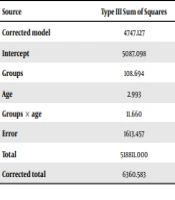
| Groups | 108.694 | 1 | 108.694 | 3.773 | 0.057 | 0.063 |
| Age | 2.993 | 1 | 2.993 | .104 | 0.748 | 0.002 |
| Groups × age | 11.660 | 1 | 11.660 | .405 | 0.527 | 0.007 |
| Error | 1613.457 | 56 | 28.812 | |||
| Total | 518811.000 | 60 | ||||
| Corrected total | 6360.583 | 59 |
As shown in Table 2, the interaction between the independent variable (i.e., Adobe Connect treatment) and the covariate (i.e., age) was not significant (P = 0.527). Consequently, the researcher examined the difference between the performances of the experimental group and the control group on the self-concept posttest (Table 3).
Table 3.
Comparison Between the Performances of the Experimental Group and Control Group on the Self-concept Posttest
| Source | Type III Sum of Squares | df | Mean Square | F | P-Value | Partial Eta Squared |
|---|---|---|---|---|---|---|
| Corrected model | 4735.467 a | 2 | 2367.733 | 83.047 | 0.000 | 0.745 |
| Intercept | 5689.802 | 1 | 5689.802 | 199.566 | 0.000 | 0.778 |
| Groups | 4720.456 | 1 | 4720.456 | 165.567 | 0.000 | 0.744 |
| Age | 0.650 | 1 | 0.650 | 0.023 | 0.881 | 0.000 |
| Error | 1625.117 | 57 | 28.511 | |||
| Total | 518811.000 | 60 | ||||
| Corrected total | 6360.583 | 59 |
a R squared = 0.902 (adjusted R squared = 0.899)
Table 3 shows a significant difference between the experimental and control group’s performances on the self-concept post-test (P = 0.000).
Moreover, the researcher used the ANCOVA test to examine the interaction between the participant’s age and treatment on their self-regulation (Table 4).
Table 4.
Descriptive Statistics for the Medical Students’ Performance on the Self-regulation Posttest
| Groups | Mean ± Standard Deviation | n |
|---|---|---|
| Experimental group | 278.93 ± 13.222 | 30 |
| Control group | 212.40 ± 8.708 | 30 |
| Total | 245.67 ± 35.336 | 60 |
The researcher examined the results of Levene’s test to determine the equivalence of variances between the groups. Based on the test results, the variance values were equivalent (P = 0.21). Therefore, the researcher examined the homogeneity of the regression slopes (Table 5).
Table 5.
Homogeneity Test of the Regression Slopes Regarding the Participants’ Performance on the Self-regulation Posttest
| Source | Type III Sum of Squares | df | Mean Square | F | P-Value | Partial Eta Squared |
|---|---|---|---|---|---|---|
| Corrected model | 66571.863 a | 3 | 22190.621 | 175.087 | 0.000 | 0.904 |
| Intercept | 36259.599 | 1 | 36259.599 | 286.093 | 0.000 | 0.836 |
| Groups | 240.406 | 1 | 240.406 | 1.897 | 0.174 | 0.033 |
| Age | 15.336 | 1 | 15.336 | 0.121 | 0.729 | 0.002 |
| Groups × age | 118.894 | 1 | 118.894 | 0.938 | 0.337 | 0.016 |
| Error | 7097.470 | 56 | 126.741 | |||
| Total | 3694796.000 | 60 | ||||
| Corrected total | 73669.333 | 59 |
a R squared = 0.902 (adjusted R squared = 0.899)
As shown in Table 5, the interaction between the independent variable (i.e., Adobe Connect treatment) and covariate (i.e., age) was not statistically significant (P = 0.337). Therefore, the researcher examined the difference between the performances of the experimental group and the control group on the self-regulation posttest (Table 6).
Table 6.
Comparison Between the Performances of the Experimental Group and the Control Group on the Self-regulation Posttest
| Source | Type III Sum of Squares | df | Mean Square | F | P-Value | Partial Eta Squared |
|---|---|---|---|---|---|---|
| Corrected model | 66452.969 a | 2 | 33226.485 | 262.447 | 0.000 | 0.902 |
| Intercept | 38191.568 | 1 | 38191.568 | 301.664 | 0.000 | 0.841 |
| Groups | 66347.321 | 1 | 66347.321 | 524.059 | 0.000 | 0.902 |
| Age | 52.702 | 1 | 52.702 | 0.416 | 0.521 | 0.007 |
| Error | 7216.364 | 57 | 126.603 | |||
| Total | 3694796.000 | 60 | ||||
| Corrected total | 73669.333 | 59 |
a R squared = 0.902 (adjusted R squared = 0.899)
Table 6 indicates a significant difference between the experimental and control group’s performances on the self-regulation post-test (P = 0.000).
Consequently, the Adobe Connect-based vocabulary instruction was more effective for ameliorating the participants’ self-concept and self-regulation than the traditional vocabulary instruction.
5. Discussion
This study aimed to evaluate the teaching effectiveness through an online platform, such as Adobe Connect, in affecting Iranian ESP medical students’ self-regulation and self-concept. The results revealed that the Adobe Connect group’s self-regulation scores were higher than the controls. Thus, online learning instruction significantly improved self-regulation among the students. This finding agrees with previous studies, highlighting the superiority of technology-enhanced learning environments in promoting self-regulated learning (35-37). Students’ ability to use computers, information technology, and the internet is attributed to the effectiveness of online instruction in the Iranian context, where self-study is a dominant practice. As echoed by Zimmerman and Schunk, self-regulation among students is closely associated with contextual factors (38). In other words, self-regulation is promoted when teachers foster learner engagement and interact with their students (39).
The learning outcomes of SRL-oriented classes are enhanced, particularly in terms of the vocabulary component. As Bernacki et al. concluded, self regulation practices positively affect learning and development (40). Furthermore, Seker showed that self-regulated learners could set their learning objectives and build knowledge independently, especially in the case of learning English in online learning classrooms (37). The evidence for the claim can be Orhan et al.’s study, which implied the less effectiveness of traditional classes in preparing self-regulated learners (41). Digital learning can be advantageous in terms of its appropriacy in accounting for various learning paces. In a digital learning environment, students are fully responsible for their learning and control of the process (42). Kassab et al. argued that self-regulation is not a fixed trait; motivation and learning strategies of the students may be improved when practical and interactive online instruction are provided (43).
According to Barnard et al., online learning affects cognitive, metacognitive, and motivational aspects and improves self-regulation (44). However, many SRL practices are required in online classes, and less self-regulated learners may encounter numerous challenges. On the contrary, virtual classes can be suitable for learners with high potential and self-control abilities (44). However, it is unclear whether struggling learners can deal with online learning challenges. Any virtual learning platform could be helpful depending on design issues, such as learning tasks and information. The features of online learning platforms that support self-regulation should be considered when developing such environments.
Additionally, this study investigated the effect of teaching medical vocabularies through Adobe Connect on students’ self-concept, and the findings approved the effectiveness of the online platform in this respect. A virtual class like Adobe Connect would greatly benefit from considering student attitudes toward learning in light of our results. In line with this finding, Alexander found a significant relationship between academic performance and self-concept in an online learning platform (45). On the other hand, the results differ from those of Zhan and Mei, who reported an insignificant difference between online and traditional instruction in affecting self-concept and academic learning outcomes (46). In the same vein, previous studies have found no significant differences between traditional classroom instruction and distance education regarding self-concept (47, 48). Both methods require a strong sense of academic self-concept.
5.1. Conclusions
The results revealed that medical vocabulary instruction through Adobe Connect significantly improved medical students’ learner factors, including their self-regulation and self-concept. Therefore, digital learning tools can help deal with learning and teaching challenges during the COVID-19 pandemic. Education has changed dramatically under the distinctive rise of e-learning, whereby teaching is undertaken remotely and on digital platforms. Major world events are often an inflection point for rapid innovation in the big field of e-learning. Although Adobe Connect virtual classrooms can be used globally during the COVID-19 pandemic and post-virus era, face-to-face classes should not be overlooked. The pandemic has pushed the teaching industry worldwide to find alternatives to in-person instruction.