1. Background
Chronic obstructive pulmonary disease (COPD) is one of the major respiratory problems which is diagnosed by irreversible chronic airway obstruction (1). Approximately 5% of the world’s population is affected by COPD, such that it was the third leading cause of death in 2012. The prevalence of this health problem is expected to rise to the extent that by 2020 it will be one of the top three causes of mortality in the world (2-4). Based on official statistics, an average of 14% of Iranians have COPD, varying from 0.4% to 1% across communities with different weather conditions (4). Due to its debilitating nature, COPD imposes direct and indirect costs to the healthcare system, society, and the patient (5). Therefore, it is necessary for the healthcare system to take effective measures in order to promote self-care among affected individuals. Self-care refers to activities aimed at limiting the incidence of complications and maintaining one’s health (6). In the case of COPD, these activities include patient-specific respiratory practices and using incentive spirometer and spacer to improve airway function and increase respiratory power (7). According to several studies, self-care behaviors of patients with COPD are lower than desired (8-11). Lack of awareness of people with chronic illnesses about how to take care of themselves is one of the causes of re-admission. On the other hand, self-care education enhances quality of life, assures continuity of care, mitigates patient’s anxiety, reduces the incidence of complications, increases participation in self-care programs, improves patient’s autonomy in performing daily activities, lowers costs, and consequently reduces hospitalizations (12). Meanwhile, health awareness of patients with COPD is very poor, with only 1.4% of individuals being aware of effective measures to prevent respiratory complications. In this regard, Hernandez et al. (13) reported that implementing effective educational measures can reduce the risk of developing respiratory conditions in these patients. Understanding the benefits of adopting self-care behaviors can motivate patients to adhere to these practices. Evidently, this requires that these patients receive necessary instructions (14).
2. Objectives
Hence, the purpose of this study was to determine the impact of self-care training on spirometric indices of patients with COPD.
3. Methods
After acquiring the approval of the Ethics Committee of Zahedan University of Medical Sciences (IR.ZAUMS.REC.1397.259), the authors began the study on 70 patients with COPD who had referred to Ali Ibn Abi Talib Hospital in Zahedan in 2017. The eligibility criteria included willingness to participate in the study, age between 40 - 65 years, COPD diagnosis, literacy, lack of mental-cognitive disorder, lack of visual-hearing impairment, previous hospitalization, living in Zahedan, not studying in medical or paramedical fields, lack of previous education about COPD, telephone accessibility, understanding Persian, and lack of psychoactive substance abuse. The exclusion criteria, on the other hand, were reluctance to participate further in the study, absence from more than 3 sessions, lack of telephone access to the patient and his/her family during the course of the study, and death due to COPD or other events. Based on previous studies (15, 16) the sample size was estimated at 30 for each group at 95% confidence interval and the power of 80%. To account for possible sample attrition, the authors finally selected 35 patients for each group.
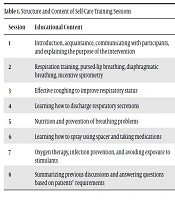
Data were collected using a demographic questionnaire (covering age, gender, weight, height, marital status, education, employment status, underlying illness, length of hospitalization, and residence) and Vitalograph Alpha Spirometer. Convenience sampling method was utilized to recruit participants. Thus, between January and March, 2018, the researcher referred to Ali Ibn Abi Talib Hospital and selected qualified patients who were about to be discharged and randomly assigned them to the intervention and control groups. To this end, a vase was used which contained balls marked intervention and control. The first eligible samples was assigned to the intervention group, and other samples were alternatively placed in the intervention and control groups. The self-care training program was conducted individually based on the needs of each patient (Table 1). Over 4 weeks, the intervention group attended eight 30-minute training sessions held twice a week at the Training Center of Ali Ibn Abi Talib Hospital. At the end of the program, the educational content was presented to the patients in a booklet. To adhere to research ethics, the control group attended one general training session on COPD and its symptoms and complications. The intervention group were followed up for 45 days in order to ensure the implementation of the self-care program. Possible questions raised by the patients during this period were answered over the phone. At the beginning of the intervention and before the implementation of the self-care program, patients’ respiratory function was measured by a pulmonologist who monitored all stages of the study. Respiratory function was re-evaluated 45 days after the intervention. Data were analyzed in SPSS V. 21 using chi-square, Independent t-test, and Paired t-test at the significance level of 0.05.
Table 1.
Structure and Content of Self-Care Training Sessions
| Session | Educational Content |
|---|---|
| 1 | Introduction, acquantaince, communicating with participants, and explaining the purpose of the intervention |
| 2 | Respiration training, pursed-lip breathing, diaphragmatic breathing, incentive spirometry |
| 3 | Effective coughing to improve respiratory status |
| 4 | Learning how to discharge respiratory secretions |
| 5 | Nutrition and prevention of breathing problems |
| 6 | Learning how to spray using spacer and taking medications |
| 7 | Oxygen therapy, infection prevention, and avoiding exposure to stimulants |
| 8 | Summarizing previous discussions and answering questions based on patients’ requirements |
4. Results
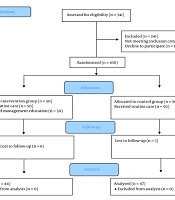
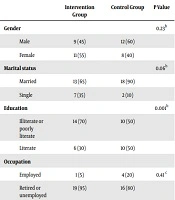
No sample attrition took place and the analysis is based on 70 patients. The results showed that 60% and 85.7% of participants in the intervention group were male and married, respectively. The mean age of patients was 51.94 ± 6.74 in the intervention group and 48.88 ± 6.39 in the control group. There was no significant difference between the two groups in terms of demographic characteristics (Table 2).
Table 2.
Frequency Distribution of Personal Characteristics of Patients with COPD in the Intervention and Control Groups
| Variable | Frequency | Minimum | Maximum | Mean | SD | P Value |
|---|---|---|---|---|---|---|
| Patient’s age | 0.06a | |||||
| Intervention group | 35 | 41 | 63 | 51.94 | 6.74 | |
| Control group | 35 | 41 | 61 | 48.88 | 6.39 | |
| Patient’s work experience (occupation) | 0.17a | |||||
| Intervention group | 35 | 1 | 5 | 4.62 | 0.87 | |
| Control group | 35 | 2 | 5 | 4.34 | 0.88 | |
| Variable | Intervention Group, No. (%) | Control Group, No. (%) | P Value | |||
| Gender | 1b | |||||
| Male | 21 (60) | 21 (60) | ||||
| Female | 14 (40) | 14 (40) | ||||
| Total | 35 (100) | 35 (100) | ||||
| Education | 0.32b | |||||
| Literate | 20 (57.1) | 24 (68.6) | ||||
| Illiterate | 15 (42.9) | 11 (31.4) | ||||
| Total | 35 (100) | 35 (100) | ||||
| Residence | 0.06b | |||||
| City | 23 (65.7) | 30 (85.7) | ||||
| Village | 12 (34.3) | 5 (14.3) | ||||
| Total | 35 (100) | 35 (100) | ||||
| Occupational status | 0.31b | |||||
| Employed | 31 (88.6) | 34 (97.1) | ||||
| Unemployed | 4 (11.4) | 1 (2.9) | ||||
| Total | 35 (100) | 35 (100) | ||||
| Marital status | 0.57b | |||||
| Married | 30 (85.7) | 32 (91.4) | ||||
| Single | 5 (14.3) | 3 (8.6) | ||||
| Total | 35 (100) | 35 (100) | ||||
| History of COPD | 0.7b | |||||
| Yes | 2 (5.7) | 1 (2.9) | ||||
| No | 33 (94.3) | 34 (97.1) | ||||
| Total | 35 (100) | 35 (100) | ||||
aIndependent t-test.
bFisher’s exact test.
The results suggest that the mean forced expiratory volume (FEV1) was not significantly different in the two groups before the intervention (P = 0.63); on the other hand, comparing the mean FEV1 index after the intervention revealed a significant difference between the two groups (P = 0.001), with the intervention group scoring higher than the control group. Similarly, the mean forced vital capacity (FVC) did not differ significantly between the two groups before the intervention (P = 0.18). After the intervention, however, the two groups had a significant disparity in terms of FVC score (P = 0.02), indicating the positive effect of self-care training on improving FVC index (Table 3).
Table 3.
Comparison of Mean and Standard Deviation of FEV1 and FVC Indices in Patients with COPD in the Intervention and Control Groups Before and After Self-Care Traininga
| Variable | Before | After | Changes | Paired t-test (Before - After) |
|---|---|---|---|---|
| FEV1/cc index in patients with COPD | ||||
| Intervention | 46.71 ± 13.33 | 57.20 ± 15.73 | 10.48 ± 19.75 | 0.003 |
| Control | 45.37 ± 9.99 | 46.31 ± 10.31 | 0.94 ± 3.16 | 0.08 |
| Independent t-test | 0.63 | 0.001 | 0.006 | |
| FVC/cc index in patients with COPD | ||||
| Intervention | 43.40 ± 8.54 | 48.62 ± 9.30 | 5.22 ± 11.34 | 0.01 |
| Control | 46.54 ± 10.73 | 47.11 ± 10.27 | 0.57 ± 2.35 | 0.16 |
| Independent t-test | 0.18 | 0.52 | 0.02 | |
aValues are expressed as mean ± SD.
5. Discussion
The results of the study demonstrated that self-care education has a positive effect on improving FVC and FEV1 of patients with COPD. In this regard, Decramer (17) reported that the lung function tests of COPD patients obtained better results thanks to undergoing the rehabilitation program, which is in line with the findings of the present study. Collins et al. (18) found a direct relationship between the rehabilitation program and the improvement of lung function tests. The authors observed that implementing the rehabilitation program had enhanced the function of respiratory muscles in 48% of patients. Similarly, in the present study, after the self-care program, an improvement was seen in the results of lung function tests in the intervention group; besides, lung function tests improved by 75% after administering the lung rehabilitation program on patients with COPD. Perry (19) confirmed that lung function tests in COPD patients receiving lung rehabilitation showed better results, which is compatible with the present study. Investigating the impact of self-care training on respiratory and mood status of patients with COPD, Nasiri et al. (20) reported that using this program exerts positive effects on breathing pattern, chest pain, and pulmonary sounds. In the study by Izadi et al. (21), which examined the effect of breathing exercises on arterial oxygen saturation and respiratory pattern in patients with COPD, the results showed a rise in arterial oxygen saturation after the intervention, suggesting the favorable influence of these exercises on the respiratory status of patients. Izadi-Avangy et al. (22) noted that while breathing training had a positive effect on arterial oxygen saturation and patients’ daily activities, it did not affect FEV1 and FVC. The reason for this inconsistency could be associated with differences in the duration of self-care follow-up as well as geographical variations between the research by Izadi-Avangy et al. and the present study. Moghaddasi et al. (23), addressing the effect of exercise on clinical manifestations of pulmonary function in asthmatic patients, reported that exercise could reduce symptoms of asthma (such as wheezing, dyspnea, and coughing) and improve pulmonary function. Meamari et al. (24) examined the impact of six weeks of structural corrective exercises along with respiratory muscle exercises on cardiopulmonary indices in ten-year-old children with kyphosis. Consistent with the present study, they reported that respiratory exercises had increased FVC and FEV1 values. Previous studies have proposed that pulmonary emphysema is a likely complication in patients with severe COPD. Thus, a large fraction of respiration is contained in the anatomical dead space and tachypnea occurs to compensate for respiration (25). This reduces the activity of inspiratory muscles and eventually leads to weakness. In such cases, respiratory exercises, including lip-pursed breathing, raise the pressure of airways in the expiratory flow, thereby decreasing the accumulation of air flow and resistance in the airways, enhancing oxygen transfer, and enabling slow and deep breathing (26). Moreover, respiratory exercise increases the use of ancillary muscles of the chest wall, amplifies the activity of abdominal muscles during inhalation, and simultaneously lowers the function of the diaphragm muscle. All of these changes help COPD patients experience more efficient breathing and require less oxygen (27-29). Concerning the possible effect of spirometry and pursed-lip breathing as part of the self-care training program in this study, it seems that the proposed breathing exercises have enhanced pulmonary ventilation in patients with COPD.
Several other studies have similarly confirmed that various types of breathing exercises can prolong exhalation, which in turn decreases respiratory rate, increases FVC, and ultimately boosts the efficiency of pulmonary ventilation (27-32). In short, given the chronicity of respiratory problems, which can limit one’s activities and exacerbate the symptoms, and the fact that no special equipment is needed to raise patients’ awareness, [self-care] training can be provided to people with COPD as a way to improve their respiratory status and thus help them adapt to disease conditions.
5.1. Conclusions
The results of this research established that self-care training improves spirometry indices of FCV and FEV1. It is recommended that nurses and treatment teams provide patients with self-care instructions in order to improve their respiratory status and quality of life.