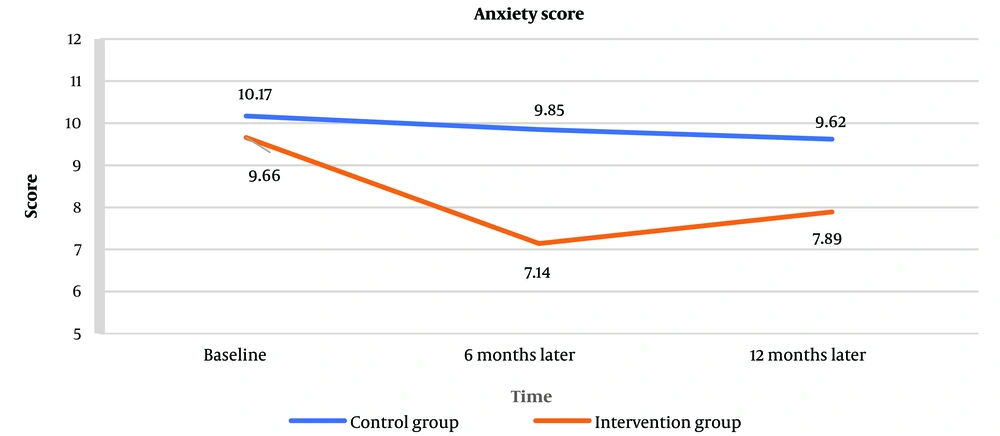
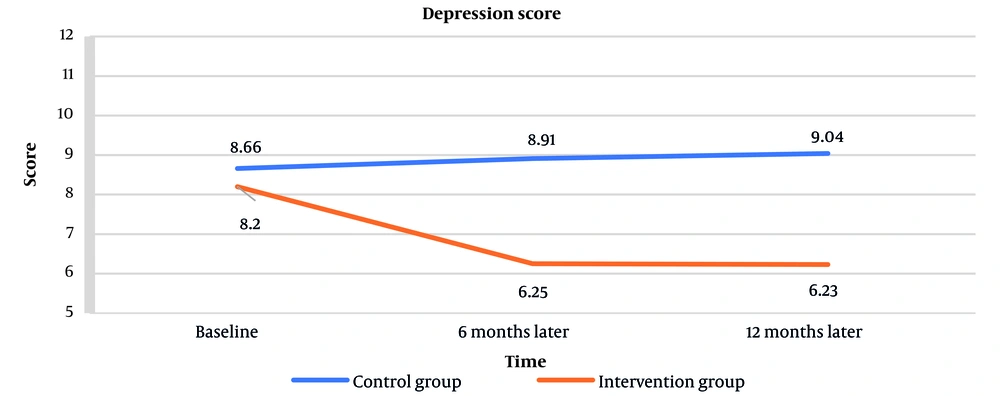
In the present study, the effect of a SM program on anxiety and depression in individuals with COPD was investigated. According to the research team's searches, this study is the first of its kind conducted in Iran. The findings indicated that initially, the mean anxiety and depression scores in both groups were higher than normal and at a mild level. Anxiety scores in the intervention group decreased at 6 and 12 months post-intervention, whereas depression scores in the intervention group decreased only at 6 months post-intervention and were no longer significant at 12 months. Individuals with COPD are at a higher risk for anxiety and depression (
1). Although these comorbidities negatively impact physical and social functioning—such as decreased physical performance, social interaction, self-esteem, increased physical disability, caregiver dependence, and emotional distress — and adversely affect hospitalization duration, disease exacerbation, quality of life, and mortality in COPD patients, they are often underdiagnosed and undertreated (
8,
25).
Other studies investigating the effects of SM on anxiety and depression in COPD patients have not reached clear conclusions. Wang et al. found that a health coaching SM program reduced anxiety and depression in COPD patients (
14). Lou et al. reported that the number of patients with anxiety and depression in the intervention group receiving the COPD health management program was lower than in the control group after four years of follow-up (
26). Lamers et al. demonstrated that a minimal psychological intervention (MPI) based on cognitive behavioral therapy (CBT) principles and SM alleviated depression in depressed COPD patients 9 months post-intervention, but had no effect after 1 or 3 months (
27). Studies by Apps et al., Bucknall et al., and Mitchell et al. indicated that SM for COPD patients improves anxiety but has no significant effect on depression (
28-
30). A meta-analysis showed that nurse-driven SM programs reduced anxiety and depression in COPD patients (
13). After 12 months, Jonsdottir et al. found that a partnership-based SM program for patients with mild and moderate COPD did not reduce anxiety or depression in either the intervention or control group (
31). A meta-analysis by Cannon et al. concluded that SM interventions for COPD had no significant effect on anxiety and depression in these patients (
11). Jolly et al. conducted another meta-analysis showing that community-based SM interventions did not improve anxiety and depression in COPD patients in primary care (
12). The differences in results could be attributable to variations in the content of the SM program, its implementation, and differences in the characteristics of the samples studied.
The present study also demonstrated that dyspnea is associated with anxiety and depression. This association has been reported repeatedly in previous studies (
32-
35). Anxiety is known to increase respiratory rate, leading to rapid and shallow breathing patterns and worsening dyspnea in COPD patients (
36). The relationship between dyspnea and depressive symptoms in COPD patients can be explained by complex causal processes (
37). We found that smoking status is related to anxiety and depression, consistent with prior studies (
6,
34,
38). Smoking can promote anxiety and depression, likely due to central nervous system toxicity caused by the constituents of tobacco smoke, as well as nicotine withdrawal (
39). Symptoms of depression in patients with COPD are associated with less successful smoking cessation (
40), and depressed individuals are more likely to smoke, while smokers are more likely to be depressed (
8).
The findings of this study are consistent with previous studies that have associated anxiety and depression in patients with COPD with their disease stage (
41-
43) and CAT score (
35). Although studies by Blanchette et al. and Miravitlles et al. show a relationship between comorbidity and depression similar to the results of our study (
44,
45), several studies reported no association between comorbidity and anxiety and depression (
40,
46). Additionally, several studies reported higher anxiety and depression in women than in men (
41,
42,
47) and an association between BMI and anxiety and depression (
42,
48), but we found no association between gender and BMI with anxiety and depression. These contradictory results could be explained by differences in the study samples.
The most important difference between this study and others is that it was conducted during the COVID-19 pandemic, which had a significant impact on COPD patients, and our educational content included information about the importance and prevention strategies for COVID-19.
5.1. Strengths and Limitations
The main strengths of this study include its well-designed methodology, randomization, and the involvement of a team of experts in all phases of the research. Nevertheless, there were several limitations. First, the study sample was based on convenience sampling, and the sample size was relatively small. Second, the research setting was limited to two sites. Third, having the capacity to read and write as an inclusion criterion led to the exclusion of a large number of participants who were screened for eligibility. Fourth, demographic information was not collected from those who did not participate in the study, which could affect the generalizability of the findings. Fifth, although the reduction in depression scores in the intervention group was significant at both time points, the reduction in anxiety scores was significant only 6 months after the intervention and was no longer significant 12 months later. This may indicate that the timing of the intervention is an important factor influencing changes in anxiety scores, and a longer follow-up period may reveal more details about these changes. Therefore, it is recommended that future studies consider a larger sample size, a more robust sampling method, multiple sites, and a longer follow-up period.
5.2. Implications for Nursing Practice
The results of this double-blinded randomized controlled trial demonstrated a positive effect of the SM education program on reducing anxiety and depression in patients with COPD. Based on the findings of this study, healthcare providers can incorporate SM programs into the care of these patients, as they represent an important and feasible approach to improving psychological outcomes and a positive step toward addressing this often-overlooked dimension in these patients. Additionally, healthcare policymakers can consider including SM programs in COPD management guidelines with more evidence and certainty. Given the high levels of anxiety and depression observed at baseline in the study samples, healthcare policymakers can plan to involve psychologists and psychiatrists in the treatment team for these patients.
5.3. Conclusions
The results of this double-blinded randomized controlled trial demonstrated a positive effect of the SM education program on reducing anxiety and depression in patients with COPD. Therefore, given the high prevalence of anxiety and depression and the lack of attention to these psychological dimensions in these patients, SM education programs delivered by healthcare providers represent an important and feasible approach to treating anxiety and depression in this population.