Journal of Nursing and Midwifery Sciences
The Official Journal of Mazandaran University of Medical Sciences
The effect of emotional intelligence training on employed nurses
Authors
Abstract
Background and Purpose: Nurses are frequently exposed to anxiety-related problems. In fact, anxiety and stress can negatively affect
nurses’ mental health and performance. Therefore, in the present study, we aimed to investigate the effect of emotional intelligence
training on employed nurses in Sabzevar, Iran in 2014.
Methods: In this experimental trial, 135 nurses working in Sabzevar hospitals were enrolled and randomly assigned to intervention
and control groups. The subjects were evaluated, using a demographic questionnaire, Bar–On's emotional quotient inventory, and
Spielberger’s State-Trait Anxiety Inventory (STAI). The intervention group was trained in six sessions by an expert. In the final session,
the questionnaires were completed by the participants and analyzed. For statistical analysis, t-test and non-parametrical tests were
performed. P-value less than 0.05 were considered statistically significant.
Results: Based on the findings, 80% of the samples were female. The mean age of the participants was 32.11±6.68 years. Before the
intervention, the difference between the two groups was insignificant (P>0.05), while after the intervention, a negative relationship was
found between the STAI score and emotional intelligence in the two groups. Also, the difference between the groups regarding STAI
scores was significant (P<0.003). Following the intervention, the emotional intelligence scores were higher in comparison with the preintervention
period in the intervention group. Also, after the intervention, anxiety decreased in the intervention group in comparison
with the pre-intervention period (P<0.001).
Conclusion: The present results showed that emotional intelligence scores could improve as a result of training, while the STAI scores
significantly decreased.
Highlights
Copyright
2022 Journal of Nursing and Midwifery Sciences. This work is licensed under a Creative Commons Attribution-NonCommercial 3.0 Unported License which allows users to read, copy, distribute and make derivative works for non-commercial purposes from the material, as long as the author of the original work is cited properly. https://jnms.mazums.ac.ir/ https://wiki.creativecommons.org/wiki/License_Versions
Similar Articles
Emotional Intelligence Training for Reducing Illicit Drug Use Potential among Iranian Nurses: A Pilot Study
Goudarzian AH, Esmaeili R, Alizadeh-Navaei R, Yousefi M, Balouchi A. Emotional Intelligence Training for Reducing Illicit Drug Use Potential among Iranian Nurses: A Pilot Study. Iran J Psychiatry Behav Sci. 2017;11(3):e6676. doi: https://doi.org/10.5812/ijpbs.6676

Emotional Intelligence and Depression Among Hospital Nurses of Tehran University of Medical Sciences
Shabany M, Ghajarzadeh M. Emotional Intelligence and Depression Among Hospital Nurses of Tehran University of Medical Sciences. Arch Neurosci. 2018;5(4):e70734. doi: https://doi.org/10.5812/ans.70734
The effects of emotional intelligence training on anxiety in hemodialysis patients
Yarahmadi F, Ghasemi SF, Forooghi S. The effects of emotional intelligence training on anxiety in hemodialysis patients. J Nurs Midwifery Sci. 2015;2(4):e141281. doi: https://doi.org/10.18869/acadpub.jnms.2.4.8
Effect of Spiritual Skills Training on Stress, Anxiety, and Depression Among Nurses Working in Baharan Psychiatric Hospital, Zahedan: A Quasi-Experimental Study
Rezvaniamin M, Pourkahkhai M, Mojahed A, Keikha H, Fouladi F, et al. Effect of Spiritual Skills Training on Stress, Anxiety, and Depression Among Nurses Working in Baharan Psychiatric Hospital, Zahedan: A Quasi-Experimental Study. Zahedan J Res Med Sci. 2026;28(3):e168825. doi: https://doi.org/10.5812/zjrms-168825
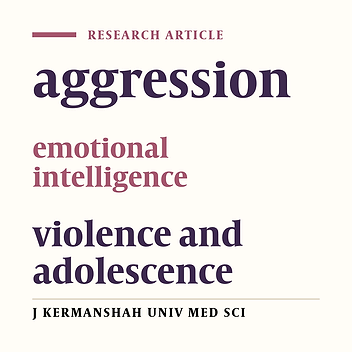
The effectiveness of the emotional intelligence training on the aggressiveness among adolescent boys
Naghdi H, Adibrad N, Nouranipour R. The effectiveness of the emotional intelligence training on the aggressiveness among adolescent boys. J Kermanshah Univ Med Sci. 2010;14(3):e79474. doi:
- Scopus by DOI: 0
Last Update: 4 days ago
- Scopus by Title: 0
Last Update: 4 days ago
- Scopus by Title (Ref): 11
Last Update: 4 days ago
- CrossRef: 0
Last Update: 57 minutes ago
- OpenAlex: 12
Last Update: 2 days ago
- OpenCitations: 9
Last Update: 4 days ago