
Fulltext
Full-text is available in PDF format.
Journal of Nursing and Midwifery Sciences
The Official Journal of Mazandaran University of Medical Sciences
Authors
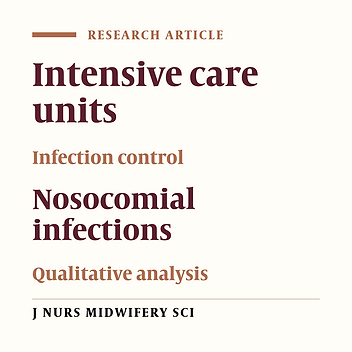
Background and Purpose: Nosocomial infections, especially those occurring in intensive care units (ICUs), are one of the major health
problems in every community. Nosocomial infections are associated with increased mortality rate and high treatment costs. Effective
control of these infections essentially depends on the knowledge of healthcare providers regarding the detection and eradication of the
associated causes. This study aimed to investigate the main challenges involved in the prevention and control of nosocomial infections
in hospital ICUs.
Materials and Methods: This qualitative study was conducted on 21 healthcare providers selected via purposive sampling from
various medical subgroups, including anesthesiologist, nursing managers, supervisors, faculty members, head nurses, and hospital
managers. Data were collected via semi-structured interviews with the participants. Data analysis was performed using qualitative
conventional content analysis.
Results: In total, four main themes were emerged from conventional content analysis, as follows: 1) complex nature of work in the
ICU; 2) lack of knowledge of healthcare providers; 3) inadequate equipment and resources and 4) human resource shortage.
Conclusion: According to the results of this study, appropriate resource allocation, improvement of organizational health structures,
and competency of healthcare personnel in hospital ICUs could be remarkably effective in the prevention, control and reduction of
nosocomial infections.
2022 Journal of Nursing and Midwifery Sciences. This work is licensed under a Creative Commons Attribution-NonCommercial 3.0 Unported License which allows users to read, copy, distribute and make derivative works for non-commercial purposes from the material, as long as the author of the original work is cited properly. https://jnms.mazums.ac.ir/ https://wiki.creativecommons.org/wiki/License_Versions
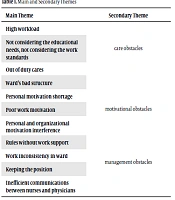
Rezaee N, Ghaljeh M, Salar A. Barriers to Providing High-Quality Nursing Care in Intensive Care Units: A Qualitative Study. Med Surg Nurs J. 2020;9(3):e110265. doi: https://doi.org/10.5812/msnj.110265
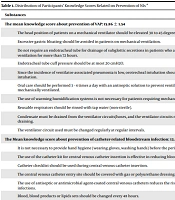
Askeroğlu A, Saygılı F, Balkaya F. Investigation of Knowledge and Behaviors of Intensive Care Nurses on the Prevention of Nosocomial Infections and Related Factors. Ann Mil Health Sci Res. 2022;20(1):e121729. doi: https://doi.org/10.5812/amh.121729
Kazemifar AM, Yahyaee A, Seddighi M, Soleimannejad M. The Prevalence and Risk Factors of Nosocomial Infections in the Intensive Care Unit of a Hospital in Iran. J Inflamm Dis. 2024;24(4):e156236. doi:
Ashrafi Z, Nobahar M. Nurses’ Experience of Facilitators of Adaptation to Nursing Care in Intensive Care Units: A Qualitative Content Analysis Study. Iran J Psychiatry Behav Sci. 2023;17(2):e134054. doi: https://doi.org/10.5812/ijpbs-134054
Kalantarzadeh M, Mohammadnejad E, Ehsani SR, Tamizi Z. Knowledge and Practice of Nurses About the Control and Prevention of Nosocomial Infections in Emergency Departments. Arch Clin Infect Dis. 2014;9(4):e18278. doi: https://doi.org/10.5812/archcid.18278
Last Update: 4 days ago
Last Update: 4 days ago
Last Update: 4 days ago
Last Update: 55 minutes ago
Last Update: 2 days ago
Last Update: 4 days ago