
1. Background
As declared by the World Health Organization (WHO), nurses are the backbone of any healthcare system worldwide, the failure of whom in providing nursing care can have irreparable consequences, and the reason behind this is their leading role in improving patient outcomes (1). The presence of nurses endowed with professional adaptation has always been vital to maintaining the quality of nursing care and even boosting individuals’ health status and performance (2). Nevertheless, professional adaptation to new work environments is a challenging experience. Since the recruitment, selection, and training of new human resources can incur huge costs, adaptation has become one of the major challenges organizations face today. Accordingly, employees can be highly efficient if they reach appropriate mental and physical adaptation to their new work environment (3).
The intensive care unit (ICU), as one of the pillars of healthcare centers, is known as a special ward in which nurses are exposed to ever-increasing occupational stress and provide critical care services for patients with critical health conditions (4). Given their direct relationships with patients’ health status, nurses are one of the most influential human resources in these units (5). In this regard, ICU nurses are frequently affected by occupational stressors, such as daily exposure to critically ill patients, inadequate staffing (especially in crises), work pressure, rapid emergency response and interventions, and safe work with tools and equipment (6). Accordingly, hospital administrators need a team of nurses immersed in their work with strong feelings and adapted to their profession and work environment (7).
Karatepe and Avci also stated that adaptation in nurses represents a combination of psychological and non-psychological factors that often seem necessary to maintain success at work and provide high-quality care for patients (1). In this regard, Johnson et al. conducted a study using a qualitative research design to find multilevel facilitators and barriers to implementing an academic-to-community hospital ICU quality improvement program. Based on the results, they realized two main categories of external (i.e., degree of understanding of the programs based on managers’ opinions) and internal (i.e., change management and staff readiness to accept them) underlying factors (8). In a study on reflecting the main facilitators and barriers to nursing interventions in long-term dementia care, Hirt et al. addressed some issues, such as shared attitudes, organizational cohesion, organizational commitment, nursing interventions, evaluation, and the support of knowledge and competencies (6).
To the best of our knowledge, there is no study investigating the facilitators of adaptation in ICU nurses. Considering the above-mentioned issues, it is of utmost importance to explain ICU nurses’ experiences regarding their adaptation strategies. Therefore, such experiences can be effective in improving adaptation among nurses and possibly reduce the barriers in this regard. As describing nurses’ experiences demands much focus on understanding their lived experiences and viewpoints, a qualitative research design can be better than a quantitative one in meeting the study objectives.
2. Objectives
This study was conducted to determine the facilitators of adaptation to nursing care among ICU nurses.
3. Methods
3.1. Design
This qualitative study was conducted using the conventional content analysis approach. Content analysis is one of the research methods for analyzing textual data and its hidden content (9). Conventional content analysis is generally used in a study that aims to describe a phenomenon. Researchers avoid using preconceived categories and instead generate new insights by allowing the categories and their names to emerge from the data.
3.2. Ethical Considerations
Before the beginning of the study, ethical approval was obtained from the Review Board of Semnan University of Medical Sciences, Semnan, Iran (ethics code: IR.SEMUMS.REC.1398.261). All participants were also informed of the study objectives, the voluntary nature of their participation, their right to withdraw from the study at any time, and the anonymity and confidentiality of their personal information. Written informed consent was also obtained from all participants before the study.
3.3. Participants and Settings
In this study, participants were composed of 13 individuals with a mean age of 34 years, including 12 nurses (i.e., 9 ICU nurses,1 nurse manager, 1 head nurse, and 1 nurse instructor) and 1 resident. Imam Hossein Hospital in Shahroud, Iran, is equipped with an air ambulance and four ICUs, based on which it is considered the regional trauma center. All participants fulfilled the inclusion criteria, namely at least 6 months of work experience in the ICU, bereavement experience during the last 6 months, and willingness to participate in the study. The first author of the research (Z. A.) has attended the department as a researcher.
3.4. Data Collection
The data were collected using semi-structured face-to-face interviews by the first author within December 2019 to April 2021. Before each interview, the interviewees received the necessary explanations about the study objectives and the confidentiality of personal data and recorded interviews. All the participants gave their written informed consent to participate in the study. The interviews were conducted using general questions and more specific ones based on the categories obtained according to the study objectives (e.g., How did you adapt to care in the ICU? and was there anything that helped you adapt?). Each interview lasted 30 - 120 minutes (average: 40 Minutes). The interviews were conducted at a place suggested by the participants. It was usually outside the hospital. There was also open air and respect for the distance between the interviewee and the participants. The first interview was conducted twice to provide further explanation. The interviews were recorded using a mobile recording application. The participants’ non-verbal reactions, along with their interactions and communications, were recorded immediately, further reviewed, and consequently analyzed using MAXQDA software (version 10; VERBI, Berlin, Germany). All the interviews and observations were also performed by a single researcher. Additionally, data collection and interviews continued until data saturation was reached.
3.5. Data Analysis
The data elicited from the interviews were analyzed using the constant comparative method and the conventional content analysis approach developed by Graneheim and Lundman. Accordingly, five steps were taken to analyze data, including, a) transcribing the whole content of the interview immediately after its completion and examining the transcripts thoroughly to get a general understanding of their content, b) determining the semantic units and initial codes, c) classifying similar initial codes into more comprehensive categories, and d) concluding the content contained in the data (10). In this study, the audio file of each interview was transcribed verbatim and entered into a Word File after its completion. After examining the transcripts and obtaining the initial codes, the codes were based on a central concept. Then, the codes were placed inside a basement. Afterward, the subcategories were reviewed several times and compared based on their similarities and differences to have the most homogeneity within the categories and the most heterogeneity between them.
3.6. Rigor
The trustworthiness and accuracy of the qualitative findings were assured based on Lincoln and Guba’s (1985) stringent criteria (i.e., credibility, confirmability, dependability, and transferability). To check the credibility of the data, various methods, including the repeated examination of the interviews and codes, the review of the concepts and categories, the selection of the first person to establish more and better communication, and eloquent statements for referring to one’s own experiences, were exploited. Moreover, confirmability was met by observing the researchers’ impartiality, agreeing on the initial codes and main categories, and reviewing the interview transcripts, codes, and categories extracted by the supervisor, two participant nurses (i.e., member checking), and two faculty members (i.e., peer checking).
The selection of the participants was conducted with reference to the analysis of each interview and attention to the desired points. Transferability was correspondingly made possible by interviewing a variety of participants and providing some direct quotes or giving examples and scientific consultations with a panel of experts and professors. Moreover, long-term contacts and engagement with the participants and data led to building trustworthiness and developing a more comprehensive understanding of the participants’ experiences. In addition, the sampling and data collection methods utilized in this study involved the participants with a maximum variation in terms of gender to further augment the data’s trustworthiness.
4. Results
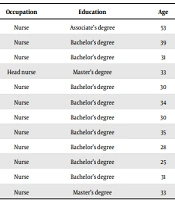
The participants’ age range was within 24 - 49 years. In terms of education, all the participants had a bachelor’s degree, and there were only three nurses with a master’s degree (Table 1).
Table 1.
Demographic Characteristics of Study Participants
| Participants ID | Gender | Marital Status | Age (Y) | Work Experience (Y) | Work Experience in ICU (Y) | Level of Education |
|---|---|---|---|---|---|---|
| P1 | Female | Married | 35 | 16 | 16 | BSc |
| P2 | Female | Married | 27 | 7 | 2 | BSc |
| P3 | Female | Married | 24 | 2 | 2 | BSc |
| P4 | Female | Single | 33 | 8 | 8 | MSc |
| P5 | Male | Single | 24 | 4 | 2 | BSc |
| P6 | Female | Married | 45 | 26 | 13 | BSc |
| P7 | Male | Married | 41 | 5 | 3 | Specialist |
| P8 | Female | Single | 30 | 8 | 8 | BSc |
| P9 | Male | Married | 41 | 12 | 5 | BSc |
| P10 | Female | Single | 49 | 26 | 7 | MSc |
| P11 | Female | Married | 35 | 12 | 8 | MSc |
| P12 | Male | Married | 28 | 6 | 3 | BSc |
| P13 | Female | Single | 34 | 10 | 10 | BSc |
Abbreviations: BSc, bachelor’s degree; MSc, master’s degree; ICU, intensive care unit.
In addition, the results of data analysis led to the emergence of three main categories, including psychological capital, professional capital, and social capital (Figure 1).
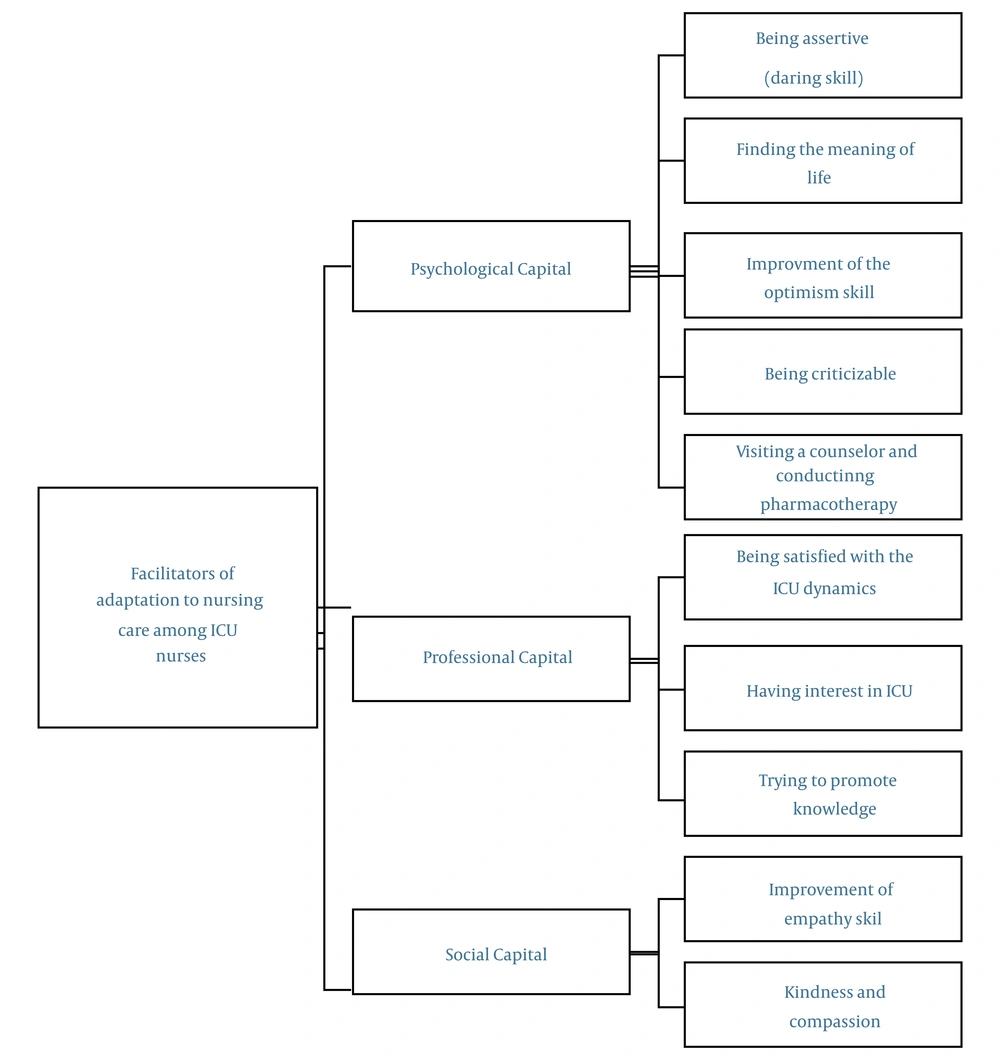
Figure 1.
Categories obtained for facilitators of adaptation to nursing care among intensive care unit nurses
4.1. Category 1: Psychological Capital
Psychological capital is the acquisition of skills by participants in psychological processes to improve their adjustment and have a better understanding of existing situations, through which they can choose the best option. In this regard, the category of psychological capital was comprised of the subcategories of being assertive (daring skill), finding the meaning of life, improvement of the optimism skill, being criticizable, and visiting a counselor and conducting pharmacotherapy.
4.1.1. Subcategory 1: Being Assertive (Daring Skill)
According to this subcategory, nurses felt frightened and even anxious due to their frequent exposure to complicated clinical situations and the existence of various tools and equipment in the ICU. In this regard, one of the participants affirmed the following statement:
“I made a great effort not to feel intimidated and tried the existing procedures on my own. I also attempted not to lose hope but to deal with the events occurring in this special unit.” (P5)
4.1.2. Subcategory 2: Finding the Meaning of Life
The ICU nurses were trying to make the best use of their life opportunities by observing severe illnesses and deaths in patients of different age groups with various living conditions. In this regard, one of the participants acknowledged the following statement:
“The things that I had to face in the ICU taught me not to miss the opportunities arising during our life. I think we do not have many opportunities in life.” (P9)
4.1.3. Subcategory 3: Improvement of the Optimism Skill
By paying much more attention to positive stimuli and focusing less on negative points, positive attitudes could help nurses articulate good feelings, establish valuable relationships with others, make rational decisions, resist facing problems, and deal with life challenges. Below is a statement expressed by one of the participants:
“Spending time with those who have a quiet personality feels good. I like to talk with them. In my opinion, people with positive attitudes and optimism bring hope to you. I think that my sister has such a personality. I talk with her about my own problems. She helps me a lot and gives me some pieces of advice.” (P8)
4.1.4. Subcategory 4: Being Criticizable
Constructive criticism could cause nurses to try to overcome their weaknesses and eliminate their flaws. Considering the high sensitivity of patient care in the ICU, nurses with the ability to welcome constructive criticism could provide higher-quality care for patients by accepting their own errors and trying to correct them. Two of the participants expressed their experience in this regard as follows:
“I learned to admit my mistakes.” (P1)
“Some people do not accept criticism at all. I mean that they never accept their errors, so they do not try to fix the problems they encounter in life and work, and they fail to work in the ICU.” (P6)
4.1.5. Subcategory 5: Visiting a Counselor and Conducting Pharmacotherapy
Mental health was vital for ICU nurses since it could help manage patients, perform tasks, survive working 12-hour shifts, and run their personal lives. Below is a statement expressed by one of the participants in this regard:
“I always ask why I bother myself to the extent that I need to have a consultation.” (P3)
Taking medications, antidepressants, and sedatives was also common among ICU nurses. In this regard, a participant mentioned the following statement:
“I suffered from mental problems. I had to be in a good mood to survive in my workplace and not to struggle with my family and others. I had to start taking some antidepressants.” (P5)
4.2. Category 2: Professional Capital
The study participants brought about the positive experiences they gained while working in the ICU, which facilitated their adaptation. Accordingly, the category of professional achievement encompassed the subcategories of being satisfied with ICU dynamics, having an interest in the ICU, and trying to increase knowledge.
4.2.1. Subcategory 1: Being Satisfied with ICU Dynamics
Regarding some complex conditions and the high workload in the ICU, the dynamism and extensive activities in this unit could become a positively attractive element for the nurses. In this regard, the participants stated their experience as follows:
“I am fond of the ICU because this unit is replete with activities and is a living department.” (P3)
“ICU nurses are active and can hardly ever sit because the nature of this special unit is dynamic.” (P10)
4.2.2. Subcategory 2: Having Interest in the ICU
One of the main prerequisites for adaptation to critical care nursing was an interest in working in the ICU. In this regard, one of the participants mentioned the following statement:
“I love ICU.” (P4)
Although ICU nurses encounter many problems and stressful situations, they showed strong interest in this unit and preferred to work there. Below is a statement expressed by a participant in this regard:
“Among all units in healthcare centers, I was very interested in the ICU, and that made me keep working there.” (P2)
4.2.3. Subcategory 3: Trying to Increase Knowledge
The high levels of knowledge and skills required to work in the ICU could make the nurses strive to achieve adaptation and boost their knowledge. The participants declared and confirmed the importance of this matter as follows:
“You should always study for the ICU.” (P1)
“It is clear from the outset that the individuals who study and research should go and work in the ICU.” (P11)
4.3. Category 3: Social Capital
Social capital represented the nurses’ experiences of personality changes to facilitate adaptation. This type of achievement could also have the potential to grow and improve; therefore, it could be utilized wherever needed to meet the existing challenges. Social capital, as another main category of this study, consisted of the subcategories of improvement of empathy skills and kindness and compassion.
4.3.1. Subcategory 1: Improvement of Empathy Skills
As most ICU patients are critically ill and have low levels of consciousness, the nurses could take responsibility for patient care, and their empathy skills improvement could make them be prepared for such practices. Some participants stated their experience in this regard as follows:
“We always put ourselves in the patient’s shoes. Once we may lie on the same ICU bed.” (P12)
“ICU nurses feel like their relatives are hospitalized in this ward and have this perspective when providing nursing care.” (P13)
“My ICU nurse was really good because she cared for me like I was one of her family members. She treated me like this.” (P9)
4.3.2. Subcategory 2: Kindness and Compassion
Kindness has always been like a lifeblood in a patient-related profession, especially in the ICU, where visitation is forbidden and patients are in constant contact with the nurses. Here is a statement expressed by one of the participants:
“The fact is that a patient is hospitalized in the ICU, and I have to be kind as a nurse when I go to provide care.” (P.4)
Nurses are also the only full-time health workers at the patient’s bedside in the ICU and the only individuals with whom patients could be in contact. Therefore, ICU nurses’ compassion and kindness were also important to patients. In this regard, one of the participants stated the following statement:
“The first thing that comes to my mind when talking about ICU nurses is their kindness.” (P7)
5. Discussion
This study aimed to illuminate the facilitators of adaptation to critical care nursing by reflecting the main categories of psychological, professional, and social capital. Based on the results, one of the main categories addressed in this study was psychological capital. In this regard, the existence of high cognitive capital in ICU nurses could reduce stress, burnout, and other negative symptoms and even give rise to more professional adaptation at the workplace (11).
One of the subcategories of psychological capital was being assertive (daring skill). Confronting individuals with what they are afraid of shows them that their fear is too much. In line with the results of the present study, Ahlstedt et al. reported that the identification of fears and the ways to deal with them led to lower stress and higher adaptation (12). However, for some nurses, leaving the stressful situation was a better choice for them (13). The efforts of nurses to face what they are afraid of will lead to solving their weaknesses and ultimately facilitating their adaptation.
Another subcategory of psychological capital was finding the meaning of life. The ICU nurses work under challenging circumstances; as a result, the level of psychological stress can be multiplied among them. Therefore, their efforts to seize life opportunities were due to observing no chance of survival in patients. In line with the aforementioned findings, Chang concluded that seeing critically ill and dying patients in different age groups in ICU make nurses appreciate their own well-being and disease-free life and have a greater value for the facilities and natural events of life (14). Achieving a new concept of life brought about peace and facilitated the nurses’ adaptation.
Moreover, another subcategory of psychological capital was the improvement of the optimism skill. Wan et al. revealed that employees with positive mental characteristics were better able to manage stress and adapt to stressful work environments (15). Feng et al. similarly postulated that optimistic beliefs were positively related to various aspects of health. Thinking about positive outcomes could relieve individuals’ anxiety and boost their abilities to understand and adapt to the existing situation (16). Improving the optimism skill would facilitate the adaptation of nurses because the positive view would improve the process of doing the work by nurses.
Being criticizable, as demonstrated in the results of this study, was one of the subcategories of the category of psychological capital and meant to welcome opposing opinions as a necessity for collective life in small-scale societies (e.g., organizations) and large-scale urban ones (17). In China, Uddin et al. reported that criticism means accepting opposing opinions, which is necessary for the collective life of individuals in any society on a small scale (organization) and on a large scale in urban societies (17). In this regard, Bagheri and Akbari indicated that nursing leadership could strengthen assertive scientific communication, boost nurses’ ability to accept criticism, and ultimately increase their adaptation by establishing, fostering, and applying innovative behaviors (18). Accepting the weaknesses of nurses leads to solving them and thus improving the performance of nurses.
The final subcategory of psychological capital was visiting a counselor and conducting pharmacotherapy. In this regard, ICU nurses were more exposed to occupational stress than those working in other units (19). Yang et al. considered nursing one of the most stressful professions and maintained that nurses were one of the working groups referring to physicians for their mental health problems (20).
Based on the results of this study, professional capital constituted one of the main categories of adaptation in ICU nurses and was regarded as the positive experiences individuals could receive from their profession (11). Accordingly, those with higher professional capital could become more adapted and have better performance in their workplace (21).
One of the subcategories of professional capital was being satisfied with ICU dynamics. The improvement of the health status of patients admitted to the ICU and the conditions existing in this unit was of utmost importance for ICU nurses and their perceptions toward reaching adaptation (22). Monsalve-Reyes et al. concluded that when individuals feel satisfied with their workplace, some signs start to emerge, including increased commitment, responsibility, efficiency, and reduced job leaving, all of which could give rise to the quality of healthcare services (23). Ahlstedt et al. also demonstrated that nurses’ satisfaction with the nature and characteristics of their profession relegated some negative symptoms, such as stress and burnout, and such high levels of satisfaction could lead to more professional adaptation in nurses at work (24).
In addition, showing interest in the ICU was another subcategory of professional capital. The positive consequences of career interests for individuals and organizations could bring mental health, develop organizational commitment, and improve job performance. Wan et al. also reported that aspiring nurses who tend to provide patient-centered care caused them to have higher work productivity and fewer layoffs (15). Seaman et al. also considered job satisfaction a psychological factor and a kind of emotional adaptation to work and employment conditions. They also showed that when the desired job can provide the planned pleasure for the person, he/she can feel satisfied (19). There is also a lack of interest in working in the ICU among nurses, which causes them to change their section (25).
The results also showed that one of the subcategories of professional capital was trying to increase knowledge. In this regard, De Simone et al. considered it essential to recruit well-developed and qualified nurses and retain them in healthcare systems to provide high-quality and safe services, which could only be achieved by updating the levels of knowledge and skills in these individuals (26). Contrary to the obtained concept, some nurses prefer to have limited information because they can be transferred to the administrative department from this path (27).
Moreover, one of the main categories of adaptation in ICU nurses was social capital. Of note, psychological well-being could be simply formed in concepts related to a person’s social personality and was crucial for the proper management of personal life and the surrounding world (28). Accordingly, acquiring social capital could lead to accepting the conditions and attaining higher adaptation.
Likewise, the results of this study demonstrated that one of the subcategories of social capital was the improvement of empathy skills. In this regard, Hunt et al. stated that empathy is defined as feeling the client’s world is similar to what it is (29). In line with the results of the present study, Guven Ozdemir and Sendir reported that empathy was one of the main skills in nursing, and nurses could better understand patients, communicate with them, and even provide support if they had empathic tendencies and skills and individualized care perceptions (30). Therefore, establishing an effective therapeutic relationship through empathy could involve meeting patients’ concerns, understanding patients, and providing comfort and support (31). Nurses’ empathy with patients has a very effective and accelerating role. In other words, nurses’ empathy with patients provides a shortcut to establishing a relationship with patients, and understanding the patient’s needs facilitates the nurse’s adaptation.
Furthermore, another subcategory of social capital was kindness and compassion. The results of a study by Wan et al. showed that the more individuals focused on positive traits, such as kindness and good manners, the better they could cope with stress (15). Perera et al. also demonstrated that positive psychological characteristics, such as being religious and having spirituality, particularly good manners, and kindheartedness, at the workplace, could act as mediators, prevent psychological harm, and improve individuals’ health status and performance (32). The exposure of nurses to all kinds of stress and work emotions leads to the emergence of aggressive and moody behaviors (33).
5.1. Conclusions
Currently, healthcare services are one of the most important areas of sustainable development in most human societies due to their direct relationship with human health. Meanwhile, nurses are one of the most effective and important health workers in health centers. The ICU nurses are remarkable due to their experience with the different conditions of patients. The adaptation of ICU nurses by providing care is directly effective in the quality of nursing services and, as a result, the patient’s recovery. The awareness of the facilitators of adaptation to special care nursing in nurses will lead to increased adaptation because more adaptation affects health conditions and quality nursing care in different communities. Accordingly, it is recommended to conduct similar studies in different contexts to gain a broader range of experiences. Additionally, it is very important for managers to recognize and pay attention to the facilitators of the nurses’ adaptation to achieve the nurses’ adaptation.
5.2. Study Limitations
One of the limitations of this study was the difficulty of having access to the ICU nurses for face-to-face interviews due to their busy schedules. The study was conducted in a hospital. The conditions in hospitals might be different, which affected the results of the study. Therefore, further studies are suggested in other hospitals, including private and specialized hospitals. The outbreak of coronavirus disease 2019 caused delays and limitations in conducting the study. It is suggested to investigate the impact of this pandemic in the subsequent study.