
1. Background
Today, as the importance of information technology (IT) in delivering healthcare services continues to grow, knowledge of informatics and digital skills has become essential in nursing education (1). Nursing informatics is crucial for safety, efficiency, and quality, offering learning opportunities for the effective use of IT in nursing tasks and leading to improved patient care (2). In Canada, nursing informatics practices have been documented since 1990, with applications such as tele-nursing, electronic health records, decision support systems, workload measurement tools, and online education (3). In Iran, nursing informatics and its role in care, education, and research were introduced in 2012 (4). The development of an evidence-based nursing approach and the focus of nursing managers on improving the quality of nursing care highlighted the need for nursing informatics development. Over time, the necessity of nursing informatics has become evident due to the increasing use of technology in the health sector, in line with the capacities of the comprehensive health system map and the country’s comprehensive scientific roadmap for expanding IT usage, making it prominent in the country’s development goals (5).
Medical education must be prepared to respond to society’s healthcare needs and adapt to new technologies (6). Given the expansion of digital tools in healthcare service delivery, it is expected that graduates will enter the professional environment ready to employ these technologies (7). Equipping nursing students with the necessary knowledge and skills to use digital tools supports their performance and ensures that competent nurses enter the clinical work environment (8). However, studies have reported significant issues in nursing students' readiness to use technologies in clinical settings (9, 10). Research has also indicated that clinical nurses lack the necessary readiness or competencies to effectively utilize IT in patient care. Additionally, nursing education programs have not established standard criteria for nursing informatics skills (11).
In today’s healthcare environment, in response to the increasing digitization of healthcare and the transformative role of informatics, nursing competency in this field is internationally recognized as essential for entering technology-based work environments (12, 13). In various countries, formal nursing informatics education ranges from certification to doctoral programs (14). Informatics impacts all functions within the nursing profession (15). Therefore, nurses must be knowledgeable and competent in using a range of informatics tools to deliver care services effectively (16). Since nurses are the primary users of information technology and informatics is a core professional competency, and given the limited studies in this field in Iran, the present study aims to conduct a comparative examination of nursing informatics competency among faculty members, students, and clinical nurses.
2. Objectives
This study aims to compare nursing informatics competencies among educators, students, and clinical nurses.
3. Methods
3.1. Study Design
This descriptive-analytical study aimed to compare the nursing informatics competencies of educators, students, and nurses working in hospitals affiliated with Abadan University of Medical Sciences in 2023. A suitable sample size of 297 clinical nurses was selected randomly using Cochran’s formula. In addition, 73 nursing educators and 300 nursing students were included in the study through census sampling. The inclusion criteria required participants to be willing to take part in the research, with nurses having at least one year of work experience, educators having a minimum of one year of teaching experience, and students having completed at least two years of nursing education. Exclusion criteria included unwillingness to continue participation in the study and incomplete questionnaires.
After obtaining the necessary permissions, the researcher uploaded the questionnaires to the Digi Survey electronic system and sent the response link to the participants’ contact numbers. Messaging apps like Eitaa and Soroush were used to send messages explaining the study’s objectives to participants. If participants clicked the link and completed the questionnaire, this was considered informed consent to participate in the study.
3.2. Data Collection Tools and Methods
Data were collected using the Nursing Informatics Competency Assessment Tool (NICAT) and a demographic information questionnaire. The NICAT was developed by Rahman in 2015 based on the American Nurses Association standards and Benner’s model of skills acquisition in nursing. It is designed to assess educational programs and nurses' competencies in informatics (17). The NICAT evaluates informatics competency through 30 components across three dimensions: Computer literacy (10 questions), informatics literacy (13 questions), and information management skills (7 questions). The tool uses a five-point Likert scale, ranging from one to five, with an overall score range of 30 to 150. Higher scores reflect greater nursing informatics competency. A score of 30 indicates a novice, 31 - 59 an advanced beginner, 60 - 89 a competent nurse, 90 - 119 a proficient nurse, and 120 - 150 an expert nurse (18).
The validity and reliability of the questionnaire were confirmed in Iran by Jouparinejad et al. in 2020. Content validity was assessed by surveying 30 nurses, and reliability was established using the Cronbach’s alpha method, yielding a coefficient of 0.95 (19). The demographic information questionnaire gathered details on participants' sex, age, education level, and type of employment.
3.3. Data Analysis
After data collection, the data were entered into SPSS software v. 26 for analysis. Descriptive analysis was performed by calculating frequency percentages, means, and standard deviations (SD). The Kolmogorov-Smirnov test was used to check the normality of the data. Independent t-tests, ANOVA, and Pearson correlation coefficients were employed to examine relationships between the different dimensions of the questionnaires, with a significance level of P < 0.05.
3.4. Ethical Considerations
This paper is part of a research project titled “Assessment of Nursing Informatics Applications in Student Education,” with ethics code IR.ABADANUMS.REC.1399.203 and project No. 1058. The study was conducted in full compliance with ethical principles, both in its execution and publication. Comprehensive information was provided to participants regarding the purpose of the research, its results, confidentiality, and how the study would be conducted. Informed consent was obtained from all participants.
4. Results
In this descriptive-analytical study, a total of 670 participants were recruited, including 73 nursing educators, 300 nursing students, and 297 clinical nurses from hospitals affiliated with Abadan University of Medical Sciences. The participants' ages ranged from 17 to 56 years, with a mean age of 25.91 ± 7.33 years. The sample consisted of 68% female and 32% male participants. In terms of educational qualifications, 80.5% held a bachelor's degree, 17% had a master's degree, and 2.5% held a PhD.
The average overall informatics competency score among the participants was 105.58. Information management skills had the lowest average score (24.59), while informatics literacy had the highest average score (45.84). Educators scored the highest in informatics competency with an average score of 110.21, followed by clinical nurses with 106.24 and students with 103.78 (Table 1).
Table 1.
Mean and SD of Informatics Competence and its Dimensions According to the Groups Participating in the Study a
| Variables | Nursing Educators | Nursing Students | Clinical Nurses | Total |
|---|---|---|---|---|
| Computer literacy | 43.01 ± 6.19 | 33.47 ± 8.72 | 34.86 ± 8.99 | 35.13 ± 9.05 |
| Informatics literacy | 47.65 ± 11.85 | 45.26 ± 10.18 | 45.99 ± 11.47 | 45.84 ± 10.97 |
| Information management skills | 19.54 ± 7.74 | 25.05 ± 6.4 | 25.38 ± 6.83 | 24.59 ± 6.97 |
| Informatics competency | 110.21 ± 23.79 | 103.78 ± 19.94 | 106.24 ± 24.07 | 105.58 ± 22.34 |
a Values are expressed as mean ± SD.
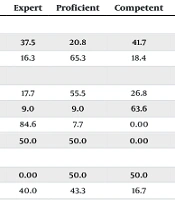
The findings indicated that, on average, 46.3% of all participants, including 43.8% of educators, 53.5% of students, and 39.8% of clinical nurses, reported their informatics competency at the proficient level. Additionally, within the groups of educators and students, no instances of nursing informatics competency at the novice level were reported (Table 2).
Table 2.
The Levels of Nursing Informatics Competency Among the Participant Groups a
| Variables | Minimum Score | Maximum Score | Novice | Advanced Beginner | Competent | Proficient | Expert |
|---|---|---|---|---|---|---|---|
| Nursing educators | 56 | 147 | 0 | 4.1 | 21.9 | 43.8 | 30.1 |
| Nursing students | 31 | 145 | 0 | 1.7 | 22.1 | 53.5 | 22.7 |
| Clinical nurses | 30 | 150 | 0.7 | 1 | 23.1 | 39.8 | 35.5 |
| Overall | 30 | 150 | 0.3 | 1.6 | 22.5 | 46.3 | 29.2 |
a Values are expressed as (%).
Before conducting analytical tests, the normality of the three dimensions of the questionnaire—total scores for computer literacy, informatics literacy, and information management skills—was assessed using the Kolmogorov-Smirnov test. The results indicated that all three dimensions followed a normal distribution.
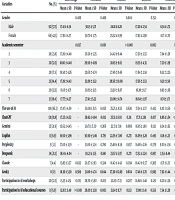
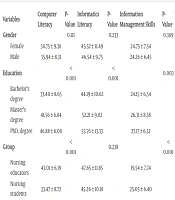
The ANOVA test revealed that informatics competency and all its dimensions were highest among nursing educators. Moreover, there were statistically significant differences in the mean scores of computer literacy and information management skills among the participant groups (Table 3).
Table 3.
The Relationship Between the Studied Variables and Informatics Competency and its Dimensions a
| Variables | Computer Literacy | P-Value | Informatics Literacy | P-Value | Information Management Skills | P-Value | Total Informatics Competency | P-Value |
|---|---|---|---|---|---|---|---|---|
| Gender | 0.111 | 0.233 | 0.369 | 0.335 | ||||
| Female | 34.75 ± 9.36 | 45.52 ± 11.49 | 24.75 ± 7.54 | 105.03 ± 23.05 | ||||
| Male | 35.94 ± 8.31 | 46.54 ± 9.75 | 24.26 ± 6.45 | 106.74 ± 20.77 | ||||
| Education | < 0.001 | < 0.001 | 0.003 | < 0.001 | ||||
| Bachelor’s degree | 33.40 ± 8.65 | 44.19 ± 10.62 | 24.15 ± 6.54 | 101.75 ± 20.96 | ||||
| Master’s degree | 41.56 ± 6.84 | 52.21 ± 9.02 | 26.31 ± 8.58 | 120.08 ± 20.21 | ||||
| PhD. degree | 46.88 ± 6.00 | 55.76 ± 13.33 | 27.17 ± 6.32 | 129.82 ± 24.75 | ||||
| Group | < 0.001 | 0.238 | < 0.001 | 0.070 | ||||
| Nursing educators | 43.01 ± 6.19 | 47.65 ± 11.85 | 19.54 ± 7.74 | 110.21 ± 23.79 | ||||
| Nursing students | 33.47 ± 8.72 | 45.26 ± 10.18 | 25.05 ± 6.40 | 103.78 ± 19.94 | ||||
| Clinical nurses | 34.86 ± 8.99 | 45.99 ± 11.47 | 25.38 ± 6.83 | 106.24 ± 24.07 |
a Values are expressed as mean ± SD.
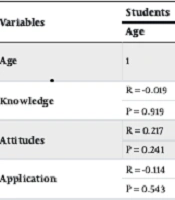
The Pearson correlation test revealed a statistically significant correlation between age and all dimensions of informatics competency in the nursing educators’ group. Furthermore, there was a significant relationship between the dimensions themselves and between each dimension and the overall informatics competency within the educators’ group (P = 0.001). In the student group, the study found no significant correlation between age and overall informatics competency or any of its dimensions (P = 0.699). However, significant correlations were found between the dimensions, indicating that as the score in one dimension increased, the score in another dimension also increased (P = 0.001). In the clinical nurses’ group, the results indicated no statistically significant correlation between age and computer literacy (P = 0.14). However, age was significantly correlated with the other dimensions, indicating a direct relationship (P = 0.001). The pairwise relationships between the other dimensions within this group were also statistically significant (P = 0.001).
5. Discussion
The results of the present study indicated that the average informatics competency scores for educators, students, and clinical nurses fell within the proficient range. Numerous studies have similarly reported nursing informatics competency within the competent and proficient ranges (20-23). For example, according to a study by Elsayed et al. (2017), 34% of the nurses examined were proficient, while 32% were classified as experts (24). Temporal trends in these studies show that, in recent years, informatics competency scores among nurses have been increasing as informatics-related courses are added to nursing curricula and continuous training is provided to nurses in hospitals (21). The slight differences in the results of these studies may be attributed to variations in educational curricula, empowerment initiatives, and the cultural conditions of the research environments in different countries.
Based on the results of the present study, the highest score in informatics competency was related to the informatics literacy dimension. Carter-Templeton (2013), in his study on nursing educators and students at a university in the southeastern United States, similarly reported that their informatics literacy ranged from competent to proficient (25). Furthermore, studies by Uneke et al. (2015) on healthcare policymakers in Nigeria and by Eldoushy and Behairy (2023) at the National Liver Transplant Institute in Egypt also found that informatics literacy received the highest scores, consistent with the present study (26, 27). However, it is important to note that the complexity and transformative nature of informatics literacy skills (28) require further empowerment of nurses in this area to help them reach expert levels.
The results of the present study also revealed that the lowest score in informatics competency was related to information management skills. Several studies have reported similar findings, with the lowest informatics competency scores associated with information management skills (29, 30). The era of paper-based systems for documenting patient care is coming to an end, and electronic health records (EHRs) are becoming mandatory for all documentation purposes (31). According to a study by Schenk et al. (2016), nurses reported lower confidence in using EHRs and expressed feelings of insufficient mastery and anxiety about using them effectively (32). Insufficient educational content and limited exposure to EHR systems in hospitals during nursing education present significant barriers to developing information management skills among nurses (33). Therefore, it is recommended that nursing managers and educators implement educational and empowerment programs aimed at enhancing nurses' informatics competency, particularly in information management skills, which received the lowest average score.
5.1. Limitations
This study used a self-reporting method for completing the questionnaires. It is important to consider that factors such as embarrassment about low competency or a desire to appear proficient in informatics may have influenced the reported results.
5.2. Strengths
By including educators, students, and clinical nurses, this research provides a comprehensive view of nursing informatics competencies across different levels of the profession, highlighting variations, strengths, and weaknesses in knowledge and skills.
5.3. Conclusions
The present study evaluated the informatics competency of educators, students, and clinical nurses. While informatics competency was generally reported at a proficient level, there are notable gaps in nursing informatics skills, particularly in information management, which require further development and enhancement. The specific competencies required may vary based on the educational or clinical context, yet there is a growing demand for informatics competencies in patient care.
To address this need, the integration of contemporary informatics into the nursing curriculum can significantly influence the attitudes and knowledge of nursing students. Additionally, continuous informatics education for clinical nurses can enhance the roles of professional nurses and nursing managers. The increased utilization of informatics will ensure that faculty members stay current in their educational and research activities.
It is recommended that workshops and training courses focusing on the application of informatics in nursing be implemented to improve the knowledge and skills of educators, students, and clinical nurses. Medical universities should ensure that nurses have access to up-to-date, high-quality infrastructure, materials, and resources.
Furthermore, comprehensive national studies that incorporate both qualitative and quantitative research on nursing informatics competencies in Iran are necessary. Research with an action-oriented approach, along with strategies for improving informatics education and competency application, is crucial for policymakers and nursing managers.