
1. Background
Breastfeeding is considered the gold standard for infant nutrition because of its nutritional quality and protective effects, particularly during exposure to pathogens and antigens (1). The American Academy of Pediatrics and the World Health Organization recommend exclusive breastfeeding for the first six months, followed by complementary feeding for at least one year (1, 2). Various global initiatives are also in place to promote breastfeeding and extend the duration of exclusive breastfeeding (3). Individual and social factors influence women’s desire and ability to breastfeed successfully. At the individual level, breastfeeding self-efficacy, defined as a mother’s confidence in her ability to breastfeed successfully (4), plays an important role in breastfeeding initiation, continuation, and overall success (3, 5). Factors such as the number of pregnancies, previous breastfeeding experience, mode of delivery, and maternal satisfaction with the quality of infant feeding during the hospital stay may influence breastfeeding self-efficacy (3). Successful breastfeeding also requires access to accurate information and the development of essential skills (6). Many first-time mothers face substantial challenges in initiating and sustaining breastfeeding, primarily because of limited experience, which may adversely affect self-efficacy (5). Education, counseling, and support can help these women recognize their feelings, identify challenges, and make informed decisions to overcome them (6). At the social level, access to health services, including postpartum and breastfeeding counseling and education, can influence breastfeeding rates.
During the COVID-19 pandemic, women faced unprecedented restrictions on routine postpartum care. Quarantine measures, social distancing, and limited access to in-person health services were associated with increased isolation and anxiety, reduced access to essential breastfeeding information, and intensified breastfeeding challenges in various countries, including Iran (5, 7). Many mothers were discouraged from breastfeeding because of concerns about transmitting the virus to their infants, and limited professional support further reduced breastfeeding self-efficacy. A study conducted at a community maternal facility in southern India found that mothers with COVID-19 had significantly lower breastfeeding self-efficacy scores than healthy mothers. Conversely, mothers who received postpartum breastfeeding counseling had higher breastfeeding self-efficacy scores (8). Cultural and social beliefs and practices related to breastfeeding vary considerably across societies. Some beliefs may positively influence breastfeeding outcomes, whereas others may act as barriers. These beliefs are predominantly acquired from significant others, including spouses, close relatives, and peers (9-11). The Turkmen are an ethnic group residing in northern and northeastern Iran. In Turkmen culture, childbirth and child care are deeply interwoven with symbolic rituals and beliefs. Consequently, breastfeeding is regarded as a sacred and identity-forming practice shaped by traditional values, family experiences, and the intergenerational transmission of beliefs. Although COVID-19 is no longer a pandemic, developing targeted interventions, particularly within traditional communities, may improve preparedness for future public health crises. Previous studies have highlighted the effectiveness of online education in improving breastfeeding self-efficacy (5, 12, 13); therefore, the present study was designed as a non-face-to-face educational intervention delivered via one of the most popular social networking platforms in Iran.
2. Objectives
This quasi-experimental study evaluated the effect of online postpartum self-care training on breastfeeding self-efficacy among primiparous Turkmen mothers during the COVID-19 pandemic.
3. Methods
3.1. Study Design and Participants
This quasi-experimental study included two groups (intervention and control) and used a pretest-posttest design over six months. Sampling was conducted for approximately five months, from June 24, 2021, to November 17, 2021, at Imam Khomeini Hospital in Bandar Turkman, affiliated with Golestan University of Medical Sciences and Health Services, Iran. The study population comprised primiparous women with a history of low-risk, uncomplicated pregnancies and deliveries. Participants were recruited from the postpartum ward after childbirth.
The inclusion criteria were being a Turkmen woman with both parents of Turkmen ethnicity; being 15 to 45 years old; residing in Bandar Turkmen; having had a normal vaginal delivery without obstetric complications requiring more than routine postpartum care; having delivered a term neonate at 37 weeks + 0 days to 42 weeks + 0 days of gestation with an appropriate-for-gestational-age weight; having a functional smartphone and knowing how to use it; and being able to read and write in Farsi. Participants were also required to have a live infant with a birth weight of 2500 to 4000 g, as recorded in the medical record, who was exclusively breastfed on the first day.
The exclusion criteria were experiencing significant stress during the three months before the study; having fever from triage admission to discharge, as documented in the medical record; maternal or partner addiction or substance abuse; education or employment in a medical sciences field; a known behavioral or mental disorder documented in the medical record or diagnosed by the researcher; or hearing or speech impairment that could hinder virtual communication, based on self-report. The loss-to-follow-up criteria were infant hospitalization in the intensive care unit for more than four hours at any time during the study, which was the routine hospital observation period for identifying high-risk infants; death of the infant or mother during the study; occurrence of a stressful event for the mother during the study; use of formal counseling services outside the study during the study period; absence from more than one training session; failure to be discharged from the maternity ward within 72 hours of delivery; maternal COVID-19 infection confirmed by a definitive laboratory test during the study; or occurrence of any disease or condition that prevented breastfeeding or its continuation.
3.2. Sample Size and Sampling
The sample size was estimated based on findings from a previous study. To determine the minimum required sample size with a 95% confidence level and 80% statistical power, the expected effect of the educational intervention on breastfeeding self-efficacy among primiparous women was considered. A mean difference of 5 points in breastfeeding self-efficacy scores was regarded as statistically significant. Using the standard sample size formula for comparing two independent means, the initial sample size was calculated as 38 participants per group. After accounting for potential attrition, the final sample size was increased to 42 participants in each group.
d = 5
s1 = 6.8, s2 = 8.8
Sampling was consecutive. Individual randomization was not used because of the risk of contamination between participants. Therefore, weeks were used as the allocation units. By coin toss, the first week was assigned to the intervention group; subsequent weeks were allocated alternately until the required sample size was reached. Approximately six to eight eligible individuals entered the study each week and were assigned to the group corresponding to that week. The researcher visited the postpartum ward daily and invited eligible mothers to participate. Written informed consent was obtained from each mother who verbally agreed to participate. Sampling continued from June 24, 2021, to November 17, 2021.
3.3. Data Collection Instruments
Data were collected using a demographic profile form and the Breastfeeding Self-Efficacy Scale. Demographic information included the woman’s and her husband’s age, education level, and employment status, as well as place of residence. The Breastfeeding Self-Efficacy Scale, developed by Dennis and Fox, is intended for use during pregnancy and breastfeeding. It is a unidimensional questionnaire comprising 14 items rated on a 5-point Likert scale from 1 (not at all sure) to 5 (always sure). No items are reverse scored. The total score is the sum of all items and ranges from 14 to 70, with higher scores indicating greater breastfeeding self-efficacy (14, 15). A previous study of the Persian version reported a Cronbach alpha coefficient of 0.87, indicating strong reliability. Internal consistency was reported as a Cronbach alpha of 0.91. The validity of the Persian version was previously established, with excellent face and content validity (CVR = 1 and CVI = 1) and a stable one-dimensional structure (15). In the present study, reliability was confirmed with a Cronbach alpha of 0.787.
3.4. Intervention
The control group received routine postpartum education and care at hospitals and health centers in Bandar Turkman. The intervention group received routine care plus educational content delivered through virtual groups. Interactive education was provided over two weeks in three 30-minute sessions per week. The sessions were aligned with national guidelines for maternal and newborn health care, as described in the National Safe Mother Program booklet available at health centers. The session content was developed and shared with faculty members at Iran University of Medical Sciences for final review and approval. The training materials included 7 text files, 30 educational slides, 8 videos, and 6 audio files. In addition, every Thursday for two hours, the researcher answered participants’ questions online regarding their understanding or implementation of care (Table 1).
Table 1.
Educational Content of Self-Care for Primiparous Breastfeeding Women
| Educational Sessions | Educational Content | Type of Content Provided |
|---|---|---|
| First | 1) Welcome, introduction, statement of goals, and familiarization with the program; 2) pretest; 3) postpartum warning signs, part 1: fever and chills and foul-smelling discharge (16, 17); 4) maternal and neonatal benefits of breastfeeding (18); 5) basic handwashing before breastfeeding (19, 20); 6) importance of child care by a health care provider according to Iran's Ministry of Health (21, 22); 7) importance of child care by a health care provider according to Iran's Ministry of Health (23, 24); 8) coronavirus self-care protocol (25) | PowerPoint slides: 5; audio files: 1; videos: 1 |
| Second | 1) Review of previous sessions and encouragement to breastfeed; 2) breastfeeding positions, part 1: lying on the back, cradle position, and cross-cradle position; 3) postpartum warning signs, part 2: vaginal bleeding, genitourinary infections, breast problems, symptoms of high blood pressure, and unilateral swelling of the legs and thighs (16, 17); 4) warning signs in newborns (26, 27); 5) review of coronavirus self-care training (25, 28) | PowerPoint slides: 7; audio files: 1; videos: 2 |
| Third | 1) Review of previous sessions and encouragement to breastfeed; 2) breastfeeding positions, part 2: football hold, side-lying position, and breastfeeding with the help of a hug; 3) personal hygiene and episiotomy-site care; 4) advice and techniques for increasing breast milk; 5) physical pain, including leg or calf pain and cramps, and simple approaches such as gentle massage and local heat (29); 6) routine child health care, including avoiding kohl in the infant's eyes, avoiding ash, oil, or other substances on the umbilicus, and vaccinating children according to the national childhood immunization schedule; 7) review of the coronavirus self-care protocol | PowerPoint slides: 8; audio files: 1 |
| Question and answers (Q&A), Thursday | The main researcher, a midwife, answered questions submitted offline or online between 10:00 AM and 12:00 PM | |
| Fourth | 1) Review of previous sessions and encouragement to breastfeed; 2) early and late signs of hunger in the newborn; 3) nutritional recommendations during breastfeeding; 4) common symptoms of postpartum grief and depression and strategies for sleep problems, appetite changes, anxiety, and mood swings; 5) common postpartum problems, such as constipation and fatigue | Text files: 2; audio files: 2; videos: 2 |
| Fifth | 1) Review of previous sessions and encouragement to breastfeed; 2) encouragement of mothers and caregivers to express traditional thoughts and beliefs about breastfeeding and infant care; 3) incorrect breastfeeding practices that lead to cracked or sore nipples; 4) common postpartum problems, such as labor-like pelvic pain; 5) review of the coronavirus self-care protocol | PowerPoint slides: 10; text files: 2; audio files: 2 |
| Sixth | 1) Review of previous sessions and encouragement to breastfeed; 2) postpartum sexual activity and appropriate spacing between pregnancies; 3) review of postpartum warning signs; 4) review of the coronavirus self-care protocol; 5) posttest | Text files: 2; videos: 3 |
Each group included four to eight primiparous mothers. Each participant could invite a female family member to join the group as an educational companion. In total, eight groups were created using WhatsApp. The breastfeeding self-efficacy questionnaire was completed on paper before the study, in the presence of the researcher. It was then administered online immediately after the intervention and again two weeks later using the Porsline platform (https://porsline.ir/).
3.5. Ethical Considerations
This study was approved by Iran University of Medical Sciences under ethics code IR.IUMS.REC.1400.262. It was conducted in accordance with ethical principles throughout its implementation and publication. Participants received comprehensive information about the study purpose, expected outcomes, confidentiality measures, and procedures. Written informed consent was obtained from all participants.
3.6. Data Analysis
Data were analyzed using SPSS version 16. Descriptive statistics included frequency distributions for qualitative variables and the minimum, maximum, mean, and standard deviation for quantitative variables. The chi-square test and Fisher exact test were used to compare qualitative variables between the two groups, and independent t tests were used to compare quantitative variables. Paired t tests were used for within-group comparisons of quantitative variables over time. Repeated-measures analysis of variance was used to evaluate breastfeeding self-efficacy at three time points: before the intervention, immediately after the intervention, and two weeks after the intervention. The significance level was set at P < 0.05 for all tests.
4. Results
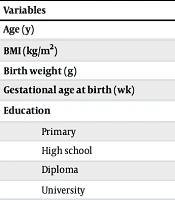
Data from all participants were analyzed, and no cases were excluded. No statistically significant differences were observed between the groups in participant demographic characteristics or newborn characteristics, including sex, gestational age at birth, and birth weight (Table 2).
Table 2.
Demographic Characteristics of Primiparous Women and Their Neonates in the Self-Care Training and Control Groups a
| Variables | Control | Self-Care Training | Test Statistics |
|---|---|---|---|
| Age (y) | 21.92 ± 5.68 [15 - 37] | 20.71 ± 5.17 [15 - 37] | t = -1.02; df = 82; P = 0.30 |
| BMI (kg/m2) | 22.58 ± 3.24 [18.50 - 31.04] | 21.74 ± 2.99 [17.20 - 27.30] | t = -1.23; df = 82; P = 0.22 |
| Birth weight (g) | 3107.38 ± 369.66 [2400 - 3800] | 3110.71 ± 335.78 [2600 - 3800] | t = 0.04; df = 82; P = 0.96 |
| Gestational age at birth (wk) | 38.52 ± 1.13 [37 - 40] | 38.04 ± 1.10 [37 - 40] | t = -1.95; df = 82; P = 0.054 |
| Education | χ2 = 6.58; df = 3; P = 0.08 | ||
| Primary | 6 (14.3) | 2 (4.8) | |
| High school | 16 (38.1) | 22 (52.4) | |
| Diploma | 11 (26.2) | 15 (35.7) | |
| University | 9 (21.4) | 3 (7.1) | |
| Residency | χ2 = 0.77; df = 1; P = 0.38 | ||
| Town | 25 (59.5) | 21 (50) | |
| Village | 17 (40.5) | 21 (50) | |
| Receiving information from social media | χ2 = 0.76; df = 1; P = 0.38 | ||
| Yes | 19 (45.2) | 23 (54.8) | |
| No | 23 (54.8) | 19 (45.2) | |
| Newborn sex | χ2 = 0.43; df = 1; P = 0.51 | ||
| Male | 19 (45.2) | 22 (52.4) | |
| Female | 23 (54.8) | 20 (47.6) |
a Values are expressed as mean ± SD [min - max] or No. (%). Abbreviations: BMI, Body Mass Index; SD, standard deviation.
Breastfeeding self-efficacy scores before, immediately after, and two weeks after the intervention are presented in Table 3. Mean baseline breastfeeding self-efficacy scores did not differ significantly between the groups (P = 0.575). However, significant between-group differences were observed immediately after the intervention and two weeks after the intervention (P = 0.008 and P < 0.001, respectively). Repeated-measures analysis of variance showed that breastfeeding self-efficacy scores increased significantly after the intervention compared with baseline (P < 0.001).
Table 3.
Mean Breastfeeding Self-Efficacy Scores Before, Immediately After, and 2 Weeks After the Intervention in the Intervention and Control Groups a
| Time | Control | Self-Care Training | Test Statistics |
|---|---|---|---|
| Baseline | 47.07 ± 5.65 | 46.40 ± 5.18 | t = -0.56 b; df = 82; P = 0.57 |
| Immediately after training | 59.47 ± 8.85 | 64.40 ± 7.65 | t = -2.73 b; df = 82; P = 0.008 |
| 2 weeks later | 57.04 ± 10.54 | 66.14 ± 7.46 | t = -4.56 b; df = 82; P < 0.001 |
| Effect of time | - | - | F = 126.56 c; P < 0.001 |
| Effect of group | - | - | F = 15.35 c; P < 0.001 |
| Time × group interaction | - | - | F = 10.08 c; P < 0.001 |
a Values are expressed as mean ± SD.
b Independent t test.
c Repeated-measures analysis of variance (ANOVA).
Repeated-measures analysis of variance indicated that measurement time had a significant effect on mean breastfeeding self-efficacy scores (P < 0.001). Scores increased significantly immediately after the intervention and two weeks later, compared with baseline. The group effect was also significant (P < 0.001) (Table 3). In addition, there was a significant time-by-group interaction, indicating that changes in mean breastfeeding self-efficacy scores over time differed by group. Overall, the study groups differed significantly in mean breastfeeding self-efficacy scores regardless of measurement time (Table 3).
In the between-group comparison, differences in mean self-efficacy scores between the intervention and control groups were statistically significant for two time intervals: T2-T1 (immediately after the intervention vs baseline) and T3-T2 (two weeks after the intervention vs immediately after the intervention) (Table 4). This indicates that self-efficacy in the intervention group increased significantly immediately after the intervention compared with baseline and also increased two weeks after the intervention compared with immediately after the intervention. The respective P values for these differences were P < 0.001 and P < 0.01. However, no significant difference was found in mean breastfeeding self-efficacy scores between the two groups when T3 was compared with T2 (P > 0.05) (Table 4).
Table 4.
Comparison of Mean Breastfeeding Self-Efficacy Scores Between the Intervention and Control Groups Over Different Time Intervals a
| Time Interval | Intervention b | Control b | Between-Group Test c | ||
|---|---|---|---|---|---|
| Mean Difference | P-Value | Mean Difference | P-Value | ||
| T2-T1 | 18 | < 0.001 | 12.41 | < 0.001 | t = 2.61; df = 82; P = 0.01 |
| T3-T1 | 19.74 | < 0.001 | 9.98 | < 0.001 | t = 4.26; df = 82; P < 0.001 |
| T3-T2 | 1.74 | 0.50 | -2.42 | 0.48 | t = 1.97; df = 82; P = 0.05 |
a T1, baseline; T2, immediately after intervention; T3, 2 weeks after intervention.
b Paired t-test.
c Independent t-test.
5. Discussion
This study evaluated the effectiveness of virtual self-care training on breastfeeding self-efficacy among primiparous Turkmen women during the postpartum period of the COVID-19 pandemic. Breastfeeding self-efficacy increased over time in both groups; however, the improvement was greater in the intervention group than in the control group. These findings are consistent with several previous studies. A study in Iran reported that online education can effectively improve breastfeeding self-efficacy among primiparous mothers (5). Research in Taiwan showed that online education for women in the third trimester of pregnancy enhanced maternal self-confidence during the postpartum period (20). A quasi-experimental study in Greece showed that a four-hour structured hospital-based educational class for pregnant women at 32 to 37 weeks of gestation significantly increased breastfeeding knowledge and improved attitudes toward breastfeeding (21). However, the findings of the present study differ from those of a Canadian study involving healthy first-time mothers at a tertiary care center in northwestern Ontario. That intervention comprised three postpartum self-efficacy sessions, two delivered in the hospital and one by telephone, and did not produce a significant increase in participants’ self-efficacy (22). This discrepancy may be related to the timing and delivery method of the intervention. In the present study, training was provided interactively three times per week over two weeks, whereas the Canadian study used fewer, more intensive sessions.
The intervention in the present study included more than self-care training; it also provided midwifery support and companionship during the first two weeks of breastfeeding and the postpartum period. The training included strategies for managing common postpartum challenges, potentially helping mothers better understand how to address these problems. These components may have promoted peace of mind, reduced anxiety, and increased confidence in breastfeeding. A pilot study showed that mindfulness training resulted in a statistically significant increase in breastfeeding self-efficacy (23). In addition, a randomized controlled trial in Turkey in 2022 found that breastfeeding support provided through video calls reduced maternal anxiety, increased breastfeeding self-efficacy, and improved newborn outcomes (24). The timing of the intervention during the postpartum period may also have contributed to its effectiveness, as this is a period when women encounter breastfeeding challenges and often seek support and education. A meta-analysis found that interventions to improve breastfeeding self-efficacy were most effective when they focused on educational content, were implemented in hospital and community settings, and occurred during the postpartum period (25). A key strength of this study is its focus on a specific ethnic and cultural group of women that has been underrepresented in previous research.
5.1. Limitations
One limitation of this study was the use of online questionnaires, which restricted participation to women who were familiar with and able to use the internet and mobile phone technology. Technical limitations in internet and technology access in underserved areas further restricted participation to women with access to these resources. In addition, the effects of the pandemic may have introduced multiple intervening variables that should be considered when interpreting the findings. Other limitations include the quasi-experimental design rather than a randomized controlled design and the assessment of a specific population. The frequency of exclusive breastfeeding at 2, 4, and 6 months after birth was not compared between the groups and should be evaluated in future research.
5.2. Conclusions
The findings indicate that breastfeeding self-efficacy among primiparous women increased significantly following virtual self-care training in the early postpartum period. Virtual education addressing breastfeeding self-efficacy, self-care, infant care, and breastfeeding may serve as an effective supplement to in-person education and counseling at health centers, particularly during critical periods such as pandemics. Postpartum breastfeeding and self-care educational programs should therefore be made available to postpartum women, including through dedicated virtual programs.