
1. Background
In recent years, smartphones have become integral to communication, information access, learning, and everyday activities (1). Although these functions provide substantial benefits, excessive or poorly controlled smartphone use has been associated with psychological, social, and functional difficulties (2). Such use may involve impaired control despite awareness of negative consequences and may resemble features observed in other behavioral addictions (3). Because the terminology and classification of problematic smartphone use remain under discussion, this study uses “Smartphone Use Disorder” and “Smartphone Addiction” interchangeably to reflect the terminology commonly used in the literature.
Previous studies have reported associations between problematic smartphone use and anxiety, poor sleep quality, reduced concentration, communication difficulties, and lower academic functioning (4). These concerns may be particularly relevant among nursing and midwifery students because clinical education requires sustained attention, precision, timely decision-making, and continuous interaction with patients (5). Smartphone use during clinical care has also been associated with distraction and interruptions that may interfere with professional activities and potentially create patient-safety concerns (6). However, patient-safety outcomes were not directly assessed in this study; therefore, the findings should not be interpreted as demonstrating a causal relationship between smartphone use and patient-safety events.
The Smartphone Addiction Scale (SAS), developed by Kwon et al. (7), assesses smartphone-related dependency across six dimensions: Daily Life Disturbance, Positive Anticipation, Withdrawal, Cyberspace-oriented Relationship, Overuse, and Tolerance. The present study used the full 33-item SAS rather than the 10-item short version (SAS-SV) to preserve the original six-dimensional structure and provide detailed subscale information. The full instrument may therefore offer a more comprehensive description of problematic smartphone use when the purpose is psychometric evaluation and multidimensional assessment. In contrast, the SAS-SV is more appropriate when brevity and rapid administration are primary considerations (8). Previous validation studies have also shown that the psychometric structure of smartphone-addiction measures may vary across populations and cultural settings (8-10). For nursing and midwifery students receiving clinical education, the multidimensional information provided by the full SAS was considered especially relevant because problematic smartphone use may be expressed through different combinations of withdrawal, tolerance, overuse, online-related behavior, and disruption of daily functioning.
Accurate identification of problematic smartphone use is an important prerequisite for research, screening, and preventive planning (11). Although several instruments assess internet or general technology addiction, smartphone-specific measures may provide more behaviorally focused information (12). Using a validated smartphone-specific instrument is therefore relevant in populations whose academic activities partly occur in clinical environments (13).
Despite increasing international research, psychometric evidence regarding smartphone-addiction measures in Iranian clinical-education populations remains limited. Existing Persian studies have primarily included general student or adolescent samples and have examined either the full SAS or SAS-SV using different psychometric approaches (8). A dedicated evaluation among nursing and midwifery students is warranted because clinical education involves specific demands, including patient interaction, time pressure, professional responsibilities, and sustained attention, which may influence the expression and measurement of problematic smartphone use.
The SAS was originally developed based on behavioral and cognitive aspects of smartphone dependency and demonstrated strong psychometric properties (7). Subsequent studies have emphasized the importance of examining problematic smartphone use among health-science and university students using theoretically grounded models (14-17). However, many studies have relied primarily on exploratory analyses, and fewer have evaluated factor-structure stability using separate exploratory and confirmatory samples.
2. Objectives
Accordingly, this study aimed to comprehensively evaluate the psychometric properties of the Persian SAS among nursing and midwifery students receiving clinical education. Specifically, complementary psychometric procedures were used to examine content validity, concurrent validity, factor structure, internal consistency, split-half reliability, and test–retest reliability.
3. Methods
This psychometric study evaluated the validity and reliability of the SAS among nursing and midwifery students at teaching hospitals affiliated with universities in Kerman Province, Iran. The study was conducted in accordance with the Declaration of Helsinki and approved by the Ethics Committee of Kerman University of Medical Sciences (IR.KMU.REC.1404.315; approved September 13, 2025).
Because the survey was anonymous, online, and considered minimal risk, informed consent was obtained electronically. Participants first received an information sheet describing the study purpose, the voluntary nature of participation, confidentiality, and their right to withdraw at any time. After reading the information sheet, participants provided electronic informed consent by selecting the “agree to participate” option. No identifying information was collected.
3.1. Translation and Cultural Adaptation Process
A nine-member translation and cultural-adaptation panel was established specifically to translate the questionnaire and perform linguistic and cultural adaptation. This panel was distinct from the subsequent content-validity panel. It comprised four psychologists (three women and one man, all holding doctoral degrees and working as assistant professors), one psychometrician (a woman with a doctoral degree working as an assistant professor), three nursing faculty members (all women with doctoral degrees working as assistant professors), and one midwifery faculty member (a woman with a doctoral degree working as an assistant professor).
The role of this nine-member panel was limited to translation, conceptual equivalence, linguistic review, and cultural adaptation; its members were not responsible for the formal assessment of the content validity ratio (CVR) and Content Validity Index (CVI). Two translators independently translated the questionnaire into Persian; one was familiar with its medical content, whereas the other was not. Their translations were compared, reconciled, and edited to produce a preliminary Persian version. Two independent translators, blinded to the original English version, subsequently back-translated the Persian version into English to assess conceptual equivalence.
The preliminary Persian version was administered to 30 students to evaluate clarity, comprehensibility, and cultural appropriateness. Based on participant feedback, minor wording revisions were made to five items. Specifically, colloquial expressions were replaced with standard Persian equivalents, and two items with potentially ambiguous wording were rephrased without changing their intended meaning (18).
3.2. Target Population and Data Collection
The target population consisted of nursing and midwifery students enrolled in clinical education during the spring semester of 2025 (March 21 to June 20, 2025) at teaching hospitals affiliated with universities in Kerman Province. Data collection was conducted from September 22 to October 7, 2025, after completion of the translation and pilot-testing stages. The survey was administered to students in the defined clinical-education population who remained enrolled in relevant clinical courses.
A multistage cluster-sampling procedure was used. Of the eight nursing and midwifery faculties/schools in Kerman Province—Kerman University of Medical Sciences, Rafsanjan University of Medical Sciences, Jiroft University of Medical Sciences, Bam University of Medical Sciences, Sirjan School of Nursing, Zarand School of Nursing, Kahnuj School of Nursing, and Shahr-e-Babak School of Nursing—six were randomly selected as primary clusters using a random-number generator, with selection probability proportional to faculty size.
Within each selected faculty/school, lists of eligible students were prepared and stratified by academic year and discipline (nursing vs. midwifery). Participants were then selected by simple random sampling. This procedure was intended to capture variation in geographic location, faculty size and resources, academic stage, and academic discipline.
The questionnaire link was distributed electronically to the selected students. Participants were excluded if they reported a current or previous diagnosis of a severe psychiatric disorder, including schizophrenia, bipolar I disorder, or severe major depressive disorder requiring hospitalization; a major chronic medical condition requiring ongoing specialty care; or substance dependence other than tobacco. At the beginning of the survey, participants answered the following screening question: “Do you currently have or have you ever been diagnosed with any of the following conditions?” A checklist included the specified psychiatric disorders, chronic medical conditions, and substance dependence. Students who endorsed an exclusion criterion were screened out automatically. This self-report approach was considered appropriate for an anonymous, minimal-risk online survey because verification through clinical records would have required access to protected health information and introduced additional ethical and logistical requirements. Students who were unwilling to participate or returned incomplete questionnaires were excluded from the final analysis.
A total of 900 students were initially selected and invited according to the prespecified sampling plan. Participation was voluntary, and some invited students did not provide complete, usable responses. Consequently, the final analytic sample was smaller than the originally planned sample.
3.3. Sample Size
Sample-size planning was based on commonly used recommendations for psychometric studies and the requirements of the planned analyses (19). A total of 900 students were initially targeted and invited to participate. The planned allocation consisted of 400 participants for exploratory factor analysis (EFA), 300 for confirmatory factor analysis (CFA), 100 for concurrent-validity analysis, and 100 for reliability assessment.
During data collection, 33 questionnaires did not yield complete, usable responses and were therefore excluded from the final analysis. Thus, the final analytic sample consisted of 867 participants, representing 96.3% of the originally targeted sample.
The subsamples used in the final analysis were smaller than planned because of nonparticipation or incomplete responses: EFA = 382, CFA = 295, concurrent validity = 93, and reliability = 97. These four nonoverlapping subsamples accounted for all 867 participants (382 + 295 + 93 + 97 = 867). Confirmatory factor analysis was conducted in a random subsample of 295 participants. The other complete cases were assigned to the EFA, concurrent-validity, and reliability subsamples according to the prespecified analysis plan. The complete final sample (n = 867) was used for descriptive analyses. All internal-consistency and split-half estimates were calculated in the reliability subsample (n = 97).
3.4. Research Instruments
3.4.1. Smartphone Addiction Scale
The SAS, developed by Kwon et al. (7), is a 33-item self-report instrument designed to assess smartphone addiction across six dimensions: Daily Life Disturbance, Positive Anticipation, Withdrawal, Cyberspace-oriented Relationship, Overuse, and Tolerance. The full 33-item version was selected instead of the 10-item SAS-SV to preserve the original six-factor structure and provide more detailed subscale information.
Items are rated on a six-point Likert scale ranging from 1 (strongly disagree) to 6 (strongly agree). Total scores range from 33 to 198, with higher scores indicating greater problematic smartphone use. In the original validation study, the SAS demonstrated high internal consistency (Cronbach’s α = 0.967) and strong sampling adequacy (Kaiser–Meyer–Olkin [KMO] statistic = 0.936) (7). Permission to translate, culturally adapt, and use the SAS in Persian was obtained from the original developers via email correspondence.
The factor labels in the present study were retained exactly as in the original SAS development study: Daily Life Disturbance (Factor 1), Positive Anticipation (Factor 2), Withdrawal (Factor 3), Cyberspace-oriented Relationship (Factor 4), Overuse (Factor 5), and Tolerance (Factor 6).
3.4.2. Chen Internet Addiction Scale
The Chen Internet Addiction Scale (CIAS) was used as the concurrent-validity criterion because it is an established measure of problematic internet use that has been evaluated in Iranian populations (20). The CIAS was not considered a clinical gold standard; rather, it was used as a theoretically related criterion measure. Smartphone and internet addiction share several behavioral and cognitive characteristics, although they represent related but distinct constructs.
The CIAS consists of 26 items across five dimensions: lack of control, withdrawal, tolerance, interpersonal/health problems, and time management. Items are rated on a four-point Likert scale, with total scores ranging from 26 to 104; higher scores indicate greater internet-addiction severity. The original study reported Cronbach’s alpha values ranging from 0.79 to 0.93. An Iranian study reported an overall alpha of 0.93 and a correlation of r = 0.85 with Young’s Internet Addiction Test (20). In the present study, the Cronbach’s alpha coefficient for the CIAS was 0.91.
3.5. Statistical Analysis
Data were analyzed using SPSS version 24 and LISREL version 8.8. Of the 900 students initially targeted and invited, 33 questionnaires (3.7%) were excluded because they were incomplete or did not provide sufficient usable responses, leaving 867 participants for the final analysis.
Descriptive statistics were used to summarize demographic characteristics and study variables.
The formal content-validity assessment was conducted by a separate 10-member expert panel. The panel consisted of eight psychologists (six women and two men, all holding doctoral degrees and university faculty positions, including seven assistant professors and one associate professor) and two psychometricians (both women with doctoral degrees working as assistant professors). The nursing and midwifery faculty members belonged to the separate nine-member translation and cultural-adaptation panel described in Section 3.1 and were not members of the formal content-validity panel.
The content-validity panel evaluated item necessity, relevance, clarity, and simplicity. The CVR was calculated using Lawshe’s method, with a cutoff of 0.62, and the CVI was evaluated using a cutoff of 0.79 (18).
Concurrent validity was examined using Pearson’s correlation between the SAS and CIAS total scores.
Construct validity was assessed using EFA and CFA. Exploratory factor analysis was performed in the final subsample of 382 participants, whereas CFA was conducted in a separate final subsample of 295 participants. The KMO statistic was used to assess sampling adequacy, with values > 0.60 considered acceptable, and Bartlett’s test of sphericity was used to assess factorability (P < 0.05) (18). Latent factors were extracted using principal axis factoring (PAF) with Varimax rotation. Factor loadings ≥ 0.50 were considered acceptable. Secondary loadings below 0.30 were used to evaluate potential cross-loadings.
For CFA, model fit was evaluated using χ2, the root mean square error of approximation (RMSEA), Comparative Fit Index (CFI), Non-normed Fit Index (NNFI), also known as the Tucker–Lewis Index (TLI), Normed Fit Index (NFI), Incremental Fit Index (IFI), Relative Fit Index (RFI), standardized root mean square residual (SRMR), Goodness-of-Fit Index (GFI), adjusted Goodness-of-Fit Index (AGFI), and Parsimony Normed Fit Index (PNFI). Values of RMSEA < 0.08, CFI/NNFI/NFI/IFI/RFI > 0.90, and SRMR < 0.08 were considered indicative of acceptable model fit. Greater interpretive weight was given to RMSEA, CFI, NNFI, and SRMR, whereas GFI and AGFI were considered supplementary indices because of their sensitivity to sample size and model complexity (21).
Reliability was assessed using Cronbach’s alpha and the split-half method. All internal-consistency and split-half analyses were performed in the final subsample of 97 participants. Two-week test–retest reliability was also assessed in this subsample. A correlation coefficient of ≥ 0.70 was considered acceptable (13). Statistical significance was set at P < 0.05.
4. Results
A total of 900 students were initially targeted and invited to participate. Thirty-three questionnaires (3.7%) were excluded because they did not provide complete, usable responses, resulting in a final analytic sample of 867 participants and a usable-data rate of 96.3%. The final sample comprised four nonoverlapping analysis subsamples: 382 participants for EFA, 295 for CFA, 93 for concurrent validity, and 97 for reliability. These subsamples summed exactly to 867 participants.
Participants were predominantly aged 20 - 25 years (46.6%), female (61.4%), single (73.5%), and nursing students (70.8%). Most participants lived in dormitories (59.5%). Regarding academic stage, 39.1% were in preclinical semesters (2nd - 4th), whereas 60.9% were in clinical semesters (5th - 8th) (Table 1).
Table 1.
Demographic Characteristics of Participants by Analysis Subsample a
| Variables | Concurrent-Validity Subsample, n = 93 | Exploratory Factor Analysis Subsample, n = 382 | Confirmatory Factor Analysis Subsample, n = 295 | Reliability Subsample, n = 97 | Total Sample, n = 867 |
|---|---|---|---|---|---|
| Age (y) | |||||
| < 20 | 38 (40.9) | 135 (35.3) | 98 (33.2) | 25 (25.8) | 296 (34.1) |
| 20 - 25 | 40 (43.0) | 170 (44.5) | 138 (46.8) | 56 (57.7) | 404 (46.6) |
| > 25 | 15 (16.1) | 77 (20.2) | 59 (20.0) | 16 (16.5) | 167 (19.3) |
| Gender | |||||
| Female | 52 (55.9) | 233 (61.0) | 183 (62.0) | 64 (66.0) | 532 (61.4) |
| Male | 41 (44.1) | 149 (39.0) | 112 (38.0) | 33 (34.0) | 335 (38.6) |
| Marital status | |||||
| Single | 61 (65.6) | 281 (73.6) | 215 (72.9) | 80 (82.5) | 637 (73.5) |
| Married | 32 (34.4) | 101 (26.4) | 80 (27.1) | 17 (17.5) | 230 (26.5) |
| Academic group | |||||
| Nursing | 72 (77.4) | 270 (70.7) | 198 (67.1) | 74 (76.3) | 614 (70.8) |
| Midwifery | 21 (22.6) | 112 (29.3) | 97 (32.9) | 23 (23.7) | 253 (29.2) |
| Residential status | |||||
| Non-dormitory | 35 (37.6) | 157 (41.1) | 122 (41.4) | 37 (38.1) | 351 (40.5) |
| Dormitory | 58 (62.4) | 225 (58.9) | 173 (58.6) | 60 (61.9) | 516 (59.5) |
| Academic stage | |||||
| Preclinical (2nd – 4th semesters) | 31 (33.3) | 169 (44.2) | 102 (34.6) | 37 (38.1) | 339 (39.1) |
| Clinical (5th – 8th semesters) | 62 (66.7) | 213 (55.8) | 193 (65.4) | 60 (61.9) | 528 (60.9) |
a Values are expressed as No. (%). A total of 900 students were initially targeted and invited. Thirty-three questionnaires did not provide complete usable responses and were excluded, resulting in a final analytic sample of 867 participants. The final non-overlapping analysis subsamples comprised 382 participants for EFA, 295 for CFA, 93 for concurrent validity, and 97 for reliability (382 + 295 + 93 + 97 = 867). Abbreviations: EFA, exploratory factor analysis; CFA, confirmatory factor analysis.
The demographic characteristics reported in Table 1 correspond to the final analyzed subsamples rather than the originally planned allocation.
Content validity of the Persian SAS was supported by the formal 10-member content-validity panel. CVR values ranged from 0.80 to 1.00, whereas CVI values ranged from 0.80 to 0.97 (Table 2), indicating satisfactory expert agreement regarding item necessity, relevance, clarity, and simplicity.
Table 2.
Rotated Factor Matrix and Content Validity Indices a
| Item | Positive Anticipation | Withdrawal | Daily Life Disturbance | Cyberspace-Oriented Relationship | Overuse | Tolerance | CVR | CVI |
|---|---|---|---|---|---|---|---|---|
| i1 | 0.14 | 0.19 | 0.70 b | 0.14 | 0.09 | 0.11 | 0.80 | 0.93 |
| i2 | 0.12 | 0.18 | 0.72 b | 0.13 | 0.15 | 0.05 | 0.80 | 0.90 |
| i3 | 0.12 | 0.16 | 0.68 b | 0.17 | 0.11 | 0.09 | 1.00 | 0.83 |
| i4 | 0.11 | 0.16 | 0.74 b | 0.14 | 0.06 | 0.04 | 1.00 | 0.83 |
| i5 | 0.05 | 0.18 | 0.73 b | 0.11 | 0.09 | 0.14 | 1.00 | 0.90 |
| i6 | 0.74 b | 0.11 | 0.07 | 0.11 | 0.09 | 0.07 | 1.00 | 0.93 |
| i7 | 0.73 b | 0.06 | 0.09 | 0.12 | 0.16 | 0.09 | 1.00 | 0.83 |
| i8 | 0.73 b | 0.13 | 0.14 | 0.16 | 0.08 | 0.06 | 0.80 | 0.90 |
| i9 | 0.75 b | 0.09 | 0.14 | 0.07 | 0.05 | 0.13 | 0.80 | 0.93 |
| i10 | 0.75 b | 0.06 | 0.05 | 0.05 | 0.11 | 0.07 | 1.00 | 0.87 |
| i11 | 0.80 b | 0.06 | 0.10 | 0.06 | 0.10 | 0.01 | 1.00 | 0.90 |
| i12 | 0.75 b | 0.10 | 0.05 | 0.09 | 0.07 | 0.10 | 1.00 | 0.93 |
| i13 | 0.75 b | 0.09 | 0.03 | 0.10 | 0.14 | 0.06 | 0.80 | 0.80 |
| i14 | 0.10 | 0.12 | 0.07 | 0.74 b | 0.03 | 0.09 | 0.80 | 0.83 |
| i15 | 0.16 | 0.03 | 0.13 | 0.75 b | 0.07 | 0.15 | 0.80 | 0.97 |
| i16 | 0.07 | 0.13 | 0.14 | 0.72 b | 0.04 | 0.02 | 0.80 | 0.87 |
| i17 | 0.15 | 0.08 | 0.09 | 0.74 b | 0.06 | 0.02 | 1.00 | 0.87 |
| i18 | 0.13 | 0.13 | 0.25 | 0.67 b | 0.09 | 0.04 | 0.80 | 0.90 |
| i19 | 0.07 | 0.73 b | 0.11 | 0.04 | 0.09 | 0.05 | 1.00 | 0.90 |
| i20 | 0.06 | 0.78 b | 0.10 | 0.04 | 0.09 | 0.10 | 0.80 | 0.90 |
| i21 | 0.11 | 0.74 b | 0.13 | 0.02 | 0.09 | 0.09 | 1.00 | 0.90 |
| i22 | 0.09 | 0.76 b | 0.12 | 0.10 | 0.06 | 0.09 | 1.00 | 0.97 |
| i23 | 0.09 | 0.70 b | 0.17 | 0.14 | 0.05 | 0.00 | 0.80 | 0.90 |
| i24 | 0.09 | 0.72 b | 0.12 | 0.04 | 0.16 | 0.14 | 0.80 | 0.83 |
| i25 | 0.05 | 0.72 b | 0.11 | 0.10 | 0.03 | 0.14 | 1.00 | 0.97 |
| i26 | 0.14 | 0.71 b | 0.12 | 0.14 | 0.10 | -0.05 | 1.00 | 0.87 |
| i27 | 0.12 | 0.15 | 0.09 | 0.04 | 0.76 b | 0.09 | 1.00 | 0.90 |
| i28 | 0.17 | 0.16 | 0.13 | 0.10 | 0.73 b | 0.04 | 0.80 | 0.90 |
| i29 | 0.13 | 0.11 | 0.13 | 0.12 | 0.75 b | 0.04 | 1.00 | 0.97 |
| i30 | 0.19 | 0.10 | 0.07 | 0.02 | 0.72 b | 0.07 | 1.00 | 0.83 |
| i31 | 0.08 | 0.20 | 0.13 | 0.08 | 0.08 | 0.66 b | 1.00 | 0.90 |
| i32 | 0.14 | 0.14 | 0.10 | 0.09 | 0.05 | 0.72 b | 1.00 | 0.83 |
| i33 | 0.21 | 0.05 | 0.11 | 0.09 | 0.09 | 0.73 b | 1.00 | 0.93 |
a Factor labels correspond exactly to the original SAS development study by Kwon et al. (7). Abbreviations: SAS, Smartphone Addiction Scale; CVR, content validity ratio; CVI, Content Validity Index.
b Factor loadings ≥ 0.40.
Concurrent validity showed a strong positive correlation between total scores on the SAS and CIAS (r = 0.73, 95% CI, 0.61 - 0.81, P < 0.01), supporting the expected association between smartphone-specific problematic use and broader internet-related addictive behavior.
Exploratory factor analysis was conducted using PAF with Varimax rotation. The KMO value was 0.908, and Bartlett’s test of sphericity was significant (χ2 = 7002.737, df = 528, P < 0.001), indicating that the data were suitable for factor analysis (Table 3). Communalities ranged from 0.506 to 0.635. Six factors were extracted, cumulatively explaining 59.265% of the total variance.
Table 3.
Kaiser–Meyer–Olkin Statistic and Bartlett’s Test
| Statistic | Value |
|---|---|
| Kaiser–Meyer–Olkin measure of sampling adequacy | 0.908 |
| Bartlett’s test of sphericity | |
| Approximate chi-square | 7002.737 |
| df | 528 |
| P-value | < 0.001 |
The variance explained by each factor was as follows: Withdrawal = 14.778%, Positive Anticipation = 14.224%, Daily Life Disturbance = 8.925%, Cyberspace-oriented Relationship = 8.847%, Overuse = 7.369%, and Tolerance = 5.122%. Factor loadings ranged from 0.656 to 0.798. No item had a secondary loading ≥ 0.30, and every item showed its highest loading on the intended factor, supporting a clear simple structure. The six-factor labels corresponded to those in the original SAS development study by Kwon et al. (7) (Table 2).
Confirmatory factor analysis of the six-factor model yielded the following fit indices: χ2 = 677.80 (df = 480, P < 0.001), RMSEA = 0.037 (90% CI, 0.031 - 0.044), CFI = 0.987, NFI = 0.964, NNFI = 0.986, IFI = 0.987, RFI = 0.961, GFI = 0.877, AGFI = 0.857, SRMR = 0.037, and PNFI = 0.877 (Figure 1). Standardized factor loadings ranged from 0.689 to 0.843, and all were statistically significant (P < 0.001).
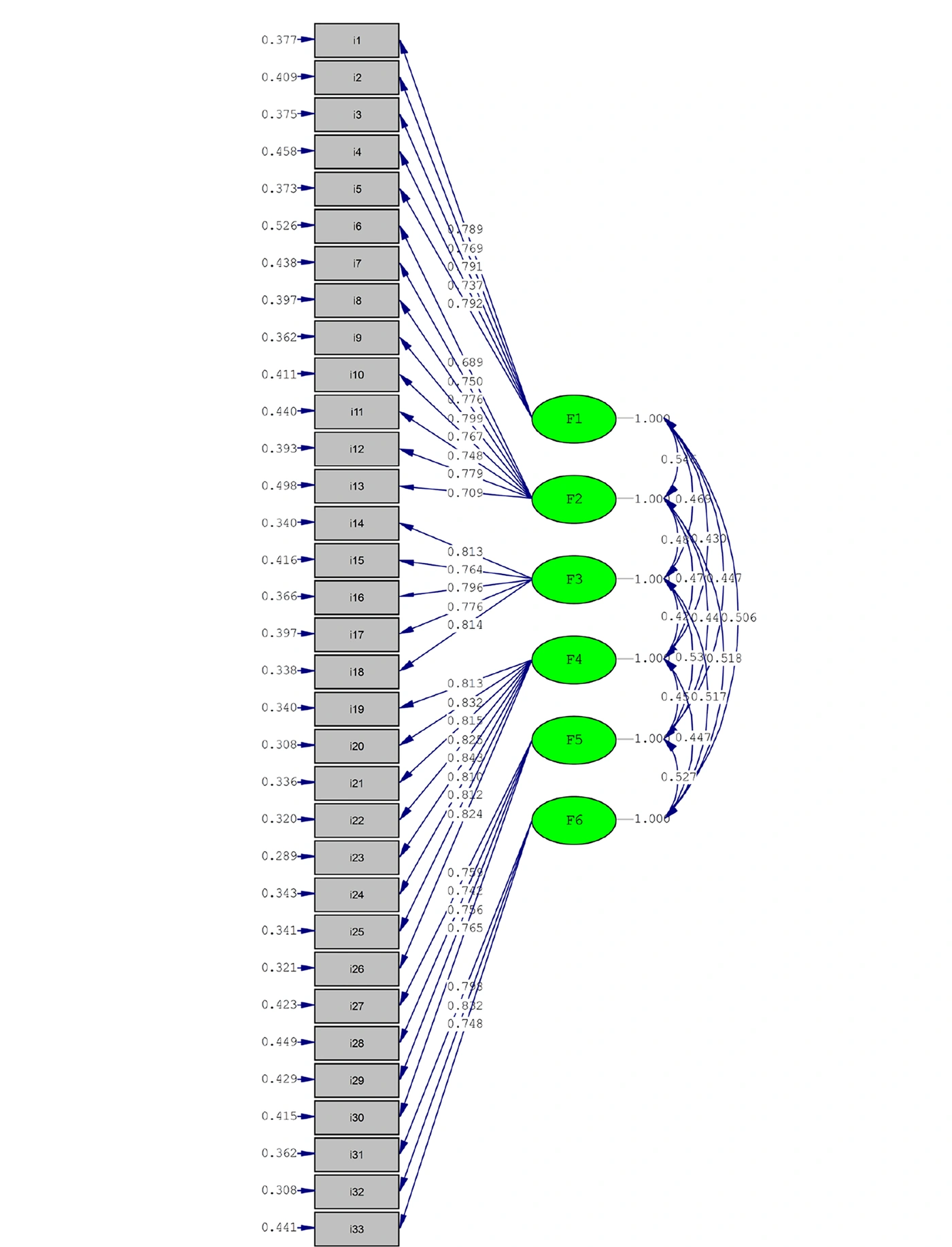
Figure 1.
Confirmatory factor analysis path diagram of the six-factor model of the Persian Smartphone Addiction Scale (SAS).
Standardized factor loadings from latent factors to observed items are shown on the single-headed arrows, and all loadings were statistically significant (P < 0.001). The model fit indices were as follows: χ2 = 677.80 (df = 480), RMSEA = 0.037 (90% CI, 0.031 - 0.044), CFI = 0.987, NFI = 0.964, NNFI = 0.986, IFI = 0.987, RFI = 0.961, GFI = 0.877, AGFI = 0.857, and SRMR = 0.037.
Abbreviations: df, degrees of freedom; RMSEA, root mean square error of approximation; CI, confidence interval; CFI, comparative fit index; NFI, normed fit index; NNFI, non-normed fit index; IFI, incremental fit index; RFI, relative fit index; GFI, goodness-of-fit index; AGFI, adjusted goodness-of-fit index; SRMR, standardized root mean square residual.
Although GFI = 0.877 and AGFI = 0.857 were below the conventional 0.90 threshold, the model showed strong fit according to RMSEA, CFI, NNFI, and SRMR. Given the complexity of the six-factor, 33-item model, GFI and AGFI were interpreted as supplementary rather than decisive indices.
In the reliability subsample (n = 97), Cronbach’s alpha for the total scale was 0.929. Subscale alpha coefficients ranged from 0.843 to 0.925. Specifically, the coefficients were 0.877 for Daily Life Disturbance, 0.925 for Positive Anticipation, 0.890 for Withdrawal, 0.904 for Cyberspace-oriented Relationship, 0.843 for Overuse, and 0.854 for Tolerance.
The split-half reliability coefficient was 0.618. However, the Spearman–Brown corrected coefficient was 0.764, and the Guttman split-half coefficient was 0.762; both exceeded the predefined threshold of 0.70. The lower uncorrected correlation may reflect the multidimensional structure of the SAS, because the two halves may contain items representing different but related dimensions.
Two-week test–retest reliability was assessed in the 97-participant reliability subsample. Forty-nine participants (50.5%) completed the second administration, yielding a test–retest correlation of r = 0.89 (P < 0.01), indicating strong temporal stability.
5. Discussion
This study evaluated the psychometric properties of the Persian SAS among nursing and midwifery students receiving clinical education. The results supported satisfactory content validity, concurrent validity, construct validity, internal consistency, split-half reliability, and temporal stability. EFA identified six factors corresponding to the original SAS structure, and CFA provided additional support for this factor structure in a separate subsample.
The study distinguished between the two expert panels. The nine-member translation and cultural-adaptation panel included psychologists, a psychometrician, nursing faculty members, and a midwifery faculty member and was responsible for linguistic and cultural adaptation. Formal content-validity assessment was subsequently conducted by a separate 10-member panel consisting of eight psychologists and two psychometricians. Thus, the nursing and midwifery faculty members involved in translation were not part of the formal CVR/CVI assessment.
The six-factor structure identified in this study corresponded to the original SAS framework developed by Kwon et al. (7), comprising Daily Life Disturbance, Positive Anticipation, Withdrawal, Cyberspace-oriented Relationship, Overuse, and Tolerance. Replication of these dimensions suggests that the Persian translation retained the main conceptual organization of the original instrument.
The CVR and CVI findings demonstrated substantial agreement among content-validity experts regarding item necessity, relevance, clarity, and simplicity. These findings support the adequacy of the translation and cultural-adaptation procedures and are consistent with previous Persian validations of smartphone-addiction instruments (8).
Concurrent validity was supported by a strong positive association between SAS and CIAS scores. This relationship was theoretically expected because the two instruments assess related aspects of problematic technology use. Nevertheless, the CIAS measures internet addiction more broadly, whereas the SAS specifically addresses smartphone-related symptoms. Therefore, the observed correlation should be interpreted as evidence of concurrent validity rather than as evidence that the two instruments assess identical constructs.
The EFA results demonstrated adequate sampling conditions and yielded six interpretable factors that accounted for 59.265% of the total variance. The absence of substantial secondary loadings supported a relatively clear simple structure. Confirmatory factor analysis conducted in a separate sample provided additional evidence for the stability of the six-factor model.
The CFA indices showed a low RMSEA, high CFI and NNFI, and low SRMR. GFI and AGFI were below 0.90, but these indices were interpreted as supplementary because they may be sensitive to sample size and model complexity. The overall interpretation was therefore based on the pattern of multiple complementary fit indices rather than on any single cutoff value.
The reliability findings were also satisfactory. The total-scale Cronbach’s alpha of 0.929 and subscale coefficients ranging from 0.843 to 0.925 indicate strong internal consistency. The uncorrected split-half correlation was lower, but both corrected split-half estimates exceeded 0.70. Because the SAS represents six related dimensions, lower agreement between arbitrary halves of the instrument does not necessarily imply inadequate reliability. The two-week test–retest coefficient of 0.89 further supported temporal stability.
The present findings are broadly consistent with the original SAS validation and subsequent Persian and international investigations (7-10, 22). Duke and Montag (22) reported associations between smartphone addiction, daily interruptions, and self-reported productivity, which are conceptually relevant to the Daily Life Disturbance and Overuse dimensions. Persian and international studies have also reported satisfactory psychometric properties for the SAS and SAS-SV across different populations (8-10). However, direct cross-cultural comparisons should be made cautiously because measurement invariance was not evaluated in the present study.
The findings may have practical relevance for nursing and midwifery education. Problematic smartphone use during clinical education may coincide with distraction, divided attention, or difficulty managing smartphone use alongside professional responsibilities. Nevertheless, the present study did not assess medication errors, delayed responses, adverse events, or other direct patient-safety outcomes. Therefore, high SAS scores should not be interpreted as evidence that smartphone addiction causes patient-safety incidents. Instead, the SAS may be useful for identifying students whose smartphone-use patterns merit additional assessment and supportive preventive strategies.
Several limitations should be acknowledged. First, students with severe psychiatric disorders, major chronic medical conditions, or substance dependence were excluded, which may have produced a relatively healthier sample and limited applicability to clinically vulnerable groups. Second, measurement invariance across sex, discipline, and academic stage was not examined; therefore, subgroup comparisons should be interpreted cautiously. Future research should test measurement invariance before drawing substantive conclusions from between-group comparisons. Third, the sample was restricted to nursing and midwifery students receiving clinical education in Kerman Province, limiting generalizability to other populations, health professions, or regions. Fourth, although translation and cultural adaptation were systematically conducted, differential item functioning (DIF) across cultures was not evaluated. Future qualitative studies and DIF analyses may provide additional evidence. Fifth, the cross-sectional, self-report design limits causal interpretation. Finally, no second-order or bifactor model was tested.
From a practical perspective, the Persian SAS may facilitate early screening and research on problematic smartphone use in nursing and midwifery education. High scores should be interpreted as indicators of potential functional difficulties rather than as a clinical diagnosis or a basis for disciplinary action. Depending on institutional policies and individual circumstances, the findings may inform supportive interventions, such as digital-professionalism education, time-management training, counseling, and guidance regarding smartphone use during clinically sensitive activities.
5.1. Conclusions
The Persian SAS demonstrated satisfactory validity and reliability among nursing and midwifery students receiving clinical education in Kerman Province. The six-factor structure was supported by both exploratory and confirmatory analyses, and the scale showed high internal consistency and strong temporal stability.
These findings support the use of the Persian SAS as a multidimensional research and screening instrument for problematic smartphone use in this specific population, rather than solely as a measure of smartphone-use frequency. The instrument may help educational researchers and student-support services identify patterns of problematic smartphone use that warrant further assessment and preventive support.
In clinical education, where sustained attention and professional conduct are important, a validated instrument may contribute to the development of evidence-informed educational guidance. However, the SAS should be used as a screening and research measure, not as a standalone diagnostic instrument.
Future research should examine measurement invariance across sex, discipline, and academic stage; incorporate objective indicators of smartphone use; and use longitudinal or intervention-based designs to evaluate changes over time. Additional psychometric studies in diverse Persian-speaking populations are also recommended.