Prediction of Cocrystal Formation Between Drug and Coformer by Simple Structural Parameters
Authors
Abstract
Background: Cocrystal formation between an active pharmaceutical ingredient (API) and coformer is an applicable technique to change the physicochemical and pharmacokinetic properties. Computational methods can overcome the need for extensive experiments and improve the chances of success in the coformer selection. In this method, two compounds connect by non-covalent interactions that form a unique crystalline structure. Prediction of a cocrystal formation between API and coformer can help in the screening and design of new cocrystals.
Methods: In this study, available data in the literature were applied to develop a prediction method based on binary logistic regression to screen cocrystal formation by sum and absolute difference of structural parameters (the number of rotatable bonds, Abraham solvation parameters, and topological polar surface area) of the two involved compounds.
Results: The results showed various factors (eight structural parameters of the two compounds) could affect cocrystal formation, and the developed model can predict cocrystallization with a probability of about 90%.
Conclusion: The related parameter to hydrogen bonding basicity and volume of compounds has the most significant effect on cocrystal formation.
Highlights
Copyright
© 2022, Author(s). This open-access article is available under the Creative Commons Attribution 4.0 (CC BY 4.0) International License (https://creativecommons.org/licenses/by/4.0/), which allows for unrestricted use, distribution, and reproduction in any medium, provided that the original work is properly cited.
Similar Articles
Cocrystallization: An Innovative Route toward Better Medication
Dutt B, Choudhary M, Budhwar V. Cocrystallization: An Innovative Route toward Better Medication. J Rep Pharm Sci. 2020;9(2):e147121. doi: https://doi.org/10.4103/jrptps.JRPTPS_103_19
Response Surface Study on Molecular Docking Simulations of Citalopram and Donepezil as Potent CNS Drugs
Alikhani R, Ebadi A, Karami P, Shahbipour S, Razzaghi-Asl N. Response Surface Study on Molecular Docking Simulations of Citalopram and Donepezil as Potent CNS Drugs. Iran J Pharm Res. 2021;20(3):e124300. doi: https://doi.org/10.22037/ijpr.2020.113644.14409
A Computational Study of Some Benzenesulfonamide Derivatives as HIV- 1 Protease Enzyme Inhibitors: Three-Dimensional Quantitative Structure-Activity Relationship and Molecular Docking
Abdizade R, Abdizadeh T. A Computational Study of Some Benzenesulfonamide Derivatives as HIV- 1 Protease Enzyme Inhibitors: Three-Dimensional Quantitative Structure-Activity Relationship and Molecular Docking. Koomesh. 2025;27(6):e159682. doi: https://doi.org/10.69107/koomesh-159682
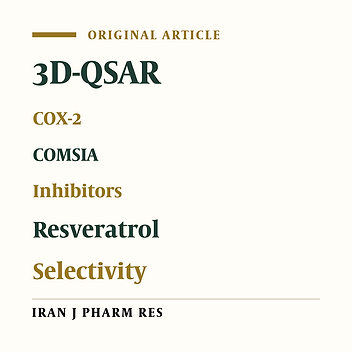
Developing a CoMSIA Model for Inhibition of COX-2 by Resveratrol Derivatives
Shamsara J, Shahir-Sadr A. Developing a CoMSIA Model for Inhibition of COX-2 by Resveratrol Derivatives. Iran J Pharm Res. 2016;15(3):e125136. doi: https://doi.org/10.22037/ijpr.2016.1891
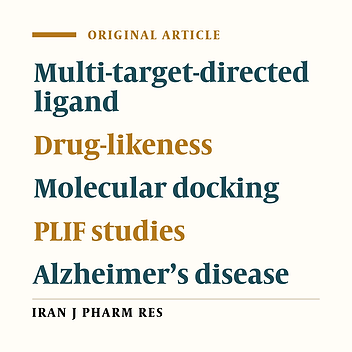
Multitarget Drug Design, Molecular Docking and PLIF Studies of Novel Tacrine−Coumarin Hybrids for the Treatment of Alzheimer’s Disease
Fereidoonnezhad M, Mostoufi A, Eskandari M, Zali S, Aliyan F. Multitarget Drug Design, Molecular Docking and PLIF Studies of Novel Tacrine−Coumarin Hybrids for the Treatment of Alzheimer’s Disease. Iran J Pharm Res. 2018;17(4):e124858. doi: https://doi.org/10.22037/ijpr.2018.2308
- Scopus by DOI: 1
Last Update: 3 weeks ago
- Scopus by Title: 1
Last Update: 3 weeks ago
- Scopus by Title (Ref): 1
Last Update: 3 weeks ago
- CrossRef: 0
Last Update: 6 days ago
- OpenAlex: 1
Last Update: 11 hours ago
- OpenCitations: 1
Last Update: 4 days ago
