
1. Background
Hyperhidrosis is characterized by excessive sweating beyond the body’s normal physiologic needs and can substantially affect occupational functioning, physical health, emotional well-being, and social interactions (1, 2). The disorder can be classified as primary or secondary. Primary hyperhidrosis is a chronic idiopathic condition characterized by excessive, typically bilateral and symmetric, sweating (3). It is often associated with overactivity of the sympathetic nervous system and commonly affects the palms, soles, axillae, face, and scalp (2, 3).
Approximately 3% of the population has primary hyperhidrosis, with the highest occurrence reported among individuals aged 18 to 54 years (2). Available treatments include topical agents, formaldehyde soaks, iontophoresis, oral anticholinergics, botulinum toxin injections, and surgical procedures such as sympathetic denervation (4-8). Tap-water iontophoresis is commonly used; however, its effects may be temporary and inconsistent. Previous studies have examined the addition of agents such as poldine methyl sulfate, glycopyrronium bromide, and atropine; however, their efficacy compared with that of tap-water iontophoresis remains inadequately studied.
Iontophoresis is an established noninvasive option for palmar hyperhidrosis; however, the quality of evidence and durability of benefit vary across studies. Recent reviews continue to support iontophoresis as a useful treatment while emphasizing the need for maintenance sessions and more standardized outcome measures. More recent comparative studies have also evaluated alternative solutions delivered by iontophoresis. These considerations support further evaluation of anticholinergic-enhanced iontophoresis.
2. Objectives
This study aimed to compare the effectiveness of glycopyrrolate iontophoresis with that of tap-water iontophoresis in patients with primary focal hyperhidrosis involving the palms, with or without plantar involvement.
3. Methods
3.1. Study Design and Setting
A 2-month, parallel-group, open-label, 2-arm randomized controlled superiority trial was conducted at a tertiary care center in Himachal Pradesh, India. Simple randomization was used to allocate participants to tap-water iontophoresis or glycopyrronium bromide iontophoresis.
3.2. Participants and Eligibility
Patients presenting to the dermatology outpatient department with a clinical diagnosis of primary focal hyperhidrosis involving the palms, with or without plantar involvement, and aged > 15 years were considered eligible. Patients were excluded if they were already receiving treatment for hyperhidrosis; were pregnant; or had ischemic heart disease, arrhythmia, narrow-angle glaucoma, a pacemaker or metal implant, other cardiac disease, and/or epilepsy. Primary focal hyperhidrosis was diagnosed clinically on the basis of the presenting pattern and the absence of an identified secondary cause.
3.3. Data Collection and Treatment Protocol
After written informed consent was obtained, all participants completed baseline data collection using a structured proforma. Assessments included the Hyperhidrosis Disease Severity Scale (HDSS) and the number of dry days.
In the glycopyrrolate iontophoresis group, the anode tray was filled with glycopyrronium bromide 0.04% solution and the cathode tray with tap water. In the tap-water group, both trays contained tap water. Before treatment, the skin was cleaned with an antiseptic, and any cuts were covered with soft paraffin. Each hand was placed in a tray with the water level just above the palmar surface. The current was gradually increased to 8 mA and maintained for 10 minutes, after which polarity was reversed and treatment continued at 8 mA for another 10 minutes. Sessions were performed twice weekly for 4 weeks, followed by 4 weeks of treatment-free observation. The same treatment protocol was followed regardless of baseline severity. HDSS and the number of dry days were reassessed at weeks 4 and 8.
Figure 1 shows the study protocol.
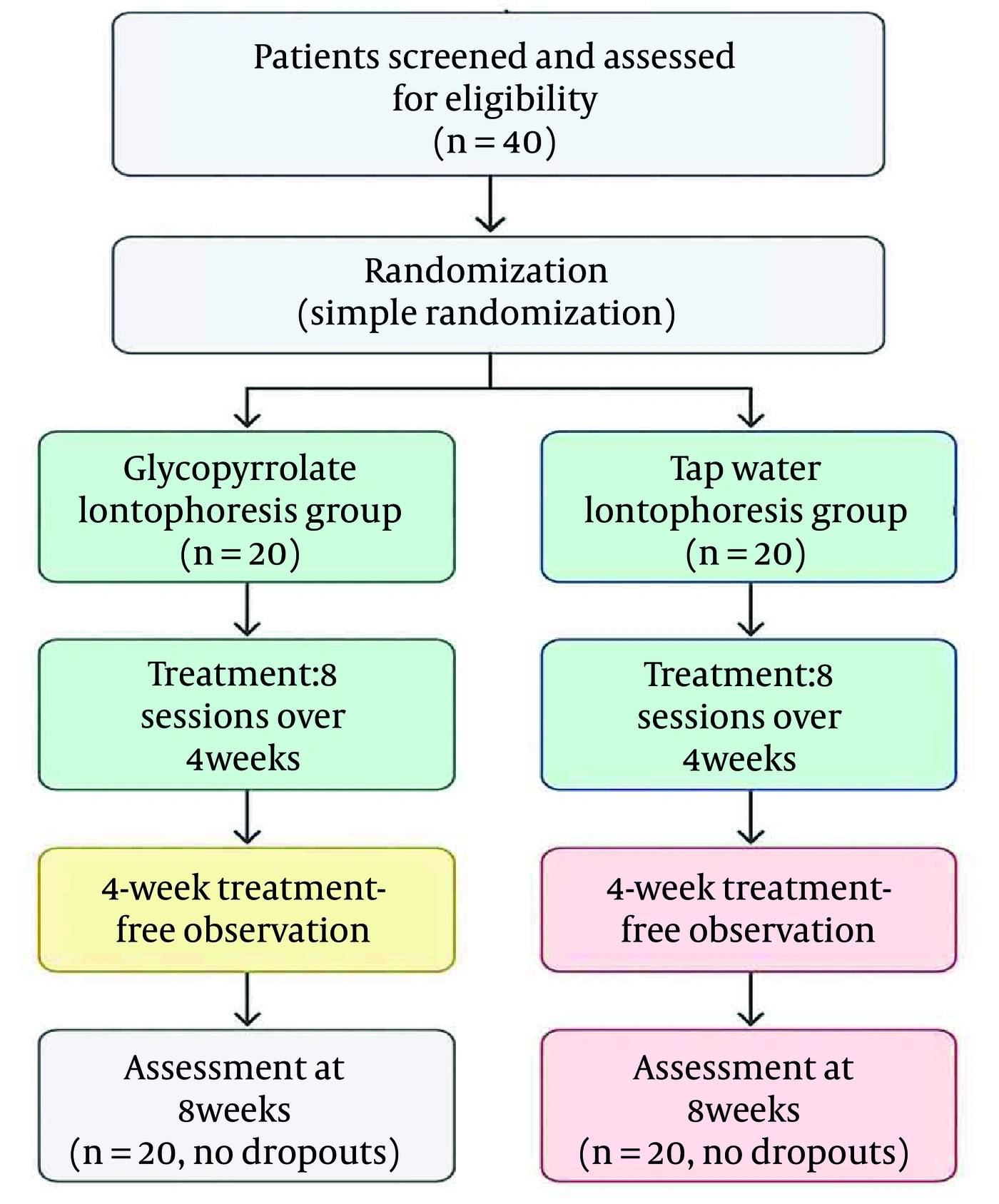
Figure 1.
Flowchart of the Study Design for the Randomized Controlled Superiority Trial Comparing Glycopyrrolate and Tap-Water Iontophoresis in Palmar Hyperhidrosis
3.4. Sample Size
The sample size was calculated to detect a minimum clinically important difference of 1 point in HDSS between the 2 groups, assuming a standard deviation of 1, a 2-sided alpha of 0.05, and 80% power. This yielded approximately 16 participants per group; the target sample was increased to 20 per group to allow for potential dropouts. Because the final sample comprised 20 participants per group with no withdrawals, the study remained small, and the precision of treatment-effect estimates was limited.
3.5. Statistical Analysis
Data were analyzed using SPSS version 20.0. A 2-sided P < 0.05 was considered statistically significant, and 95% confidence intervals were calculated for between-group treatment effects where derivable from the reported individual-level frequency distributions. Continuous outcomes were summarized using medians and means, as appropriate. The Wilcoxon signed-rank test was used for within-group comparisons, and the Mann-Whitney U test was used for between-group comparisons. Mean and median values for the number of dry days and severity scores were calculated.
3.6. Ethical Considerations
Written informed consent was obtained from all participants. The study was approved by the institutional ethics committee (MMMCH/IEC/22/519) and registered with the Clinical Trials Registry-India (CTRI/2022/10/046893). Study development and reporting were guided by the CONSORT statement.
4. Results
4.1. Participant Characteristics
Forty participants were randomized, with 20 assigned to each treatment group; all 40 received treatment, completed the 4-week treatment period and the 4-week treatment-free follow-up, and were included in the final analysis. Nineteen participants were women and 21 were men. The glycopyrrolate group included 8 women and 12 men, whereas the tap-water group included 11 women and 9 men. The mean age was 23.53 years (range, 15 to 37 years).
The clinical profile and pattern of hyperhidrosis are summarized in Table 1.
Table 1.
Clinical Profile of Participants a
| Characteristics | Values |
|---|---|
| Gender | |
| Male | 21 (52.5) |
| Female | 19 (47.5) |
| Age group (y) | |
| ≥ 20 | 5 (12.5) |
| 21 to 30 | 34 (85.0) |
| 31 to 40 | 1 (2.5) |
| Median | 23 |
| Duration of disease (y) | |
| < 1 | 2 (5.0) |
| 1 to 5 | 15 (37.5) |
| 6 to 10 | 12 (30.0) |
| > 10 | 11 (27.5) |
| Aggravating factors | |
| Anxiety | 12 (30.0) |
| Exercise | 5 (12.5) |
| Stress | 12 (30.0) |
| Summer season | 11 (27.5) |
| Family history | |
| Positive | 34 (85.0) |
| Negative | 6 (15.0) |
| Type of hyperhidrosis | |
| Palmar only | 22 (55.0) |
| Plantar only | 1 (2.5) |
| Palmoplantar | 17 (42.5) |
a Values are expressed as No. (%) unless otherwise indicated.
Palmar, plantar, and palmoplantar hyperhidrosis were reported in 22 (55%), 1 (2.5%), and 17 (42.5%) participants, respectively.
4.2. Treatment Outcomes
Table 2 summarizes the distribution and severity of hyperhidrosis in the 2 groups before and after treatment.
Table 2.
Disease Severity at Different Time Points in the Treatment Groups a
| Severity Parameter | Glycopyrrolate Group | Tap-water Group |
|---|---|---|
| Number of dry days at baseline | ||
| 0 | 20 (100) | 20 (100) |
| Number of dry days at 4 weeks | ||
| 2 | 0 | 11 (55) |
| 3 | 6 (30) | 9 (45) |
| 4 | 9 (45) | 0 |
| 5 | 5 (25) | 0 |
| Number of dry days at 8 weeks | ||
| 1 | 0 | 8 (40) |
| 2 | 1 (5) | 9 (45) |
| 3 | 6 (30) | 3 (15) |
| 4 | 6 (30) | 0 |
| 5 | 7 (35) | 0 |
| HDSS score at baseline | ||
| 1 | 0 | 0 |
| 2 | 7 (35) | 8 (40) |
| 3 | 9 (45) | 7 (35) |
| 4 | 4 (20) | 5 (25) |
| HDSS score at 4 weeks | ||
| 1 | 8 (40) | 1 (5) |
| 2 | 9 (45) | 11 (55) |
| 3 | 3 (15) | 4 (20) |
| 4 | 0 | 4 (20) |
| HDSS score at 8 weeks | ||
| 1 | 9 (45) | 0 |
| 2 | 9 (45) | 12 (60) |
| 3 | 2 (10) | 4 (20) |
| 4 | 0 | 4 (20) |
a Abbreviation: HDSS, Hyperhidrosis Disease Severity Scale.
In both study groups, the baseline number of dry days was zero. In the glycopyrrolate group, the number of dry days increased significantly from baseline at weeks 4 and 8 (both P < 0.001), and HDSS decreased significantly at weeks 4 and 8 (both P < 0.001). No significant changes were observed between weeks 4 and 8 in either dry days or HDSS, suggesting that the observed treatment effect persisted during the treatment-free observation period.
In the tap-water group, the number of dry days increased significantly from baseline at weeks 4 and 8 (both P < 0.001), and HDSS decreased at week 4 (P = 0.014) and week 8 (P = 0.025). However, outcomes deteriorated significantly between weeks 4 and 8, with fewer dry days and higher HDSS at week 8 (P = 0.001 for both comparisons).
Between-group comparisons favored glycopyrrolate iontophoresis. At week 4, the median number of dry days was 4 in the glycopyrrolate group and 2 in the tap-water group, corresponding to a Hodges-Lehmann median difference of 1 day (95% CI, 0 to 2; P < 0.001). At week 8, the corresponding medians were 4 and 2 days, with a Hodges-Lehmann median difference of 2 days (95% CI, 1 to 3; P < 0.001). For HDSS, the Hodges-Lehmann median difference favored glycopyrrolate by -1 point at both week 4 (95% CI, -2 to 0; P = 0.009) and week 8 (-1 point; 95% CI, -2 to 0; P = 0.001). Table 3 summarizes the between-group statistical comparisons.
Table 3.
Statistical Comparison of the Treatment Groups a
| Outcomes and Groups | Mean Rank | P Value |
|---|---|---|
| Dry days at 4 weeks | < 0.001 | |
| Glycopyrrolate | 29.15 | |
| Tap water | 11.85 | |
| Dry days at 8 weeks | < 0.001 | |
| Glycopyrrolate | 29.68 | |
| Tap water | 11.33 | |
| HDSS at 4 weeks | 0.009 | |
| Glycopyrrolate | 15.73 | |
| Tap water | 25.28 | |
| HDSS at 8 weeks | 0.001 | |
| Glycopyrrolate | 14.60 | |
| Tap water | 26.40 |
a Abbreviation: HDSS, Hyperhidrosis Disease Severity Scale.
Localized adverse events occurred in 3 of 40 participants (7.5%): irritation along the water line occurred in 1 of 20 participants (5%) in the glycopyrrolate group and 2 of 20 participants (10%) in the tap-water group. No systemic adverse events were reported, and there were no withdrawals. Given the small number of events, no meaningful formal comparison of adverse-event rates could be made; the Fisher exact test yielded P = 0.61.
No subgroup analysis was performed to compare participants with higher baseline severity scores (HDSS 3 - 4) with those with lower severity scores (HDSS 1 - 2) because of the small sample size and insufficient power for such stratification.
5. Discussion
In this randomized superiority trial, glycopyrrolate iontophoresis produced greater short-term improvement than tap-water iontophoresis across both reported outcomes. The between-group difference was evident at week 4 and persisted at week 8, although the study was not designed or powered to establish long-term remission. Our findings are broadly consistent with earlier studies of glycopyrronium bromide delivered by iontophoresis. Dolianitis et al. reported a longer duration of dryness with glycopyrrolate than with tap-water iontophoresis, whereas Chia et al. observed improved palmar dryness after glycopyrronium bromide iontophoresis (9, 10).
Tap-water iontophoresis remains an effective noninvasive treatment for palmar hyperhidrosis. A 2024 randomized clinical trial comparing aluminum chloride hexahydrate gel iontophoresis with tap-water iontophoresis further illustrates that the choice of iontophoresis solution can influence treatment response, although the evidence remains heterogeneous across protocols (11). Recent systematic reviews similarly conclude that iontophoresis provides clinically meaningful improvement but generally requires ongoing maintenance treatment, underscoring the importance of longer follow-up and standardized, patient-centered outcomes (12, 13).
The rationale for adding glycopyrronium bromide is pharmacologic rather than purely electrochemical. Tap-water iontophoresis is thought to reduce sweating through mechanisms that may include functional obstruction of sweat ducts, changes in local pH and ion concentration, and effects on eccrine nerve transmission; however, its precise mechanism remains incompletely established. Glycopyrronium bromide is a quaternary ammonium antimuscarinic agent that blocks muscarinic signaling at eccrine sweat glands. Iontophoresis may facilitate local drug delivery, potentially producing a more sustained anticholinergic effect than tap water alone. The mechanism underlying persistence of benefit, however, remains uncertain and should not be inferred from the present clinical data.
Our observation of stable outcomes between weeks 4 and 8 in the glycopyrrolate group, contrasted with deterioration in the tap-water group, suggests persistence of treatment benefit during the short treatment-free period. Contemporary evidence continues to support iontophoresis as a useful treatment option while emphasizing maintenance requirements and the need for standardized outcome measures and longer-term studies.
A study by Tey et al. using 0.04% glycopyrronium bromide iontophoresis in 114 patients found that patients needed to return weekly for treatment to maintain palmar dryness after an initial symptom remission lasting 7 days, which was achieved after 5 iontophoresis sessions. In our study, however, longer remission periods were observed. This discrepancy may be related to the increased frequency of treatment sessions in our study (14).
During the 4-week follow-up period after treatment cessation, the tap-water group showed evidence of relapse, as indicated by a significant decrease in dry days and an increase in HDSS scores from week 4 to week 8 (P = 0.001). In contrast, the glycopyrrolate group maintained stable outcomes with no significant changes, suggesting longer-lasting effects without immediate relapse. Other comparative studies support the greater effectiveness of glycopyrrolate iontophoresis. Abell et al. (15) treated 53 patients, with 26 receiving tap-water iontophoresis and the remainder receiving glycopyrronium bromide; glycopyrrolate showed prolonged hypohidrotic effects compared with tap water. Askari et al. (16), in a chart review of 70 patients, found that 40% required glycopyrrolate after tap-water failure, indicating a better response with glycopyrrolate among nonresponders to tap water.
5.1. Study Limitations
This study has several important limitations. First, the sample size was small (n = 40), limiting statistical precision and generalizability and precluding adequately powered subgroup analyses. Second, the trial was open-label; therefore, subjective outcomes such as HDSS and participant-reported dry days may have been susceptible to expectation and measurement bias. Third, no objective measure of sweat production, such as gravimetric sweat assessment, was used. Fourth, follow-up extended only 4 weeks after treatment cessation; thus, long-term durability and recurrence could not be established. Finally, this was a single-center study, and no quality-of-life, cost-effectiveness, or objective sweat-output outcomes were assessed.
5.2. Conclusions
In this small randomized open-label trial, glycopyrrolate iontophoresis produced greater short-term improvement in HDSS and number of dry days than tap-water iontophoresis and maintained the observed benefit during the 4-week treatment-free observation period. These findings should be considered hypothesis-generating and interpreted in light of the subjective outcomes, absence of objective sweat measurement, small sample size, and limited follow-up. Larger, adequately powered, preferably blinded trials with objective sweat quantification, standardized diaries, and longer follow-up are needed to confirm the durability and comparative effectiveness of glycopyrrolate iontophoresis.