Journal of Semnan University of Medical Sciences
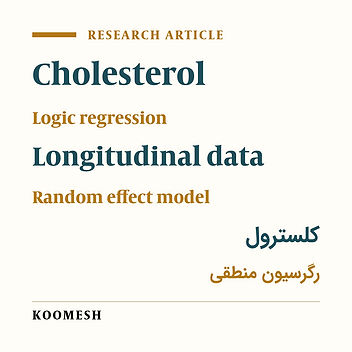
Association of polymorphisms and other risk factors with cholesterol level over time using logic random effect model: Tehran Lipid and Glucose Study
Authors

Abstract
Introduction: changes in cholesterol level can be a product of Genetic interactions of some factors. These interactions are time-dependent. Since a time-dependent genetic interaction study related to blood cholesterol levels has not been performed until now, this study is proposed to evaluate the time-dependent association of SNPs and cholesterol by using a logic random effect model of assessment . Materials and Methods: logic random effect model was proposed in the frame of random effects models by using negative likelihood as the score function to analyze the interactions related to longitudinal quantitative responses. Data of 329 participants in TLGS prospective cohort study was analyzed using proposed model to identify effective interactions related to cholesterol. Annealing algorithm was used to search interaction effects. Coefficient of these interactions and random effect were estimated using maximum likelihood method. Results : The results for male or other subjects with GG genotype for ApoAIV who had normal blood pressure and waist circumference had shown significant lower cholesterol levels (19.8 mg/dl, CI 95%: 13.9, 25.69) (p< 0.001) than other subjects without this combination. Also, having (high triglyceride or allele e2 for ApoE) was significantly associated with an increasing effect on cholesterol (β=16.1, CI 95%: 11.64, 20.55). The level of the cholesterol in phase 1 of study was 21.4 mg/dl (CI 95%: 18.35, 24.44) more than other phases (p< 0.001). The model’s random effect was estimated 165.82 with standard deviation 30.89 (p
Highlights
Copyright
© 2024, Author(s). This open-access article is available under the Creative Commons Attribution 4.0 (CC BY 4.0) International License (https://creativecommons.org/licenses/by/4.0/), which allows for unrestricted use, distribution, and reproduction in any medium, provided that the original work is properly cited.
Similar Articles
Assessment of SNP Interactions Affecting Total Cholesterol Over Time Using Logic Mixed Model: TLGS Study
Mehrabi Y, Sarbakhsh P, J. Houwing-Duistermaat J, Zayeri F, Sadat Daneshpour M. Assessment of SNP Interactions Affecting Total Cholesterol Over Time Using Logic Mixed Model: TLGS Study. Gene Cell Tissue. 2015;2(1):e25572. doi: https://doi.org/10.17795/gct-25572
Underestimating the Effect of Lipids on Cardiovascular Events: Regression Dilution Bias in the Population-Based Cohort of Tehran Lipid and Glucose Study
Masudi S, Yavari P, Mehrabi Y, Azizi F, Khalili D, et al. Underestimating the Effect of Lipids on Cardiovascular Events: Regression Dilution Bias in the Population-Based Cohort of Tehran Lipid and Glucose Study. Int J Endocrinol Metab. 2015;13(4):e27528. doi: https://doi.org/10.5812/ijem.27528
Logic Regression Analysis of Gene Polymorphisms and HDL Levels in a Nationally Representative Sample of Iranian Adolescents: The CASPIAN-III Study
Moghadasi M, Kelishadi R, Marateb HR, Haghjooy Javanmard S, Mansourian M, et al. Logic Regression Analysis of Gene Polymorphisms and HDL Levels in a Nationally Representative Sample of Iranian Adolescents: The CASPIAN-III Study. Int J Endocrinol Metab. 2017;15(3):e14037. doi: https://doi.org/10.5812/ijem.14037
Serum Lipids During 20 Years in the Tehran Lipid and Glucose Study: Prevalence, Trends and Impact on Non-Communicable Diseases
Baghbani-Oskouei A, Tohidi M, Asgari S, Ramezankhani A, Azizi F, et al. Serum Lipids During 20 Years in the Tehran Lipid and Glucose Study: Prevalence, Trends and Impact on Non-Communicable Diseases. Int J Endocrinol Metab. 2018;16(4 (Suppl)):e84750. doi: https://doi.org/10.5812/ijem.84750
Comparison Between Applicability of the Logit and Probit Models to Diagnose Influencing Risk Factors of Cardiovascular Disease in Mashhad
Esmaily H, Shakeri MT, Avazzadeh Z, Doosti H, Ghayour Mobarhan M. Comparison Between Applicability of the Logit and Probit Models to Diagnose Influencing Risk Factors of Cardiovascular Disease in Mashhad. Health Scope. 2013;2(2):67-72. doi: https://doi.org/10.17795/jhealthscope-8622
- Scopus by DOI: 0
Last Update: 1 week ago
- Scopus by Title: 1
Last Update: 1 week ago
- Scopus by Title (Ref): 0
Last Update: 1 week ago
- CrossRef: 0
Last Update: 5 hours ago
- OpenAlex: 0
Last Update: 7 hours ago
- OpenCitations: 0
Last Update: 5 days ago