Journal of Semnan University of Medical Sciences
Outline
Older adults experiences of online social interactions: A phenomenological study
Authors
Abstract
Introduction: Online social networks allow users, who are anywhere in the world, to communicate with other people with text, audio, and video. Studies have shown that older adults use of social networks and online communication can increase social support, improve quality of life and increase their health. The purpose of this study was to understand the older adult;#39s experiences of online Social Interactions. Materials and Methods: This study was performed following a qualitative approach and phenomenological methodology in Semnan (Iran) in 2016. The studied sample was taken by purposive sampling method. Required data was collected via deep and semi-structured interviews with 9 older adults who were active members of at least one online social network. The obtained data was analyzed using the seven-step Colaizzi;#39s method. Results: From data analysis, the main theme of "developed social interactions" was extracted from five sub-themes: "interaction with family and friends", "revival of old relationships", "familiar with people with common interests", "impalpable control" and "liberation from loneliness". Conclusion: The results explained the various dimensions of the use of the older adults from online social networks and showed that these networks have the potential to be used to enhance social interactions in aging. The results of this study can help planners by identifying the benefits of these networks, while taking necessary interventions to increase the use of the elderly from these networks, promote social interactions and, consequently, promote the health of the elderly.
References
- 1.Lin KY, Lu HP. Why people use social networking sites: An empirical study integrating network externalities and motivation theory. Comput Hum Behav 2011; 27: 1152-1161.
- 2.Ellison N, Heino R, Gibbs J. Managing impressions online: Self presentation processes in the online dating environment. J Comput Mediat Commun 2006; 11: 415-441.
- 3.About Skype. 2017; Available from: https://www.skype.com/en/about/.
- 4.Katz JE, Rice RE. Social consequences of Internet use: Access, involvement, and interaction: MIT press; 2002.
- 5.Mirzaei M, Shams-Ghahfarkhi M. Demographic characteristics of the elderly population in Iran according to the census 1976-2006. Iran J Ageing 2007; 2: 326-331. (Persian).
- 6.Mellor D, Firth L, Moore K. Can the internet improve the well-being of the elderly? Ageing Int 2008; 32: 25-42.
- 7.Marcelino I, Barroso J, Cruz JB, Pereira A. Elder Care Architecturea physical and social approach. Int J Adv Life Sci 2010; 29: 9.0.
- 8.Joinson AN. Looking at, looking up or keeping up with people?: motives and use of facebook. Proceedings of the SIGCHI Conference on Human Factors in Computing Systems; Florence, Italy. 1357213: ACM; 2008. 1027-36.
- 9.Golden J, Conroy RM, Bruce I, Denihan A, Greene E, Kirby M, Lawlor BA. Loneliness, social support networks, mood and wellbeing in communitydwelling elderly. Int J Geriatr Psychiatry 2009; 24: 694-700.
- 10.Mulvaney-Day NE, Alegra M, Sribney W. Social cohesion, social support, and health among Latinos in the United States. Soc Sci Med 2007; 64: 477-495.
- 11.Quan-Haase A, Mo GY, Wellman B. Connected seniors: how older adults in East York exchange social support online and offline. Inf Commun Soc 2017; 20: 967-983.
- 12.Chakraborty R, Vishik C, Rao HR. Privacy preserving actions of older adults on social media: Exploring the behavior of opting out of information sharing. Decis Support Syst 2013; 55: 948-956.
- 13.Cotten SR, Ford G, Ford S, Hale TM. Internet use and depression among older adults. Comput Hum Behav 2012; 28: 496-499.
- 14.Selwyn N. The information aged: A qualitative study of older adults' use of information and communications technology. J Aging Stud 2004; 18: 369-384.
- 15.Cornejo R, Tentori M, Favela J. Enriching in-person encounters through social media: A study on family connectedness for the elderly. Int J Hum Comput Stud 2013; 71: 889-899.
- 16.Harley D, Fitzpatrick G. Appropriation of social networking by older people: two case studies. ECSCW 2011 Workshop on Fostering Social Interactions in the Ageing Society: Artefacts Methodologies Research Paradigms: Springer International Publishing; 2012.
- 17.Jung EH, Sundar SS. Senior citizens on Facebook: How do they interact and why? Comput Hum Behav 2016; 61: 27-35.
- 18.Sundar SS, Oeldorf-Hirsch A, Nussbaum J, Behr R. Retirees on Facebook: can online social networking enhance their health and wellness? CHI '11 Extended Abstracts on Human Factors in Computing Systems; Vancouver, BC, Canada. 1979931: ACM; 2011. 2287-92.
- 19.Czaja SJ, Charness N, Fisk AD, Hertzog C, Nair SN, Rogers WA, Sharit J. Factors predicting the use of technology: findings from the Center for Research and Education on Aging and Technology Enhancement (CREATE). Psychol Aging 2006; 21: 333.
- 20.De Belvis AG, Avolio M, Sicuro L, Rosano A, Latini E, Damiani G, Ricciardi W. Social relationships and HRQL: A cross-sectional survey among older Italian adults. BMC Public Health 2008; 8: 348.
- 21.Chopik WJ. The benefits of social technology use among older adults are mediated by reduced loneliness. Cyberpsychol Behav Soc Netw 2016; 19: 551-556.
- 22.Pittman M, Reich B. Social media and loneliness: Why an Instagram picture may be worth more than a thousand Twitter words. Comput Hum Behav 2016; 62: 155-167.
- 23.Fochtman D. Phenomenology in pediatric cancer nursing research. J Pediatr Oncol Nurs 2008; 25: 185-192.
- 24.Streubert Speziale H, Carpenter D. Qualitative research in nursing. Third Editionth edition Philadelphia: Williams & Wilkings Co 2003.
- 25.VanderStoep SW, Johnson DD. Research methods for everyday life: Blending qualitative and quantitative approaches: John Wiley & Sons; 2008.
- 26.Padilla-Daz M. Phenomenology in Educational Qualitative Research: Philosophy as Science or Philosophical Science? Educational Excellence 2015; 1: 101-110.
- 27.Colaizzi PF. Psychological research as the phenomenologist views it. 1978.
- 28.Shosha GA. Employment of Colaizzi's strategy in descriptive phenomenology: A reflection of a researcher. Eur Sci J 2012; 8.
- 29.Gharibpoor M, Allameh S, Abrishamkar M. New concept of social network citizenship behavior: Definition and elements. Aust J Basic Appl Sci 2012; 6: 154-163.
- 30.Lincoln YS, Guba EG. Naturalistic inquiry: Sage; 1985.
- 31.Gabriel Z, Bowling ANN. Quality of life from the perspectives of older people. Ageing Soc 2004; 24: 675-691.
- 32.Lehtinen V, Nsnen J, Sarvas R, editors. A little silly and empty-headed: older adults' understandings of social networking sites. Proceedings of the 23rd British HCI Group Annual Conference on People and Computers: Celebrating People and Technology; 2009: British Computer Society.
- 33.Tsai TH, Chang HT, Ho YL. Perceptions of a specific family communication application among grandparents and grandchildren: an extension of the technology acceptance model. PLoS One 2016; 11: e0156680.
- 34.Stevens NAN. Combating loneliness: a friendship enrichment programme for older women. Ageing Soc 2001; 21: 183-202.
- 35.Nef T, Ganea RL, Mri RM, Mosimann UP. Social networking sites and older usersa systematic review. Int Psychogeriatr 2013; 25: 1041-1053.
- 36.MacCallum J, Palmer D, Wright P, Cumming-Potvin W, Northcote J, Brooker M, Tero C. Community building through intergenerational exchange programs: Report to the National Youth Affairs Research Scheme (NYARS). 2006.
- 37.Boyd D. Why youth (heart) social network sites: The role of networked publics in teenage social life. MacArthur foundation series on digital learningYouth, identity, and digital media volume 2007 Dec: 119-42.
- 38.Meneses Fernndez MD, Santana Hernndez JD, Martn Gutirrez J, Henrquez Escuela MR, Rodrguez Fino E. Using communication and visualization technologies with senior citizens to facilitate cultural access and self-improvement. Comput Hum Behav 2017; 66: 329-344.
- 39.Jung EH, Walden J, Johnson AC, Sundar SS. Social networking in the aging context: Why older adults use or avoid Facebook. Telematics and Informatics 2017.
- 40.Gilbert E, Karahalios K. Predicting tie strength with social media. Proceedings of the SIGCHI Conference on Human Factors in Computing Systems; Boston, MA, USA. ACM; 2009. 211-20.
- 41.Ciboh R. Adult users engagement and utilisation of social networks sites in nigeria. Stud Media Commun 2015; 3: 129-136.
- 42.Yuan S, Hussain SA, Hales KD, Cotten SR. What do they like? Communication preferences and patterns of older adults in the United States: The role of technology. Educ Gerontol 2016; 42: 163-174.
- 43.Chayko M. Superconnected: The Internet, Digital Media, and Techno-Social Life: SAGE Publications; 2016.
- 44.Coelho J, Duarte C. A literature survey on older adults' use of social network services and social applications. Comput Hum Behav 2016; 58: 187-205.
- 45.Erickson LB, editor. Social media, social capital, and seniors: The impact of Facebook on bonding and bridging social capital of individuals over 65. AMCIS; 2011.
- 46.Lampe C, Ellison N, Steinfield C. A face(book) in the crowd: social Searching vs. social browsing. Proceedings of the 2006 20th anniversary conference on Computer supported cooperative work; Banff, Alberta, Canada. ACM; 2006; 167-170.
- 47.Karahasanovi A, Brandtzg PB, Heim J, Lders M, Vermeir L, Pierson J, et al. Co-creation and user-generated contentelderly peoples user requirements. Comput Hum Behav 2009; 25: 655-678.
- 48.Bruggeman J. The strength of varying tie strength: comment on aral and van alstyne. AJS 2016; 121: 1919-1930.
- 49.Hampton K, Rainie L, Lu W, Shin I, Purcell K. Social media and the cost of caring. Washington, DC: Pew Research Center 2015.
- 50.Rains SA, Brunner SR, Oman K. Self-disclosure and new communication technologies. J Soc Pers Relat 2014; 33: 42-61.
- 51.Wenger GC, Burholt V. Changes in levels of social isolation and loneliness among older people in a rural area: A twentyyear longitudinal study. Can J Aging 2004; 23: 115-127.
- 52.Stek ML, Vinkers DJ, Gussekloo J, Beekman AT, van der Mast RC, Westendorp RG. Is depression in old age fatal only when people feel lonely? Am J Psychiatry 2005; 162: 178-180.
- 53.Voner HB, Bobek S, Kokol P, Krei MJ. Attitudes of active older Internet users towards online social networking. Comput Hum Behav 2016; 55: 230-241.
- 54.Aarts S, Peek STM, Wouters EJM. The relation between social network site usage and loneliness and mental health in community-dwelling older adults. Int J Geriatr Psychiatry 2015; 30: 942-949.
- 55.Farkas PA, Schrenk M, Hlauschek W. Senior Social PlatformAn application aimed to reduce the social and digital isolation of seniors: na; 2010.
- 56.Ballantyne A, Trenwith L, Zubrinich S, Corlis M. I feel less lonely: what older people say about participating in a social networking website. Qual Ageing Older Adults 2010; 11: 25-35##.
Copyright
© 2018, Author(s). This open-access article is available under the Creative Commons Attribution 4.0 (CC BY 4.0) International License (https://creativecommons.org/licenses/by/4.0/), which allows for unrestricted use, distribution, and reproduction in any medium, provided that the original work is properly cited.
Similar Articles

Barriers and Challenges Experienced by Seniors in Using Online Social Networks: A Phenomenological Study
Momeni M, Hariri N, Nobahar M, Noshinfard F. Barriers and Challenges Experienced by Seniors in Using Online Social Networks: A Phenomenological Study. Middle East J Rehabil Health Stud. 2018;5(1):e65310. doi: https://doi.org/10.5812/mejrh.65310
Role of Socio-demographic Factors in Predicting the Use of Communication Technologies by Older People in Iran
Habibollah Pour M, Motalebi SA, Mahdikhani Z, Mohammadi F. Role of Socio-demographic Factors in Predicting the Use of Communication Technologies by Older People in Iran. J Inflamm Dis. 2024;24(6):e156250. doi:
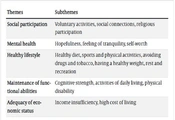
Healthy Aging from the Perspective of Older Adults: A Descriptive Qualitative Study
Saki T, Rashidi F, Mamene M, Azadi H, Azadi A. Healthy Aging from the Perspective of Older Adults: A Descriptive Qualitative Study. Shiraz E-Med J. 2024;25(2):e141332. doi: https://doi.org/10.5812/semj-141332
Evaluation of Healthy Aging Themes from the Perspectives of the Elderly: A Qualitative Study
Kaveh Farsani Z. Evaluation of Healthy Aging Themes from the Perspectives of the Elderly: A Qualitative Study. J Kermanshah Univ Med Sci. 2022;26(2):e123750. doi: https://doi.org/10.5812/jkums-123750
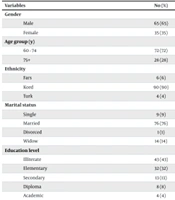
Factors Affecting Social Capital Among Elderly Individuals Visiting Imam Ali Hospital in Kermanshah: A Descriptive Cross-sectional Study
Hazratian S, Abdi Ardekani A, Hashemian AH, Kaikhosro Doulatyari P, Veisimiankali M. Factors Affecting Social Capital Among Elderly Individuals Visiting Imam Ali Hospital in Kermanshah: A Descriptive Cross-sectional Study. Care Pathw Hosp Home. 2026;1(2):e168323. doi: https://doi.org/10.69107/cphh-168323
- Scopus by DOI: 0
Last Update: 1 week ago
- Scopus by Title: 1
Last Update: 1 week ago
- Scopus by Title (Ref): 1
Last Update: 1 week ago
- CrossRef: 0
Last Update: 5 days ago