
1. Background
The aging of the population poses a significant challenge to health and social care systems throughout the world. Globally, the number of people over the age of 60 has increased dramatically over the past 30 years, and will reach more than 2 billion by 2050 (1, 2). By the year 2050, Iran's population of older persons is expected to reach approximately 29 million. In addition, the increase in life expectancy and the decrease in birth rates have led to population inversion (3). Thus, increasing life expectancy allows humans to plan their future differently based on the central element such as health (4). Therefore, the World Health Organization (WHO) has designed a global strategy and action plan (healthy aging) to help the elderly and their health (2) because chronic illnesses, physical disabilities, and inability to meet personal needs are all likely to increase with increasing age, especially from the age of 55 onwards. As a result, the need for health care and a healthy lifestyle will be vital for this population (5). In this regard, promoting healthy aging is the best strategy.
Accroding to WHO, everybody can experience healthy ageing. Being free of disease or infirmity is not a requirement for healthy ageing, as many older adults have one or more health conditions that, when well controlled, have little influence on their wellbeing (6). The process of healthy aging consists of enhancing and maintaining the functional capacities of individuals; it supports their well-being at an older age (4, 6). The healthy aging model was developed based on the WHO concept of healthy aging, consisting three components of internal capacities as physical and mental health factors, social and political context of the elderly, and their interaction with the environment (7). Physiological health, risk factors, and psychological well-being can all serve as indicators of internal capacity. Components of social welfare, including the economic and social climate and the political environment, indicate whether the elderly have support from various institutions. Finally, the interaction of the elderly with the environment refers to their participation in society and the support received from their children, sisters, brothers, and other family members and friends (1, 8). Healthy aging emphasizes skills that enable older people to experience aging in a positive manner (4).
Various studies have focused on different variables, including physical activity (9), proper nutrition (10, 11), happiness (12), social relations (11, 13), voluntary contributions to social affairs (8), and independence in affairs (10, 14). Culture plays an important role in the findings of these research studies. The elderly are often seen in Western cultures as independent and autonomous, whereas they are viewed as interdependent in Eastern cultures, particularly in Thailand and China. In Thailand, the elderly are at the center of the family, and other family members, including children, grandchildren and brides, behave toward them respectfully. Elderly people also provide financial support to their families and care for their grandchildren. Alternatively, older Chinese family members are bestowed the highest respect from family members and society. As a result of the comprehensive and complete understanding provided by the WHO and the results of various studies on healthy aging, the Iranian elderly's views on this issue seem important and necessary, given Iranian culture, society, and economy. The perspectives and strategies of Iranian older adults in relation to healthy aging can help plan future interventions, policies and programs for their support.
2. Objectives
This study aimed to evaluate the healthy aging themes among the Iranian elderly.
3. Methods
This qualitative study used the thematic analysis approach by Attride-Stirling (15) to examine the 'healthy aging' phenomenon from the elderly’s point of view using thematic analysis. The experiences of the elderly were thoroughly and comprehensively reviewed to uncover themes related to healthy aging. This qualitative study was conducted to enter the inner world of the elderly to discover these themes. Healthy aging in the elderly is a unique and contextual topic, which has not been studied in Iran due to specific cultural, social, and economic contexts. Therefore, thematic analysis was used to understand and interpret the phenomenon of healthy aging from the perspective of the elderly.
The participants of the current research consisted of 15 (11 women and 4 men) elderly in Shahrekord, who were selected through a purposive sampling method based on the inclusion criteria of being 60 years and older (72), ability to communicate effectively and logically, and willingness to participate in the study. Participant education ranged from illiteracy to diploma, and their occupations were from housemakers to businesspeople.
The data were collected through semi-structured interviews, which were continued until achieving theoretical data saturation and when the researcher concludes that that new interviewees are unlikely to provide new concepts because the interviewees would provide similar concepts and answers (16). Theoretical data saturation was achieved after 12 interviews; however, three more interviews were conducted. The researcher explained the research objectives, obtained permission to record audio, and informed the participants that only he would have access to the data before conducting the interviews to comply with ethical principles. The interviews began once informed consent had been received. Approximately 30 to 45 minutes were spent on each interview. The interview began with the question, "How do you define health? Please explain". All recorded interviews were transcribed and then checked to ensure that the information was transcribed correctly.
Thematic analysis was used to analyze the data based on coding and analyzing data. Accordingly, the researcher extracted phrases, sentences, or paragraphs, which contained appropriate qualitative concepts, while immersing himself in the data obtained from the interviews. Extracted data from raw interviews were defined by a short proposition or conceptual phrase. Then, the conceptual phrases were coded based on the thematic analysis approach into the three categories of basic, organizing, and global themes (15, 17).
Lincoln and Guba’s credibility, transferability, dependability, and conformability criteria were used to legitimize and validate the findings and analyzes. The member review method was used to ensure credibility (18). All extracted topics and interpretations were reviewed in a two-way process among the authors. The participants were asked whether the interpretation of the messages received from the messages was correct or not during the interviews and during the data analysis. Efforts were made to ensure transferability and elaborate on all the details of the primary and secondary concepts, and the actions were taken to interview participants and the obstacles ahead (18).
4. Results
In this study, the raw data were first coded through basic coding. Then, eight organizing themes emerged from the existing codes. Finally, the global theme of dynamic aging was extracted by integrating the organizing themes.
4.1. Marital Satisfaction with Life
In this study, the elderly were found to have experienced satisfaction with their marital life during their life with their spouse as one of the organizing themes related to healthy aging, causing a feeling of pleasure and satisfaction with life. This organizing theme included some basic themes such as a good-natured husband, a responsible spouse, and companionship in life. Although some of the participants’ spouses were not alive, one of the reasons they were satisfied with their current life was the spouse and his/her memories. The participants talked about the spouse who has kept up for years, respected him/her both in public and in private, been good-natured, strived to make money legally, and tried to make his/her family happy. For instance, a 68-year-old woman said, "I was satisfied with him since the first day because, God bless my husband, he was very good-natured, calm, and did not hit me. Every moment of my marital life was good. He did everything for the family. I was respected in public and satisfied at home with this life".
4.2. Satisfaction with Moral Issues
The role of children in Iranian culture is crucial, and the elderly seek support, especially from their children. In this study, the elderly expressed satisfaction with their children and support. They referred to issues such as children's respect for the elderly, consultant for children, physical and mental health, moral and social health, loyalty, education, and parental appreciation. For example, a 65-year-old woman stated, "All of my children are educated, and I am satisfied with them. I have six children, all of them have master's degrees, and they are all healthy and non-addicted. They live their own lives". Another 71-year-old man said, "I have ten children, and they are all fine. They are not addicted; they have respected me and their mother. Well, it makes me satisfied with life".
4.3. Healthy Lifestyle
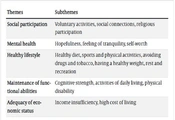
The elderly should have a good lifestyle, consisting of a set of appropriate behaviors and habits observed in all interviews to achieve healthy aging. Nutrition, exercise, non-smoking, regular medical checks, and weight loss are some of the basic themes incorporated into this organizing theme. These habits and behaviors seem to help the elderly prevent diseases such as heart attack and pneumonia. A 65-year-old woman stated, "Every two or three months, I visit a doctor, and the doctor prescribes some tests. I go to Isfahan to do the tests. I do this so that if I have a problem with aging, I can stop it quickly". In addition, a 68-year-old man advocated that "I exercise from Saturday to Wednesday, I go to a club to exercise. Then, I do the same exercises at home on Thursdays and Fridays. At 7 o'clock, I go for a walk. Then, I come here to the daycare center. I generally go to the park for a long walk".
4.4. Spiritual Orientation
Old age is a critical time when religion fills the voids in life and even makes it meaningful. A religion can be an essential source of hope, comfort, and peace during every stage of old age in a complex economic, social, and psychological environment. Interviewees discussed concepts such as praying for health, trusting in God to solve problems, creating calm, receiving healing from God, coping with stress, reducing negative thoughts, and reducing loneliness. People with chronic illnesses, especially the elderly, seem more inclined to turn to a higher power for help. For example, a 66-year-old woman whose husband had cancer for many years said, "Doctors operated on seven or eight parts of my husband's body. We went to Isfahan for a few years and did chemotherapy. My children were all upset every time they came home. I said this was God's will. Trust in God; he would be fine. I asked my children to pray for him. I asked God to help me".
4.5. Elderly’s Independence and Financial Self-sufficiency
A second organizing theme identified in this study was financial independence and self-sufficiency in the elderly. The elderly are independent in the sense that they still manage their own lives, and do not feel that they have no authority or role in making decisions as they age. In addition, the participants used the term independence to show that they can perform tasks such as daily activities, dressing, shopping, and visiting the doctor's office. In fact, the elderly wanted to point out that they do not like to be a burden on their children and family by referring to the term independence and feel pleasant and positive. In the interview sessions, a 71-year-old man stated, "I thank God that I am physically healthy. Although I have diabetes, I walk and do my activities. I'm satisfied. I'm not paralyzed. I make my food; I help my wife in the house choirs. I'm very pleased that I'm behaving in a way that everybody respects me".
Similarly, a 72-year-old woman advocated that "I am old now. I am satisfied that I am healthy. I can do my daily chores. I do not need my children and do not want to ask them for help". Moreover, the elderly highlighted financial self-sufficiency, meaning that they did not want to be financially dependent on their children and desired to meet their own needs independently. One of the fears the elderly mentioned was financial dependence, so they preferred to have financial independence rather than expensive equipment and food. There was a possibility that their children would not financially support them in these specific economic conditions. For instance, a 73-year-old man mentioned, "Financial issues are important for the elderly because if they ask their children for help, they may not accept and may tell we have our own life".
4.6. Intra-generational Dynamism
Dynamism within generations was another organizing theme, referring to the notion that older people do not have a close or distant relationship with their peers and have very dynamic and active relationships. These dynamic relationships within the generation are important during this period when work and family responsibilities are reduced. Many participants stated that they enjoyed spending time with their friends more than with family members because they shared enjoyable activities and leisure time together. When the participants were asked to describe their friendships and intimacy, they referred to shared tendencies, feelings of belonging, opportunities to share secrets and talk about their memories, and group walks. The participants believed these relationships would be strengthened that over time and seem to protect the elderly from the negative judgments of others about their abilities and values as human beings. For example, a 63-year-old woman said, "Another thing that comes to my mind is the fact that we are delighted when we are together. When we go to a class and gather, bad thoughts disappear. It's better to be together than to be at home because we feel lonely there".
4.7. Intergenerational Dynamism
The participants named their relationship with their children and grandchildren as another issue, which affected their health. Relationships between grandparents and grandchildren can make grandparents feel efficient and appreciated the value they receive from their grandchildren. In addition, this relationship creates a sense of self-worth and efficiency and eliminates loneliness. The basic themes related to this organizing theme include visiting grandchildren and children, inviting family, spending time with families, sightseeing with grandchildren, taking grandchildren to the park, telling stories, and calling grandchildren and children. A 68-year-old woman stated, "I'm pleased to see my granddaughter. She comes to my house two days a week. She blows me a kiss. I take her hand; I take her to the park. We go for a walk, and I do not understand how time passes at all. I am happy when I see we have a good relationship".
4.8. Social Satisfaction
The theme relates to social conditions, economic conditions, access to health services, and satisfaction with various institutional support for the elderly. The basic themes, which led to this organizing theme include providing the elderly with free and supplementary insurance, free travel tours, suitable parks, and free medical services on holidays. Mentioning this theme of social satisfaction does not mean that the participants were satisfied with the current situation. However, it means that creating this mechanism by the government will significantly affect the healthy aging of the elderly. A total of 66-year-old women asked for free welfare services and said that "Those who do not have money, the government should help them, should provide them with free tours to visit holy shrines, and should make a good park with some equipment for the elderly to help them relieve their muscle pains".
4.9. Global Theme: Dynamic Aging
According to the themes and categories obtained from the current study, healthy aging can lead to dynamic aging for the elderly. The findings are essential because they are based on the lived experiences of the elderly to describe their healthy and successful aging according to their experiences. Themes such as satisfaction with marital life, healthy lifestyle, satisfaction with moral issues, spiritual orientation, independence and financial self-sufficiency, intra-generational dynamism, intergenerational dynamism, and social satisfaction reflect the fact that older people have shifted from a static world to a dynamic system to reflects the actual conditions of an interactive and changing context. This dynamic aging would have many consequences for the elderly. For example, the elderly increase their activities, accept changes, communicate with friends and acquaintances, and pursue purposeful activities instead of reducing their activities due to their age.
5. Discussion
This study aimed to evaluate the healthy aging themes from the perspectives of the elderly. Eight organizing themes including satisfaction with marital life, satisfaction with moral issues, healthy lifestyle, spiritual orientation, independence and financial self-sufficiency, intra-generational dynamism, intergenerational dynamism, and social satisfaction, and eventually, the global theme of dynamic aging were identified based on the codes obtained from the participants’ data. In the following, some of these themes will be explained.
The elderly raised the issue of marital satisfaction as one of the most critical issues. The studies have shown that the level of marital satisfaction was high among the elderly (19). Children and doing things together give them more pleasure than disagreements (20), and marital interaction among older couples is less emotionally negative and more affectionate (21). Another study also showed that the elderly reported fewer conflicts in their marital life, loved each other, enjoyed being with their children, and the number of insults and negative emotions between them was very small. They believed that these issues increased their satisfaction with their marital life (22). Based on this finding, it should be noted that some elderly couples attributed their satisfaction with each other in their married life to a number of factors, such as mutual respect in public and in private, support for each other, fewer negative interactions between them, and finally, love and affection they experienced. As the results of the mentioned studies showed, they were less likely to suffer from mental problems such as depression, and as a result, they enjoyed good physical and mental health. Therefore, satisfaction with marital life can play an essential role in healthy aging.
Another theme related to healthy aging was satisfaction with moral issues. In Iranian culture, receiving support from children is very important for the elderly. Thus, elderly people feel happy and relaxed when they have good children who love them, meet their needs, and maintain respect and dignity for them. As a result, they consider this factor influential in maintaining physical and mental health. Many studies have examined the role of children in the elderly’s life. For example, Nouri and Farsi indicated the role of child support and its effect on their physical and mental health (23). Another study showed that the rejection or abandonment of the elderly by children led to feelings of insecurity and anxiety in the elderly because child support was negatively related to anxiety and depression (24). Therefore, this theme can also be effective in healthy aging.
Following a healthy lifestyle is another theme mentioned by the participants. The elderly consider healthy habits and behaviors an essential and effective principle of their health. The elderly should follow a healthy diet (10), proper physical activity and exercises (9), and non-smoking habits (11) in their lifestyle according to their age and physical condition. These habits and factors can protect against non-contagious diseases such as heart attack and stroke. Accordingly, most geriatricians highly emphasize a healthy lifestyle. The elderly can improve their physical and mental health and quality of life by establishing and maintaining a healthy lifestyle and thereby reducing non-communicable diseases. Hence, teaching and implementing this theme would be one of the preconditions of healthy aging.
Spiritual orientation was another theme explored in this study. Religion can help the elderly understand the meaning of many life events, especially the tragic ones as a supportive force to reduce psychological pressures and increase the quality of life and physical and mental health. In this regard, the results of a study showed that religious beliefs and practices provided a potent source of peace, hope, and meaning for the elderly to reduce anxiety and depression (25). The results of another study showed that religion was associated with longer life, better physical and mental health, and more hope in health (26).
In addition, another discovered theme was intra-generational dynamism, which is about the mutual connection and support of the elderly. People who are older have changed plans, financial status, and health status, so they can spend more time with their friends. A good and supportive relationship with the elderly results in belonging and connection with the elderly, reducing loneliness, and ultimately improving happiness and satisfaction with life (27).
Furthermore, intergenerational dynamism was another discovered theme of healthy aging. Intergenerational dynamism is an intimate and lovely relationship between children and grandchildren with the elderly, including caring, nurturing and communicating with the elderly. Since old age is accompanied by a series of physical, psychological, and social changes and feelings of withdrawal and loneliness, intergenerational dynamism such as the role of children and grandchildren is critical in the health of the elderly. For instance, studies have revealed that the elderly find happiness, joy, and purpose in life when they are surrounded by grandchildren, as this relationship promotes their quality of life and health (28). Other studies also showed that this relationship increased life expectancy, life satisfaction, and happiness in the elderly (29).
The results of this this study should be generalized with caution since this study, like other studies, has limitations such as the small sample size in the qualitative study and selection of the participants through the purposive sampling method. On the other hand, this study was performed on the elderly in Shahrekord in Chaharmahal and Bakhtiari province. The findings may be culturally different from the study of the elderly in other provinces. Finally, this study was conducted only on the healthy elderly at an appropriate financial level. Therefore, a national study is recommended in Iran by a practical and appropriate model for the elderly through the aggregation of the findings of future studies in which both healthy and sick elderly would participate.
5.1. Conclusions
Populations around the world are aging rapidly. Therefore, improving and promoting healthy aging from the perspective of the elderly themselves is essential due to these changes in the global population and increasing treatment costs. The perception of the elderly depends on biological dimensions, including healthy nutrition, physical activity, and psychological and social dimensions. Accordingly, a set of eight organizing themes has been developed, which are applicable to both healthy and sick groups. Hence, the results of this study can be beneficial for policymakers. A healthy aging should include addressing family, social, and other issues faced by the elderly, as well as promoting health issues.