Journal of Semnan University of Medical Sciences
Application of a four-component educational design model and its effect on learning, attitude, and practice of radiology assistants in Mashhad University of Medical Sciences
Authors
Abstract
Introduction: In response to the increasing demand for improving the professional competencies of medical graduates, significant changes have been made in learning strategies in medical education. A four-component instructional design as one of the task-oriented models emphasizes a set of actual learning tasks that physicians face. The implementation of this method can be effective in promoting professional competencies in medical education by eliminating the gap between theoretical and practical knowledge along with experiencing authentic learning tasks. Therefore, this study as a new experience was conducted to evaluate the effect of a four-component educational design on the learning, attitude, and practice of radiologists.
Materials and Methods: This experimental study was performed in the second semester of the 2019-2020 academic year on 50 specialized assistants in radiology who were randomly divided into two experimental (n=25) and comparison groups (n=25). Relatively, the data were collected using three tools to measure learners' attitudes toward learning, as well as the levels of learning and practice.
Results: The results of this study as a new experience showed a significant difference between the experimental and comparison groups regarding the posttest scores after the implementation of the educational intervention. Moreover, the learners in the experimental group had more positive attitudes toward the learning environment and showed higher levels of learning and better practice than the comparison group.
Conclusion: The findings of this study showed that the educational intervention based on the four-component educational design led to the effectiveness and promotion of assistants' performance due to its realistic learning assignments in the clinical learning environment. Therefore, the use of this method is recommended in medical education.
Highlights
Copyright
© 2022, Author(s). This open-access article is available under the Creative Commons Attribution 4.0 (CC BY 4.0) International License (https://creativecommons.org/licenses/by/4.0/), which allows for unrestricted use, distribution, and reproduction in any medium, provided that the original work is properly cited.
Similar Articles
Improving Medical Education In Iran: An Action Research In Changing The Curriculum And Teaching And Learning Methods
Mirzabeygi MA, Basiri A, Yadegarynia D, Zarein-Dolab S. Improving Medical Education In Iran: An Action Research In Changing The Curriculum And Teaching And Learning Methods. J Med Edu. 2001;1(1):e104935. doi: https://doi.org/10.22037/jme.v1i1.6244
Effect of Simulation Based Education in Reduction Error and Achieves Skills in Medical Radiation Technologist Students
Hasanzadeh H, Barati AH, Jabari N, Yarahmadi M, Allavaisi F. Effect of Simulation Based Education in Reduction Error and Achieves Skills in Medical Radiation Technologist Students. J Med Edu. 2016;15(4):e105549. doi: https://doi.org/10.22037/jme.v15i4.13295
The Effect of Direct Observation of Procedural Skills Assessment Method on Clinical Performance of Radiology Students
Tohidnia MR, Weisi S, Eskandari S. The Effect of Direct Observation of Procedural Skills Assessment Method on Clinical Performance of Radiology Students. Educ Res Med Sci. 2018;7(1):e80301. doi: https://doi.org/10.5812/erms.80301
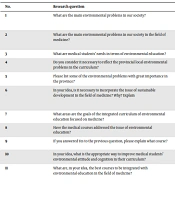
Designing and Validating an Integrated Environmental Education Curriculum Model for General Medicine
Saidi M, Shobeiri SM, Rezaee M, Ahmadi P. Designing and Validating an Integrated Environmental Education Curriculum Model for General Medicine. Educ Res Med Sci. 2021;10(2):e120546. doi: https://doi.org/10.5812/erms.120546
Effectiveness of Residents as Teachers, Researchers and Role Models: A Unique Program at SUMS
Bazrafkan L, Paknejad S, Ghayoomi MA, Kojuri J, Roozbeh J, et al. Effectiveness of Residents as Teachers, Researchers and Role Models: A Unique Program at SUMS. J Med Edu. 2015;14(2):e105425. doi: https://doi.org/10.22037/jme.v14i2.9241
More by these authors
- Scopus by DOI: 0
Last Update: 3 weeks ago
- Scopus by Title: 1
Last Update: 3 weeks ago
- Scopus by Title (Ref): 1
Last Update: 3 weeks ago
- CrossRef: 0
Last Update: 3 hours ago
- OpenAlex: 0
Last Update: 7 hours ago
- OpenCitations: 0
Last Update: 4 days ago
