
1. Background
As important educational systems, universities play a key role in the expansion and development of environmental knowledge. Salehi and Pazouki Nejad (1) conducted a study entitled the "Need for environmental education for university students", reporting that universities are faced with challenges and problems in scientific and specialized resources and curricula. Furthermore, students could become aware of their responsibility both as citizens and the future holders of social positions in order to preserve and protect the environment. In another study, Martínez-Borreguero et al. (2) introduced issues such as the lack of environmental activities, lack of knowledge about these activities, sustainable development in academic curricula, and the lack of support in this regard as the main challenges in sustainability and the environment.
Human’s distance from pristine and healthy nature, as well as the destruction of the environment to make a developed and industrial world, have led to various physical, mental, and psychological diseases (3). One of the most powerful means to reducing and stopping such irresponsible behaviors is to educate students in primary schools, high schools, and universities (4). As medical education is aimed at the diagnosis, treatment, and prevention of diseases through maintaining and promoting health, it is the first step toward providing health services to the community and the relationship between public health and diseases with environmental health and pollution. Therefore, environmental education is of utmost importance.
According to experts, an integrated design of subjects and curriculum plays a pivotal role in effective learning and enhances skills such as critical thinking, problem-solving, participation, and teamwork (5). Beerhoof is an environmental education expert who states that the citizens of the countries that have incorporated environmental education into their literature have better environmental behaviors, which could be achieved through revising the contents of textbooks (6). The curriculum is a means to attaining educational goals and may be viewed as the basis for transferring knowledge, attitudes, and behaviors to learners. Based on the definition of the educational design model by Razavi (7), a curriculum design model represents the process of designing the curriculum, as well as the main elements/stages of designing the curriculum and their correlations. Therefore, such a model is the merge of a curriculum, curriculum processes, and the associated contents to integrate learners' experiences (8).
Theories of adaptation, reconstruction, and social action are the basics of an environmental education curriculum as an interdisciplinary curriculum (9). Since university students and pupils may hold political and managerial positions in the future, Counts (10) believed that the education system should not be morally neutral, and students and teachers should be actively involved in social changes. Based on the theory of social action, Newmann, (11), stated that the goal is to optimize learners' environmental capability, suggesting an association between the ability to influence the environment and promote one’s perception of self as a moral agent. A moral agent is a person who takes thoughtful action through involvement in situations dealing with potential conflicts between self-interest and others’ interest or conflicts between the interests of different groups (8).
Martínez-Borreguero et al. (2) identified the possible causes of problems in sustainability and the environment as the lack and non-recognition of environmental activities and sustainable development in the university curriculum and a lack of support in this regard. On the other hand, Poursalim et al. (12) conducted a study via semi-structured interviews, discussing that the global citizen education model encompasses needs, goals, contents, teaching methods, teachers’ role, evaluation, time, space, materials/resources, organizational factors, tacit learning, and program outcomes. Willis and Weiser believe that environmental education is interdisciplinary and can be applied to any curriculum or problem-solving in any course (13). Hassan and Ismail believe that the purpose of environmental education is to combine environmental knowledge and awareness and attitudes, and believe that the combination of environmental education provides the basis for creating an environmentally friendly community (14).
A brief review of national and international research shows that the integration of a curriculum is widely acknowledged by professors and experts on all levels of education. Previous studies also recommend the development of science and highlight the need for the association between the curricula and students' and learners' future life due to the inefficiency of the current curricula. Other findings also suggest factors such as students' tendency to pass environmental courses in university, the role of learners (students) and professors in designing the curriculum, the impact of integration on improving an effective learning process, creating positive attitudes, critical thinking, and promoting students' decision-making power and understanding.
2. Objectives
However, this research seeks to achieve the following goals: (1) designing an integrated curriculum model for environmental education in medicine; (2) validation of the integrated curriculum model of environmental education in medicine.
3. Methods
This was an applied research in terms of objective and a mixed research in terms of data collection. A quantitative method was used to assess the students' attitudes toward environmental education, and a questionnaire was applied to collect the data. To achieve the research objectives, two questionnaires were developed in the areas of environmental cognition and attitude and provided to the students. The questionnaire of cognition consisted of 20 items on environmental education, environmental pollution, and the association between diseases and pollution, focusing on the field of medicine. The questionnaire of attitude had 15 items. The items of both questionnaires were designed by the researcher based on documentary studies, lived experiences, and expert opinions.
The study was conducted in 2019 at Isfahan University of Medical Sciences, Iran on 850 medical students. The sample size was determined to be 280 using the Morgan’s table. In total, 320 online questionnaires were distributed via a press line system and completed by the students. Based on content validity indices and the content validity ratio in the sample population of the students (n = 30) and professors (n = 11), the validity index of the questionnaire was estimated at 0.8. The reliability of the cognition questionnaire was calculated to be 0.7 using the Kuder-Richardson Formula 20 (KR-20) coefficient, and the reliability of the attitude questionnaire was estimated at 0.9 using the Cronbach's alpha, both of which were confirmed. To reduce the variables of the attitude questionnaire, the Kaiser-Meyer-Olkin (KMO) coefficient was estimated at 0.8 using factor analysis, and the Bartlett test was also considered significant, indicating good fit (P < 0.001).
Qualitative tools such as interviews and documentary studies were also used to collect data. The interview was designed to be semi-structured with 20 questions. The validity of the questionnaires items was confirmed by the professors of the curriculum planning and environment departments of Tabriz University, Isfahan University, Isfahan University of Medical Sciences, and Tehran Payam-e-Noor University. The interviewees were the professors and faculty members of the clinical, environmental health, and curriculum planning and education departments. The interviews continued until reaching data saturation. Five experts of environmental health, four experts of medical curriculum planning, one expert of health promotion and education, four clinical experts, and one expert of occupational (professional) health were interviewed. Following that, the interview responses were prioritized by quantitative and qualitative content analyses (repeating codes), coding, and recoding.
To confirm the reliability of the interviews, several factors were evaluated. First, the questions had to be the same for all the participants. Second, the options of each question were inserted and coded. During the interviews, if the participants expressed a different option from those inserted, the response would be written and considered in the analysis. The third factor was focused on structural analysis, content analysis, and coding methods (initial and recoding), which were used to analyze the interviews. The answers were presented in a table in which each option was inserted based on the repetition and prioritization of it, and the answers were transcribed following the research questions to design the integrated curriculum model. At the next stage, a specialized committee consisting of experts in curriculum, medicine, and the environment, who were recruited from medical universities, was asked for advice regarding the interview items and process. After conducting the interviews and extracting the options of the questions, the obtained results were provided to the experts to be confirmed and incorporated into the model in line with the research objectives. In the case of ambiguous answers during the interviews, the interviewer would repeat the question to the interviewee to prevent deviation. Finally, the interviews were recorded, and the researcher revised the transcriptions at every stage of the research to add or revise missing or misunderstood notes.
The interviews were analyzed in terms of medical courses and lesson plans by the researcher and confirmed by the professors so that the integrated model would be finally designed. Notably, the questionnaires of cognition and attitude contributed to determining the goals and areas of the curriculum model, and most of the model components were designed based on the conducted interviews, reviewed articles, and the documents available at the ministry level. Since the interview responses were in line with the stages of the curriculum model, the structure of the model was designed accordingly.
4. Results
The objective of the quantitative stage of the study was to evaluate students' recognition and attitude toward environmental education and meet their needs in terms of an environmental education curriculum. To analyze the scores of the cognition questionnaire, five levels of very weak (0 - 19%), weak (20 - 39%), medium (40 - 59%), good (60 - 79%), and very good (80 - 100%) were considered. The percentage of the scores obtained in the cognition questionnaire completed by the medical students was compared with these levels. By analyzing the questionnaires, it was observed that the students' cognition level was low in the three areas of environmental education, environmental pollution, and related diseases.
According to the analysis of the cognition questionnaire (Table 1), the students' cognition about the areas under study was weak and undesirable. The correct answers to the questions of environmental pollution were 12 and 8% more than those to the questions of environmental education and related diseases, respectively. This could be attributed to a brief explanation about environmental pollutions in the academic course of general health, which had been passed by the students.
Table 1.
Mean Percentage of Students' Correct Answers to Cognition Questionnaire in Three Areas
| Cognition Percentage | Environmental Education (8 Items) | Environmental Pollution (7 Items) | Diseases Caused by Environmental Pollution (5 Items) | Total Mean |
|---|---|---|---|---|
| Correct answers | 27.12 | 39.2 | 31.5 | 32.3 |
The items in the questionnaire of attitude were scored based on a Likert scale. Since the answers to the options of strongly agree and strongly disagree were few, the sum of these values was distributed between the two options of agree and disagree. Therefore, a table was designed in three scales, including agree, no idea, and disagree. As can be seen, factor analysis was used to reduce the variables due to their large number in the questionnaire of attitude. The Bartlett test (P < 0.001) and the KMO coefficient of 0.8 showed the good fit for the factor analysis of the attitude questionnaire. Finally, four variables were obtained from the variables of the attitude questionnaire (Table 2).
Table 2.
Percentage of Answers to Attitude Questionnaire for Variables Obtained by Factor Analysis
| Variables | Agree | No Idea | Disagree |
|---|---|---|---|
| Effect of environmental pollution on human health and illness | 91.2 | 7.3 | 1.5 |
| Environmental education and its effect on human's environmental problems and behavior | 76.5 | 20 | 3.5 |
| Integrating environmental education into medical curriculum | 76.4 | 14 | 9.6 |
| Need for environmental education for all medical fields | 78 | 16.2 | 5.8 |
The analysis of the data obtained from the students' attitude questionnaire indicated that more than 91% agreed with the effect of environmental pollution on human diseases and health. In addition, more than 76% of the students agreed that environmental education affects environmental behavior. More than 76% of the students also agreed with the issue of integrating environmental education into the medical curriculum. Furthermore, 78% of the students regarded environmental education as a necessity for all medical fields and confirmed its effect on solving environmental problems (Table 2). Therefore, it could be inferred that the students’ attitude toward the environmental education curriculum was positive, and they considered its integration into medical courses to be desirable.
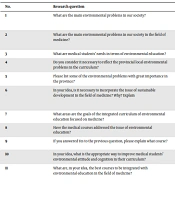
To analyze the interviews, the answers were prioritized using content analysis (initial coding and recoding). After conducting the interviews with 15 professors and faculty members, 555 codes were obtained, 47 of which were kept after listening to the recorded interviews twice, performing qualitative and quantitative content analyses, recoding the identical cases, and integrating the related cases. The codes were used in different stages of the model. A summary of the professors' and experts' statements is shown (Table 3).
Table 3.
Prioritized Answers of Interviews
| No. | Research Question | Prioritized Answers |
|---|---|---|
| 1 | What are the main environmental problems in our society? | (1) Air pollution; (2) Municipal, hospital, and industrial waste; (3) Water quality and pollution; (4) Soil pollution; (5) Culture and environmental attitude; (6) Excessive use of resources and plastic products; (7) Food pollution; (8) Radiation and waves; (9) Polluting industries. |
| 2 | What are the main environmental problems in our society in the field of medicine? | (1) Improper management of hospital waste; (2) Failure to comply with standards in disinfecting the environment and hospitals; (3) Inappropriate ventilation inside the hospital; (4) Physicians' unawareness of standards of pollution; (5) Diseases caused by pollution, especially waste in the environment. |
| 3 | What are medical students' needs in terms of environmental education? | The three areas of cognition, attitude, and practice. |
| 4 | Do you consider it necessary to reflect the provincial local environmental problems in the curriculum? | Yes |
| 5 | Please list some of the environmental problems with great importance in the province? | (1) Air pollution, especially particulate matter; (2) Industrialization of the province; (3) Water problems; (4) Subsidence of land; (5) Climate problems and Gavkhooni swamp; (6) Radiation; (7) Waste management, especially medical waste. |
| 6 | In your idea, is it necessary to incorporate the issue of sustainable development in the field of medicine? Why? Explain | Yes, it is necessary because development does not only rely on the number of graduated people, but healthy and developed human is the basis of sustainable development, and it should be designed by needs assessment in dimensions of improving health in the society. However, according to statements of a professor, it is to some extent taught in the course of preliminary prevention. |
| 7 | What areas are the goals of the integrated curriculum of environmental education focused on medicine? | The three areas with the focus on practical areas. |
| 8 | Have the medical courses addressed the issue of environmental education? | Most professors answered No. Only 3 stated that it is discussed to a limited extent in the course of Generalities of Health under air pollution and waste. |
| 9 | If you answered Yes to the previous question, please explain what course? | Only 3 professors stated that it is discussed to a limited extent in the course of Generalities of Health under air pollution and waste. |
| 10 | In your idea, what is the appropriate way to improve medical students' environmental attitude and cognition in their curriculum? | The professors of medicine, curriculum, and health promotion (7 professors) emphasized integration, and the professors of the environment and professional health (6 professors) emphasized an independent course along with its integration. |
| 11 | What are, in your idea, the best courses to be integrated with environmental education in the field of medicine? | All the interviewees believed that it should be started from the basic sciences field and continue to the clinical field. The fields of medicine are basic sciences, physiopathology, internship, and clinical fields. The interviewees stated that the clinical field can have the highest effect on students' performance. They generally stated, about other courses, that medical concepts, generalizations, and terms should be included in the basic sciences field, and practice should be trained in medical-social internship and the clinical field. The basic sciences courses such as physics, chemistry, epidemiology, ethics, Quran interpretation, family and population knowledge, health in disasters, and Islamic culture and civilization, can be integrated with environmental education. Moreover, the topics of the relationship between diseases and the environment and pollution in the course of diseases in the field of physiopathology can be incorporated. Especially emerging and re-emerging diseases can be incorporated in the internship and clinical fields. Environmental education should be trained in the form of groups, case studies, and reporting diseases caused by the environment. The important note is to define the syllabus that plays an important role in giving importance to the topic of environmental education; that is, failure to define the syllabus leads to disregarding the environmental education in courses and topics. |
| 12 | In your idea, what is the most appropriate method to teach integrated environmental education in the field of medicine? | In order of priority, it is problem-solving, critical thinking, ethical training or modeling especially by clinical professors, discussion group, conducting projects, group work, fieldwork, case study, and scenario. |
| 13 | In your opinion, what is the appropriate method to evaluate integrated environmental education in the field of medicine? | All the interviewees confirmed both developmental and final term methods but, regarding the evaluation of performance, they emphasized the need for observing students' behavior in the field and clinical (OSCE Method) about environmental issues, diseases, and providing case reports. |
| 14 | Have you considered environmental education as a way of prevention, concerning environmental problems? | All the interviewees believed in environmental education to resolve problems, and according to the mission of the medical sciences and the Ministry of Health, they considered it important and necessary. |
| 15 | In your opinion, is it possible to integrate environmental education into your field of study, i.e. medicine? | All the interviewees agreed that medicine can be linked to the issue of environmental education. They stated that primary prevention and environmental specialists should play a role and an independent course should be devoted to environmental education. |
| 16 | Have you ever discussed an environmental problem in medicine? Explain | One of the participants explained a related discussion in the clinical field. This participant had a related experience dressing a diabetic wound. Another participant had such an experience in research projects, and other participants did not. In this regard, the integration of environmental issues long with identification of its topics will play an effective role. |
| 17 | Can such experiences be enhanced? How can they be operationalized? | Yes, they can be enhanced because the physicians are unaware of the issue, so there must be taken measures to make all clinical professors concern about the environmental issues and transfer their knowledge and experiences to students. |
| 18 | Students are not sensitive and knowledgeable about this issue. What should be done to influence students' behavior and attitude? | The issue can be sensitized at the Ministry and curriculum levels as well as educational settings. More importantly, those who are concerned about the environment should find their place in the curriculum. |
| 19 | What is the most appropriate time to teach environmental education? Why? | It should be incorporated in all stages of the plan. It should be practically planned in clinical rounds. |
| 20 | Are the courses of internship, behavior with a patient, and in clinics and hospitals effective on this issue? | Yes. According to medical professors, the highest practical effect and the integration of knowledge attitude, and practice takes place in this course because the student is objectively involved with environmental issues; so students are suggested to perform case studies. |
The interviews consisted of 20 brief questions, with questions 1, 2, 4, 5, and 6 addressing needs assessment, questions 3 and 7 focused on different areas (cognition, attitude, and practice), questions 8, 9, and 11 addressing the content, question 10 addressing the need for the integration of environmental education into medicine, question 12 addressing teaching methods, question 13 addressing evaluation methods, questions 14 - 16 focused on the need for environmental education in the field of medicine, questions 17 and 18 evaluating the need for an environmental education curriculum, and questions 19 and 20 addressing the appropriate time for teaching different fields of environmental education curriculum in the field of medicine in the proposed model (Table 3).
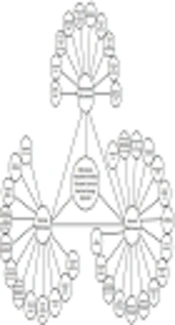
The integrated curriculum model was designed in 11 steps. The first step was needs assessment in three areas of environmental education, society, and medical students. The second step was goals in three cognitive, attitudinal, and skill (practice) domains. The third step was curriculum content in two areas of selecting and organizing the content. The fourth step was defining the educational fields and lesson plan. The fifth step was defining learning and teaching strategies. The sixth step was implementation and the role of professors. The seventh step was learning materials and resources. The eighth step was student grouping, and the ninth step was educational setting in terms of areas, the tenth step was the time of teaching in terms of areas, and the eleventh step was assessment and evaluation. The proposed model was based on an integrated curriculum and designed based on the foundations of constructivism and cognitive, social action, and social adjustment theories.
4.1. Model Validation
In the first method (i.e., asking for experts' opinions), the designed model was provided to 15 experts and professors of environmental health, medicine, social medicine, and medical science curriculum. The experts' opinions were considered in some stages of the model and have been further discussed below.
The curriculum experts emphasized separate areas in the model and selected a research method in line with the areas of skills and attitude. Furthermore, they considered student grouping for virtual learning during the COVID-19 pandemic. To address these opinions, a lesson plan was prepared on a daily and yearly basis with a pre-determined duration of time and syllabus for each subject. These issues were predicted in the model as well. In line with the opinions of the curriculum experts, the areas were presented separately in the model, and the research method encompasses the areas of skills and attitude. Due to the COVID-19 pandemic, measures such as student grouping and group practices/tasks could be accomplished in virtual education systems. Moreover, student grouping could be performed in the fields of internship given the small number of students during the COVID-19 pandemic. In the present study, the medical professors confirmed all the stages and the generality of the model.
In the current research, the experts were asked to provide their opinions about the second method (i.e., CVR). CVR had three options of necessary, helpful but unnecessary, and unnecessary (15). The method was validated by a formula in which the number of the experts who chose the option ‘necessary’ deducted from half of the experts. The result was divided by half the number of the experts. Using the formula, the content validity was calculated to be one for the 11 stages of the model based on the opinions of 13 experts (seven environmental experts, two medical experts, one expert in professional health, and three curriculum experts), confirming its validity. The designed model of the research is depicted (Figure 1).
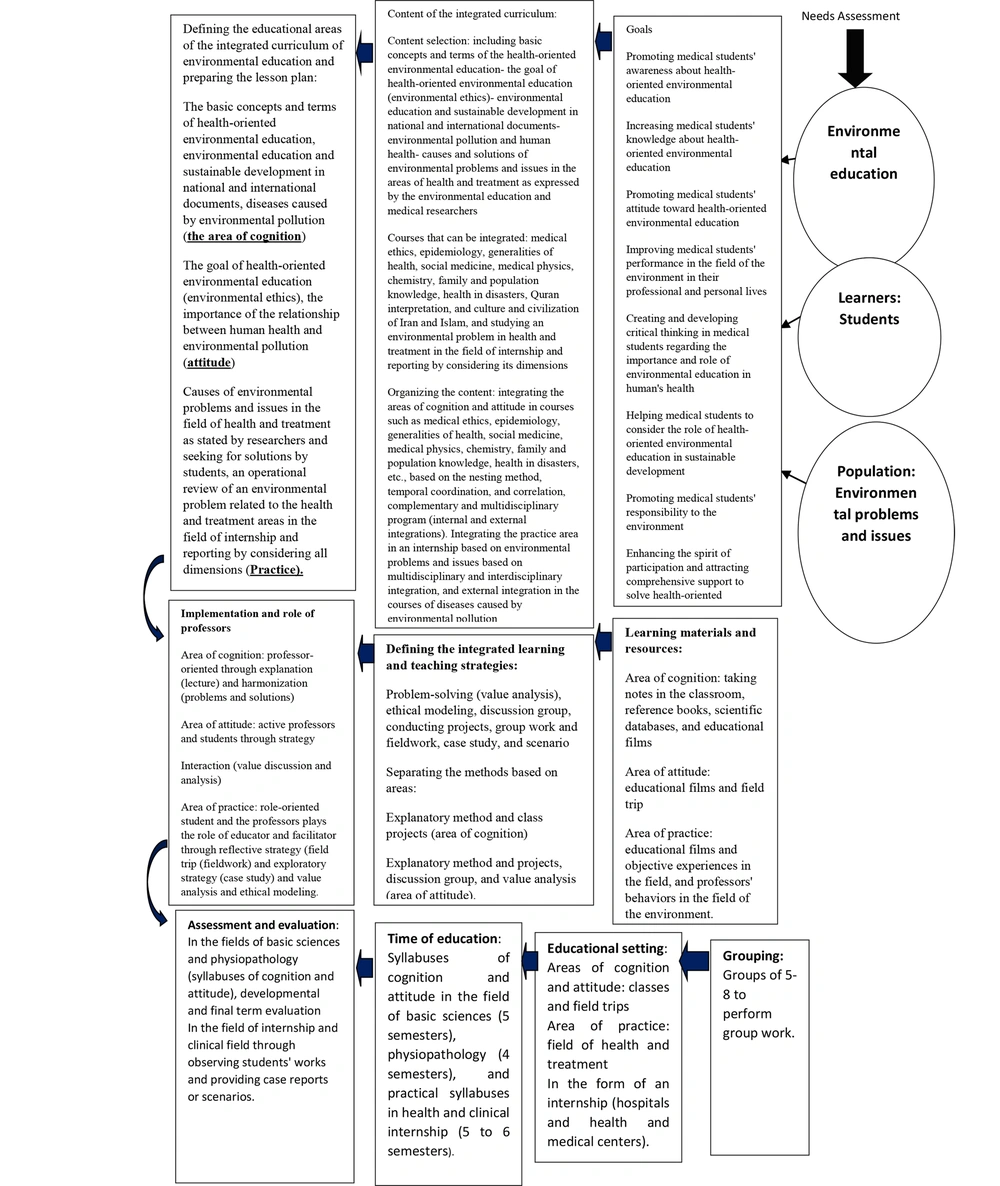
Figure 1.
Environmental education integrated curriculum model in field of medicine
5. Discussion
In general, education provides deeper insight, as well as knowledge, awareness, and skills, in learners. Given the need for individuals who are able to cope with environmental crises and reduce/resolve these issues, medical education could be the ‘stepping stone’ for designing an integrated curriculum that could bridge this gap.
In the present study, the variables of the integrated curriculum were obtained through conducting the interviews and collecting the questionnaires. The answers helped the researcher design the variables of the proposed model. Furthermore, the model structure was derived from the curriculum models developed by Klein (1991) (16) and Klein (2006) (17), given the maximum consistency of the data obtained from the interviews, questionnaires, and analysis of documents and texts in the present study and the previous models in this regard. The environmental experts mainly emphasized three areas of cognition, attitude, and performance, while the curriculum experts focused on attitude and performance, and the medical experts placed an emphasis on knowledge and performance. Finally, the variables were distributed and classified into three main areas.
According to the analysis of the medical students' cognition and attitude questionnaires (Tables 1 and 2), the students, as the main clients of the curriculum design process both as university students and citizens, agreed with integrating environmental education curriculum into the curriculum of medical fields. This is in line with the results obtained by Alavi Moghaddam et al. (18), which showed that students agreed with integrating environmental subjects into their curriculum. Moreover, this perspective and attitude would be effective in attaining the goals of the environmental education curriculum in terms of implementation to observe the effect of the audience (students) on accepting the curriculum. This is in line with the studies by Ngan and Sim (19) and Alavi Moghaddam et al. (18). Notably, the process of integrating a curriculum for implementation requires the support of staff and line levels. Finally, this process should be achieved gradually, and the designed curriculum should also be consistent with common learning styles and local realities.
Studying the documents and interviews in the present study revealed that despite the large population of medical students, the issue of environmental education in this field has been neglected. We aimed to bridge this gap, resolve environmental problems, and determine the impact of students as the future holders of social, political, and economic positions in this regard. By interviewing with the participants and collecting the questionnaires, the variables of the integrated curriculum were obtained, and the environmental experts focused on three areas of cognition, attitude, and practice.
The integrated design of the model in the present study is in line with the opinions of researchers such as Estrada (20), Colorado et al. (21), and Mahmoodi and Cheraghi (22). They considered the use of interdisciplinary and multidisciplinary approaches to environmental education to be appropriate and the society to be of higher validity in the implementation and effectiveness of these methods. This is also in line with the opinions of Ngan and Sim (19) and Zamanifar et al. (23).
In the proposed model of the current research and the stage of organizing the content, we used the nesting method, temporal coordination, and a correlation, complementary, and multidisciplinary program (internal and external integrations). This is in line with the study by Willis and Weiser (13) on environmental education as they also used multidisciplinary and interdisciplinary approaches. The present study and the proposed model aimed to describe the stages in a coordinated manner based on the opinions of experts and the needs of society to be of high efficiency in the stages of implementation and effectiveness. This is in line with the results obtained by Zamanifar et al. (23).
Since the proposed model in the current research is an integrated model aimed at making an association between the subjects with a single subject and concept, educational fields such as medical physics, demography, Islamic ethics, and knowledge could also be integrated into the model based on medical professors' opinions regarding the subjects of the environment; these subjects could be integrated into environmental education using nesting or interdisciplinary methods.
5.1. Conclusions
The main feature of the integrated model in this study was to make an association between various subjects with a single subject in response to society's needs and problems without adding a separate course. Using different subjects and communication focused on important social issues are the main concerns and important goals of curriculum experts. Due to its integrated features, the model presented in this study applies to all stages of medical education and may result in effective interactions between students and environmental education during the seven-year education period; this proves the efficiency of the model if implemented properly. Considering the environmental education subjects based on health-oriented environment and its effects on physical, mental, and social health, the proposed model has first recognized the contents of the existing medical curricula (i.e., disease prevention and treatment and the position of integration in content organization). Following that, the contents of the model are selected and reflected in the integrated approaches of the model. Furthermore, the model encompasses thematic knowledge, efficient knowledge, and functional knowledge for environmental education in medicine in the form of an integrated curriculum. It is expected that the proposed model be not only applied to one field, but that it would also extend to other medical fields and be a proper model for other higher education disciplines after approval and implementation with staff level support (Ministry of Health, Treatment, and Medical Education) and line level support (universities, professors, and faculty members).