
1. Background
Rotator cuff tendinopathy is a clinical disorder in which the soft tissue of the shoulder joint becomes painful. Patients with rotator cuff tendinopathy experience pain when raising their arms or lying on the injured side (1). Shoulder pain is a common complaint of patients of all ages during daily activities, and about one-third of these individuals experience this pain throughout their lives. This type of pain can lead to shoulder joint dysfunction and a severe reduction in quality of life. Rotator cuff tendinopathy, defined as shoulder impingement disease, is one of the most common causes of shoulder pain and may contribute to shoulder pain in 56% of the cases. A common symptom of rotator cuff tendinopathy is pain localized to the acromial anterolateral region, extending laterally to the mid humerus. The experience of pain at night is another significant complaint of these patients. Moreover, there may be an overall decrease in muscle strength (2). The etiology of this disease is multifactorial and results from the interaction of internal and external factors (3). Rotator cuff tendinopathy accounts for 35% of shoulder disorders and has the highest incidence among shoulder disorders (4).
The treatment aims to relieve the pain and restore the joint function. Conservative and surgical methods can lead to very good results in about 10% of the patients (1). The most common treatments in relieving shoulder pain symptoms are steroid injections, physiotherapy, oral NSAIDs, and "waiting and seeing," Each of which has been scientifically tested to prove its effectiveness. According to previous studies, physiotherapy, as the most common treatment, has certainly not been effective in this case. On the other hand, the ultrasound treatment has been documented to have few effects on shoulder pain treatment (5).
Acupuncture, which is two thousand years old, originates from China. This technique is based on the meridians and the qi energy flow (6). Pain and tension are thought to occur when energy flow is disrupted, and the stimulation of acupuncture points improves obstruction. According to the theory of traditional Chinese medicine, pain is caused by blood stasis or Qi stagnation (7). Qi stagnation is a stasis of blood flow, and the function of the liver is believed to be controlling Qi. Liver dysfunction, caused by stress, leads to Qi stagnation. Accordingly, there is thrombosis or coagulation, leading to various diseases. In traditional Chinese medicine, pain occurs in a meridian when normal blood flow or Qi is cut off. Meridians are the pathway of energy in the body, which includes several acupuncture points working together. The stimulation of one of the acupuncture points in a meridian can improve pain in other parts of the same meridian (8).
The 1970s marked the beginning of a scientific study on acupuncture, and since then, acupuncture has been used as an alternative treatment for pain relief. Acupuncture has a neuroregulatory effect on CNS and activates pain-regulating or multiple analgesic systems involved in neurotransmitters such as internal opioids. The analgesic action mechanism in acupuncture is the induction of the production and the release of endogenous opioids. When pain is relieved using acupuncture, there is an increase in endorphins in the cerebrospinal fluid. Another theory indicates the descending adrenergic agents, serotonergic pathways, which stimulate the interneuron connections of the posterior horn of the spinal cord gray matter or the interneuron connections of the spinal cord neurons, and the trigeminal nerve nucleus. Pain transfer from the first to the second neuron is inhibited using enkephalin (9).
In 2020, Ben-Arie et al. conducted a meta-analytic study to examine the effectiveness of acupuncture in treating frozen shoulders. The results showed that acupuncture could be safe and effective in reducing pain, restoring shoulder function, and restoring flexion ROM for FS patients in the short-and mid-term. However, there is no sufficient evidence in this regard as such further high-quality, and longitudinal studies are required to confirm the evidence (10). Lathia et al. used acupuncture to treat chronic shoulder pain. The results showed that acupuncture might be an effective treatment for chronic shoulder pain, and there may be no difference between individualized treatment and standardized acupuncture treatment in terms of effectiveness (11).
Many studies have examined the effect of acupuncture on shoulder pain, especially on frozen shoulders. However, in particular, no study has addressed the effect of acupuncture on cuff tendinopathy. Since no study has evaluated the effectiveness of acupuncture on some of the evaluated points in this study in treating rotator cuff tendinopathy, the present study aimed to evaluate the effectiveness of acupuncture in reducing pain and improving shoulder function in patients with rotator cuff tendinopathy.
2. Objectives
3. Methods
3.1. Participants
This study was a randomized clinical trial on 40 patients aged 18 - 60 years, who referred to a medical-educational center in Isfahan, Iran, from May 2020 to March 2021. Patients with rotator cuff tendinopathy were assessed in terms of inclusion criteria. The study was then explained to the eligible patients, and their informed consent was received. The eligible patients with informed consent were randomly assigned to one of the two study groups (n = 20 per group). Simple randomization was used to allocate the patients to the groups. In this study, allocation concealment was performed using sequentially numbered, sealed, opaque envelopes. To avoid bias in interpretation, the researcher in charge of the data analysis was blinded to the type of intervention in each group. Figure 1 shows the consort diagram of the study.
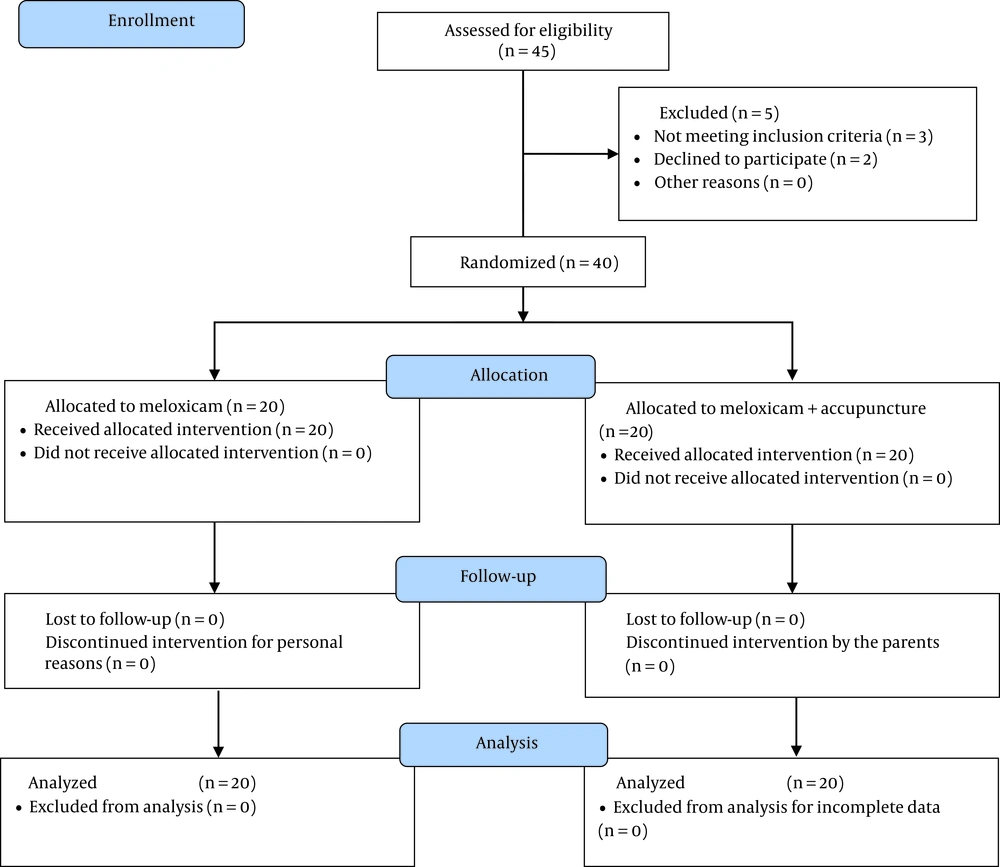
Figure 1.
Evaluation of pain indices and shoulder function in patients (P-values based on paired sample t-test)
Inclusion criteria included patients aged 18 - 60 years, who could submit their informed consent to participate in the study with unilateral rotator cuff tendinopathy and the absence of visible pathology on shoulder X-ray. Exclusion criteria were unwillingnessss to participate in the study, uncontrolled seizure disorder, needle insertion site infection, and allergic reaction to meloxicam. Patients with a history of shoulder injuries, including surgery, fracture, direct or indirect injuries needing traction, and patients with known systemic diseases such as renal, coagulative, rheumatologic, or neurologic disorders.
Rotator cuff tendinopathy was defined as a clinical disorder, in which the soft tissue of the shoulder joint becomes painful on arm abduction or laying down on the injured side. The definite diagnosis was made by a physiatrist using history and physical examination (painful arc test, Neer test, Hawkin test, and lift-off test). The range of motion was assessed using a goniometer, with the head placed in the anterior axillary line and the patient abducting his/her shoulder in the coronal or frontal plane. The angles at which pain started and finished were also recorded.
3.2. Ethical Considerations
The study protocol was approved by the Ethics Committee of the Isfahan University of Medical Sciences (Code: No. IR.MUI.MED.REC.1398.621) and was also registered on the Iranian Registry of Clinical Trials (IRCT20200514047443N1).
3.3. Intervention Method
Patients in both groups took meloxicam 15 mg with food once daily for two weeks and underwent exercise therapy three times a week for three weeks. The exercise routine consisted of stretching the posterior capsule, stretching the trapezius muscle, Codman pendulum exercise, and wall walking. Each movement continued for 20 seconds and was repeated five times.
The patients assigned to the intervention group also underwent acupuncture. Acupuncture was done three times a week for three weeks. This treatment was performed by a specialist trained in acupuncture. Every point of the skin was sterilized before inserting the needles. Acupuncture was performed at 10 points using a sterile 25 mm × 25 mm disposable acupuncture needle: LI14 (10, 12, 13), LI15 (10, 12, 13), LI16 (10), ST36 (13), ST38 (12), GB34 (13), SI9 (12), SI10 (13), SI11 (14), and SI12 (14). The needle was inserted at a depth of 0.5 - 1 cm. The needle was inserted at the desired point, and the patient remained sitting while the legs were hanging off of the chair. These ten sites were selected based on the common points in previous studies and some new points. The needle remained in place for 20 minutes.
3.4. Data Collection Method
The patients were randomly assigned into acupuncture (group A) and control (group B) groups. Before beginning treatment, a questionnaire was used to record demographic information (age, gender, occupation), previous experience of shoulder pain, neck pain, duration of shoulder pain, previous treatment, and intensity of general pain before the study and over the night using a visual analog scale (VAS), shoulder function using the Disabilities of the Arm, Shoulder, and Hand (DASH) Questionnaire, shoulder painful range of motion using a goniometer, and type of analgesic pill used in the last two weeks. The intensity of pain, shoulder function, and the painful shoulder’s range of motion were recorded after completing the treatment sessions (after three weeks of treatment) and three months after the completion of treatment. Visual Analog Scale (VAS) was used to measure the severity of pain based on a scaled line from 0 to 10, where zero means completely painless and 10 indicates the most severe pain. The VAS is a standard tool to measure pain intensity and is widely used in Iran. The scientific validity and reliability of the pain measurement scale have been analyzed in several studies. Williamson and Hoggart confirmed the validity and reliability of this tool as such, it can be used for treatment (15). Moreover, the validity and reliability of this tool were approved previously (16). Furthermore, the acceptable validity and reliability of this tool is also reported in the reference nursing books (Brunner & Suddarth's Internal and Surgical Nursing) (16).
The Disabilities of the Arm, Shoulder, and Hand (DASH) Questionnaire measured shoulder function (measure outcome 30 questions). This questionnaire consists of 30 questions on the symptoms and function of the upper limbs involved in orthopedic and neurological disorders. Each items is responded based on a six-point sacle, ranging from 1 for no difficulty and no symptoms to 6 for unable to perform the activity and the most severe symptoms. The final score is the sum of the scores (=160). The increase indicates more involvement of the upper limb (160 for severe disability), and the decrease represent its less involvement (30 for no disability). In addition to the 30 questions of this questionnaire, there are two series of optional four-item questions called DASH of sports/arts and DASH of occupation, which are scored as above. This questionnaire was translated into Persian and validated in 2008 by Mousavi et al. (17).
3.5. Statistical Methods
SPSS software version 22 was used for the data analysis. Quantitative data were reported as mean ± SD, and qualitative data were described as No. (%). Independent t-test, ANOVA Repeated Measure, and chi-squared tests were used for the data analysis. In all tests, P < 0.05 was set as the significance level.
4. Results
Out of the 40 patients, 16 (40%) were male, and 24 (60%) were female. The mean and standard deviation of patients' age was 46.02 ± 12.85 years, and the duration of shoulder pain was 3.87 ± 4.13 years. The other demographic information of the patients, including occupation, previous experience of shoulder pain, neck pain, previous treatment, and analgesic use, is reported in Table 1.
Table 1.
Patients’ Demographic Information
| Variables | Groups | P-Value | ||
|---|---|---|---|---|
| Total | Meloxicam | Acupuncture + Meloxicam | ||
| Age | 46 ± 12.86 | 44.3 ± 11.15 | 47.6 ± 14.34 | 0.4333 |
| Gender (female) | 24 (60) | 11 (55) | 13 (65) | 0.5239 |
| Job | ||||
| Engineer | 3 (7.5) | 3 (15) | 0 (0) | 0.0754 |
| Nurse | 4 (10) | 2 (10) | 2 (10) | 1 |
| Housewife | 14 (35) | 7 (35) | 7 (35) | 1 |
| Teacher | 3 (7.5) | 3 (15) | 0 (0) | 0.0754 |
| Freelancer | 6 (15) | 2 (10) | 4 (20) | 0.3819 |
| Retired | 3 (7.5) | 1 (5) | 2 (10) | 0.5533 |
| Unemployed | 1 (2.5) | 0 (0) | 3 (15) | 0.0754 |
| Not mentioned | 3 (7.5) | 2 (10) | 1 (5) | 0.5533 |
| Previous shoulder pain | 2 (5) | 0 (0) | 2 (10) | 0.1519 |
| Neck pain | 7 (17.5) | 1 (5) | 6 (30) | 0.0399 |
| Previous treatment | 2 (5) | 0 (0) | 2 (10) | 0.1519 |
| Analgesic use | 1 (2.5) | 0 (0) | 1 (5) | 0.3173 |
This research examined the pain index between the two acupuncture and meloxicam groups. The research results are reported in Table 2 and Figure 2. According to the results reported in Figure 1, both methods reduced the pain index. However, the acupuncture method revealed a more significant reduction than meloxicam.
Table 2.
Evaluation of Pain Indices and Shoulder Function in Patients a
| Variables | Before | First Follow-up | Second Follow-up | P-Value b | F | ||||||
|---|---|---|---|---|---|---|---|---|---|---|---|
| Meloxicam | Acupuncture + Meloxicam | P-Value c | Meloxicam | Acupuncture + Meloxicam | P-Value c | Meloxicam | Acupuncture + Meloxicam | P-Value c | |||
| VAS | 6.6 ± 1.4 | 7.1 ± 1.8 | 0.241 | 4.4 ± 1.9 | 2.5 ± 1.7 | 0.004 | 5.6 ± 2.1 | 1.4 ± 1.6 | < 0.001 | < 0.001 | 14.394 |
| DASH | 57.0 ± 15.3 | 59.3 ± 13.3 | 0.611 | 33.1 ± 12.2 | 22.7 ± 12.4 | 0.011 | 47.0 ± 15.6 | 11.2 ± 13.1 | < 0.001 | < 0.001 | 15.443 |
| Minimum painful Arc | 65.7 ± 9.6 | 76.5 ± 13.5 | 0.008 | 81.9 ± 13.5 | 95.2 ± 11.6 | 0.003 | 72.6 ± 11.7 | 87.0 ± 15.1 | 0.02 | 0.024 | 5.717 |
| maximum painful arc | 123.1 ± 10.6 | 121.2 ± 8.0 | 0.532 | 115.5 ± 7.4 | 114.4 ± 7.2 | 0.653 | 118.9 ± 8.7 | 112.5 ± 8.8 | 0.072 | 0.322 | 1.017 |
a Values are expressed as mean ± SD.
b P-Value for repeated measures test (group × time)
c P-Value for independent sample t-test (compare groups at the same times)
This study examined the DASH index between the two intervention groups. The study results are reported in Table 2 and Figure 2. According to the results in Figure 2, both methods reduced the DASH index. However, the acupuncture method revealed a more significant reduction than meloxicam.
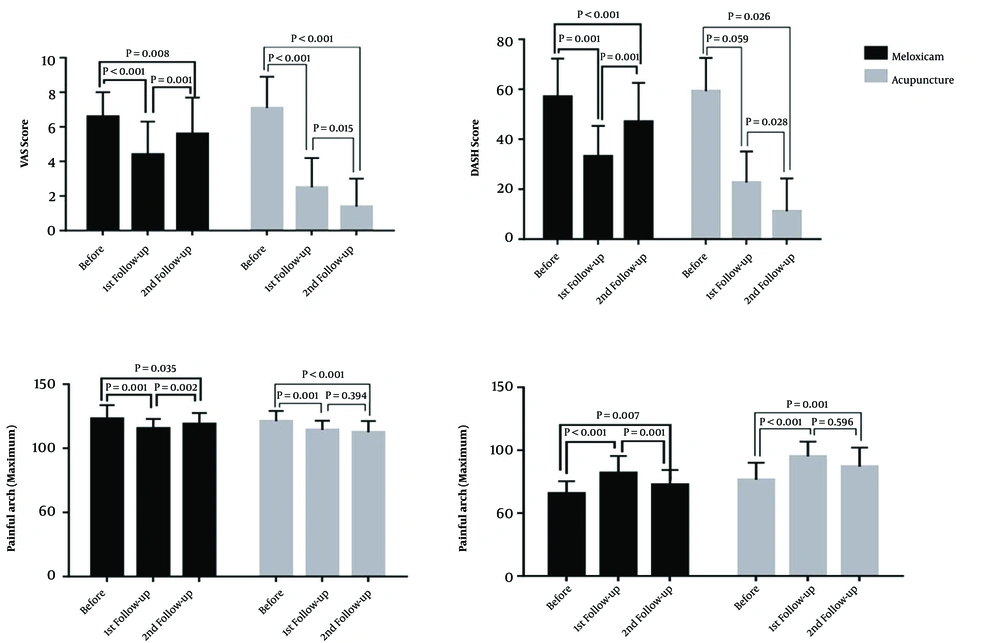
Figure 2.
Evaluation of pain indices and shoulder function in patients (P-values based on paired sample t-test)
This study examined the painful-arch-max and painful-arch-min, and the results are reported in Table 2 and Figure 2. According to the results, painful-arch-min improved in both groups; however, its effect in the acupuncture group was more significant than meloxicam. Pain-arch-max was improved in both groups, and there was no significant difference between the two groups.
5. Discussion
This study examined the effectiveness of acupuncture in reducing pain and improving shoulder function in patients with rotator cuff tendinopathy. The research results showed that both methods reduced pain, decreased the DASH index, and improved the painful arc. This effect was significantly greater in the acupuncture group (P < 0.001). The maximum range of motion inshoulder without pain was significantly improved in both groups compared to the pre-treatment preriod; however, there was no significant difference between the two groups (P > 0.05).
According to this study, acupuncture had acceptable effectiveness in treating rotator cuff tendinopathy. In previous studies, acupuncture also revealed favorable results in treating rotator cuff tendinopathy. In a review study by Rueda Garrido (18), acupuncture was used to treat rotator cuff tendinopathy active points, namely SJ14 Jian, LI16 Ju Gu, LI15 Jian Yu, SI 9 Jian Zhen, Liao, and distal points LI4 He Gu, and S38 Tiao Kou. The results of this study implied a significant reduction in pain and improved function in the acupuncture group compared to the Sham group, which is consistent with the results of the present study. In another study by Itoh et al., acupuncture was used to treat chronic shoulder pain at the trigger point. The results showed that acupuncture at the trigger point significantly reduced chronic shoulder pain compared to the Sham group (19), which is also consistent with the present results. In a study conducted by Molsberger et al., acupuncture was performed one to three treatments a week for a total of 15 treatments. Acupuncture was reported to be more effective than sham in the study (12). Our results are also in line with the findings of Vas et al. (13). In their study, acupuncture plus physiotherapy was superior to physiotherapy alone for pain reduction and function improvement in painful shoulder treatment.
To justify this study's findings and compare them with other findings, acupuncture seems to have a neuroregulatory effect on the CNS and activates pain-regulating or multiple analgesic systems involved in neurotransmitters such as internal opioids. The analgesic action mechanism in acupuncture is the induction of the production and the release of endogenous opioids. There is an increase in endorphins in the cerebrospinal fluid when acupuncture relieves pain. Another theory indicates the descending adrenergic agents and serotonergic pathways, which stimulate the interneuron connections of the posterior horn of the spinal cord gray matter or the interneuron connections of the spinal cord neurons, and the trigeminal nerve nucleus.
Pain transfer from the first to the second neuron is inhibited using enkephalin (9). On follow-up, no complication such as pain or hematoma is observed in our cases. One of the limitations of this study is the small sample size. A similar study is recommended to be conducted with a larger sample size in future studies. Moreover, more extended follow-up periods and more acupuncture needle injection sites may be examined for future studies.
5.1. Study Limitations
This study was not a double-blinded clinical trial as such, it suffers from many limitations. The patients randomized into the control group may or may not have reported different scores. This small study with limited participants assessed the effectiveness of acupuncture in treating this disease. With the result of this primary study being promising, future studies can compare sham procedures with acupuncture to remove possible bias from patient reporting and placebo effect.
5.2. Conclusions
According to the research findings, acupuncture can reduce pain and improve shoulder function in patients with rotator cuff tendinopathy.