
1. Background
Shoulder tendinopathy can be attributed to various factors, including excessive movement in daily activities, overloading of the musculature, sedentary lifestyle, stress, and advanced age. Patients with rotator cuff tendinopathy commonly experience insidious and intense pain localized in the superior and lateral parts of the shoulder. This condition also leads to impaired range of shoulder motion and muscle weakness, resulting in disability. Pain typically worsens during shoulder extension, particularly between 60 and 120°, which restricts joint movement and causes weakness in the shoulder joint muscles (1).
Nam and Lee emphasized the prioritization of conservative treatment for shoulder tendinopathy. This approach includes the use of anti-inflammatory drugs to alleviate pain, enhance range of motion, strengthen shoulder muscles, and ultimately stabilize the joint to improve quality of life without resorting to surgical intervention (2). However, it is important to note that the use of anti-inflammatory drugs can cause adverse effects, which often are more severe than the shoulder tendinopathy itself. These effects may include gastrointestinal reactions, such as gastric and duodenal ulcer formation, elevated blood pressure, and circulatory disorders (3). Moreover, anti-inflammatory drugs can impact muscle strength and elasticity (4).
Advancements in science and technology have led to the development of physical therapy devices, such as exercise therapy, ultrasound, cold therapy, and the use of lasers. These innovations have the potential to provide fundamental treatment for shoulder tendinopathy-related pain (5). Exercise therapy, in particular, has been extensively studied and confirmed as an effective and beneficial treatment for shoulder tendonitis, as evidenced by numerous review articles (6, 7). There has been ongoing discussion regarding the impact of incorporating new modalities, such as lasers, on treatment outcomes (8). The emergence of high-power lasers, specifically class 4 lasers that often use multiple wavelengths simultaneously with a power of more than 1000 mW, represents a recent development in laser therapy. These lasers are expected to offer greater penetration depth and more effective treatment due to the absorption of various wavelengths at different tissue levels and higher output energy compared to low-power lasers (9, 10).
Research has demonstrated that the application of high-intensity low-intensity (HILI) light, penetrating the keratinous body of humans and animals, can elicit inflammatory responses (11). Some of these responses resemble those induced by inflammation mediators, including increased expression of cytokines and chemokines (12). Laboratory studies have proposed that the laser's mechanism of action involves enhancing cellular activity, promoting anti-inflammatory elements, and stimulating collagen synthesis (13).
Failure to address the pain and inflammation associated with shoulder tendinopathy can lead to chronicity, making treatment challenging and resulting in patient disability. Hence, it is crucial to initiate treatment during the acute and early stages of the condition (14). Laser therapy for the treatment of musculoskeletal disorders has been the subject of numerous studies, and its positive effects have been highlighted in several systematic reviews (15-17).
2. Objectives
We designed this study to investigate the effect of high-power laser treatment on shoulder tendinopathy in comparison to standard non-steroidal anti-inflammatory drug (NSAID) treatment. The study aims to assess the magnitude and duration of its effects in the short and long term, specifically in improving the clinical symptoms of patients with rotator cuff tendinopathy.
3. Methods
This study was conducted as a randomized, single-blind clinical trial. All patients who were referred to the physical medicine and rehabilitation clinics of Isfahan University of Medical Sciences in 2022 were included in this study. They were diagnosed with shoulder impingement syndrome based on their medical history and physical examination, which involved assessments such as the painful arc, Neer, Hawkin, etc. The diagnosis was made under the supervision of a physical medicine specialist. Patients were then evaluated for the presence of rotator cuff tendinopathy and subsequently included in the study.
To determine the sample size, we followed the approach used in previous studies and used the statistical formula:
Considering a 10% potential dropout rate, we aimed to include at least 19 participants in each group. Thus, to account for potential dropouts, we selected 21 participants for each group. In the formula, Z1 represents the 95% CI (1.96), Z2 represents the 80% test power coefficient (0.84), S represents the estimated average SD of the variables in both groups, and d represents the minimum significant difference in the average of each variable between the 2 groups, set at 0.9 S (18).
To initiate the study, approval was obtained from the ethics committee of the university, and subsequently, it was registered with the code IRCT20200825048515N52 on the Iranian Registry of Clinical Trials. The study commenced following these steps. The inclusion criteria for patients were as follows: Unilateral shoulder rotator cuff tendinopathy, patient consent and willingness to participate in the study, age between 18 and 65 years, symptom duration of less than 3 months, no previous treatment interventions within the past 3 months (e.g., shoulder joint steroid injections or physical therapy). Furthermore, there were specific contraindications for laser treatment, including a history of cancer, treatment at sites of bleeding, individuals with pacemakers or other implanted devices, treatment at sites of infection, treatment on light-sensitive areas, treatment on sympathetic nerves, vagus and heart in cardiopathic patients (19). Exclusion criteria included surgical interventions, fractures near the shoulder, severe direct or indirect injuries resulting from stretching, generalized musculoskeletal or nervous disorders, lymphedema, high blood pressure, coagulation disorders, heart disease, liver disease, kidney disease (creatinine more than 1.5), use of certain medications, inability to communicate effectively, and cognitive impairment.
The failure of patients to attend follow-up visits during and after the intervention, despite researcher efforts to follow up, was considered an exclusion criterion for the study.
Patients were randomly assigned to 2 groups using permuted block randomization with block sizes of 2. Group A received high-power laser treatment and exercise, while group B received meloxicam (NSAID) treatment and exercise. Each group consisted of 21 participants. Each patient was assigned a unique code, and these codes were kept confidential during the evaluation of the results.
Before starting the treatment, a checklist was used to record demographic information such as age, height, and weight for each patient. The primary outcome measure was pain intensity, which was assessed using the Visual Analog Scale (VAS). The VAS is a numerical scale ranging from 0 to 10, with 0 representing no pain and 10 representing the most severe pain. Secondary outcomes were a painful range of motion of the shoulder during the abduction, patients abducting the shoulder from a neutral position, when the hands were in pronation, and the point of onset of pain to the end of pain was measured with a goniometer, and shoulder performance, which was measured by the Disabilities of the Arm, Shoulder, and Hand (DASH) questionnaire outcome measure with 30 questions. The DASH questionnaire consists of 30 questions related to upper limb symptoms and function in orthopedic and neurological disorders. Each question has 5 response options, ranging from 1 (no difficulty or symptoms) to 5 (inability to perform activities and severe symptoms). The total score ranges from 30 to 150, with higher scores indicating greater disability and lower scores indicating less disability. The Farsi translation of the DASH questionnaire was validated in 2008 by Mousavi et al. (20).
Outcome assessments were conducted at baseline (before treatment), immediately after the completion of treatment, and 3 months after the last treatment session.
3.1. The Working Method of Group A
The patient was placed in a sitting position. The high-power laser treatment in group A was administered in 2 stages based on previous research conducted (21). In the first stage, a slow scan (100 cm2/min) was performed along the rotator cuff tendons with an average of 10 - 15 J/cm2. The maximum energy received during this stage was 3000 J. The second stage involved targeting the painful muscle points around the shoulder, joint line, and acromioclavicular joint. Each point received 10 - 15 J/cm2, with a maximum energy of 2000 J. The output power settings for each wavelength were as follows: 810 wavelengths at 3 and 1.5 W outputs, 910 wavelengths at 300 and 0.1 W outputs, and 1064 wavelengths at 2 and 1 W outputs. The pulse frequency was set at 6000, with a duty cycle of 50%. The total output power was 2.6 W. Each patient received a total of 10 laser sessions, alternating every other session, with a frequency of 3 sessions per week.
The treatment method for group B involved exercise therapy and the administration of meloxicam tablets. In this group, the only pharmaceutical intervention consisted of taking 1 meloxicam tablet (15 mg) with food once a day for a duration of 2 weeks. The exercise therapy (lasted 3 weeks) was the same in both groups and included the following self-treatment exercises to be performed by the patients: Posterior capsule stretching, trapezius muscle stretching, Codman's pendulum exercise, and finger wall walking. Each exercise was to be performed 3 times a day for a duration of 20 seconds, with 3 sets each time.
Once the pain was reduced, the patient was instructed in strengthening exercises for the rotator cuff and shoulder girdle muscles. These exercises included shoulder shrugs, adduction against resistance, abduction against resistance, internal rotation against resistance, and external rotation against resistance. The patients' performance of the exercises was verified through phone calls and questioning.
The device used in the study was the LUMIX® C.P.S.® device manufactured by Fisioline in Italy. Data analysis was conducted using independent t tests and balloon analysis with repeated measures (if the data followed a normal distribution) or Mann-Whitney and Friedman tests (if the data did not follow a normal distribution). The statistical software used was SPSS version 22. The significance level for the tests was set at 0.05.
4. Results
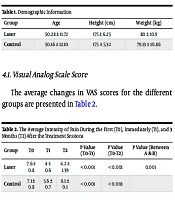
In this study, demographic information did not differ significantly between the 2 groups (Table 1).
Table 1.
Demographic Information
| Group | Age | Height (cm) | Weight (kg) |
|---|---|---|---|
| Laser | 50.28 ± 11.72 | 175 ± 6.25 | 80 ± 10.9 |
| Control | 50.16 ± 12.10 | 175 ± 5.32 | 79.13 ± 10.86 |
4.1. Visual Analog Scale Score
The average changes in VAS scores for the different groups are presented in Table 2.
Table 2.
The Average Intensity of Pain During the First (T0), Immediately (T1), and 3 Months (T2) After the Treatment Sessions
| Group | T0 | T1 | T2 | P-Value (T0-T1) | P-Value (T0-T2) | P-Value (Between A & B) |
|---|---|---|---|---|---|---|
| Laser | 7.6 ± 0.8 | 4 ± 0.6 | 4.2 ± 1.39 | < 0.001 | < 0.001 | 0.001 |
| Control | 7.1 ± 0.8 | 5.6 ± 0.7 | 6.1 ± 0.1 | < 0.001 | < 0.001 |
To compare the mean changes in pain scores between the high-power laser group and the control group, the TMS test was used. Statistically, the magnitude of these changes was significantly greater in the high-power laser group (P = 0.001).
4.2. Disabilities of the Arm, Shoulder, and Hand Questionnaire Score
The average changes in DASH scores for the different groups are presented in Table 3.
Table 3.
Average Disabilities of the Arm, Shoulder, and Hand at the First (T0), Immediately (T1), and 3 Months After the Treatment Sessions (T2)
| Treatment Methods | T0 | T1 | T2 | P-Value (T0-T1) | P-Value (T0-T2) | P-Value (Between A & B) |
|---|---|---|---|---|---|---|
| Laser | 92.2 ± 5.2 | 63.88 ± 6.7 | 71.1 ± 1.5 | < 0.001 | < 0.001 | 0.001 |
| Control | 98.3 ± 5.7 | 73.6 ± 9.7 | 82.6 ± 5.9 | < 0.001 | 0.002 |
A comparison of the mean score changes between the high-power laser group and the control group was conducted using an independent t test, revealing that these changes were significantly higher in the high-power laser group (P = 0.001).
Range of motion of the shoulder (abduction) is shown in Table 4.
Table 4.
Average Painful Range of Motion at the First (T0), Immediately (T1), and 3 Months After the Treatment Sessions (T2)
| Treatment Methods | T0 | T1 | T2 | P-Value (T0-T1) | P-Value (T0-T2) | P-Value (Between A & B) |
|---|---|---|---|---|---|---|
| Laser | 52.92 ± 1.2 | 19.6 ± 1.7 | 30.1 ± 1.5 | < 0.001 | 0.002 | 0.20 |
| Control | 58.68 ± 2.1 | 34.8 ± 1.7 | 43.2 ± 1.9 | < 0.001 | 0.001 |
The results of the mean difference test for independent groups showed that the difference in the mean difference of painful shoulder range of motion between the intervention and control groups is not statistically significant (P = 0.20).
5. Discussion
In the context of seeking more effective and affordable treatments for shoulder tendinopathy to be used in routine clinical practice, the present study investigated the effect of high-power laser treatment on improving the clinical symptoms of patients with rotator cuff tendinopathy. The study aimed to explore the potential for increased penetration depth and energy density at the treatment site (21).
In this study, the average scores of the VAS questionnaire significantly decreased after treatment in both the high-power laser groups (54.6%) and the control group (29.7%), as well as after 3 months of treatment in both the high-power laser groups (42.4%) and the control group (11.7%), compared to the first treatment session. The within-group statistical differences were also significant. These findings were consistent with the studies conducted by Conforti and Fachinetti, and Notarnicola et al. (18, 22).
In this study, the comparison of changes in the average pain score during 10 treatment sessions and after 3 months of treatment between the high-power laser group and the control group demonstrated the superiority of the high-power laser in reducing pain compared to the control group. These findings were consistent with the studies conducted by Aceituno-Gomez et al., Kamal et al., and Pekyavas and Baltaci, reporting the effectiveness of laser therapy in reducing pain associated with shoulder tendonitis. This effect may be attributed to the reduction of inflammation and faster repair of shoulder rotator cuff tendons by laser therapy (23-25).
Furthermore, the average scores of the DASH questionnaire significantly decreased after treatment in both the high-power laser groups (42.4%) and the control group (19.7%), as well as after 3 months of treatment in both the high-power laser groups (34.4%) and the control group (11.7%). The difference between the groups was statistically significant. This finding supports the studies conducted by Akbari, Notarnicola et al., and Bingol et al., which also found the superiority of high-power laser therapy compared to control in terms of DASH score improvements (18, 26, 27). This information can aid therapists in making more effective treatment decisions for rotator cuff conditions.
Additionally, the assessment of shoulder range of motion after 10 treatment sessions revealed improvements in both the high-power laser group (73.3%) and the control group (66.7%), as well as after 3 months of treatment in the high-power laser group (66.7%) and the control group (48.9%). These improvements were found to be significantly different from the pre-treatment measurements. These findings are consistent with Ahmed's study, further supporting the positive impact of laser therapy on shoulder range of motion (23). This study has several important limitations, including a short follow-up period and a relatively small number of participants.
5.1. Conclusions
It appears that high-power laser therapy is more effective in reducing pain and improving shoulder function compared to standard NSAID treatment. Additionally, it demonstrates at least a similar effect in reducing painful range of motion in the shoulder. Furthermore, these effects have shown long-term durability. These findings suggest that high-power laser therapy can be considered a suitable treatment option for therapists, particularly for patients who have contraindications to the use of NSAIDs, before resorting to invasive interventions. However, it is important to note that further studies with larger participant groups and longer follow-up periods are necessary to prove this claim.