
1. Background
The physical and psychological conditions of the work environment are closely related to the health of people. A building with optimal criteria will provide security and a sense of peace to the people living in the building (1). Good indoor air quality is an important component of a healthy work environment. Indeed, poor indoor air quality can cause health problems such as breathing problems, eye irritation, sinusitis, allergic reactions, pneumonia, and bronchitis (2, 3). People in contact with unfavorable indoor air have different reactions, including temperature irritation, suffocation, and unpleasant odors, as well as non-specific symptoms with unclear causes such as sick building syndrome (SBS) and diseases related to the building, such as hypersensitivity, pneumonia, asthma, and legionellosis (4, 5).
Sick building syndrome is a disease related to indoor air quality that irritates the respiratory, skin, and nervous systems and, thus, can result in headache, confusion, nausea, cough, irritation of the mucous layer, skin inflammation, and itching (6). The severity of this disease depends on the duration of the person's presence in the building. Also, SBS refers to a condition in which building occupants suffer from nasal, skin, or eye discomfort, which are relieved when the occupants leave the building (4, 7). Besides, SBS causes employees to complain about indoor air quality, which affects health and productivity. Having one year of work experience and the presence of two of the above symptoms is considered a diagnosis of SBS (8, 9). Both individual and environmental factors may contribute to the development of SBS. The amount of ventilation, the total level of volatile organic compounds, humidity, light, and sound are among the environmental factors. Personal factors also include socio-economic status, quality of life, job satisfaction, and stress caused by work (10-12).
According to the World Health Organization, the prevalence of SBS in office and residential buildings is estimated at 30% (13, 14). According to the report of the National Occupational Safety and Health Association of Iran, about 13% of the health problems caused by the building are related to SBS (15-17). In the health service system, medical staff play an important role in improving community health and care services. Due to the continuous presence, the hospital is one of the settings wherein medical staff are exposed to injuries and risks caused by SBS. Improving the conditions of the working environment can increase motivation and productivity and, thus, can improve the performance of these employees (18, 19).
2. Objectives
Considering the importance of SBS in the performance and efficiency of hospital treatment staff and the lack of sufficient studies in this field, the present cross-sectional study aimed at evaluating the prevalence of SBS and its related factors in a university hospital in Semnan, Iran.
3. Methods
3.1. Study Design and Subjects
The present cross-sectional study was conducted on 300 employees working in Kausar Hospital, the largest medical center in Semnan Province, in 2020. Inclusion criteria consisted of medical staff working in Kausar Hospital who were willing to participate in the study. Exclusion criteria included a history of acute or chronic respiratory disease, having active neurological, skin, and digestive diseases, and unwillingness to participate in the study. The sample size was calculated as 300 participants, considering α level of 0.05, P = 40% (based on previous studies in Iran (20), and 1-β of 80%. Indeed, a total of 890 people were working as medical staff in Kausar Hospital. We read the medical records of the participants, of which 610 were eligible for inclusion in the present study. Finally, 300 medical staff were selected by random sampling and agreed to participate in the present study.
3.2. Data Collection
Demographic and occupational variables were obtained by researcher-developed questionnaires. The MM 040 EA standard questionnaire was used to obtain information about SBS and indoor air quality. We used a Persian version of the questionnaire already tested for validity and reliability in Iran (21, 22). In the SBS questionnaire, in order to identify sick people, the answers to the questions related to the symptoms are divided into sometimes, often, and never. At the same time, it is asked whether the work environment causes these symptoms. People who frequently or occasionally experience one or more general or neurological symptoms, such as a heavy head, headaches, nausea, and respiratory symptoms like irritation, itching, runny nose, sneezing, dry throat, cough, and facial redness, are classified as positive cases of SBS.
In the second part of the study, random samples were taken from various areas of the hospital to assess environmental factors. This included conducting building inspections, collecting dust samples, and measuring indoor and outdoor air quality within the building. A Wet Bulb Globe Temperature (WBGT) device was used to check the condition of physical factors, including temperature, humidity, and ventilation. Special detector tubes were used in all sections to determine the concentration of carbon dioxide (CO2) and carbon monoxide (CO). Also, the weight method was used to assess the amount of general dust in the work environment. The NIOSH 0800 method was used to measure the biological status of the working spaces in terms of fungal and bacterial contamination. The culture medium used was manufactured by Merck (Germany) and included Sabouraud Dextrose Agar (SDA) for fungal microbial agents and Chapman Agar for bacterial agents.
3.3. Study Conduct
First, the objectives of the research were explained to all participants. Instructions to complete the questionnaire were presented in a training session. Then, the employees who agreed to participate in the study were given questionnaires and asked to complete them if they had a suitable opportunity during their shift. Otherwise, they were asked to take the questionnaire home and hand it over to the researcher after completion in the next shifts.
3.4. Statistical Analyses
Statistical analyses were done by SPSS 26. The prevalence of SBS and its components in the study participants and based on sex were reported using the number and frequency (%). A chi-squared test was applied to investigate the relationship between demographic variables, harmful physical factors, and the prevalence of SBS. Also, a P-value < 0.05 was considered statistically significant.
3.5. Ethics Consideration
First, the objectives of the research were explained to the study participants. Second, an informed consent form was obtained from all participants. The study was done under consideration of the instructions outlined in the Declaration of Helsinki. The Ethics Committee of the Semnan University of Medical Sciences approved the study protocol (ID: IR.SEMUMS.REC.1395.155).
4. Results
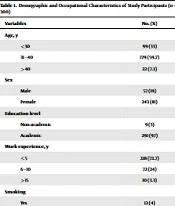
A total of 300 medical staff working in Kausar Hospital of Semnan City participated in the present study. Table 1 presents the demographic characteristics of the study participants. The mean ± standard deviation of age was 32.23 ± 5.34 years; 81% were women, and 91% had an academic degree. Of the study participants, 72.7% had a work experience of less than 5 years, 96% had no history of smoking, and 88% were medical staff. Table 2 shows the prevalence of SBS according to the hospital wards. The overall prevalence of SBS in hospital staff was 65%, with the highest prevalence in the emergency ward (17.9%), followed by the internal ward (15.9%), ICU (12.8%), and CCU (11.8%).
Table 1.
Demographic and Occupational Characteristics of Study Participants (n = 300)
| Variables | No. (%) |
|---|---|
| Age (y) | |
| <30 | 99 (33) |
| 31 - 40 | 179 (59.7) |
| >40 | 22 (7.3) |
| Sex | |
| Male | 57 (19) |
| Female | 243 (81) |
| Education level | |
| Non-academic | 9 (3) |
| Academic | 291 (97) |
| Work experience (y) | |
| ≤ 5 | 218 (72.7) |
| 6 - 10 | 72 (24) |
| >15 | 10 (3.3) |
| Smoking | |
| Yes | 12 (4) |
| No | 288 (96) |
| Type of work | |
| Educational | 7 (2.3) |
| Administrative | 27 (8.7) |
| Therapeutic | 264 (88) |
| Service | 2 (1) |
Table 2.
Number of Participants with Sick Building Syndrome According to Hospital Wards a
| Hospital Ward | Sick Building Syndrome | Total | |
|---|---|---|---|
| No | Yes | ||
| Heart | 12 (11.4) | 8 (4.1) | 20 (6.7) |
| Surgery | 15 (14.3) | 17 (8.7) | 32 (10.7) |
| Psychic | 4 (3.8) | 1 (0.5) | 5 (1.7) |
| Internal | 18 (7.1) | 31 (15.9) | 49 (16.3) |
| ICU | 10 (9.5) | 25 (12.8) | 35 (11.7) |
| CCU | 5 (4.8) | 23 (11.8) | 28 (9.3) |
| Emergency | 16 (15.2) | 35 (17.9) | 51 (17) |
| Endoscopy | 1 (1) | 2 (1) | 3 (1) |
| Dialysis | 3 (2.9) | 9 (4.6) | 12 (4) |
| Radiology | 5 (4.8) | 7 (3.6) | 12 (4) |
| Laboratory | 3 (2.9) | 7 (3.6) | 10 (3.3) |
| Surgery room | 4 (3.8) | 10 (5.1) | 14 (4.7) |
| Urinary-educational | 9 (8.7) | 10 (0.2) | 29 (9.6) |
| Total | 105 (100) | 195 (100) | 300 (100) |
a Values are expressed as No. (%).
Table 3 shows the prevalence of SBS components in the study participants. Sleep disorder (65%), tiredness (58.7%), feeling heavy (46.7%), headache (46.3%), and stress (45.3%) were the most common reported symptoms of SBS. The prevalence of tiredness, cough, skin dryness, flaking, itchy scalp, and dry hands was higher in women than in men. There was no sex difference in the prevalence of other SBS components.
Table 3.
Number of Sick Building Syndrome Components in Study Participants a
| Variables | Total | Male | Female | P-Value b |
|---|---|---|---|---|
| Tiredness | 0.02 | |||
| Yes | 176 (58.7) | 40 (70.2) | 136 (56) | |
| No | 124 (41.3) | 17 (29.8) | 107 (44) | |
| Feeling heavy | 0.23 | |||
| Yes | 140 (46.7) | 31 (54.4) | 109 (44.9) | |
| No | 160 (53.3) | 26 (45.6) | 134 (55.1) | |
| Headache | 0.78 | |||
| Yes | 139 (46.3) | 27 (47.4) | 112 (46.1) | |
| No | 161 (53.7) | 30 (52.6) | 131 (53.9) | |
| Nasal congestion | 0.35 | |||
| Yes | 14 (4.7) | 3 (5.3) | 11 (4.5) | |
| No | 286 (95.3) | 54 (94.7) | 232 (95.5) | |
| Concentration disorder | 0.74 | |||
| Yes | 75 (25) | 15 (26.3) | 60 (24.7) | |
| No | 225 (75) | 42 (73.7) | 183 (75.3) | |
| Itchy eyes | 0.31 | |||
| Yes | 43 (14.3) | 7 (12.3) | 36 (14.8) | |
| No | 257 (85.7) | 50 (87.7) | 207 (85.2) | |
| Dryness of voice | 0.67 | |||
| Yes | 39 (13) | 7 (12.3) | 32 (13.2) | |
| No | 261 (87) | 50 (87.7) | 211 (86.8) | |
| Cough | 0.01 | |||
| Yes | 45 (15) | 5 (8.8) | 40 (16.5) | |
| No | 255 (85) | 52 (91.2) | 203 (83.5) | |
| Skin dryness | 0.02 | |||
| Yes | 23 (7.7) | 2 (3.5) | 21 (8.6) | |
| No | 277 (92.3) | 55 (96.5) | 222 (91.4) | |
| Flaking and itchy scalp | 0.01 | |||
| Yes | 13 (4.3) | 1 (1.8) | 12 (4.9) | |
| No | 287 (95.7) | 56 (98.2) | 231 (95.1) | |
| Dry hands | 0.01 | |||
| Yes | 58 (19.3) | 4 (7) | 54 (22.2) | |
| No | 242 (80.7) | 53 (93) | 189 (77.8) | |
| Stress | 0.87 | |||
| Yes | 136 (45.3) | 25 (43.9) | 111 (45.7) | |
| No | 164 (54.7) | 32 (56.1) | 132 (54.3) | |
| Nervousness | 0.15 | |||
| Yes | 114 (38) | 18 (31.6) | 96 (39.5) | |
| No | 186 (62) | 39 (68.4) | 147 (60.5) | |
| Sleep disorder | 0.20 | |||
| Yes | 195 (65) | 44 (77.2) | 152 (62.1) | |
| No | 105 (35) | 13 (28.8) | 92 (39.7) |
a Values are expressed as No. (%). Nosebleed was not included in this table since it did not have the assumptions of the chi-square test.
bObtained by chi-square test.
Table 4 shows the relationship between the prevalence of SBS and physical harmful factors. All participants reported sufficient information and were eligible for inclusion in the present study. We found a statistically significant relationship between the prevalence of SBS and the existence of harmful environmental factors related to noise, static electricity, and unpleasant smell (P-value < 0.05). There was no association between the prevalence of SBS and the presence of other environmental factors such as low and high light, dust, smoking, low room temperature, intermittent change of temperature, high temperature of the room, and wind (P-value > 0.05).
Table 4.
Relationship Between Sick Building Syndrome and Physical Harmful Factors in Study Participants (n = 300) a
| Physical Factor | Sick Building Syndrome | P-Value b | |
|---|---|---|---|
| Yes | No | ||
| Low and high light | 0.07 | ||
| Yes | 116 (69.5) | 51 (30.5) | |
| No | 79 (59.4) | 54 (40.6) | |
| Dust | 0.23 | ||
| Yes | 118 (67.8) | 56 (32.2) | |
| No | 77 (61.1) | 49 (38.9) | |
| Noise | 0.001 | ||
| Yes | 154 (70.3) | 65 (29.7) | |
| No | 41 (50.6) | 40 (49.4) | |
| Smoking | 0.70 | ||
| Yes | 92 (69.3) | 52 (36.1) | |
| No | 103 (66) | 53 (34) | |
| Static electricity | <0.001 | ||
| Yes | 57 (51.4) | 54 (48.6) | |
| No | 138 (73) | 51 (27) | |
| Unpleasant smell | <0.001 | ||
| Yes | 160 (72.7) | 60 (27.3) | |
| No | 35 (43.8) | 45 (56.3) | |
| Low room temperature | 0.73 | ||
| Yes | 108 (65.9) | 156 (34.1) | |
| No | 87 (64) | 49 (36) | |
| Intermittent change of temperature | 0.31 | ||
| Yes | 105 (62.5) | 63 (37.5) | |
| No | 90 (62.8) | 42 (31.8) | |
| High temperature of the room | 0.91 | ||
| Yes | 112 (64.7) | 31 (35.3) | |
| No | 83 (65.4) | 44 (34.6) | |
| Wind | 0.09 | ||
| Yes | 61 (58.7) | 43 (41.3) | |
| No | 134 (68.4) | 62 (31.6) | |
a Values are expressed as No. (%).
b Obtained by chi-square test.
Table 5 presents the association between demographic variables and the prevalence of SBS. The results suggested a significant relationship between SBS and colleagues' cooperation in completing work tasks, as well as infection. Participants who reported higher levels of colleagues' cooperation in their work and those who had an infection had a higher prevalence of SBS compared to those who did not. There was no significant relationship between SBS and work experience (P-value > 0.05).
Table 5.
Relationship Between Sick Building Syndrome and Demographic Variables in Study Participants a
| Variables | Sick Building Syndrome | P-Value b | |
|---|---|---|---|
| No | Yes | ||
| Work experience | 0.27 | ||
| ≤ 5 | 79 (36.2) | 139 (63.8) | |
| 6 - 10 | 25 (34.7) | 47 (65.3) | |
| > 15 | 1 (10) | 9 (90) | |
| Colleagues' cooperation in doing work | <0.001 | ||
| No | 57 (47.1) | 64 (52.9) | |
| Yes | 48 (26.8) | 131 (73.2) | |
| Having an infection | 0.045 | ||
| No | 84 (38.4) | 135 (61.6) | |
| Yes | 21 (25.9) | 60 (74.1) | |
a Values are expressed as No. (%).
b Obtained by chi-square test.
5. Discussion
The present study evaluated the prevalence of SBS and its components in the medical staff working in a university hospital in Semnan. The results showed that the overall prevalence of SBS in hospital staff was relatively high, with the highest prevalence being observed in the emergency ward, followed by the internal ward, ICU, and CCU. Sleep disorder, tiredness, feeling heavy, headache, and stress were the most common symptoms of SBS. The prevalence of tiredness, cough, skin dryness, flaking, itchy scalp, and dry hands was higher in women than in men. Our result showed a statistically significant relationship between the prevalence of SBS and the presence of harmful environmental factors related to noise, static electricity, and unpleasant smell. We also found a significant relationship between SBS and colleagues' cooperation in doing work and infection.
The WHO has defined SBS as a common complication among office workers with symptoms such as inflammation of the eyes, nose, throat, skin, dry cough, confusion, dizziness, fatigue, and sensitivity to smells (13, 14). These complications are related to the length of stay at the workplace, most of which disappear after leaving the environment. Non-engineering building design, workers' activities, improper ventilation, and chemical and biological pollutants are some of the factors that can cause SBS (23, 24). Studies have shown that SBS is a multi-causal phenomenon that is related to various environmental and personal risk factors, as well as psychological and social factors (25, 26).
In the current study, the overall prevalence of SBS in hospital employees was 65%. A similar prevalence (64.7 - 74.1%) was seen in a cross-sectional study of hospital staff in Turkey (7). In the study by Vafaeenasab et al., the prevalence of SBS in hospital nurses in Yazd in central Iran was reported as 86.4% in 2014 (22). Khosravinejad et al. reported that the prevalence of this syndrome in hospital employees in Ilam, Iran, was 40.7% in 2018 (20). Other studies conducted in Turkey and Taiwan indicated that the prevalence of SBS in hospital workers was 20.9% and 84%, respectively (20, 27). In a study conducted in Malaysia, the prevalence of SBS in old and new university buildings was 33.8% and 47.5%, respectively (28). The observed difference in the prevalence of SBS across the world can be due to the difference in the design and type of building, physical and chemical factors of the work environment (e.g., lighting, sound, equipment, gases, and vapors), ventilation, people's work type, job satisfaction, and personal sensitivity. The relatively high prevalence of SBS in the hospital staff in the present study may be caused by people's active environment and other environmental factors.
In the present study, the most common symptoms in patients with SBS were sleep disorder, tiredness, feeling heavy, headache, and stress. In the study of Etemadinezhad et al. in 2017, the most common symptoms of this syndrome among bank employees were fatigue and headache (29). The most common symptoms of SBS in other studies conducted among medical staff were chronic fatigue (89.6%) and headache (83.3%) (19), lack of concentration (60.2%) and fatigue and headache (58.3%) (21), nasal symptoms (66%) and eye symptoms (53%) (19), and dry skin (40.85%) and runny nose (31%) (28). In a large cross-sectional study conducted on 3 485 residents of Chinese residential buildings, the most common symptoms were fatigue and headache (30). The reasons for the difference in the prevalence of SBS symptoms across studies can be attributed to high work pressure or work shifts, longer working hours, exposure to chemicals such as disinfectants, unpleasant odors in the work environment, people's sensitivity, and poor ventilation in the work environment.
In the present study, we found a significant relationship between SBS and harmful environmental factors such as noise, static electricity, and unpleasant smell. In the study of Vafaeenasab et al., unpleasant odor in the workplace and the amount of workload were among the most important environmental factors affecting the occurrence of SBS (22). Epidemiological research has shown that the high prevalence of SBS symptoms may be related to high microbial indoor air. The high number of patients seeking medical attention at the hospital, along with the overcrowding of patients in different wards, can lead to excessive noise and congestion. This can disrupt the focus of the medical staff. On the other hand, this crowding can lead to highly humid weather and pave the ground for the growth of microorganisms on different surfaces, which may ultimately contribute to the high prevalence of SBS in hospitals (31, 32).
This study has a number of limitations. First, this is a cross-sectional study, and thus, it may be hard to determine the temporal sequence of exposures and outcomes (33, 34). Therefore, prospective cohort studies may be needed to present robust evidence. Second, we did not measure chemical (e.g., formaldehyde, VOCs, CO2) and biological (bacteria and fungi) parameters of the environment due to the lack of facilities and equipment. Third, there was no examination of job satisfaction and sleep quality of hospital employees in the present study. Fourth, the number of men included in the study was small, and thus, the results are not generalizable to men. Therefore, similar studies may be needed to investigate the associations in men.
5.1. Conclusions
Considering the relatively high prevalence of SBS in hospital employees and its effects on their performance, efficiency, and quality of services, re-engineering the hospital environment and improving the air quality and ventilation systems of the hospital seem necessary to reduce the prevalence of SBS and its symptoms.