
1. Background
Academic achievement is a fundamental indicator used to assess the effectiveness of educational systems and reflects the quality of students' learning (1). This concept generally refers to the extent to which students attain educational goals, as reflected in their academic grades, learning progress, and ability to apply acquired knowledge in educational contexts (2). Academic achievement is influenced not only by cognitive abilities but also by emotional, motivational, familial, and social factors, all of which play decisive roles (3). Statistical evidence and official reports in Iran indicate that a considerable proportion of students, particularly at the upper secondary level, face challenges such as academic underachievement, reduced motivation, test anxiety, and educational inequalities. These challenges may lead to outcomes such as school dropout, reduced human capital, and limited future educational, occupational, and social opportunities (4). Accordingly, academic achievement, as a key variable, has both individual consequences and broader social implications.
In this context, enhancing students' academic progress in Iran has become a major priority of the educational system (5). The highly competitive nature of the national university entrance examination, increasing parental expectations, economic pressures, and regional disparities in access to educational resources have intensified the need to focus on psychological factors that influence academic achievement (6). Improving academic performance not only contributes to greater self-efficacy, academic satisfaction, and students' mental health but also plays a crucial role in promoting educational equity, sustainable development, and the growth of national human capital (7). Therefore, identifying the psychological mechanisms underlying academic achievement can provide a scientific foundation for educational policies and interventions.
Among the key variables that have attracted increasing scholarly attention in recent years are metacognitive beliefs and academic expectations stress (8-11). Metacognitive beliefs, according to Wells' metacognitive theory, specifically the self-regulatory executive function model (12), refer to individuals' attitudes and beliefs about their thoughts, memory, and cognitive control processes. In this model, these beliefs are not merely descriptive but represent procedural plans that guide how individuals respond to their own cognitions. The most widely used instrument for assessing these beliefs is the MCQ-30 (12). This questionnaire measures five distinct but related dimensions of metacognitive beliefs: 1) positive beliefs about worry, for example, "worrying helps me cope"; 2) negative beliefs about the uncontrollability and danger of thoughts, for example, "my thoughts are dangerous"; 3) cognitive confidence, or lack of confidence in one's memory and attention; 4) need to control thoughts, for example, "I must control my thoughts"; and 5) cognitive self-consciousness, or excessive monitoring of one's thoughts. Dysfunctional metacognitive beliefs, particularly negative beliefs about uncontrollability and danger, are posited to activate the cognitive attentional syndrome, a persistent pattern of worry, threat monitoring, and maladaptive coping that depletes cognitive resources and undermines academic performance. Academic expectations stress, on the other hand, arises from perceived pressures imposed by parents, teachers, and students themselves to achieve high academic success (13). Regarding the localization of the MCQ-30 in Iran, several psychometric studies have confirmed its validity and reliability within the Iranian cultural context. For instance, Shirinzadeh Dastgiri, Goodarzi, Rahimi, and Naziri (2008) validated the Persian version of the MCQ-30 among Iranian university students and reported acceptable internal consistency (Cronbach α > 0.70) for all five subscales. These findings collectively indicate that the original five-factor structure of the MCQ-30 is replicable and applicable for assessing maladaptive metacognitive beliefs among Iranian student populations. Research indicates that adaptive metacognitive beliefs can enhance academic achievement by reducing worry and improving emotional regulation, whereas maladaptive metacognitive beliefs may indirectly undermine academic performance by increasing academic expectations stress (13). Accordingly, academic expectations stress may function as a mediating variable in the relationship between metacognitive beliefs and academic achievement.
Despite the growing body of research on metacognitive beliefs, academic stress, and academic achievement, the simultaneous examination of these variables within a causal framework, particularly with an emphasis on the mediating role of academic expectations stress, has received limited attention (1). Many previous studies have been confined to bivariate relationships and have neglected the examination of mediating mechanisms. Moreover, most existing research has been conducted in metropolitan and relatively advantaged areas, whereas indigenous data from less-developed regions of the country remain scarce, thereby limiting the generalizability of the findings (8-11).
Given the specific socioeconomic conditions of Jiroft County, including high unemployment rates, substance abuse, child maltreatment and domestic conflicts as the most frequent reasons for contacting the social emergency hotline, a lack of life skills education in school curricula, and insufficient recreational facilities for youth, students in this region may be particularly vulnerable to maladaptive metacognitive beliefs (14). Such adverse conditions can foster dysfunctional cognitive patterns, such as negative beliefs about the controllability of thoughts and excessive worry about academic performance (15). Consequently, the research question guiding this study was as follows: Which metacognitive beliefs are more prevalent among Jiroft students, and how do these beliefs, shaped by local socioeconomic factors, affect academic achievement through academic expectations stress?
2. Objectives
As one of Iran's less developed regions, Jiroft County faces challenges, including limited educational resources, household economic pressures, and high academic expectations, all of which may adversely affect students' mental health and academic performance (16). Therefore, conducting this study is scientifically and practically necessary. The findings may enrich the national research literature and provide empirical evidence for designing educational and psychological interventions aimed at strengthening metacognitive beliefs and managing academic expectations stress. From an applied perspective, the results may provide practical guidance for counselors, teachers, and parents seeking to improve students' academic achievement. Accordingly, the primary objective of this study was to examine the relationship between metacognitive beliefs and academic achievement, with particular emphasis on the mediating role of academic expectations stress among upper secondary school students in Jiroft County.
3. Methods
3.1. Study Design and Setting
This cross-sectional, non-experimental study was conducted during the 2024 - 2025 academic year among upper secondary school students in Jiroft County. Jiroft, known as the "India of Iran" for its rich agricultural diversity and unique climatic conditions, provides a distinctive cultural and environmental context that may influence students' cognitive beliefs and stress experiences. Sample size estimation was performed using G*Power version 3.1 for multiple regression analysis, assuming a medium effect size (f2 = 0.15), a significance level of 0.05, and statistical power of 0.95. The analysis indicated a minimum sample size of 760 participants; however, to compensate for potential attrition, 800 students were initially recruited, and 765 provided complete data. Thirty-five participants were excluded because of incomplete responses, defined as more than 10% missing data on any scale, or multivariate outlier status, defined as a Mahalanobis distance P < 0.001.
3.2. Sampling and Participants
Sampling was conducted using a multistage cluster sampling method. First, eight schools (four boys' schools and four girls' schools) were randomly selected using a random number generator. Then, from each school, one class from grade 10, one from grade 11, and one from grade 12 were randomly selected, and all students in the selected classes were included in the final sample.
The inclusion criteria were enrollment in upper secondary school and provision of informed consent from both students and their parents. Students with incomplete data or those who did not fully complete the questionnaires were excluded.
3.3. Ethical Considerations
All ethical considerations were observed throughout the research process. Before participation, participants were informed about the study objectives, and confidentiality, voluntary participation, the right to withdraw at any stage, and the exclusive use of data for research purposes were clearly explained. The study posed no psychological or educational harm to participants, and all data were collected anonymously without recording personal identifiers. This study was approved by the Ethics Committee of Jiroft University of Medical Sciences (code: IR.IAU.SEMNAN.REC.1404.078).
3.4. Assessment of Path Analysis Assumptions
Before path analysis, all relevant assumptions were tested using the final sample of 765 participants with no missing data. Linearity was confirmed by inspecting scatterplots, which revealed no systematic patterns. Univariate normality was assessed using skewness and kurtosis values for all variables included in the model. For negative beliefs about uncontrollability and danger, skewness was -0.043 and kurtosis was -1.217; for positive beliefs about worry, skewness was -0.030 and kurtosis was -0.969; for cognitive self-consciousness, skewness was -0.048 and kurtosis was -1.137; for cognitive confidence, skewness was 0.013 and kurtosis was -0.928; for need to control thoughts, skewness was -0.124 and kurtosis was -0.712; for academic expectations stress, skewness was 0.349 and kurtosis was -0.145; and for academic performance, skewness was 0.041 and kurtosis was -1.815. All values fell within the acceptable range of ± 2, supporting the assumption of univariate normality. Descriptive statistics also showed appropriate means and standard deviations: negative beliefs (mean = 22.48, SD = 5.15), positive beliefs (mean = 12.43, SD = 3.14), cognitive self-consciousness (mean = 17.40, SD = 4.20), cognitive confidence (mean = 12.40, SD = 3.11), need to control thoughts (mean = 10.07, SD = 2.55), academic expectations stress (mean = 25.22, SD = 4.22), and academic performance (mean = 137.65, SD = 30.75). Multicollinearity among the five metacognitive belief dimensions was examined using tolerance and the variance inflation factor. The regression output indicated tolerance values ranging from 0.43 to 0.58 and variance inflation factor values ranging from 1.72 to 2.33, all well below common thresholds (tolerance > 0.1 and variance inflation factor < 10), confirming the absence of problematic multicollinearity. Autocorrelation of residuals was evaluated using the Durbin-Watson statistic, which yielded a value of 2.11, within the ideal range of 1.5 to 2.5, indicating independence of residuals. Outliers were screened using standardized residuals; casewise diagnostics identified six cases with standardized residuals exceeding |3|, ranging from -3.49 to 3.59. Given the large sample size and the fact that these cases did not exert undue influence, with leverage and Cook distance values not exceeding critical thresholds in supplementary analyses, they were retained to preserve data representativeness (17). All assumptions were satisfactorily met, permitting path analysis with maximum likelihood estimation.
3.5. Instruments
3.5.1. Academic Expectations Stress Inventory
Academic expectations stress was assessed using the Academic Expectations Stress Inventory, a 9-item measure rated on a 5-point Likert scale from 1, strongly disagree, to 5, strongly agree, with higher scores reflecting greater stress related to both external sources, including teacher and parental expectations (5 items), and internal sources, including self-imposed expectations (4 items). In the original development study, the Academic Expectations Stress Inventory demonstrated good internal consistency (total scale Cronbach α = 0.89), and confirmatory factor analysis supported its two-factor structure across Asian student samples. Subsequent cross-cultural validation confirmed measurement invariance across Hispanic and Chinese adolescent samples. The Persian version of the Academic Expectations Stress Inventory has been rigorously validated among Iranian high school students, with confirmatory factor analysis confirming the original two-factor structure (CFI > 0.90, RMSEA < 0.08), Cronbach α for the total scale ranging from 0.89 to 0.90, and test-retest reliability over a 2-week interval of 0.82, indicating excellent psychometric properties for use in Iranian educational and clinical settings. In the current study, internal consistency for the total scale was high (Cronbach α = 0.92).
3.5.2. Metacognitive Beliefs
Metacognitive beliefs were measured using the 30-item MCQ-30, originally developed by Wells and Cartwright-Hatton (2004). In line with the theoretical foundation of Wells' self-regulatory executive function model (12), this instrument assesses five core domains of metacognitive functioning: 1) positive beliefs about worry, for example, "worrying helps me cope"; 2) negative beliefs about the uncontrollability and danger of thoughts, for example, "my thoughts are dangerous"; 3) cognitive confidence, or lack of trust in one's memory and attention, for example, "I have a poor memory"; 4) need to control thoughts, for example, "I must control my thoughts"; and 5) cognitive self-consciousness, for example, "I pay constant attention to my thoughts." Responses are scored on a 4-point Likert scale from 1, do not agree, to 4, agree very much, with higher scores indicating more maladaptive metacognitive beliefs. The Persian version of the MCQ-30 has been rigorously validated and normed in Iranian populations. Specifically, Shirinzadeh Dastgiri, Goodarzi, Rahimi, and Naziri (2008) examined the psychometric properties of the MCQ-30 among a large sample of Iranian university students, confirming the original five-factor structure through confirmatory factor analysis (CFI > 0.90, RMSEA < 0.08) and reporting satisfactory reliability, with Cronbach α values ranging from 0.72 to 0.86 for the subscales. In the current sample, the overall internal consistency coefficient for the MCQ-30 was 0.92, indicating excellent reliability.
3.5.3. Pham and Taylor Academic Performance Questionnaire
Academic performance was evaluated using the 48-item Pham and Taylor Academic Performance Questionnaire, which was adapted for the Iranian population. This multidimensional instrument assesses self-efficacy, motivation, emotional factors, planning, and perceived control over outcomes. Items are rated on a 5-point Likert scale from 1, none, to 5, very high, with reverse scoring applied to 11 negatively worded items. Total scores range from 48 to 240, with higher scores indicating better academic performance. The Persian version has been validated among Iranian high school students; principal component analysis extracted two factors explaining 75.27% of the total variance: factor 1, self-efficacy, planning, and motivation; and factor 2, lack of outcome control and emotional impact. Confirmatory factor analysis supported the two-factor structure, with good fit indices. Internal consistency for the Persian version was excellent (Cronbach α = 0.904). In the present study, Cronbach α for the total score was 0.89, indicating satisfactory reliability.
3.6. Data Analysis
Data analysis included descriptive statistics, including the mean and standard deviation, as well as inferential procedures. After assessment of distributional assumptions, path analysis was conducted using LISREL with maximum likelihood estimation to examine direct and indirect relationships among variables and to test the mediating role of academic expectations stress. Model adequacy was evaluated using standard goodness-of-fit indices, including RMSEA, CFI, NFI, NNFI, GFI, and χ2/df.
4. Results
Among the 765 participating students, 425 were boys (55.6%) and 340 were girls (44.4%). Participants ranged in age from 16 to 18 years, including 254 students (33.2%) aged 16 years, 256 (33.5%) aged 17 years, and 255 (33.3%) aged 18 years. Regarding residential status, 484 students (63.3%) lived in owned homes, whereas 281 (36.7%) resided in rental housing. With respect to parental employment, 678 fathers (88.6%) were employed and 87 (11.4%) were unemployed; additionally, 602 mothers (78.7%) were homemakers and 163 (21.3%) were employed. Regarding parental education, 226 mothers (29.5%) had less than a high school diploma, 290 (37.9%) held a diploma, and 249 (32.5%) had education above the diploma level; among fathers, 206 (26.9%) had less than a diploma, 283 (37.0%) held a diploma, and 276 (36.1%) had education above the diploma level (Table 1).
Table 1.
Demographic Characteristics of the Participants (N = 765) a
| Variables | Total (n = 765) |
|---|---|
| Gender | |
| Male | 425 (55.6) |
| Female | 340 (44.4) |
| Age (y) | |
| 16 | 254 (33.2) |
| 17 | 256 (33.5) |
| 18 | 255 (33.3) |
| Residence status | |
| Owned | 484 (63.3) |
| Rented | 281 (36.7) |
| Father's employment | |
| Employed | 678 (88.6) |
| Unemployed | 87 (11.4) |
| Mother's employment | |
| Housewife | 602 (78.7) |
| Employed | 163 (21.3) |
| Mother's education | |
| < Diploma | 226 (29.5) |
| Diploma | 290 (37.9) |
| > Diploma | 249 (32.5) |
| Father's education | |
| < Diploma | 206 (26.9) |
| Diploma | 283 (37.0) |
| > Diploma | 276 (36.1) |
a Values are expressed as No. (%).
Descriptive analyses were conducted using data from 765 students, with no missing responses. The means and standard deviations for the study variables were as follows: negative beliefs about uncontrollability and danger (mean = 22.48, SD = 5.15), positive beliefs about worry (mean = 12.43, SD = 3.14), cognitive self-consciousness (mean = 17.40, SD = 4.20), cognitive confidence (mean = 12.40, SD = 3.11), need to control thoughts (mean = 10.07, SD = 2.55), academic expectations stress (mean = 25.22, SD = 4.22), and academic performance (mean = 137.65, SD = 30.75). All skewness and kurtosis values were within ± 1.8, indicating approximate normality across variables and supporting the use of parametric analyses.
The correlation matrix among the five metacognitive belief dimensions, academic expectations stress, and academic performance is presented in Table 2. All correlations were statistically significant at P < 0.001 (2-tailed). Academic expectations stress showed moderate positive correlations with all metacognitive belief dimensions (r ranging from 0.292 to 0.367). Conversely, each metacognitive belief dimension showed strong negative correlations with academic performance (r ranging from -0.745 to -0.853). Academic expectations stress also showed a moderate negative correlation with academic performance (r = -0.422).
Table 2.
Correlation Matrix of Metacognitive Belief Dimensions, Academic Expectations Stress, and Academic Performance a
| Variables | 1 | 2 | 3 | 4 | 5 | 6 | 7 |
|---|---|---|---|---|---|---|---|
| Negative beliefs about uncontrollability and danger | 1 | ||||||
| Positive beliefs about worry | 0.705 | 1 | |||||
| Cognitive self-consciousness | 0.759 | 0.678 | 1 | ||||
| Cognitive confidence | 0.725 | 0.671 | 0.679 | 1 | |||
| Need to control thoughts | 0.669 | 0.631 | 0.665 | 0.627 | 1 | ||
| Academic expectations stress | 0.362 | 0.358 | 0.367 | 0.359 | 0.292 | 1 | |
| Academic performance | -0.853 | -0.796 | -0.833 | -0.784 | -0.745 | -0.422 | 1 |
a All correlations were significant at P < 0.001 (2-tailed).
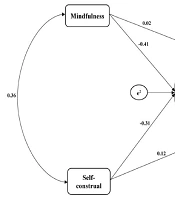
Evaluation of the structural model indicated a very strong fit to the data. The χ2/df ratio was low (1.92), and error indices were minimal (RMSEA = 0.035, standardized RMR = 0.025). In addition, goodness-of-fit indicators, including GFI (0.97), CFI (0.97), NFI (0.97), and NNFI (0.97), all exceeded 0.95, confirming the adequacy of the proposed model (Table 3 and Figures 1 and 2).
Table 3.
Fit Indices of the Final Model
| Variables | χ2/df | RMSEA | GFI | RMR a | CFI | NFI | NNFI |
|---|---|---|---|---|---|---|---|
| Final model | 1.92 | 0.035 | 0.97 | 0.025 | 0.97 | 0.97 | 0.97 |
| Acceptable level | < 5 | < 0.10 | > 0.90 | < 0.05 | > 0.90 | > 0.90 | > 0.90 |
a Standardized RMR.
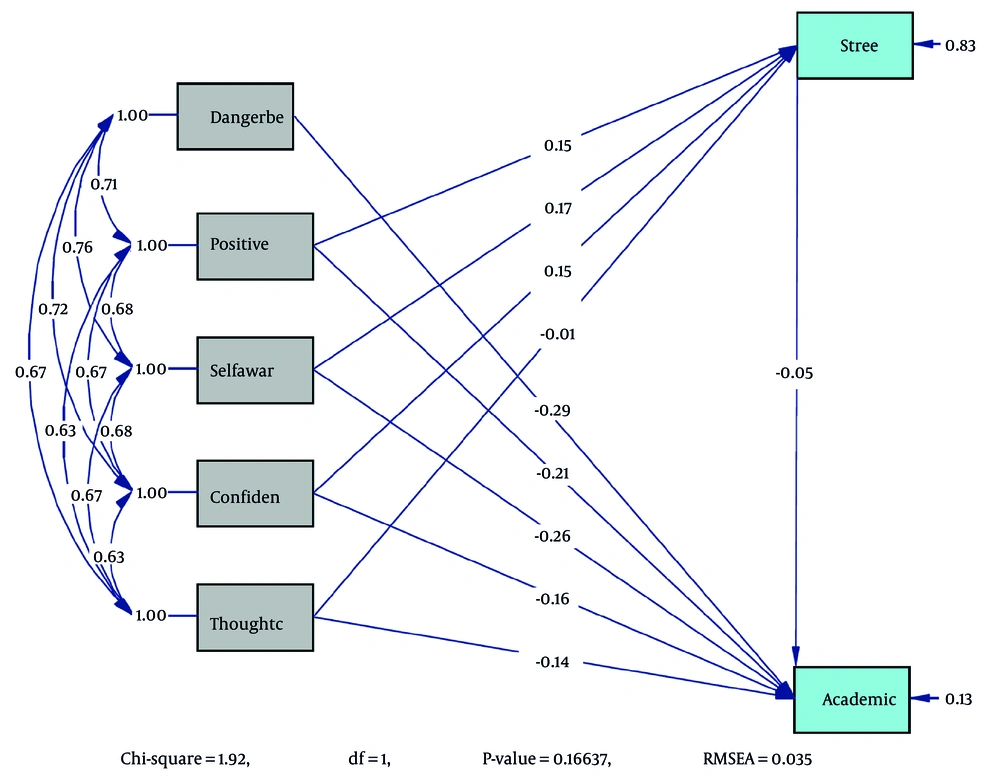
Figure 1.
Path Analysis of the Relationship Between Metacognitive Beliefs and Academic Achievement with the Mediating Role of Academic Expectations Stress (Standardized Estimates)
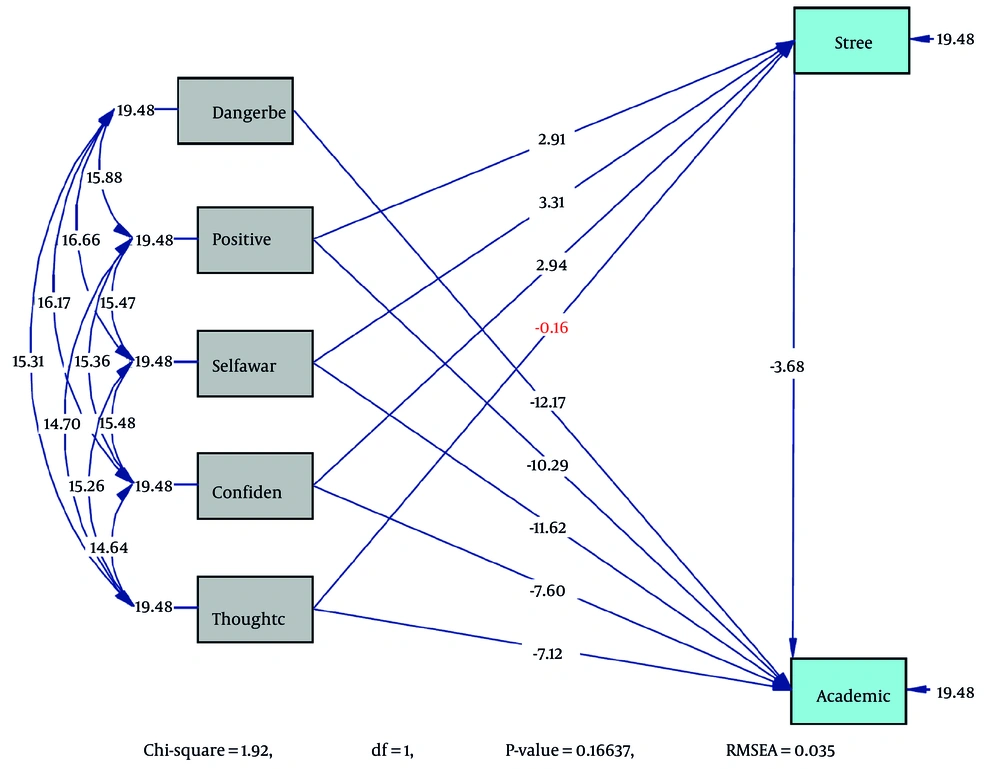
Figure 2.
Path Analysis of the Relationship Between Metacognitive Beliefs and Academic Achievement with the Mediating Role of Academic Expectations Stress (t Values)
The R2 values, or coefficients of determination, for the endogenous variables were as follows: academic expectations stress had an R2 of 0.17, indicating that the metacognitive belief dimensions, namely positive beliefs, cognitive self-consciousness, and cognitive confidence, explained 17% of its variance; academic performance had an R2 of 0.87, indicating that the five metacognitive belief dimensions, together with academic expectations stress, explained 87% of its variance.
Path analysis showed that academic expectations stress directly and negatively predicted academic performance (β = -0.05, P < 0.001). Among the five metacognitive belief dimensions, all exerted significant negative direct effects on academic performance: negative beliefs about uncontrollability and danger (β = -0.29, P < 0.001), positive beliefs about worry (β = -0.21, P < 0.001), cognitive self-consciousness (β = -0.26, P < 0.001), cognitive confidence (β = -0.16, P < 0.001), and need to control thoughts (β = -0.14, P < 0.001). In contrast, positive beliefs about worry (β = 0.15, P < 0.01), cognitive self-consciousness (β = 0.17, P < 0.001), and cognitive confidence (β = 0.15, P < 0.01) were positively associated with academic expectations stress, whereas need to control thoughts did not significantly predict stress (β = -0.01, P > 0.05). Accordingly, positive beliefs, cognitive self-consciousness, and cognitive confidence also indirectly and negatively influenced academic performance through increased academic expectations stress, with indirect effects ranging from -0.01 to -0.02, all P < 0.05, providing evidence of partial mediation (Table 4 and Figures 1 and 2).
Table 4.
Standardized Path Coefficients, Standard Errors, T Values, and Significance Levels
| Independent Variables | Dependent Variables | β | SE | tValue | P-Value |
|---|---|---|---|---|---|
| Positive beliefs about worry | Academic expectations stress | 0.15 | 0.068 | 2.91 | < 0.01 |
| Cognitive self-consciousness | Academic expectations stress | 0.17 | 0.052 | 3.31 | < 0.001 |
| Cognitive confidence | Academic expectations stress | 0.15 | 0.068 | 2.94 | < 0.01 |
| Need to control thoughts | Academic expectations stress | -0.01 | 0.080 | -0.16 | > 0.05 |
| Academic expectations stress | Academic performance | -0.05 | 0.010 | -3.68 | < 0.001 |
| Negative beliefs (danger) | Academic performance | -0.29 | 0.014 | -12.17 | < 0.001 |
| Positive beliefs about worry | Academic performance | -0.21 | 0.020 | -10.29 | < 0.001 |
| Cognitive self-consciousness | Academic performance | -0.26 | 0.016 | -11.62 | < 0.001 |
| Cognitive confidence | Academic performance | -0.16 | 0.020 | -7.60 | < 0.001 |
| Need to control thoughts | Academic performance | -0.14 | 0.023 | -7.12 | < 0.001 |
5. Discussion
This study investigated the direct and indirect relationships among the five dimensions of dysfunctional metacognitive beliefs, academic expectations stress, and academic performance among upper secondary school students in Jiroft County, Iran. Consistent with prior empirical investigations (18, 19), all five dimensions of dysfunctional metacognitive beliefs, namely negative beliefs about the uncontrollability and danger of thoughts, positive beliefs about worry, cognitive self-consciousness, low cognitive confidence or lack of trust in memory and attention, and need to control thoughts, were significantly associated with lower academic performance. This finding aligns with Wells' metacognitive theory (2009), which posits that dysfunctional metacognitive beliefs activate the cognitive attentional syndrome, characterized by persistent worry, rumination, and threat monitoring, which together consume attentional resources and impair executive functions necessary for effective learning (20). Notably, negative beliefs about uncontrollability and danger exerted the strongest direct negative effect, underscoring the particularly harmful role of perceiving one’s own thoughts as threatening and uncontrollable. In parallel, academic expectations stress also directly and negatively predicted academic performance, corroborating the stress-performance literature and Lazarus and Folkman's transactional model (1984), whereby academic demands appraised as exceeding available resources disrupt concentration and motivation (21). However, the direct effect of metacognitive beliefs on performance was considerably larger than that of stress, indicating that dysfunctional metacognitions are more powerful proximal determinants of academic achievement than stress alone, consistent with studies showing that cognitive vulnerabilities often underlie stress responses (9, 12).
A more nuanced pattern emerged regarding specific dimensions and academic expectations stress. Only three dimensions, namely positive beliefs about worry, cognitive self-consciousness, and low cognitive confidence, positively predicted academic expectations stress. In contrast, negative beliefs about uncontrollability and danger and need to control thoughts did not significantly predict stress; rather, they operated solely as direct predictors of performance, presumably through attentional deficits, avoidance behaviors, or impaired self-regulation rather than stress appraisal. This pattern partially aligns with earlier studies (22-24) but further indicates that not all metacognitive beliefs equally drive stress. Drawing on Lazarus' cognitive appraisal theory (1984), students who excessively monitor their thoughts, believe worry facilitates coping, or lack trust in their memory are more likely to perceive academic expectations as threatening. Conversely, believing that thoughts are dangerous or must be controlled may directly impair cognitive performance through sustained attentional disengagement, bypassing affective stress pathways. Consequently, academic expectations stress served as a significant partial mediator only for positive beliefs, self-consciousness, and cognitive confidence, whereas negative beliefs and need to control thoughts exerted purely direct effects (25). This dimension-specific mediation extends previous research emphasizing emotional mechanisms in transmitting cognitive variables to academic outcomes (11). Theoretically, integrating Wells' framework with stress models suggests that some beliefs, such as positive beliefs, first elevate stress, thereby depleting resources, whereas others, such as negative beliefs, directly harm cognitive efficiency.
The socioeconomic context of Jiroft County warrants consideration. Jiroft faces high unemployment, identified as a primary driver of social harm; widespread drug-related incarceration; substance abuse as a major cause of divorce and family disputes; child maltreatment; acute family conflicts; and social anomalies such as an identity crisis, isolation, and weakening of religious values. In the absence of life skills education and recreational facilities, students may be predisposed to maladaptive metacognitive beliefs, particularly negative beliefs about uncontrollability and danger, which had the strongest effect, excessive self-consciousness, and low confidence. Family tensions and substance abuse may lead children to internalize beliefs that their thoughts are dangerous, thereby increasing vulnerability to academic stress (14-16). Compared with studies conducted in more stable contexts (18), the stronger direct effects observed here suggest that environmental adversity amplifies the impact of dysfunctional metacognitions.
Several limitations must be acknowledged. The cross-sectional design precludes causal inferences, and longitudinal or quasi-experimental designs are needed. Reliance on self-report may introduce social desirability bias; future studies should use teacher reports or objective performance indicators. The sample from a single county limits generalizability, and replication in diverse contexts is essential. Potential confounders such as social support, socioeconomic status, and parenting styles were not measured. The very high explained variance raises the possibility of overfitting; therefore, independent replication is critical. Finally, other cognitive constructs, such as epistemic beliefs, were not examined. Despite these limitations, the study provides robust evidence that dysfunctional metacognitive beliefs, especially negative beliefs about uncontrollability, are powerful direct predictors of academic performance, exceeding the effect of stress, with a dimension-specific mediating role of stress. Educational interventions should prioritize metacognitive skills training, including modifying negative beliefs and reducing excessive self-consciousness, alongside stress management. Given Jiroft's adversities, such interventions may be especially impactful when combined with family-based support and life skills education.
5.1. Conclusions
The findings indicate that dysfunctional metacognitive beliefs directly and, to a lesser extent, indirectly explain lower academic achievement. All five dimensions, namely negative beliefs about uncontrollability and danger, positive beliefs about worry, cognitive self-consciousness, cognitive confidence, and need to control thoughts, directly predicted poorer performance, with negative beliefs showing the strongest effect. Positive beliefs, self-consciousness, and cognitive confidence also indirectly reduced performance by increasing academic expectations stress, whereas negative beliefs and need to control thoughts operated only directly. Thus, students with maladaptive metacognitive beliefs perform worse mainly because these beliefs deplete cognitive resources and partly through elevated stress. Educational interventions should target metacognitive skills, particularly modifying negative beliefs and excessive self-consciousness, and stress management, with parent and teacher involvement. The model's high explanatory power (R2 = 0.87) supports the centrality of metacognitive beliefs in academic outcomes.