
1. Background
Tightness of the hamstring muscles contributes to reduced function in daily and athletic activities (1). Hamstring tightness is one factor that predisposes athletes to recurrent injury (2). Hamstring injuries are associated with a prolonged recovery period, which increases treatment costs and decreases performance (3). Tight hamstrings can also cause various other health problems, including patellofemoral pain syndrome (1), abnormal pelvic tilt (4), sciatic pain (5), and disc protrusion or bulge (6). Therefore, restoring normal hamstring flexibility is important.
Several physiotherapy methods are used to treat hamstring tightness (7). These methods can broadly be classified as manual therapy, such as dynamic soft tissue mobilization (DSTM), and electrotherapy, such as extracorporeal shockwave therapy (ESWT). Dynamic soft tissue mobilization relies on therapist-applied mechanical pressure to release tight muscle fibers and improve the active knee extension angle (AKEA) and passive knee extension angle (PKEA), whereas ESWT uses high-energy acoustic waves to induce tissue remodeling and potentially reduce fibrosis, which may also influence Y-Balance Test (YBT) performance.
Dynamic soft tissue mobilization is a common technique used to treat hamstring tightness and yields significantly better results than more conventional strategies (8). For example, it improves AKEA more effectively than passive stretching techniques (9).
Extracorporeal shockwave therapy has been effective in treating musculoskeletal conditions such as calcific shoulder tendinopathy, lateral epicondylitis, and plantar fasciitis (10-12). Its effects are mediated through mechanobiology and mechanotransduction, leading to tissue regeneration and remodeling. Although the effect of ESWT on tendons is relatively well understood, its effect on muscle tightness and spasticity remains less clear. Proposed mechanisms include direct effects on fibrotic areas, modulation of chronically hypertonic muscles, and reduced intramuscular connective tissue stiffness (13). Kim et al. demonstrated a significant effect of ESWT on improving hamstring tightness compared with stretching techniques in healthy subjects (14). Extracorporeal shockwave therapy has also been used to treat spasticity in muscles other than the hamstrings in several studies (15, 16).
Although several studies have examined the effects of DSTM on hamstring tightness (8, 9, 17, 18), and others have investigated ESWT for muscle tightness or spasticity (14-16), there is a notable lack of research directly comparing these 2 interventions in athletes. Specifically, no randomized clinical trials have evaluated whether ESWT or DSTM provides superior improvements in hamstring flexibility and functional performance in healthy adolescent athletes. This gap in the literature justifies the present study.
2. Objectives
The present study aimed to compare the effects of ESWT, an electrotherapy intervention, and DSTM, a manual therapy intervention, on the hamstring muscles of male basketball players, highlighting differences in the mechanisms and effectiveness of these approaches.
3. Methods
3.1. Participants
This randomized controlled trial was conducted from January to June 2022 at Amin Hospital, Isfahan, Iran. Only male participants were included to reduce heterogeneity related to hormonal variations; this is acknowledged as a limitation. Participants aged 15 - 18 years with at least a 2-year history of playing basketball (≥ 3 sessions per week) who presented with hamstring tightness and AKEA < 170° were included. AKEA was selected as an inclusion criterion because of its high intra- and inter-rater reliability and sensitivity for detecting hamstring tightness, compared with other clinical measures of hamstring flexibility and stiffness (19, 20).
Participants were excluded if they had a positive slump test; a history of knee or hip fractures; a history of femoral fracture; internal fixators; acute hamstring injury; back pain within the previous 3 months; pain or injury in the knee or hip joints; knee stiffness; unwillingness to participate; failure to attend follow-up; or contraindications to ESWT, including coagulopathies, acute infection, pregnancy, and malignancy. This study was approved by the institutional ethics committee of Isfahan University of Medical Sciences (IR.MUI.MED.REC.1400.801). The study was also registered in the Iranian Registry of Clinical Trials (IRCT20220410054479N1).
3.2. Study Design
This single-center study was designed as a randomized, parallel-group clinical trial. Eligible participants were randomly assigned to 1 of 2 intervention groups: ESWT or DSTM. No control or sham group was included. Outcome measures were assessed at baseline, immediately after the final intervention session, and at the 1-month follow-up.
3.3. Sample Size and Randomization
The initial sample size calculation was based on results reported by Rompe et al. (21), which used a pooled SD for improvement in heel pain. Given differences in outcome measures and the study population, the present study should be considered exploratory. Power analysis confirmed > 80% power to detect the observed differences in finger-to-floor distance.
Twenty participants per group were recruited through convenience sampling and, after informed consent was obtained, were randomly assigned to either the ESWT or DSTM group using a simple randomization procedure.
The randomization sequence was generated in Microsoft Excel using the RAND function. An independent research assistant who was not involved in enrollment, treatment, or participant assessment prepared sealed, opaque envelopes containing group assignments based on the random sequence. The envelopes were opened sequentially only after participant enrollment. This process ensured allocation concealment until assignment. Although randomization and allocation were conducted independently, full concealment might not have been achievable in all cases because of the single-center design and limited staff resources.
3.4. Blinding
Assessments and treatments were performed by the main researcher, who was not blinded to group allocation. This limitation is acknowledged in the Discussion. To minimize potential bias, standardized protocols were used for all measurements, and each outcome was recorded 3 times, with the mean value used for analysis.
3.5. Assessment and Outcome Measures
Finger-to-floor distance measured immediately after the intervention was considered the primary outcome. Secondary outcomes included AKEA, PKEA, and YBT performance.
Baseline demographic and clinical data, including age, training history, and duration of hamstring tightness, were recorded. To ensure measurement consistency, the assessor was trained before data collection, standardized goniometric procedures were followed, and each measurement was performed 3 times, with the mean value recorded. Data collection ended in June 2022.
The YBT was included as a functional performance outcome to assess dynamic balance. This test is a convenient method for evaluating athletes' performance and balance. The inter-rater and test-retest reliability and validity of the YBT have been reported as good to excellent in physically active adults (22, 23). For this test, the examiner drew a Y-shaped mark on the ground using 135° and 90° angles. The athlete was instructed to stand at the center of the mark, with 1 foot positioned in the center and the other foot flat on the ground. The other foot was then lifted and reached as far as possible in the anterior, lateral, and contralateral directions without loss of balance. The therapist recorded the maximum distance reached for each foot. The test was repeated 3 times in each direction, and the mean value was used for statistical analysis. Effect sizes, reported as partial eta squared (ηp2), were calculated for the primary and key secondary outcomes.
AKEA was measured using a goniometer. This test has excellent inter-rater and intra-rater reliability for evaluating hamstring flexibility (19). For this test, the participant lay in the supine position with the hip flexed to 90° and performed active knee extension. Finger-to-floor distance was also measured. Participants stood on a 20-cm-high surface with their feet together. Fingers, arms, and knees were kept fully extended while participants brought their hands as close to the ground as possible. The distance between the tip of the middle finger and the ground was then measured. PKEA, defined as the angle between unilateral knee extension and 90° hip flexion, was also assessed. This measurement has good intertester reliability for hamstring injuries (20). To measure this angle, the participant lay in the supine position, the hip was positioned at 90° flexion, and passive knee extension was performed until the examiner felt strong resistance. Another examiner then measured the angle between the thigh and leg using a goniometer.
3.6. Interventions
Dynamic soft tissue mobilization was performed by a single physical medicine and rehabilitation specialist with > 5 years of musculoskeletal therapy experience. Four treatment sessions were conducted over 4 weeks. Each session lasted approximately 25 - 30 minutes, including assessment, positioning, and targeted strokes. Participants were placed in the prone position. Longitudinal strokes were applied to the entire hamstring muscle group to identify the specific point of muscle tightness. Once the target point was identified, subsequent treatment was limited to that point. Participants were then placed in the supine position, and the hip and knee were flexed to 90°. Deep longitudinal strokes (5 strokes per target point) were applied from distal to proximal while the leg was passively extended. The progressive, dynamic technique was then performed, with the participant actively extending the leg to facilitate deep muscle inhibition. In the final stage, the participant eccentrically contracted the hamstring against the resistance created by the therapist's hand while the muscle was stretched to the maximum range of motion. During this movement, 5 deep strokes were applied from distal to proximal at the shortened, tight point.
For ESWT, radial shockwaves were delivered using the Duolith SD1 device without local anesthesia. Each session lasted approximately 15 minutes and delivered 2000 impulses to the hamstring muscles: 1000 impulses to the biceps femoris, 500 to the semitendinosus, and 500 to the semimembranosus. The shockwave frequency was 15 Hz, and the energy flux density was 0.1 mJ/mm2. The selected parameters were based on previous studies applying low-energy radial ESWT for muscle tightness and spasticity (14, 16). Participants reported mild discomfort during some impulses, which did not require analgesics or session termination.
Both ESWT and DSTM have been used in adolescent populations in previous musculoskeletal studies, and no adverse effects were observed in our participants. To avoid potential confounding effects, participants did not receive any other routine physiotherapy or rehabilitation interventions during the study period. Compliance with this requirement was confirmed verbally at each session.
3.7. Adverse Events
Adverse events were monitored during and immediately after each treatment session. Participants were systematically asked about discomfort, pain, local tenderness, and skin changes, such as petechiae. Any reported adverse events were recorded. No participants experienced persistent or functionally limiting pain during the study period. Mild, transient discomfort was reported by some participants during ESWT impulses; however, this did not require analgesic medication or treatment discontinuation.
3.8. Statistical Analysis
Continuous data were summarized as mean (SD). The Shapiro-Wilk test was used to evaluate normality. Within-group changes over time were evaluated using one-way repeated-measures ANOVA. Between-group comparisons were conducted using independent 2-sample t tests and ANCOVA for continuous variables. Effect sizes for ANCOVA analyses were reported as partial eta squared (ηp2). According to conventional benchmarks, ηp2 values of 0.01, 0.06, and 0.14 were interpreted as small, medium, and large effect sizes, respectively. All statistical analyses were conducted using SPSS version 26.0 (SPSS Inc., Chicago, IL, USA), and a significance level of 0.05 was used for all statistical tests.
4. Results
Twenty participants were allocated to the DSTM group, and 20 were allocated to the ESWT group. No loss to follow-up occurred, and all participants completed the study. Independent t-test analyses showed no significant baseline differences between the groups in any outcome measures, including finger-to-floor distance, active and passive knee extension angles on both sides, and YBT indices in the anterior, lateral, and contralateral directions (P > 0.05).
ANCOVA adjusted for baseline values revealed significant between-group differences at the post-intervention assessment. The DSTM group demonstrated greater improvements than the ESWT group across all outcome measures (P < 0.001). These between-group differences remained significant at the 1-month follow-up (P < 0.001).
Within-group analyses using one-way repeated-measures ANOVA showed statistically significant improvements in the DSTM group from pretest to posttest and from pretest to follow-up across all variables (P < 0.001). These improvements were maintained over time. In contrast, the ESWT group showed more limited, although still statistically significant, improvements across most measures (P < 0.05).
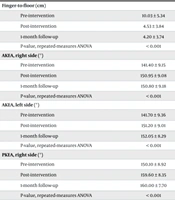
Partial eta squared values for finger-to-floor distance and active and passive knee extension angles in the DSTM group ranged from 0.45 to 0.55, representing large effect sizes according to conventional benchmarks. For YBT indices, effect sizes reached values as high as 0.79, indicating even stronger between-group differences in certain directions. Comparisons across time points showed that the magnitude of improvement in the DSTM group was greater at posttest than at the 1-month follow-up (Tables 1 and 2).
Table 1.
Comparison of the Effects of Dynamic Soft Tissue Mobilization and Extracorporeal Shockwave Therapy Interventions on Finger-to-Floor Distance and Active and Passive Knee Extension Across 3 Time Points a
| Variables and Time | DSTM | ESWT | Between-Group P-Value | Partial Eta Squared |
|---|---|---|---|---|
| Finger-to-floor (cm) | ||||
| Pre-intervention | 10.03 ± 5.34 | 9.20 ± 4.05 | 0.585 b | - |
| Post-intervention | 4.53 ± 3.84 | 7.70 ± 3.72 | < 0.001 c | 0.497 |
| 1-month follow-up | 4.20 ± 3.74 | 7.45 ± 3.82 | < 0.001 c | 0.486 |
| P-value, repeated-measures ANOVA | < 0.001 | < 0.001 | ||
| AKEA, right side (°) | ||||
| Pre-intervention | 141.40 ± 9.15 | 137.65 ± 6.52 | 0.144 b | - |
| Post-intervention | 150.95 ± 9.08 | 142.15 ± 6.39 | < 0.001 c | 0.553 |
| 1-month follow-up | 150.80 ± 9.18 | 142.55 ± 6.45 | < 0.001 c | 0.445 |
| P-value, repeated-measures ANOVA | < 0.001 | < 0.001 | ||
| AKEA, left side (°) | ||||
| Pre-intervention | 141.70 ± 9.36 | 137.15 ± 6.34 | 0.080 b | - |
| Post-intervention | 151.20 ± 9.01 | 141.95 ± 6.76 | < 0.001 c | 0.508 |
| 1-month follow-up | 152.05 ± 8.29 | 142.50 ± 5.84 | < 0.001 c | 0.467 |
| P-value, repeated-measures ANOVA | < 0.001 | < 0.001 | ||
| PKEA, right side (°) | ||||
| Pre-intervention | 150.10 ± 8.92 | 148.30 ± 6.97 | 0.481 b | - |
| Post-intervention | 159.60 ± 8.35 | 153.00 ± 6.46 | < 0.001 c | 0.499 |
| 1-month follow-up | 160.00 ± 7.70 | 153.35 ± 6.75 | < 0.001 c | 0.491 |
| P-value, repeated-measures ANOVA | < 0.001 | < 0.001 | ||
| PKEA, left side (°) | ||||
| Pre-intervention | 149.70 ± 8.82 | 147.60 ± 7.44 | 0.421 b | - |
| Post-intervention | 159.45 ± 8.60 | 152.20 ± 6.90 | < 0.001 c | 0.520 |
| 1-month follow-up | 159.90 ± 8.50 | 152.50 ± 7.16 | < 0.001 c | 0.511 |
| P-value, repeated-measures ANOVA | < 0.001 | < 0.001 |
a Values are expressed as mean ± SD. Abbreviations: DSTM, dynamic soft tissue mobilization; ESWT, extracorporeal shockwave therapy; PKEA, passive knee extension angle; AKEA, active knee extension angle.
bt-test.
c ANCOVA.
Table 2.
Comparison of the Effects of Dynamic Soft Tissue Mobilization and Extracorporeal Shockwave Therapy Interventions on Y-Balance Test Performance Across 3 Time Points a
| Variables and Time | DSTM | ESWT | Between-Group P-value | Partial Eta Squared |
|---|---|---|---|---|
| YFront right (cm) | ||||
| Pre-intervention | 69.10 ± 9.00 | 70.13 ± 7.36 | 0.694 b | - |
| Post-intervention | 76.48 ± 8.68 | 72.06 ± 7.44 | < 0.001 c | 0.747 |
| 1-month follow-up | 76.78 ± 8.91 | 72.38 ± 7.12 | < 0.001 c | 0.735 |
| P-value, repeated-measures ANOVA | < 0.001 | < 0.001 | ||
| YFront left (cm) | ||||
| Pre-intervention | 68.19 ± 7.63 | 69.67 ± 6.27 | 0.507 b | - |
| Post-intervention | 74.80 ± 7.67 | 71.49 ± 6.11 | < 0.001 c | 0.562 |
| 1-month follow-up | 75.06 ± 7.53 | 71.92 ± 6.53 | < 0.001 c | 0.535 |
| P-value, repeated-measures ANOVA | < 0.001 | < 0.001 | ||
| YLateral right (cm) | ||||
| Pre-intervention | 100.53 ± 15.73 | 97.86 ± 12.33 | 0.553 b | - |
| Post-intervention | 106.46 ± 18.18 | 99.90 ± 11.69 | 0.018 c | 0.142 |
| One-month follow-up | 106.71 ± 18.05 | 100.22 ± 11.96 | 0.019 c | 0.140 |
| P-value, repeated-measures ANOVA | < 0.001 | < 0.001 | ||
| YLateral left (cm) | ||||
| Pre-intervention | 100.39 ± 13.58 | 99.74 ± 12.09 | 0.874 b | - |
| Post-intervention | 107.16 ± 13.72 | 101.55 ± 11.67 | < 0.001 c | 0.797 |
| One-month follow-up | 107.60 ± 13.67 | 101.77 ± 12.00 | < 0.001 c | 0.781 |
| P-value, repeated-measures ANOVA | < 0.001 | < 0.001 | ||
| YContra right (cm) | ||||
| Pre-intervention | 90.20 ± 15.96 | 88.43 ± 12.70 | 0.699 b | - |
| Post-intervention | 97.40 ± 15.42 | 90.55 ± 12.35 | < 0.001 c | 0.686 |
| 1-month follow-up | 97.69 ± 15.78 | 90.88 ± 12.47 | < 0.001 c | 0.666 |
| P-value, repeated-measures ANOVA | < 0.001 | < 0.001 | ||
| YContra left (cm) | ||||
| Pre-intervention | 88.46 ± 13.90 | 90.40 ± 11.86 | 0.637 b | - |
| Post-intervention | 95.43 ± 14.24 | 92.41 ± 11.51 | < 0.001 c | 0.729 |
| 1-month follow-up | 95.84 ± 14.10 | 92.65 ± 11.84 | < 0.001 c | 0.708 |
| P-value, repeated-measures ANOVA | < 0.001 | < 0.001 |
a Values are expressed as mean ± SD. Abbreviations: DSTM, dynamic soft tissue mobilization; ESWT, extracorporeal shockwave therapy.
bt-test.
c ANCOVA.
As shown in Table 3, all outcome variables in the DSTM group improved significantly from pretest to posttest and from pretest to the 1-month follow-up (P < 0.05). No significant differences were observed between posttest and follow-up assessments (P > 0.05), indicating stability of the treatment effects. In the ESWT group, significant improvements were also observed from pretest to posttest and from pretest to follow-up for most variables; however, the magnitude of change was smaller than that observed in the DSTM group, and posttest-to-follow-up differences were generally non-significant.
Table 3.
Pairwise Comparison of Time Points Stratified by Dynamic Soft Tissue Mobilization and Extracorporeal Shockwave Therapy Groups a
| Variables and Groups | Pre-post | Pre-one Month | Post-one Month |
|---|---|---|---|
| Finger-to-floor | |||
| DSTM | < 0.001 | < 0.001 | 0.059 |
| ESWT | 0.004 | 0.001 | 0.096 |
| AKEA, right | |||
| DSTM | < 0.001 | < 0.001 | 0.453 |
| ESWT | < 0.001 | < 0.001 | 0.296 |
| AKEA, left | |||
| DSTM | < 0.001 | < 0.001 | 0.084 |
| ESWT | < 0.001 | < 0.001 | 0.443 |
| PKEA, right | |||
| DSTM | < 0.001 | < 0.001 | 0.202 |
| ESWT | < 0.001 | < 0.001 | 0.185 |
| PKEA, left | |||
| DSTM | < 0.001 | < 0.001 | 0.154 |
| ESWT | < 0.001 | < 0.001 | 0.330 |
| YFront right | |||
| DSTM | < 0.001 | < 0.001 | 0.266 |
| ESWT | < 0.001 | < 0.001 | 0.145 |
| YFront left | |||
| DSTM | < 0.001 | < 0.001 | 0.078 |
| ESWT | < 0.001 | < 0.001 | 0.555 |
| YLateral right | |||
| DSTM | 0.002 | 0.002 | 0.403 |
| ESWT | < 0.001 | < 0.001 | 0.110 |
| YLateral left | |||
| DSTM | < 0.001 | < 0.001 | 0.434 |
| ESWT | < 0.001 | < 0.001 | 0.536 |
| YContra right | |||
| DSTM | < 0.001 | < 0.001 | 0.687 |
| ESWT | < 0.001 | < 0.001 | 0.112 |
| YContra left | |||
| DSTM | < 0.001 | < 0.001 | 0.122 |
| ESWT | < 0.001 | < 0.001 | 0.562 |
a Abbreviations: DSTM, dynamic soft tissue mobilization; ESWT, extracorporeal shockwave therapy.
5. Discussion
In this randomized clinical trial, we investigated the effects of ESWT compared with DSTM on hamstring tightness in male adolescent basketball players. Both interventions led to significant improvements in primary and secondary outcomes, including finger-to-floor distance, AKEA, and PKEA, compared with baseline. However, changes in YBT performance were smaller, suggesting that dynamic balance may be influenced by factors beyond isolated hamstring flexibility (22, 23).
The mechanisms underlying ESWT-induced improvements in muscle flexibility are not fully understood. Studies in healthy adults and patients with soft tissue injuries indicate that ESWT can modulate tissue properties through mechanical stimulation, mechanotransduction, and a potential reduction in intramuscular fibrosis (14, 16, 24-27). Kim et al. demonstrated that ESWT significantly reduced hamstring tightness in healthy subjects, likely through direct mechanical effects rather than delayed tissue remodeling (14). Similarly, in neurological populations, ESWT has been shown to reduce muscle tone, spasticity, and pain, reflecting its influence on both mechanical and neural pathways (16, 24-29). Although these populations differ from our cohort, this evidence supports the plausibility of direct effects of ESWT on fibrotic or hypertonic muscle tissue.
In our study, ESWT improved hamstring flexibility in adolescents, likely reflecting changes in soft tissue extensibility rather than neural modulation. The early post-intervention effects suggest a mechanical rather than a neurophysiological mechanism, consistent with findings in healthy and spastic muscle studies (14, 16). This distinction addresses the reviewers' concern regarding applicability and avoids overgeneralization from neurological populations.
Dynamic soft tissue mobilization produced larger improvements than ESWT across key outcomes, including AKEA, PKEA, and finger-to-floor distance. This aligns with prior evidence showing that manual therapy techniques, including deep longitudinal strokes, passive stretching, and active eccentric contractions, effectively enhance muscle extensibility, relax hypertonic fibers, and increase local blood flow (8, 9, 17, 18). The observed improvements are likely attributable to the combination of mechanical pressure, fascial release, and neuromuscular inhibition inherent in DSTM. Our findings reinforce the effectiveness of DSTM for adolescent athletes and highlight its potential advantages over ESWT for improving hamstring flexibility in this population.
Although both interventions improved YBT performance, the magnitude of change was smaller than that observed for flexibility outcomes. This is expected because YBT performance is influenced by proprioception, core stability, and neuromuscular control, which were not specifically targeted by either intervention. Future studies may consider incorporating balance-specific exercises or longer intervention periods to determine whether ESWT or DSTM can meaningfully enhance dynamic balance in adolescent athletes (22, 23).
This study provides several important insights. First, it is among the few randomized clinical trials directly comparing ESWT and DSTM in healthy adolescent athletes. Previous research has primarily examined these interventions in adults or neurological populations, limiting direct applicability (14-16, 24-29). Second, the study confirms that early improvements in hamstring flexibility can be achieved with both mechanical and manual interventions, highlighting differences in their mechanisms and effect sizes.
Several limitations should be acknowledged. Intermediate assessments were not conducted, limiting conclusions regarding the temporal progression of improvements. No combined treatment arm was included; therefore, potential synergistic effects of ESWT and DSTM remain unexplored. Variations in ESWT protocols, including pulse number and energy parameters, were not evaluated. Complete allocation concealment was not feasible because of the single-center design and limited staff, and outcome assessments were performed by a non-blinded assessor; however, standardized procedures and repeated measurements were implemented to mitigate bias. Additionally, total therapist contact time differed between the groups, with DSTM requiring more individualized attention, which may have contributed to the observed effects (8, 14, 16).
Future research should explore combined or sequential ESWT and DSTM interventions, evaluate longer follow-up periods, and include balance- or functional-performance-specific training. Investigating different ESWT dosing protocols and comparing manual therapy techniques in diverse adolescent populations will further clarify optimal strategies for improving hamstring flexibility.
5.1. Conclusions
Both ESWT and DSTM effectively improved hamstring flexibility in male adolescent basketball players, with DSTM showing greater improvements across primary outcomes. These findings highlight the distinct mechanisms of mechanical and manual interventions and suggest that DSTM may be particularly advantageous for enhancing muscle extensibility in adolescent athletes. Future studies with combined treatment arms, longer follow-up periods, and diverse ESWT protocols are recommended to further refine therapeutic strategies.