
1. Background
Autism spectrum disorder (ASD) is a neurodevelopmental disorder characterized by persistent deficits in social communication and social interaction, along with restricted and repetitive patterns of behavior (1). With a rising global prevalence, currently affecting approximately 1 in 77 children (2), addressing the complex needs of this population is critical. One of the major challenges faced by children with ASD is mastering activities of daily living (ADL), which are essential self-care tasks requiring the integration of cognitive, motor, and sensory skills (3, 4). Achieving independence in ADL is a major concern for families, as it is a fundamental prerequisite for a child’s effective participation and integration in educational and social settings.
Occupational therapy plays a key role in addressing these ADL impairments and enhancing independence in individuals with ASD. As a core member of the rehabilitation team, occupational therapists use occupation-based and family-centered approaches to provide structured interventions tailored to each child’s unique sensory, motor, and cognitive profile. These targeted therapeutic strategies facilitate sensory processing and foster foundational skills, thereby improving the child’s capacity to learn daily routines, adapt to the environment, and actively participate in everyday life (5-7).
To standardize such interventions, clinical practice guidelines (CPGs) are important tools for translating evidence into consistent, high-quality patient care. However, developing CPGs de novo is resource-intensive, requiring substantial time, methodological expertise, and financial investment (8). To avoid duplication of effort and reduce costs, adapting existing international guidelines is a practical and desirable approach. Guideline adaptation uses structured frameworks, such as the ADAPTE methodology (9, 10), to review and modify recommendations to align with local resources, service structures, and sociocultural contexts (11-13).
Despite the availability of international guidelines for ASD interventions, a substantial research and clinical gap exists in Iran, as these guidelines cannot be directly implemented without contextual modification. Differences in sociocultural expectations, family routines, healthcare infrastructure, and resource availability necessitate the localization of international recommendations. To support this process, Yazdani et al. developed the “National Model for Adaptation of Clinical Practice Guidelines in the Islamic Republic of Iran,” based on the ADAPTE framework. Using this seven-phase national model, the present study aimed to adapt existing international recommendations and develop localized, evidence-informed occupational therapy recommendations targeting ADL in children with ASD in Iran.
2. Objectives
Given the current lack of standardized and culturally appropriate occupational therapy recommendations for activities of daily living for children with ASD in Iran, this study aimed to localize and culturally adapt international occupational therapy-related recommendations to the Iranian context.
3. Methods
3.1. Study Design
This mixed-method methodological study was conducted to adapt existing international CPGs on occupational therapy interventions for ADL in children with ASD to the Iranian context. The study followed the National Model for Adaptation of Clinical Practice Guidelines in the Islamic Republic of Iran. The process comprised seven phases:
3.2. Phase 1: Establishing the Steering Committee and Expert Panel
A Steering Committee comprising experts in pediatric occupational therapy, ASD interventions, and evidence-based methodology was established to oversee the adaptation process. An Expert Panel of 13 members was formed, including 10 university faculty members (with at least five years of experience in ASD) and 3 clinical occupational therapists (with more than four years of clinical work with children with ASD). All panel members provided written informed consent.
3.3. Phase 2: Defining the Clinical Questions
The study scope encompassed occupational therapy interventions targeting ADL-related outcomes in children with ASD. Clinical questions were formulated using a modified PICO framework. Because most existing ASD guidelines did not explicitly report comparison groups, the questions primarily emphasized the population, intervention, and outcome components, whereas comparison conditions were considered when available. Population characteristics, such as age and functional level, were subsequently used during scenario development to create clinically meaningful subgroups for expert rating.
To determine priority areas, data were synthesized from two sources: systematic screening of international ASD and occupational therapy-related guidelines and informal interviews with clinicians to identify real-world clinical challenges. Each clinical question followed the structure: “For children with ASD, what occupational therapy interventions are effective in improving a specific ADL-related outcome?”
3.4. Phase 3: Searching for Clinical Practice Guidelines
A systematic search was conducted in national and international websites and repositories that publish CPGs, including SIGN, NICE, G-I-N, AHRQ, EBSCO DynaMed (Plus), NHMRC, the Institute for Clinical Systems Improvement (ICSI), British Medical Journal (BMJ) Best Practice, PubMed, and other relevant databases, including AOTA, CAOT, GALE, Epistemonikos, Colleges of Occupational Therapy, and the American Academy of Neurology, using terms related to ASD. All CPGs related to ASD (regardless of direct mention of occupational therapy) were collected.
3.5. Phase 4: Selecting Recommendations
After relevant ASD guidelines were identified, they were screened and analyzed in accordance with the National Model. At this stage, the aim was not to conduct a formal score-based appraisal of source guidelines using AGREE II or a similar instrument, but to identify clinically relevant recommendations, recurring clinical scenario patterns, and the underlying evidence base relevant to occupational therapy interventions for activities of daily living in children with ASD.
All retrieved guideline records were initially screened for eligibility, scope relevance, and methodological transparency. Documents were excluded if they: (a) were not based on a systematic review process, (b) relied solely on expert opinion, or (c) lacked a transparent guideline development process. Records meeting these initial criteria were then reviewed in full text, line by line, to ensure that no recommendation relevant to occupational therapy, ADL, or occupational performance was overlooked.
Recommendations were extracted when they were directly related to occupational therapy interventions and ADL or occupational performance in children with ASD. The extracted recommendations were then reviewed by the steering committee for relevance, wording, and consistency with the study scope, and the final selection was made by consensus. In total, 12 evidence-based recommendations were retained for evidence mapping and scenario development.
Following recommendation selection, a systematic process was used to identify and verify the supporting evidence for each recommendation. When source guidelines provided explicit references, these studies were retrieved directly. When the linkage between recommendations and supporting evidence was implicit or incomplete, content analysis was used to trace the underlying evidence base. To identify additional or more recent studies and reduce the risk of missing eligible evidence, supplementary recommendation-specific PICO-based searches were conducted across PubMed, Cochrane Library, OTseeker, Scopus, Web of Science, and Google Scholar. Both the guideline search and the supplementary evidence searches were limited to publications from 2010 to 2025. English- and Persian-language guidelines and studies were considered. Because each recommendation addressed a distinct clinical issue, a single uniform search syntax was not appropriate; therefore, recommendation-specific search strategies were developed and are summarized in the Supplementary Table entitled “Recommendation-specific PICO components and summarized search strategies used to identify supporting evidence.”
Data from all included studies were extracted into a standardized analytical framework, including study design, participant characteristics, intervention details, outcome measures, main findings, statistical significance, and effect size. No formal study-level risk-of-bias or critical appraisal instrument was applied to the supporting studies; instead, their methodological strength was characterized using Sackett’s levels of evidence. These data were incorporated into evidence summary tables prepared for each clinical scenario. The clinical scenarios were then drafted by the technical committee through structured assembly of the extracted intervention, outcome, and population components. In this process, a single study could inform more than one scenario when it covered multiple target populations, whereas multiple studies could be combined into a single scenario when they addressed the same intervention–outcome–population configuration. No formal pre-panel validation, pilot testing, or external review of the scenarios was undertaken. The evidence summary tables were then provided to the expert panel during the rating process. Panel members considered the direction and magnitude of effect, statistical significance, and level of supporting evidence when judging the appropriateness of each scenario. For scenarios that did not initially achieve agreement, these indicators were revisited during panel discussion and deliberation. The resulting evidence summaries informed scenario development and final recommendation formulation.
3.6. Phase 5: Developing Clinical Scenarios
Following evidence synthesis, clinical scenarios were developed in accordance with the National Model. The extracted recommendations from the selected source guidelines were reviewed together with their supporting studies and additional eligible studies identified through complementary searching. From the included studies, key evidence elements, including the target population, intervention, ADL-related outcome, study level, effect size, and statistical significance, were extracted and translated into clinical scenario statements.
The scenarios were developed by the first author in collaboration with a faculty advisor who was a member of the technical committee and were presented to the expert panel in a structured tabular format. Each scenario included specific columns for the intervention, target population, outcome measure (including tool and subscale), and the supporting evidence (effect size and statistical significance). This template ensured that, for each scenario, panelists had immediate access to the synthesized evidence.
The scenarios were then categorized within each outcome domain according to population characteristics, based on the steering committee’s decision that relevant subgroup features, such as age and functional level, should be considered when judging appropriateness. Accordingly, when the same intervention was relevant across more than one population subgroup, it was formulated as separate scenarios for those subgroups. This process resulted in 40 clinical scenarios. After review and approval by the steering committee, the scenarios were sent to the expert panel for RAND/UCLA appropriateness rating. During scoring, the panelists considered the reported evidence provided in the table and the contextual relevance of each scenario to the Iranian setting. Median scores and agreement status were then determined according to the RAND/UCLA Appropriateness Method.
3.7. Phase 6: Consensus Building and Rating of Interventions
The RAND/UCLA Appropriateness Method (RAM) is a structured consensus method that combines the best available evidence with expert judgment to determine the appropriateness of interventions in specific clinical and contextual situations. In this study, RAM was used to assess the contextual suitability of the adapted clinical scenarios for the Iranian healthcare context.
A structured rating form was developed for the expert panel to evaluate each clinical scenario across four contextual dimensions: accessibility, cost, acceptability, and feasibility. Each dimension was rated on a 9-point Likert scale, with higher scores indicating greater appropriateness or contextual suitability. Before rating, an orientation session was held to familiarize panel members with the rating criteria and scoring procedure using hypothetical examples.
In the first round, panel members rated each scenario independently and without consultation with other members to minimize group influence. Consensus was determined using the median score and the level of agreement according to RAM criteria for a 13-member panel. Agreement was considered present when no more than three panelists rated the item outside the three-point region containing the median. Scenarios that did not meet the agreement threshold in the first round were carried forward to a second-stage deliberation process.
During this stage, panelists reviewed the evidence summaries and first-round ratings, discussed reasons for disagreement, and refined the scenarios as necessary. Final recommendations were determined based on the outcomes of the expert panel deliberation and agreement process.
3.8. Phase 7: Decision-Making
Decision-making was conducted using a RAM-informed two-round process (14).
3.8.1. First Round
After all panel members completed the ratings, the median score was calculated for each clinical scenario. Consensus was determined according to the RAND/UCLA Appropriateness Method using panel-size-specific agreement/disagreement rules, as described in the RAND/UCLA appropriateness method user's manual (14) (Table 1). Therefore, judgment was based on median panel ratings together with the corresponding agreement/disagreement rule for the 13-member panel. Based on the median, scenarios were classified as: Appropriate (median 7 - 9), Uncertain (median 4 - 6), or Inappropriate (median 1 - 3). In addition, the level of agreement among panel members was assessed.
Table 1.
Definitions of Agreement and Disagreement for Different Panel Sizes a
| Panel Size | Disagreement: Number of Panelists Rating in Each Extreme (1 - 3 and 7 - 9) | Agreement: Number of Panelists Rating Outside the 3-Point Region Containing the Median (1 - 3, 4 - 6, or 7 - 9) |
|---|---|---|
| 8 - 10 | ≥ 3 | ≤ 2 |
| 11 - 13 | ≥ 4 | ≤ 3 |
| 14 - 16 | ≥ 5 | ≤ 4 |
a Adapted from Fitch et al. (14).
3.8.2. Second Round
For scenarios requiring further discussion, a meeting was held with several panel members to exchange views and examine the reasons for disagreement. After discussion, scenarios were re-rated. Among competing scenarios for the same clinical domain, the scenario with the highest final score was selected as the final recommendation.
3.9. Ethical Considerations
This study was approved by the Ethics Committee of the University of Social Welfare and Rehabilitation Sciences (Ethics code: IR.USWR.REC.1402.181). Written informed consent was obtained from all participants. All data were anonymized and kept confidential.
4. Results
The guideline selection process is presented in a PRISMA-style flow diagram (Figure 1). A total of 116 records were identified through guideline-related and bibliographic database searches. After removal of three duplicates and screening of the remaining records, 37 documents were retained for full-text review. Following assessment of relevance to the study scope and objectives, four source guidelines were selected for recommendation extraction:
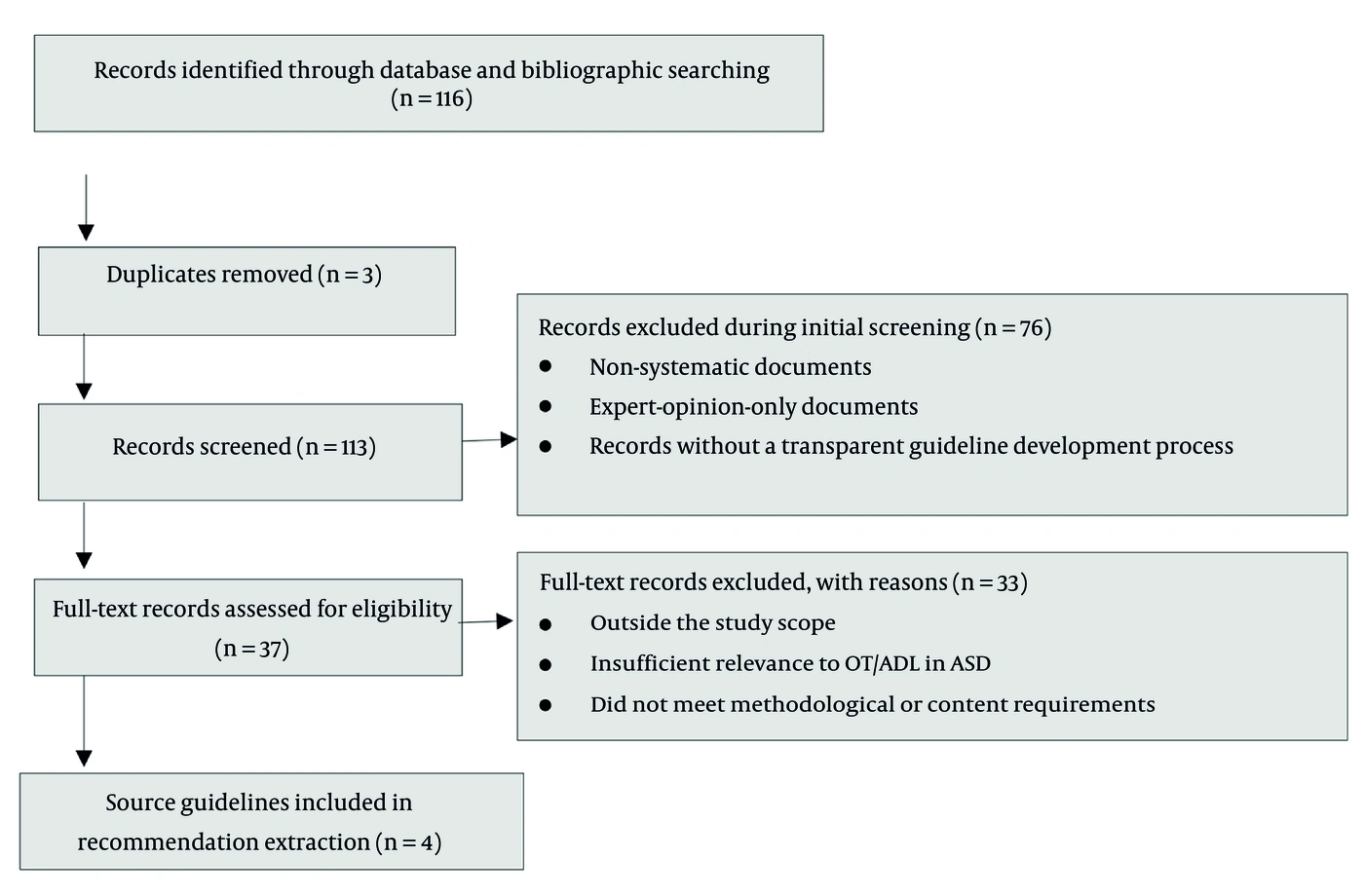
Figure 1.
PRISMA-style flow diagram of guideline identification, screening, eligibility assessment, and inclusion. Abbreviations: OT, occupational therapy; ADL, activities of daily living; ASD, autism spectrum disorder.
1. Occupational Therapy Practice Guidelines for Individuals With Autism Spectrum Disorder (15)
2. Occupational Therapy Practice Guidelines for Early Childhood: Birth to 5 Years (16)
3. Occupational Therapy Practice Guidelines for Autistic People Across the Lifespan (17)
4. Practice guideline: Treatment for insomnia and disrupted sleep behavior in children and adolescents with autism spectrum disorder (18)
From these four source guidelines, 12 recommendations relevant to occupational therapy interventions for activities of daily living in children with autism spectrum disorder were extracted. Review of the references cited in support of these recommendations identified 32 relevant studies. In addition, supplementary PICO-based searches yielded 26 further eligible studies. The 40 preliminary clinical scenarios were developed from these evidence sources. Each scenario was defined as a distinct combination of intervention, ADL-related outcome, and target population. When a study showed that a given intervention was effective for a specific ADL-related outcome in a defined population, that finding was treated as a single scenario. Multiple studies could contribute to the same scenario when they addressed the same intervention, outcome, and population combination. Conversely, more than one scenario could be derived from a single study if its study population corresponded to more than one predefined population group. For example, a study including children aged 1 - 12 years could contribute to separate scenarios for the toddler, preschool, and school-age groups.
All 40 preliminary clinical scenarios were evaluated by the 13-member expert panel. The panel’s quantitative ratings, considered alongside Sackett’s level of evidence, effect sizes, and the statistical significance of the interventions, resulted in the initial identification of 13 primary scenarios. Consensus was determined based on the median panel ratings. Agreement and disagreement were judged according to the RAND/UCLA Appropriateness Method rules for panel size (Table 1), based on the distribution of ratings across the 1 - 3 and 7 - 9 regions of the scale. In the first stage, three scenarios achieved consensus. The remaining 10 scenarios that did not meet the consensus threshold were advanced to a second-stage deliberation process, during which the panel discussed divergent ratings, reconciled viewpoints, and considered the applicability of the scenarios within the Iranian healthcare context. This process resulted in five additional finalized recommendations, yielding a total of eight clinical recommendations. Table 2 presents the RAM outcomes for the recommendation statements evaluated by the expert panel, including both appropriate and inappropriate items. Eight appropriate recommendations were ultimately retained as the final adapted recommendations.
Table 2.
RAND/UCLA Appropriateness Method Outcomes for Recommendation Statements Evaluated by the Expert Panel a
| Populations and Recommendation Statements | Feasibility | Accessibility | Cost | Acceptability | Consensus Outcome |
|---|---|---|---|---|---|
| Autistic toddlers | - | - | - | - | - |
| To improve performance in activities of daily living (ADL) in autistic toddlers, applied behavior analysis (ABA) intervention is recommended. | 7 | 7 | 5.5 | 6.5 | Appropriate; agreement; 1st round |
| Preschool-aged autistic children | - | - | - | - | - |
| To improve performance in activities of daily living (ADL) in preschool-aged autistic children, manualized OT/SI intervention is recommended. | 7 | 8 | 7 | 6.5 | Appropriate; agreement; 2nd round |
| To improve performance in activities of daily living (ADL) in preschool-aged autistic children, the Qigong Massage Protocol is recommended. | 7 | 7.5 | 7 | 6 | Inappropriate; agreement; 2nd round |
| To improve sleep in preschool-aged autistic children with sleep problems, behavioral sleep interventions are recommended. | 7 | 8 | 7.5 | 7.5 | Appropriate; agreement; 2nd round |
| To improve sleep in preschool-aged autistic children with sleep problems, telehealth cognitive behavioral therapy for insomnia is recommended. | 7 | 7 | 6.5 | 7 | Inappropriate; agreement; 2nd round |
| School-aged autistic children | - | - | - | - | - |
| To improve performance in activities of daily living (ADL) in school-aged autistic children, Ayres Sensory Integration and Cognitive Orientation to daily Occupational Performance interventions are recommended, and they can be used depending on the child’s circumstances and available resources. | 7.5 | 8 | 7.5 | 8 | Appropriate; agreement; 2nd round (integrating 2 scenarios) |
| To improve performance in activities of daily living (ADL) in school-aged autistic children, Ayres Sensory Integration and Cognitive Orientation to daily Occupational Performance interventions are recommended, and they can be used depending on the child’s circumstances and available resources. | 7 | 7 | 7 | 6 | Appropriate; agreement; 2nd round (integrating 2 scenarios) |
| To improve performance in activities of daily living (ADL) in school-aged autistic children, manualized OT/SI interventions are recommended | 7 | 8 | 7 | 6.5 | Inappropriate; agreement; 2nd round |
| To improve sleep in school-aged autistic children with sleep problems, behavioral sleep interventions are recommended. | 7 | 7 | 7.5 | 7.5 | Appropriate; agreement; 2nd round |
| To improve sleep in school-aged autistic children with sleep problems, telehealth parent training for Sleep Disturbances is recommended. | 7 | 7 | 7.5 | 7 | Inappropriate; agreement; 2nd round |
| High-functioning autistic children | - | - | - | - | - |
| To improve performance in activities of daily living (ADL) in high-functioning autistic children, CBT is recommended. | 7 | 7 | 7 | 7 | Appropriate; agreement; 1st round |
| Autistic children with anxiety | - | - | - | - | - |
| To improve performance in activities of daily living (ADL) in autistic children with anxiety, CBT is recommended. | 7 | 7 | 7 | 7 | Appropriate; agreement; 1st round |
| Autistic children | - | - | - | - | - |
| To improve nutrition in autistic children, parent training for feeding problems is recommended. | 7.5 | 8 | 7.5 | 7 | Appropriate; agreement; 2nd round |
a Abbreviations: RAM, RAND/UCLA Appropriateness Method; ADL, activities of daily living; ABA, applied behavior analysis; OT/SI, occupational therapy/sensory integration; CBT, cognitive behavioral therapy.
5. Discussion
This study presents the first systematic adaptation of international occupational therapy CPGs for ADL, feeding, and sleep in children with ASD to the Iranian context. Rather than treating international recommendations as directly transferable, we assessed their practical applicability within the Iranian healthcare context and translated them into context-specific clinical scenarios. Although international guidelines are robust, they often face implementation challenges due to variations in service structures, resource availability, and sociocultural expectations (19, 20). Accordingly, this study aimed not only to transfer evidence-based recommendations but also to determine which intervention strategies were feasible, acceptable, and appropriate for occupational therapy practice in Iran. This scenario-based approach is particularly relevant in occupational therapy for children with ASD, where intervention decisions are influenced by child characteristics, family routines, therapist expertise, and access to services.
Central to this process was the use of RAM, which provided a structured, two-round modified Delphi framework. In this study, expert consensus did not replace evidence; rather, it served as a contextual layer through which the local applicability of evidence was judged. By synthesizing empirical data with local clinical expertise, we ensured that the final framework remained aligned with global standards while maintaining practical feasibility (21, 22).
Unlike many adaptation studies that primarily evaluate existing recommendations, our approach went further. We retrieved the original evidence underlying those recommendations and conducted supplementary searches for newer studies. Rather than conducting a formal study-level risk-of-bias analysis, we characterized the supporting evidence by design and strength using Sackett’s hierarchy. These indicators were incorporated into the scenario summaries reviewed by the expert panel.
These findings are consistent with the broader international landscape of guideline adaptation. A recent scoping review of 151 applications found that, although ADAPTE-related methods remain the most prevalent, there is substantial methodological variation in how adaptation is operationalized (23). Notably, more than half of these applications were conducted at the "evidence level," and many studies modified original frameworks to meet local needs. This aligns with our methodology, in which we did not merely adopt recommendations but systematically re-evaluated the underlying evidence to ensure its validity within the Iranian healthcare context.
Our study also shares similarities with the Saudi Arabian national guideline adaptation for children with ASD, which used a modified ADAPTE approach to contextualize evidence-based care (24).
Similarly, studies from Turkey and Hong Kong have shown that successful adaptation often requires modification of the adaptation process itself and explicit consideration of local feasibility and acceptability (10, 25).
Iranian contextual factors, including variable access to occupational therapy and interdisciplinary ASD services, out-of-pocket costs, and the central role of families in home-based routines, influenced the feasibility and prioritization of recommendations. Consequently, some internationally supported interventions required narrower wording or more selective targeting in the Iranian context.
Some candidate scenarios were not retained solely because of insufficient evidence but because of concerns regarding feasibility, accessibility, acceptability, cost, or fit with routine occupational therapy practice in Iran. Thus, the reduction of scenarios reflected contextual prioritization rather than the loss of relevant evidence.
This study has several limitations. First, the adaptation process was constrained by the limited number and specificity of recommendations in the source guidelines, necessitating extensive supplementary evidence searches. Second, variability in the quantity and quality of supporting evidence (including the lack of reported effect sizes in some studies) limited our ability to prioritize interventions based on comparative effectiveness. Third, although our expert panel of occupational therapists ensured discipline-specific clinical judgment, the absence of other stakeholders (eg, families and policymakers) may limit the breadth of perspectives considered. Finally, this study focused on the systematic adaptation phase. Consequently, external validation, formal pilot testing, and cost-effectiveness analyses were outside the current scope and remain critical priorities for future research. Future implementation of the adapted recommendations within the Iranian healthcare system should therefore proceed through staged pilot deployment in occupational therapy and rehabilitation settings, with the involvement of relevant stakeholders, workforce training, and evaluation of feasibility, fidelity, clinical outcomes, resource use, and cost-effectiveness.