


1. Background
2. Objectives
3. Methods
3.1. Study Design
3.2. Participants
3.3. Sampling Method and Sample Size Determination
3.4. Ethical Considerations
3.5. Procedure
3.5.1. Translation
3.5.2. Face Validity
3.5.3. Content Validity
3.5.4. Criterion Validity, Internal Consistency, Test-Retest Reliability, and Construct Validity
3.6. Instruments
3.6.1. Family Functioning Questionnaire in Rehabilitation
3.6.2. Child Adjustment and Parent Efficacy Scale-Developmental Disability
3.6.3. Demographic Questionnaire
3.7. Statistical Analysis
4. Results
| Variables | Amount |
|---|---|
| Parent’s Variables (n = 250) | |
| Parent's gender | |
| Female | 216 (86.4) |
| Male | 34 (13.6) |
| Father's education | |
| High school | 21 (8.4) |
| Diploma | 66 (26.4) |
| Higher than diploma | 38 (15.2) |
| Bachelor | 68 (27.2) |
| Masters and higher | 55 (22.0) |
| Mother's education | |
| High school | 23 (9.2) |
| Diploma | 65 (26.0) |
| Higher than diploma | 37 (14.8) |
| Bachelor | 79 (31.6) |
| Masters and higher | 46 (18.4) |
| Father's job | |
| Unemployed | 9 (3.6) |
| Government job | 86 (34.4) |
| Freelance job | 145 (58.0) |
| Retired | 8 (3.2) |
| Mother's job | |
| Housewife | 180 (72.0) |
| Part-time | 40 (16.0) |
| Full-time | 30 (11.6) |
| Family’s income | |
| Low | 52 (20.8) |
| Medium | 181 (72.4) |
| High | 17 (6.8) |
| Parent's marital status | |
| Married | 235 (94.0) |
| Divorced | 15 (6.0) |
| Having other's support | |
| No | 151 (60.4) |
| Yes | 94 (37.6) |
| Having insurance | |
| No | 164 (65.6) |
| Yes | 86 (34.4) |
| Mother's age (y) | 38.60 ± 6.26 |
| Father's age (y) | 42.20 ± 7.08 |
| Number of children | 1.66 ± 0.69 |
| Child’s Variables (n = 250) | |
| Child’s gender | |
| Girl | 62 (24.8) |
| Boy | 188 (75.2) |
| Type of disorder | |
| ASD | 136 (54.4) |
| Speech delay | 22 (8.8) |
| ADHD | 17 (6.8) |
| Other disorders | 75 (30.0) |
| Using assistive device | |
| Yes | 49 (19.6) |
| No | 201 (80.4) |
| Having a history of seizures | |
| Yes | 63 (25.2) |
| No | 186 (74.4) |
| Having a history of medication use | |
| Yes | 130 (48.0) |
| No | 120 (52.0) |
| Type of therapeutic sessions | |
| Occupational therapy & speech therapy | 129 (51.6) |
| Speech therapy | 16 (6.4) |
| Occupational therapy | 63 (25.6) |
| Other therapeutic sessions | 42 (16.4) |
| Having independency | |
| Does not have | 62 (24.8) |
| Sometimes | 86 (34.4) |
| Most of the time | 66 (26.4) |
| Always | 35 (14.0) |
| Child's age (mo) | 82.6 ± 28.58 |
| Duration of using rehabilitation services (mo) | 32.32 ± 19.90 |
| Number of sessions per week | 5.00 ± 3.91 |
a Values are expressed as No. (%) or mean ± SD.
| Variables and Subscale | Mean ± SD |
|---|---|
| FFQR | |
| Awareness | 67.40 ± 11.40 |
| Attitude and behavior | 59.70 ± 9.80 |
| Social participation | 30.66 ± 5.10 |
| Rehabilitation engagement | 22.96 ± 3.90 |
| Total Raw Score | 182.00 ± 30.00 |
| FFQR retest | |
| Awareness | 68.90 ± 10.60 |
| Attitude and behavior | 59.60 ± 10.70 |
| Social participation | 30.60 ± 5.10 |
| Rehabilitation engagement | 22.60 ± 3.50 |
| Total Raw Score | 183.80 ± 30.00 |
| CAPES-DD | |
| Parent efficacy | 168.00 ± 33.70 |
| Child Adjustment | 27.00 ± 5.90 |
| FFQR Percentage Scores | |
| Awareness | 68.60 ± 15.90 |
| Attitude and behavior | 68.10 ± 16.70 |
| Social participation | 70.80 ± 15.90 |
| Rehabilitation engagement | 70.60 ± 16.60 |
| Total Raw Score | 69.10 ± 14.10 |
| FFQR retest Percentage Scores | |
| Awareness | 70.70 ± 14.20 |
| Attitude and behavior | 68.10 ± 16.70 |
| Social participation | 70.80 ± 15.90 |
| Rehabilitation engagement | 69.30 ± 14.90 |
| Total Raw Score | 69.50 ± 95.30 |
Abbreviations: FFQR, Family Functioning in Rehabilitation Questionnaire; CAPES-DD, Child Adjustment and Parent Efficacy Scale-Developmental Disability.
4.1. Face Validity
4.2. Content Validity
4.3. Test-Retest Reliability
| Variables | ICC | CI | Strength of Relationship |
|---|---|---|---|
| Awareness | 0.98 | 0.96 to 0.99 | Strong |
| Attitude and behavior | 0.99 | 0.96 to 0.99 | Strong |
| Social participation | 0.98 | 0.96 to 0.99 | Strong |
| Rehabilitation engagement | 0.99 | 0.997 to 0.998 | Strong |
| Total Raw Score | 0.99 | 0.97 to 0.99 | Strong |
Abbreviations: ICC, Intra-Class Correlation Coefficients; FFQR, Family Functioning in Rehabilitation Questionnaire; CI, Confidence Intervals.
a The test-retest reliability analysis demonstrates the ICC for various variables within the FFQR. The ICC values, along with their CI, Signify the strength of the relationship between scores obtained from the initial assessment and those obtained upon retesting. The strength of the relationship is categorized as "strong," emphasizing the robust stability of scores over the two-week period.
4.4. Internal Consistency
4.5. Criterion Validity
4.6. Factor Analysis and Model Fit Assessment
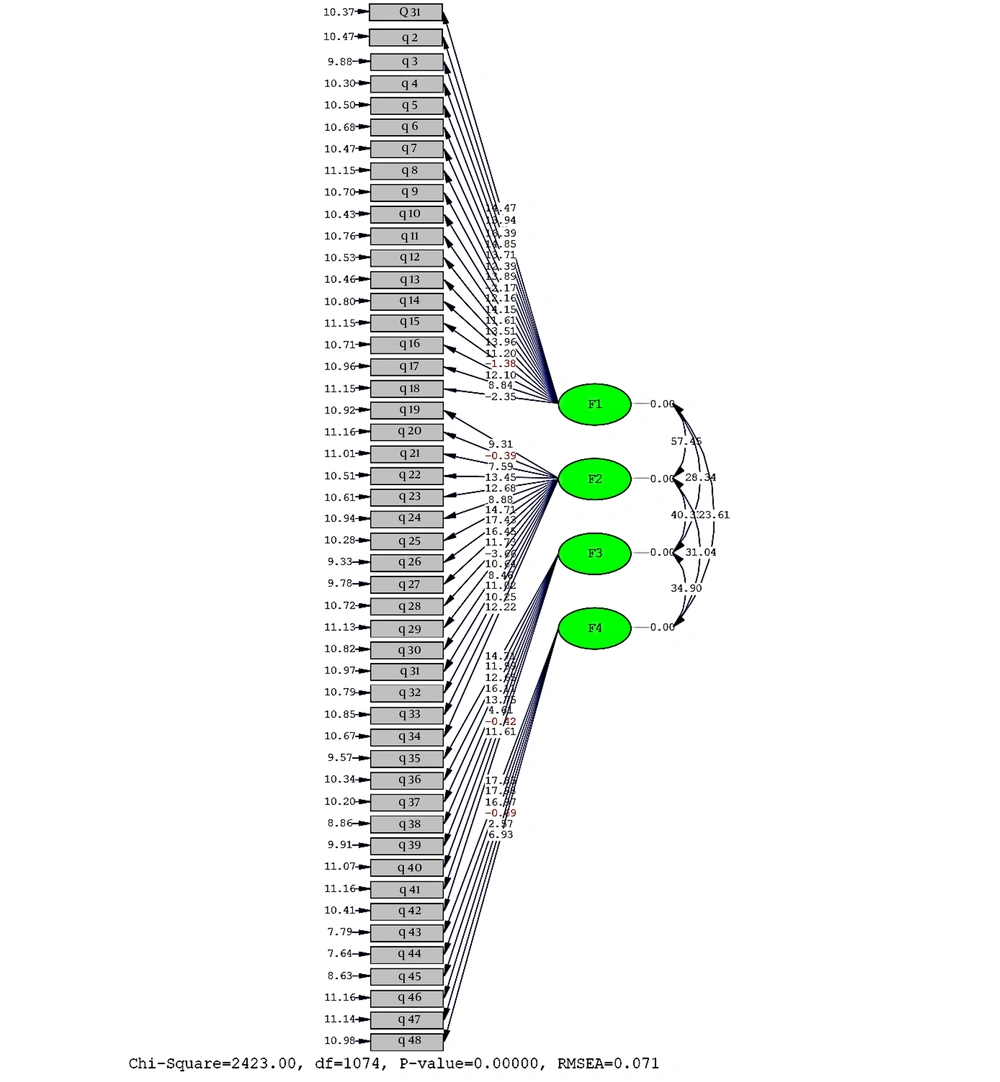
Path diagram of confirmatory factor analysis for Family Functioning in Rehabilitation Questionnaire (FFQR) model fit assessment



