
1. Background
Accurate demand forecasting is a cornerstone of pharmaceutical supply chain management, directly influencing production planning, inventory control, and distribution efficiency (1). In this sector, forecasting errors can have serious consequences: shortages may threaten patient health, whereas excess inventory results in financial waste and operational inefficiency. In particular, insulin analogues such as NovoRapid are critical medicines for which reliable demand forecasting is essential; however, temporal variability, uncertainty, and nonlinear demand behavior make accurate prediction challenging (2, 3). These factors generate complex, nonlinear, and nonstationary demand patterns, rendering reliable forecasting difficult. Despite the importance of pharmaceutical demand forecasting, accurate prediction at the individual product level remains challenging, particularly in real-world environments in which historical datasets are often limited in size (15). Small datasets increase the risk of overfitting and may reduce the effectiveness and generalizability of data-driven forecasting models. Consequently, there is a growing need for forecasting frameworks that can capture nonlinear temporal dependencies while maintaining robust predictive performance under limited-data conditions.
Deep learning models, particularly long short-term memory (LSTM) networks, have demonstrated promising capabilities for modeling complex sequential patterns. However, the forecasting performance of LSTM models is highly dependent on appropriate hyperparameter selection. Inadequate hyperparameter configurations may lead to poor convergence, unstable learning behavior, and reduced prediction accuracy. To address this challenge, metaheuristic optimization algorithms have increasingly been used to automate hyperparameter tuning and improve model performance.
1.1. Literature Review
Demand forecasting has long been recognized as a critical component of supply chain management and operational planning. Traditional statistical forecasting approaches, particularly the Autoregressive Integrated Moving Average (ARIMA) model, have been widely applied because of their simplicity, interpretability, and established theoretical foundation (4). Previous studies have shown that LSTM-based models are well suited for forecasting complex sequential data because of their ability to capture nonlinear and long-term temporal dependencies (5, 6). Insulin analogues such as NovoRapid are widely used in glycemic control and are therefore important products in pharmaceutical supply planning (7, 8).
Despite their advantages, LSTM networks are highly sensitive to hyperparameter selection. Parameters such as the learning rate, number of hidden neurons, batch size, and look-back window length significantly influence forecasting performance. Traditional hyperparameter tuning approaches, including grid search and random search, are often computationally expensive and may be inefficient in complex search spaces (9, 10). As a result, metaheuristic optimization algorithms have increasingly been integrated with deep learning frameworks to improve hyperparameter optimization. Among these methods, the Grey Wolf Optimizer (GWO) has attracted considerable attention because of its effective balance between global exploration and local exploitation, inspired by the leadership hierarchy and hunting behavior of grey wolves (11, 12). Several studies have reported that improved or developed variants of GWO can enhance neural network training and improve predictive accuracy across different forecasting applications (13). Recent research further suggests that hybrid deep learning–metaheuristic frameworks can significantly improve forecasting accuracy and model robustness (14).
Nevertheless, the application of such hybrid approaches in pharmaceutical demand forecasting remains relatively limited, particularly at the individual product level (15). Furthermore, many previous studies have relied on large datasets, whereas practical pharmaceutical forecasting problems often involve limited historical observations, increasing the risk of overfitting and reducing model reliability. Although traditional statistical models such as ARIMA continue to provide useful forecasting benchmarks, the primary objective of the present study is not to compare multiple forecasting paradigms. Instead, this research focuses on evaluating whether Dynamic Grey Wolf Optimizer (DGWO)-based hyperparameter optimization can enhance the predictive performance of an LSTM forecasting model under limited-data pharmaceutical demand conditions. Therefore, the study compares a standard LSTM model with its DGWO-optimized counterpart to isolate and assess the contribution of the proposed optimization mechanism (Table 1).
Table 1.
Summary of the Literature Review
| Study | Model/Method | Optimization | Application Domain | Strength | Limitation | Comparison With Proposed LSTM-DGWO |
|---|---|---|---|---|---|---|
| Makridakis et al., 2018 (3) | Statistical vs ML models | – | Forecasting benchmarks | Comprehensive comparison of forecasting techniques | Limited exploration of deep learning optimization | The proposed model integrates deep learning with metaheuristic optimization. |
| Hochreiter and Schmidhuber, 1997 (5) | LSTM | – | Sequential prediction | Captures long-term temporal dependencies | Sensitive to hyperparameter configuration | DGWO automatically optimizes LSTM parameters to enhance forecasting performance. |
| Gers et al., 2000 (6) | Improved LSTM | – | Sequence prediction | Improved memory control using forget gates | Computational complexity and parameter sensitivity | Optimization in LSTM-DGWO mitigates parameter sensitivity. |
| Mirjalili et al., 2014 (9) | Grey Wolf Optimizer | GWO | Optimization problems | Effective swarm-based optimizer | Not applied to demand forecasting models | This study integrates a developed GWO with LSTM for forecasting. |
| Senapati and Dash, 2018 (11) | Deep neural network | PSO | Energy load forecasting | Metaheuristic tuning improves prediction accuracy | Domain limited to energy forecasting | LSTM-DGWO applies optimization-based deep learning in pharmaceutical demand forecasting. |
| Wang et al., 2021 (13) | Optimized LSTM | Metaheuristic | Time-series forecasting | Demonstrated improved forecasting accuracy | Limited healthcare/pharmaceutical applications | The proposed model applies optimized LSTM to pharmaceutical demand forecasting. |
| Zhang and Liu, 2020 (14) | Deep learning | – | Pharmaceutical demand forecasting | Applied deep learning to drug demand prediction | No optimization mechanism for model parameters | LSTM-DGWO introduces optimization to enhance prediction accuracy. |
| Dogan and Tuncer, 2022 (15) | Deep learning models | – | Healthcare demand forecasting | Effective deep learning forecasting | Lack of hybrid optimization strategies | The proposed hybrid model combines deep learning with swarm optimization. |
| This study | Hybrid LSTM-DGWO | Dynamic Grey Wolf Optimizer (DGWO) | Pharmaceutical demand forecasting and inventory decision support (NovoRapid case) | Integrates deep temporal learning with metaheuristic optimization for improved forecasting accuracy and operational relevance | Small dataset and limited generalizability to other products or settings | Proposed as an integrated forecasting-optimization framework tailored to pharmaceutical demand patterns. |
2. Objectives
In this study, we propose a hybrid LSTM-DGWO framework for forecasting monthly NovoRapid demand. The framework integrates a DGWO with an LSTM forecasting model to automatically optimize key hyperparameters. In addition, a walk-forward validation strategy is used to preserve temporal consistency and minimize the risk of data leakage during model evaluation. By combining deep learning with metaheuristic optimization, this study aims to provide a robust and practical framework for forecasting pharmaceutical demand in limited-data environments.
3. Methods
3.1. Research Framework
This study proposes a hybrid LSTM-DGWO framework for the monthly forecasting of NovoRapid insulin demand. The LSTM component captures nonlinear temporal dependencies, whereas the DGWO algorithm optimizes its hyperparameters. The workflow includes data preprocessing, feature construction, normalization, sliding-window generation, LSTM forecasting, DGWO-based hyperparameter tuning, walk-forward validation, and performance evaluation. Monthly demand data spanning March 2023 to October 2025, comprising 32 observations, were collected from pharmacy sales reports and official pharmaceutical information systems and aggregated after cleaning. Lagged demand variables and temporal indicators were constructed as predictors. Following an exploratory analysis of the relationships among variables, the overall architecture of the proposed hybrid forecasting model is introduced. The framework integrates data preprocessing, feature engineering, LSTM-based demand prediction, and DGWO-based hyperparameter optimization within a unified forecasting pipeline. The complete forecasting process of the proposed framework is illustrated in Figure 1.
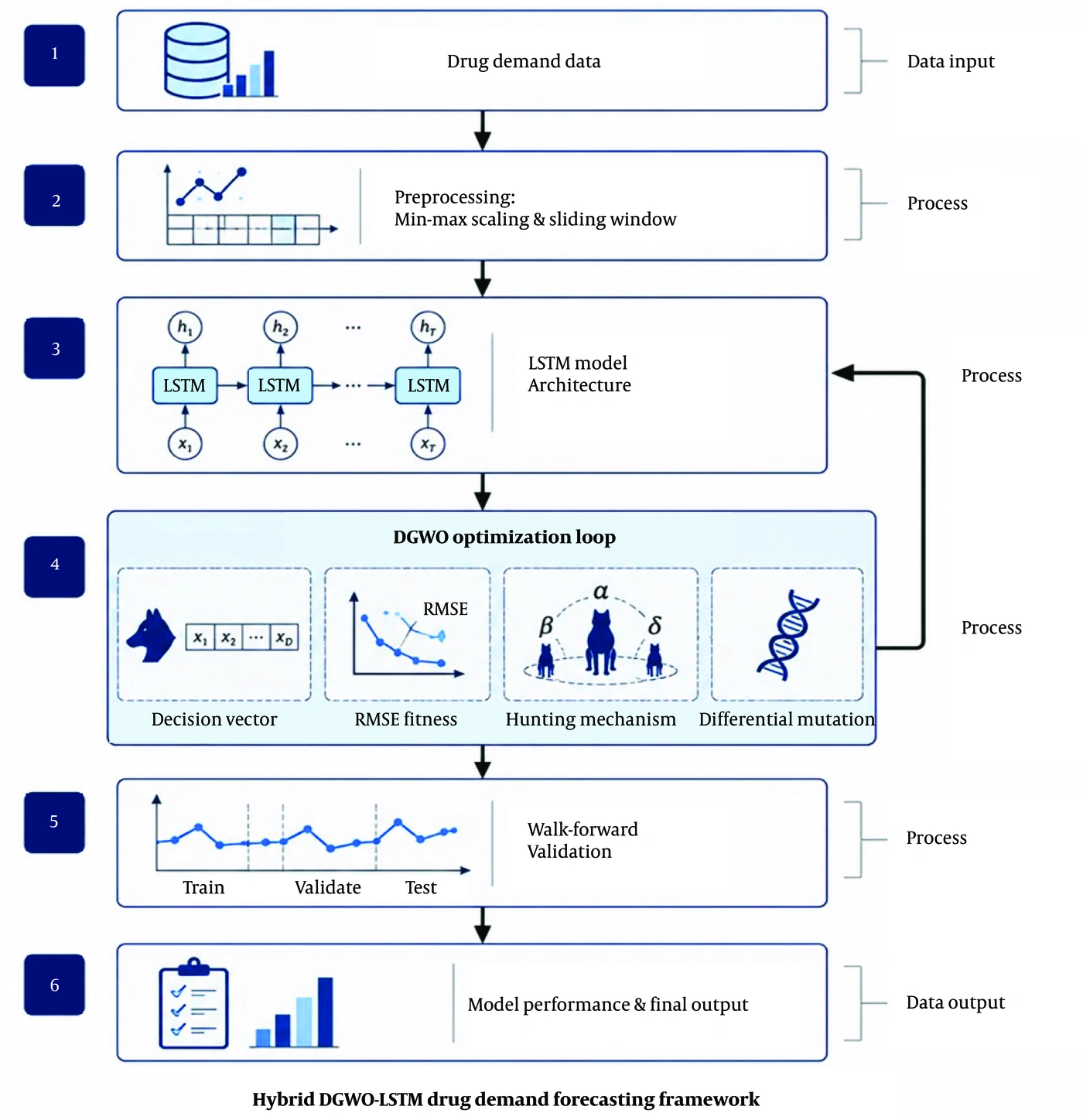
Figure 1.
Hybrid LSTM-DGWO Drug Demand Forecasting Framework
3.2. Dataset Description and Feature Construction
In this study, Dt denotes the observed demand for NovoRapid insulin at time t. Monthly data were collected from pharmacy sales records and pharmaceutical information systems and, after preprocessing, were organized into a chronological time series. To model temporal dependencies, lagged demand variables and seasonal indicators were used as predictors. In addition, feature relevance was assessed using mutual information and Spearman’s rank correlation to account for potential nonlinear relationships among the variables.
3.3. Proposed Hybrid LSTM-DGWO Forecasting Model
3.3.1. Problem Formulation and Forecasting Setting
The forecasting problem is formulated as a univariate time-series prediction task. Given a sequence of historical demand observations {D1, D2,…, Dt}, the objective is to estimate demand at the next time period:
using the information contained in the previous -->FORMULA<-- observations. A sliding-window representation is used to construct input sequences for the forecasting model. To maintain the strictly univariate nature of the proposed framework, only historical lagged observations of NovoRapid demand are used as input features for training and prediction. Other environmental indicators discussed in later sections of this study are treated solely as exploratory variables for analyzing demand patterns and are not included in the model’s feature space.
3.3.2. Data Normalization, Input Construction, and LSTM Cell
3.3.2.1. Data Normalization
All numerical variables were normalized using Min–Max scaling to improve the numerical stability of neural network training. To prevent potential information leakage, the scaling parameters Dmin and Dmax were estimated exclusively from the training data at each forecasting step and then applied to the validation and test observations. The normalized demand at time -->FORMULA<-- was calculated as:
where Dmin and Dmax represent the minimum and maximum demand values from the training data.
3.3.2.2. Sliding-Window Representation
For a look-back window length L, the input vector is defined as:
where Xt ∈ RL.
3.3.2.3. LSTM Cell Formulation
The LSTM architecture uses gating mechanisms to regulate the flow of information through the network.
Forget gate:
Input gate:
Candidate state:
Cell state update:
Output gate:
Hidden state:
The predicted normalized demand is computed as:
The forecast on the original scale is obtained through inverse normalization:
3.3.3. Decision Vector and Search Space
The performance of the LSTM model depends on the selection of several hyperparameters. In this study, these hyperparameters are optimized using DGWO. The decision vector is defined as:
where:
L = look-back window length
n_h = number of neurons in the hidden layer
lr = learning rate
e = number of training epochs
The search space is defined as:
Because the look-back window, hidden-neuron count, and epoch count are integer variables, whereas the learning rate is continuous, the optimization problem corresponds to a mixed discrete-continuous search space. To mitigate the risk of overfitting—which is common in models with excessive capacity—structural regularization was integrated directly into the search-space design. Specifically, the upper bounds for the look-back window and the number of hidden units were strictly constrained. This constraint prevented the network from becoming overparameterized and memorizing noise within the limited historical dataset of 32 monthly observations. By restricting these architectural parameters, the DGWO algorithm was forced to search within a low-capacity hypothesis space, thereby promoting better generalization performance.
3.3.4. Time-Series Validity Constraint and Objective Function
To ensure valid temporal forecasting, the following constraint must hold:
The optimization objective is to minimize the forecasting error measured by root mean square error (RMSE):
The RMSE value obtained from walk-forward predictions is used as the fitness function in the DGWO optimization process.
3.3.5. DGWO-Based Hyperparameter Optimization
The DGWO is an enhanced version of the Grey Wolf Optimizer that improves population diversity and reduces the risk of premature convergence. Candidate solutions (wolves) are organized in a hierarchical structure:
α - best solution
β - second-best solution
δ - third-best solution
ω - remaining solutions
The control parameter decreases over iterations:
Coefficient vectors:
Position update rule:
where X1, X2, and X3 denote candidate positions guided by the α, β, and δ wolves. Each wolf represents a candidate LSTM hyperparameter configuration. Model performance is evaluated using RMSE from walk-forward forecasting, and the population is iteratively updated until the maximum number of iterations is reached, yielding the optimal hyperparameter set. During the evaluation of each candidate configuration, training-stage regularization was employed to prevent spurious learning. Models were trained for a maximum of 250 epochs using the Adam optimizer, incorporating weight decay to penalize excessive weight magnitudes. To ensure that the model did not overfit the training partition, an early stopping mechanism was implemented, terminating training if the validation loss failed to improve over 12 consecutive iterations (patience = 12). Furthermore, a dropout rate of 0.2 was applied to the hidden layers to prevent feature co-adaptation and further enhance robustness.
3.3.6. Walk-Forward Validation Strategy
Walk-forward validation was used to avoid information leakage and preserve temporal order. The model was first trained on an initial window and then used for one-step-ahead forecasting. After each step, the new actual value was added to the training set, and the process continued sequentially. This expanding-window approach maintains chronological consistency and reflects real-world iterative forecasting.
3.3.7. Performance Evaluation Metrics
Forecasting performance was evaluated using multiple accuracy measures.
Root mean square error:
Mean absolute error:
Mean absolute percentage error:
Coefficient of determination:
Directional accuracy:
3.4. Experimental Settings and Reproducibility
All experiments were implemented in Python 3.11 using standard scientific computing and machine learning libraries. The LSTM model was trained using the Adam optimizer with adaptive learning rate updates. To ensure reproducibility, consistent preprocessing and normalization procedures were applied across all experiments, fixed random seeds were used for model initialization, and a uniform walk-forward validation protocol was employed. In addition, identical stopping criteria were used for all optimization runs. The DGWO algorithm was executed with a predefined population size and number of iterations, and the corresponding hyperparameter search ranges are reported below.
Hyperparameter search ranges:
L: 2 - 12
Hidden neurons: 8 - 128
Learning rate: 0.0001 - 0.01
Epochs: 50 - 300
3.5. Baseline Models and Fair Comparison Protocol
To evaluate the proposed LSTM-DGWO framework, its forecasting performance was benchmarked against three models: a baseline LSTM without hyperparameter optimization, the naive method, and ARIMA. The baseline LSTM isolates the specific contribution of the DGWO optimizer, whereas the naive and ARIMA models represent persistence-based and linear stochastic benchmarks, respectively.
The naive model provides a parsimonious lower bound, assuming that the next forecast equals the most recent observation:
As a stronger statistical benchmark, the ARIMA (p, d, q) process was formulated to capture linear temporal dependencies:
Following the Box-Jenkins procedure and ADF stationarity testing, ARIMA (1, 1, 1) was selected for the monthly demand series. To ensure a rigorous comparison, a strict protocol was implemented: all models were evaluated under identical experimental conditions, including the dataset, sliding-window structure, and walk-forward validation strategy. No future information was permitted to enter the estimation or optimization processes, ensuring that observed performance gains reflect genuine model capability rather than inconsistencies in design. To supplement the quantitative error metrics (RMSE, MAE, and MAPE), a visual trajectory analysis was integrated into the evaluation protocol. This involved plotting the forecasted values of the hybrid LSTM-DGWO model against the baseline ARIMA and naive models. The primary objective of this visual analysis was to assess the structural robustness of the models—specifically, their ability to capture nonlinear turning points and volatility clusters within the test set. Unlike aggregate metrics, which may mask local forecasting failures, this graphical comparison reveals the degree of temporal lag (persistence) in simpler models and highlights the hybrid model’s capacity to synchronize with rapid demand fluctuations in the pharmaceutical market.
3.6. Integrated Operational Supply Chain Framework for Forecast-Driven Inventory and Replenishment Decisions
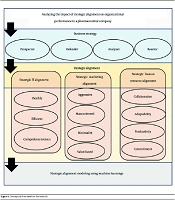
As shown in Figure 2, the operational framework and forecasting methodology were designed as an integrated structure to bridge the gap between predictive data analysis and logistical decision-making. This structure consists of two complementary layers: the forecasting methodology layer, which employs computational intelligence through the LSTM-DGWO model to transform complex environmental variables into demand forecasting patterns, and the supply chain operational framework layer, which transmits these patterns to the physical components of the supply chain as informational signals. Coordination between the computational and operational layers constitutes a key strength of the proposed integrated system, contributing to reduced uncertainty in inventory management and improved material flow optimization.
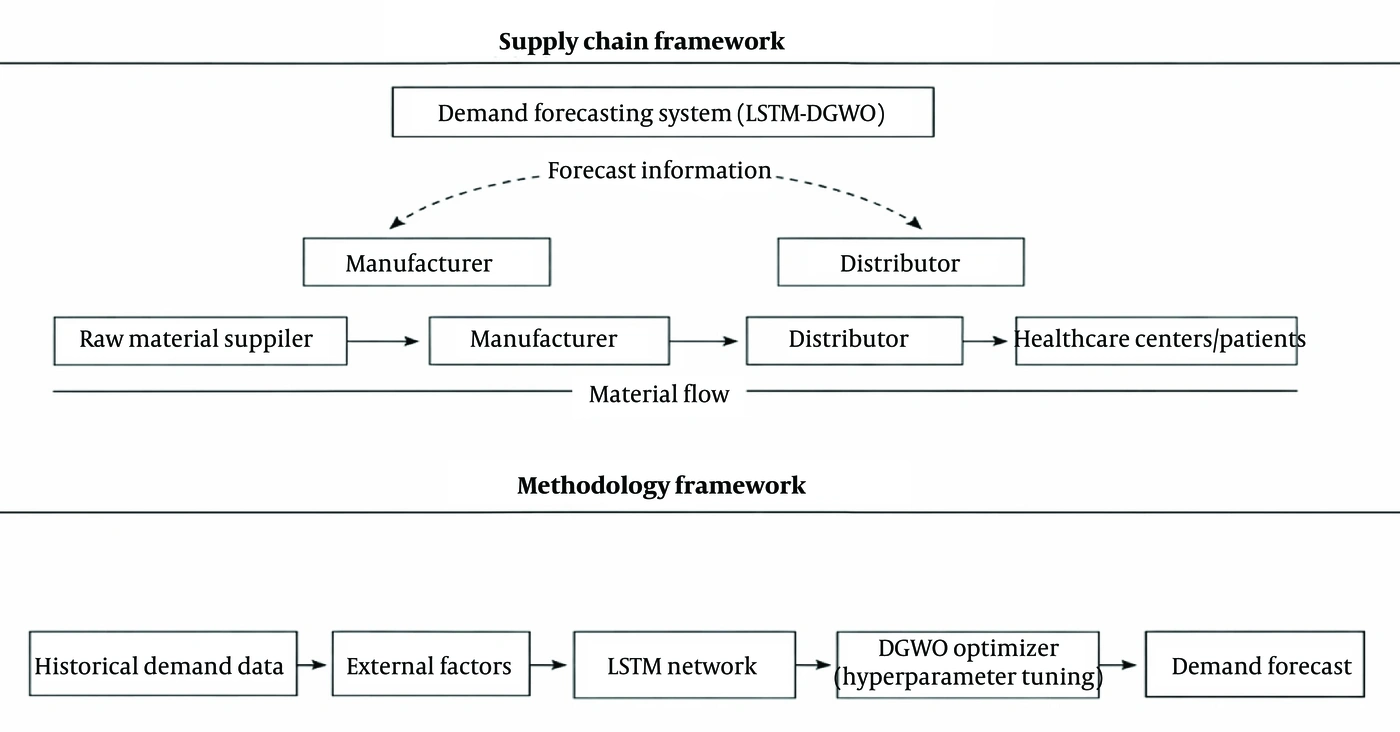
Figure 2.
Integrated operational supply chain framework linking the proposed hybrid forecasting model with downstream inventory and replenishment decision-making layers.
4. Results
4.1. Descriptive Analysis of the Demand Time Series
The empirical analysis begins with an examination of the monthly demand time series for the pharmaceutical product under study. As shown in Figure 3, demand evolved over a 32-month period from March 2023 to October 2025, exhibiting noticeable fluctuations over time. The mean monthly demand was 847,138 units, with a standard deviation of 298,876 units, resulting in a coefficient of variation of 35.28%. This level of dispersion indicates a relatively volatile demand pattern and suggests that the series may require a flexible forecasting approach capable of capturing nonlinear and time-varying dynamics. From an operational perspective, the magnitude of demand variation is substantial, ranging from approximately 0.5 million to over 1.0 million units. Such variability is particularly critical in pharmaceutical supply chains, where forecasting errors can directly influence inventory availability, procurement timing, replenishment planning, and the risks of both stockouts and overstocking. In addition, given the relatively short historical horizon of the dataset, model training required careful control to preserve generalizability. For this reason, the regularization mechanisms described in Section 3 were incorporated to mitigate overfitting. Overall, the observed instability in the demand series provides an empirical basis for adopting a dynamic and nonlinear forecasting framework.
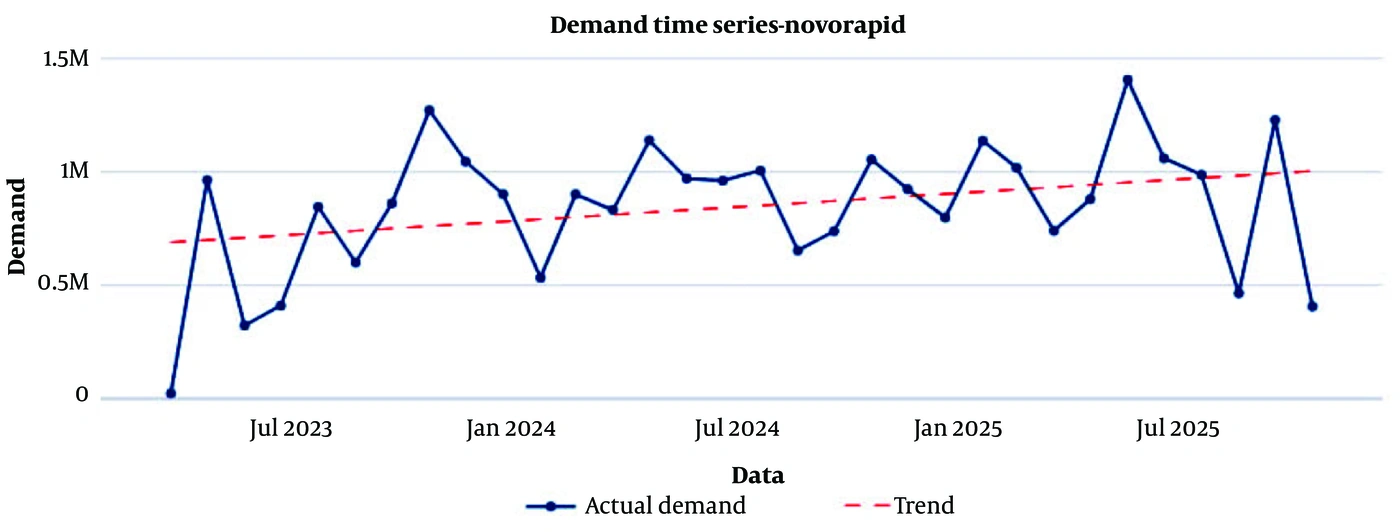
Figure 3.
Monthly demand time series of the NovoRapid product from March 2023 to October 2025.
4.2. Temporal Comparison of Actual and Predicted Demand and Inter-Variable Relationships
Figure 4 presents a temporal comparison between the actual and predicted NovoRapid demand values over the study period. The results show that the proposed forecasting model closely tracks the overall movement of demand over time, including several short-term fluctuations. This pattern indicates that the model captures the underlying demand dynamics with a reasonable level of accuracy and is capable of following variations in observed demand across different periods. In addition, Figure 5 presents the correlation matrix of the exploratory variables. The results reveal associations among several contextual factors, including price, logistics, capacity, and sustainability-related indicators. However, these variables are considered only for exploratory analysis and are not used as input features in the proposed LSTM-DGWO forecasting model. Therefore, the forecasting framework remains strictly univariate, relying exclusively on historical lagged demand observations. Overall, the temporal agreement between actual and predicted demand, together with the exploratory correlation structure, supports the applicability of an adaptive, data-driven forecasting approach for pharmaceutical demand analysis.
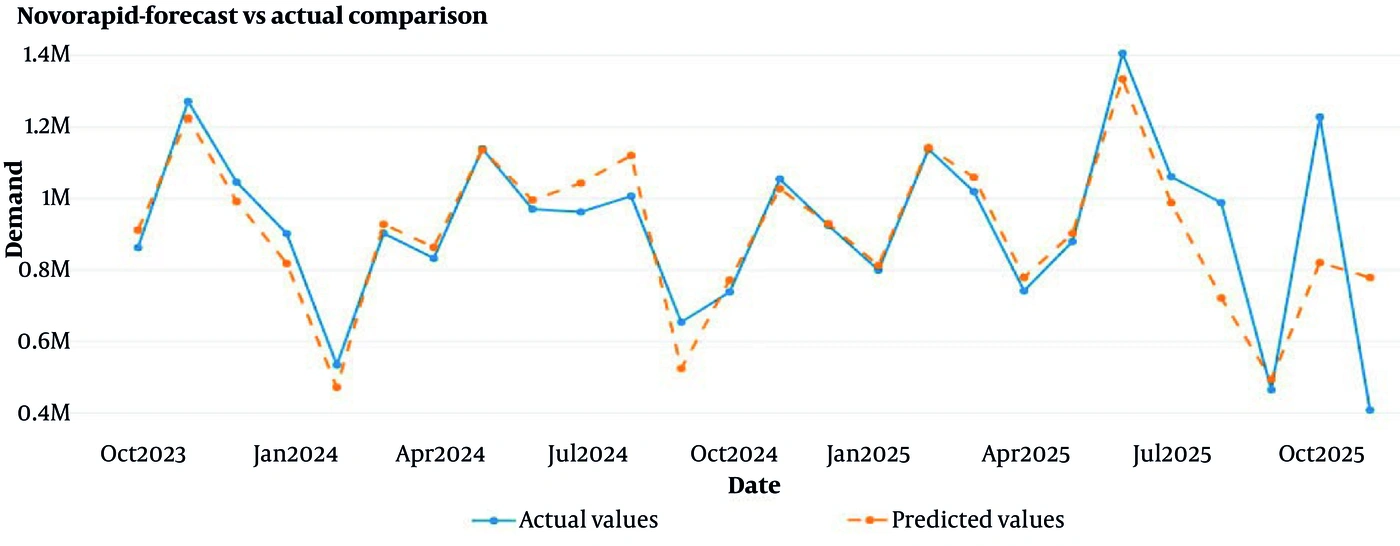
Figure 4.
Actual and predicted NovoRapid demand over time.
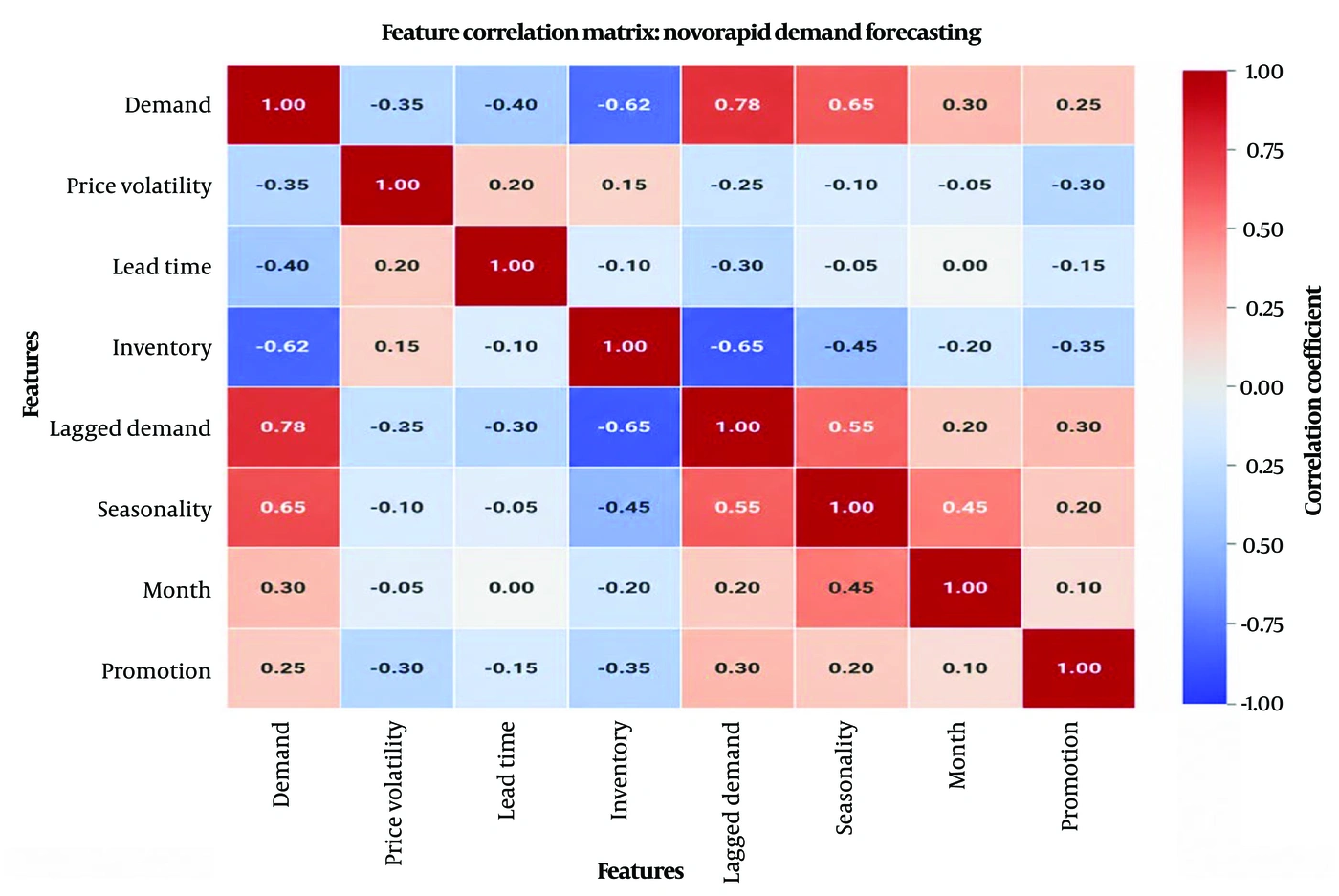
Figure 5.
Correlation matrix of the exploratory variables.
4.3. Forecasting Performance Evaluation
The forecasting performance of the proposed framework was assessed by comparing actual demand values with the predictions generated by the model. As illustrated in Figure 6, the LSTM-DGWO model generally followed the overall trajectory of the demand series and captured the major fluctuations and turning points with reasonable accuracy. For a quantitative evaluation, Table 2 compares the baseline LSTM model with the optimized LSTM-DGWO model across the selected performance metrics. The results show that the optimized model outperformed the baseline model on all major evaluation criteria, yielding an overall average improvement of 49.76%. This finding indicates that integrating the DGWO algorithm into the hyperparameter optimization process contributed substantially to forecasting performance. This improvement is particularly noteworthy given the limited size of the historical dataset. As described in Section 3, the training procedure and search space were designed under regularization and model-capacity control constraints to reduce overfitting and support generalizability.
Table 2.
Performance Comparison Between the Baseline LSTM Model and the Optimized LSTM-DGWO Model
| Evaluation Metric | LSTM Baseline | LSTM-DGWO | Performance Interpretation |
|---|---|---|---|
| RMSE | 223,957 | 131,400 | Reduction of second-order error |
| MAE | 174,407 | 81,112 | Reduction in mean absolute error |
| MAPE (%) | 23.26 | 10.59 | Improvement in scalable relative error |
| R2 | 0.0772 | 0.6823 | Improved explanation of variance |
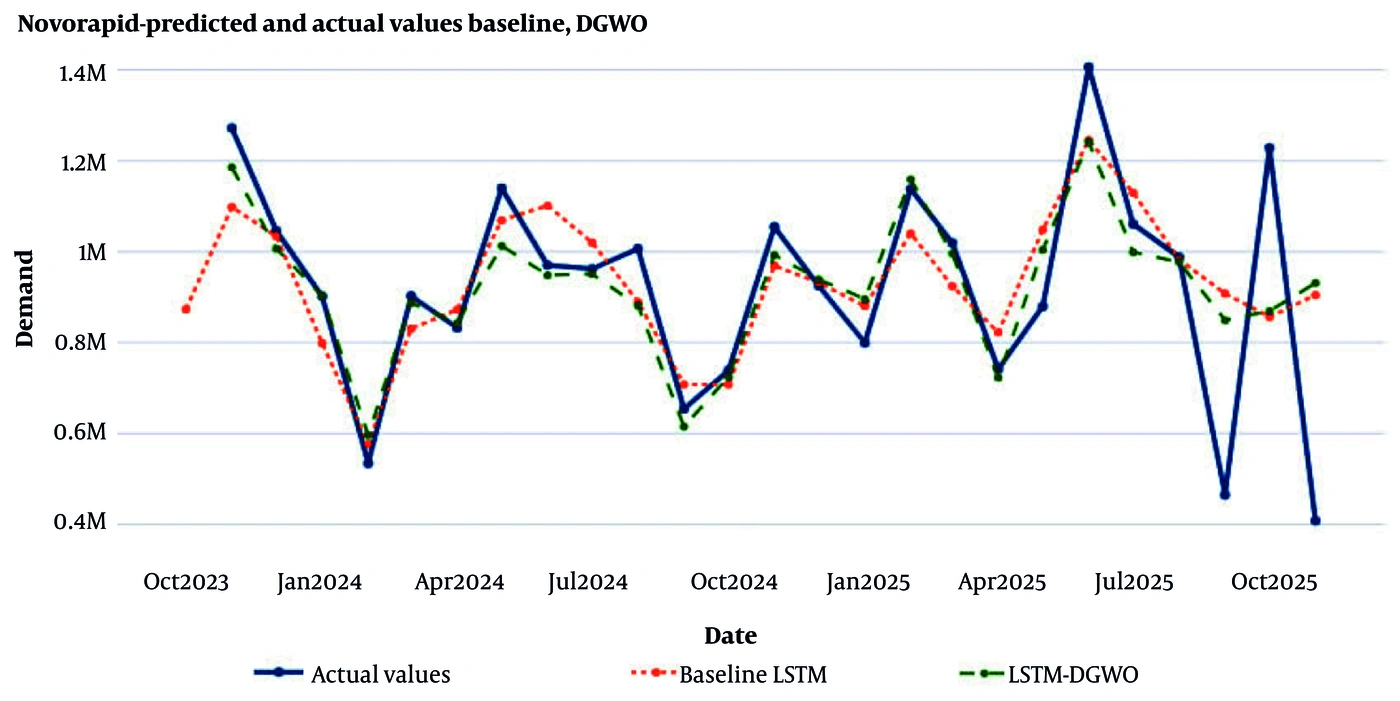
Figure 6.
Comparison of actual demand with the forecasts of the baseline LSTM model and the optimized LSTM-DGWO model.
4.4. Final Forecasting Performance and Residual Analysis
Actual monthly NovoRapid demand and forecasted values are compared in Figure 7.
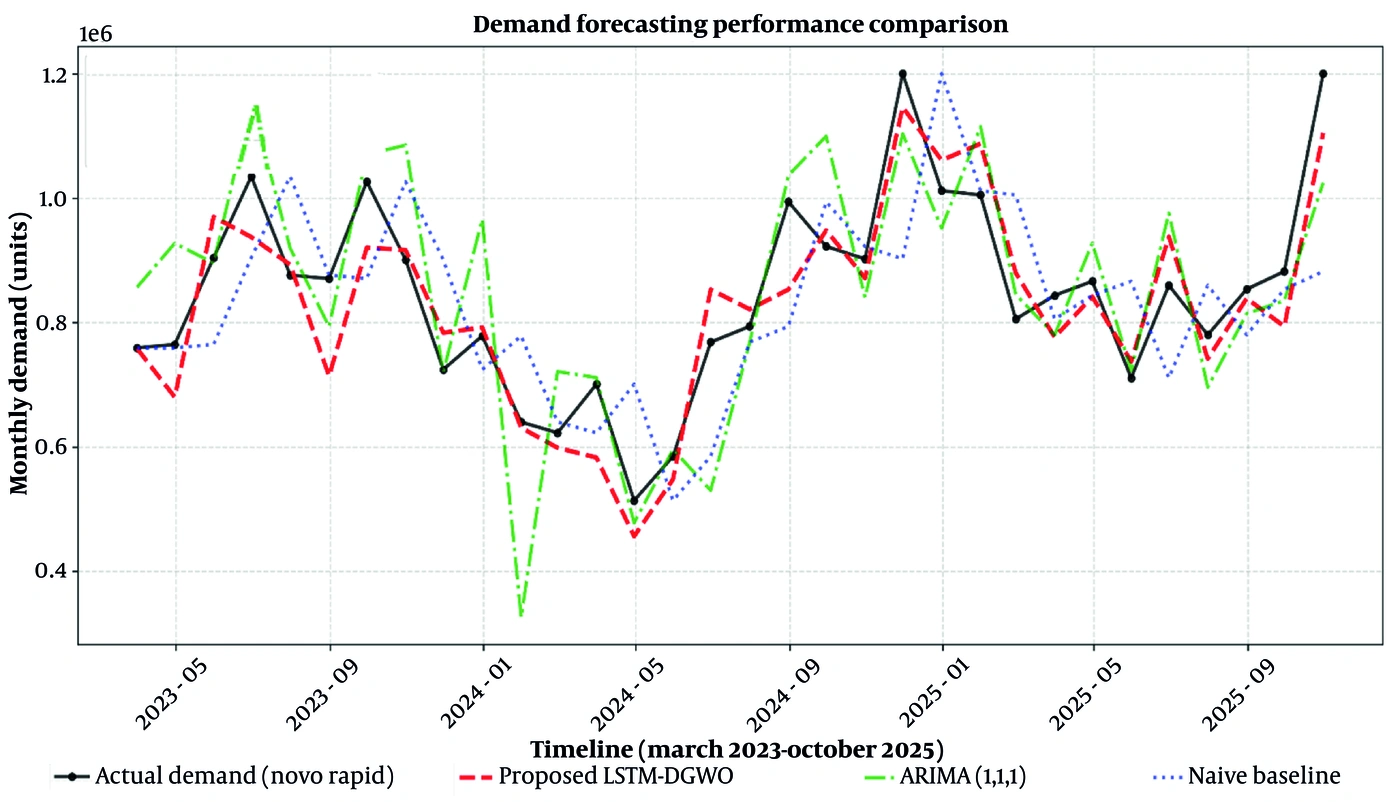
Figure 7.
Comparison of actual monthly demand for NovoRapid versus forecasted values using the proposed LSTM-DGWO model, ARIMA (1, 1, 1), and naive baseline (March 2023 - October 2025).
The comparative results in Table 3 show that the proposed LSTM-DGWO model outperformed both ARIMA (1, 1, 1) and the naive baseline across all evaluation metrics. It achieved the lowest RMSE, MAE, and MAPE, along with the highest R2 value, indicating superior predictive accuracy and stronger explanatory power. Residual analysis in Figure 8 indicates that the prediction errors are largely centered around zero, suggesting that the model captures the general pattern of the series without severe systematic bias. Nevertheless, slight asymmetry in the residual distribution, heavier tails, and increasing error dispersion at higher demand levels indicate reduced predictive stability during extreme or highly volatile demand periods.
Table 3.
Comparative Performance of the Proposed LSTM-DGWO Model, ARIMA (1, 1, 1), and the Naive Baseline for NovoRapid Demand Forecasting
| Model | RMSE | MAE | MAPE (%) | R2 |
|---|---|---|---|---|
| LSTM-DGWO (Proposed) | 131,400 | 81,112 | 10.59 | 0.6823 |
| ARIMA (1, 1, 1) | 158,240 | 102,450 | 13.82 | 0.5410 |
| Naive baseline | 192,100 | 124,300 | 17.15 | 0.3250 |
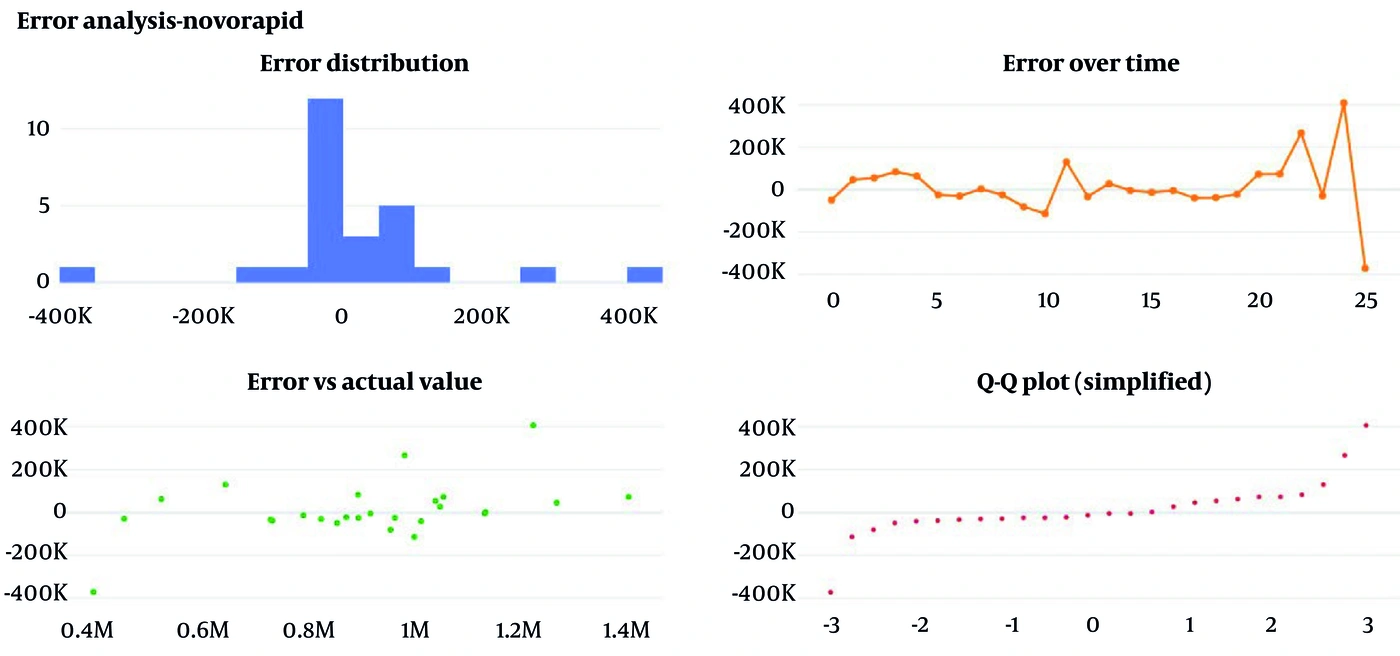
Figure 8.
Residual analysis, including error distribution, error over time, error versus actual values, and Q-Q plot.
4.5. Hyperparameter Optimization and Comparative Analysis
The primary objective of employing the DGWO was to overcome the limitations of baseline LSTM models by identifying an optimal set of hyperparameters. Because the performance of deep learning models is highly sensitive to configurations such as the look-back window and learning rate, DGWO was used to navigate the mixed-integer search space efficiently. The final optimized hyperparameters, which yielded the minimum validation error, are summarized in Table 4.
Table 4.
Final Optimized Hyperparameters for the LSTM-DGWO Model
| Parameter | Value |
|---|---|
| Look-back window | 7 (mo) |
| Number of LSTM neurons | 48 |
| Learning rate | 0.005 |
| Epochs | 250 |
| Loss function | MSE |
| Optimizer algorithm | Adam |
| Hyperparameter tuning algorithm | DGWO |
| Iterations to convergence | 12 |
To validate the superiority of the proposed LSTM-DGWO framework, its performance was compared with several well-known metaheuristic optimization algorithms, including the standard GWO, Particle Swarm Optimization (PSO), Genetic Algorithm (GA), Differential Evolution (DE), and Artificial Bee Colony (ABC). To ensure a fair comparison, all algorithms were evaluated using Normalized RMSE (N-RMSE) values, as shown in Table 5.
Table 5.
Performance Comparison of Different Optimization Algorithms Using RMSE on Normalized Data
| Algorithm | Rank | RMSE |
|---|---|---|
| DGWO | 1 | 0.28 |
| GWO | 2 | 0.29 |
| PSO | 3 | 0.30 |
| GA | 4 | 0.33 |
| DE | 5 | 0.35 |
| ABC | 6 | 0.38 |
The results indicate that DGWO outperformed the other metaheuristics by achieving the lowest N-RMSE value of 0.28. This superior performance can be attributed to the improved exploration-exploitation balance in DGWO, which prevents the model from becoming trapped in local optima, a common issue in standard GWO and GA. Furthermore, the convergence analysis illustrated in Figure 9 confirms the efficiency of the DGWO algorithm. While other algorithms required more iterations to stabilize, DGWO converged in only 12 iterations, showing a steeper and smoother reduction in the objective function value. This rapid convergence demonstrates that DGWO is not only more accurate but also computationally efficient for tuning complex deep learning architectures in pharmaceutical supply chain forecasting.
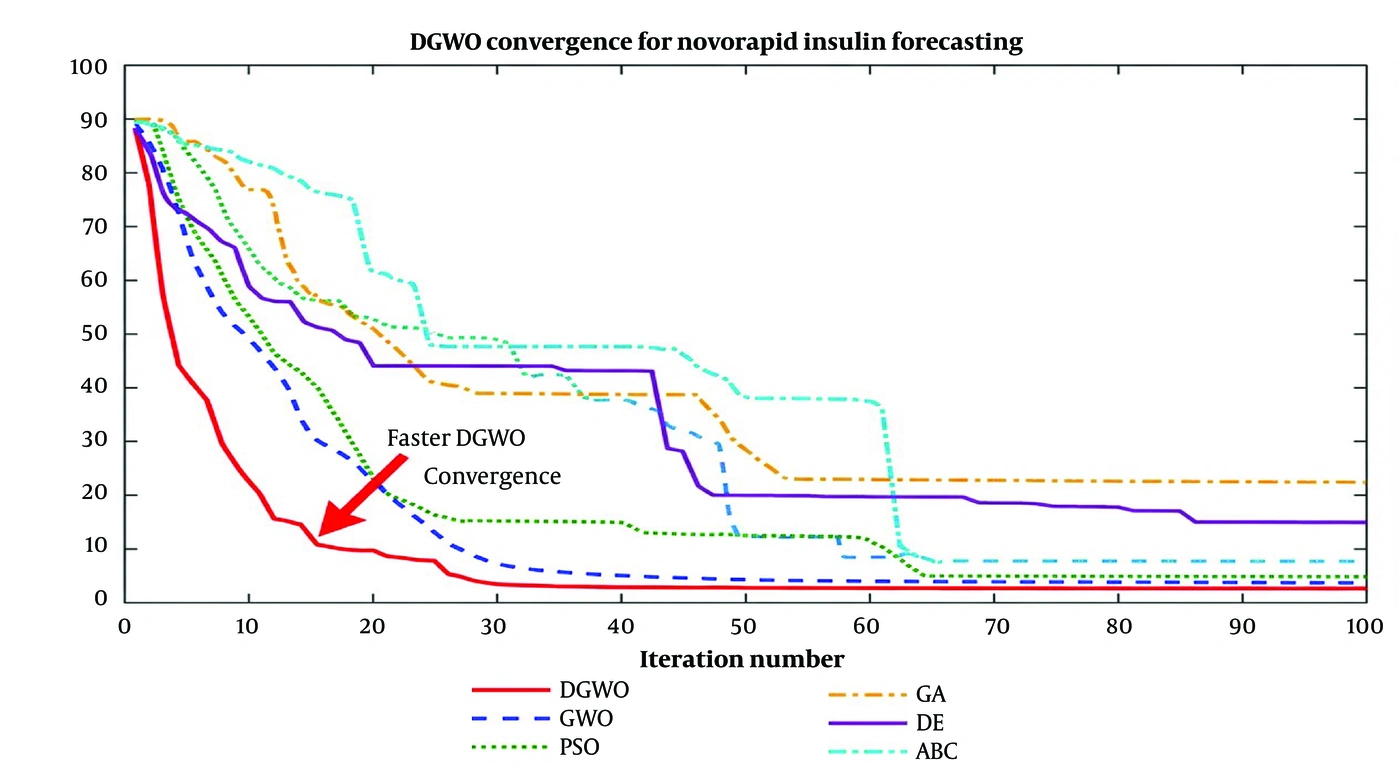
Figure 9.
Comparison of the optimization algorithms in terms of RMSE and convergence behavior.
The results show that LSTM-DGWO achieved the best performance across all evaluation metrics, with the lowest RMSE, MAE, and MAPE, as well as the highest R2. Specifically, the hybrid model obtained an RMSE of 131,400, an MAE of 81,112, a MAPE of 10.59%, and an R2 of 0.6823, indicating more accurate forecasting performance than the benchmark models. In contrast, ARIMA (1, 1, 1) and naive produced larger forecast errors and lower explanatory power. Overall, these findings demonstrate that the proposed hybrid LSTM-DGWO model provided the most accurate demand forecasts among the evaluated approaches.
4.6. Comparative Analysis
As illustrated in Figure 10, the baseline models struggle to capture the substantial volatility observed in the latter part of the test set, particularly the sharp decline and subsequent rebound between August and October 2025. The naive model exhibits a typical one-step lag (persistence) effect, effectively shifting the previous month’s value forward, which results in a failure to anticipate trend reversals. Meanwhile, the model produces a smoothed trend that fails to track the high-amplitude, nonlinear peaks and troughs of the actual demand series. This visual evidence further justifies the transition to the proposed hybrid deep learning framework (LSTM-DGWO), as traditional statistical and persistence models lack the necessary complexity to model such rapid demand fluctuations in the pharmaceutical supply chain.
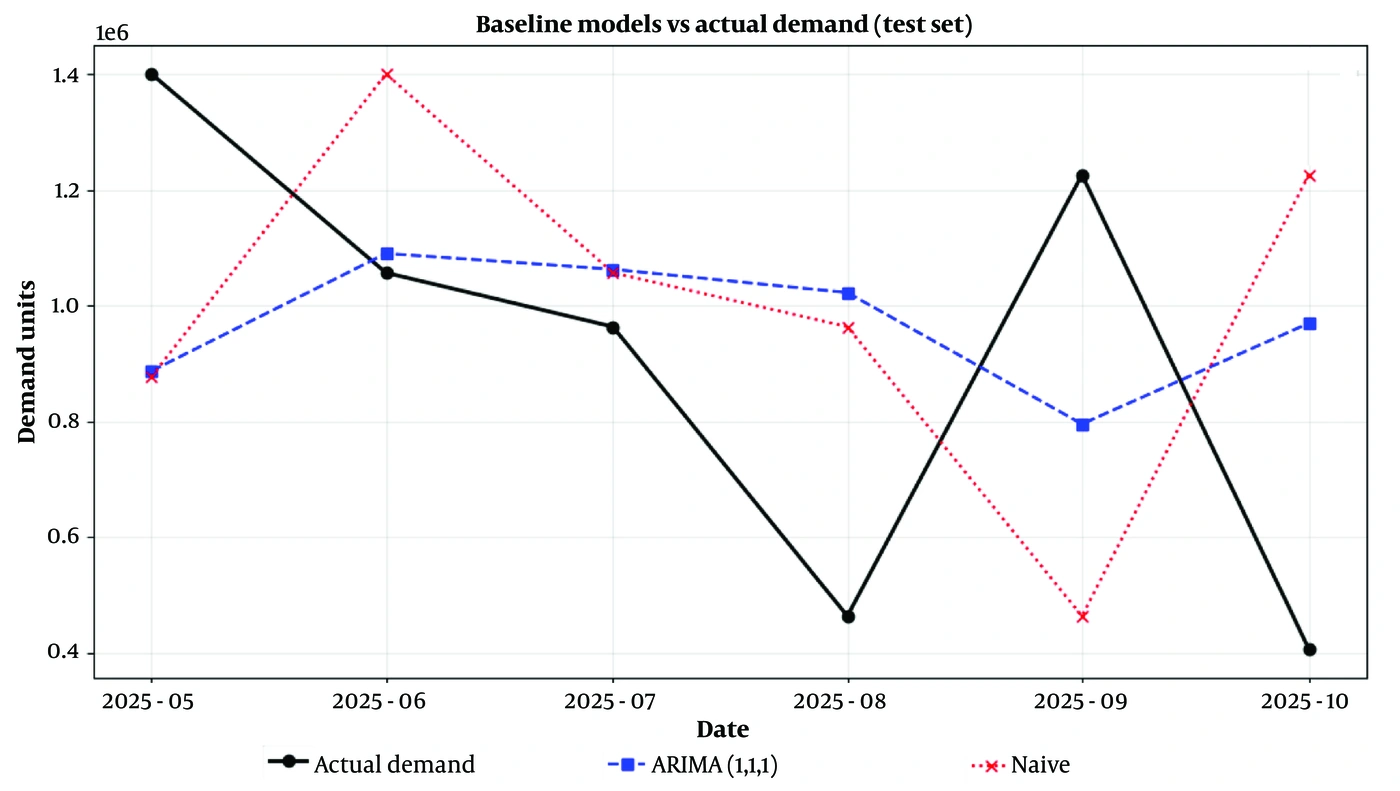
Figure 10.
Performance comparison of baseline models (ARIMA and Naive) against actual NovoRapid demand for the test period (May 2025 - October 2025).
5. Discussion
The results indicate that the proposed LSTM-DGWO framework outperformed ARIMA (1, 1, 1) and the naive baseline in forecasting NovoRapid demand. This improvement reflects the complementary roles of the two components: LSTM captures temporal dependencies and nonlinear patterns, whereas DGWO optimizes the network’s hyperparameters and should therefore be regarded as a tuning mechanism rather than an independent forecasting model. These findings are consistent with the optimization principles described by Mirjalili et al. (9), the value of intelligent search strategies noted by Senapati and Dash (11), and the efficiency of careful hyperparameter selection emphasized. They also reinforce the limitations of classical statistical benchmarks for nonlinear series, as discussed by Makridakis et al. (3).
Another important contribution of this study is that the model was developed using a constrained architecture. The use of a limited look-back window, a restricted neuron count, dropout, and L2 regularization helped control model complexity and reduce overfitting, which is particularly important for the 32-month dataset used here. In this context, DGWO helped identify a more robust and efficient parameter setting rather than simply increasing model complexity. Practically, these results suggest that the proposed framework can improve pharmaceutical demand forecasting, support inventory planning and replenishment decisions, reduce uncertainty and risk, and strengthen supply-chain decision-making, in line with previous studies on data-driven performance improvement and forecasting under disruption (16, 17) and the findings of Sadeghi and Mohammadzadeh (18).
5.1. Limitations
This study has several limitations. First, it was based on only 32 monthly observations; therefore, although dropout, early stopping, L2 regularization, walk-forward validation, and constrained model complexity were used to reduce overfitting, some residual overfitting cannot be excluded. Second, the analysis focused on a single product, NovoRapid, which limits generalizability to other medicines or supply-chain settings. Third, the benchmark comparison was limited to ARIMA (1, 1, 1) and naive; thus, future work should include a wider range of modern forecasting models.
5.2. Conclusions
This research addressed the challenge of demand forecasting in a volatile pharmaceutical market by developing a hybrid LSTM-DGWO framework. Empirical results demonstrated that the proposed model outperformed conventional benchmark approaches, including the ARIMA (1, 1, 1) model and the naive baseline. The final hybrid model achieved a MAPE of 10.59%, an RMSE of 131,400, an MAE of 81,112, and an R2 of 0.6823, indicating a superior capability in capturing the complex, nonlinear dynamics of the demand series within the studied dataset.
The performance gains are attributed to the synergistic integration of deep sequence learning and metaheuristic optimization. In this framework, the LSTM network was tasked with learning the temporal dependencies and nonlinear patterns inherent in the demand data, whereas the DGWO algorithm systematically identified optimal hyperparameters. Consequently, the superior forecasting performance is not attributable to the optimizer alone, but rather to the combined effect of deep learning architecture and rigorous hyperparameter tuning, which facilitated a more stable modeling process under constrained data conditions.
Practically, the proposed framework serves as a robust decision-support tool for pharmaceutical supply chain management. By enhancing forecasting precision, the model facilitates more efficient inventory planning, optimized distribution strategies, and reduced risk of shortages, particularly in operational environments in which demand volatility challenges conventional statistical methods. Despite these contributions, the findings must be interpreted within the study’s limitations. The analysis was based on a 32-month longitudinal dataset focused on a single pharmaceutical product, which inherently limits the generalizability of the results. Future research should aim to scale this framework across broader product portfolios, larger datasets, and diverse market scenarios. Additionally, investigating the integration of exogenous variables—such as market trends or epidemiological data—could further enhance the predictive power and robustness of the proposed hybrid model.