
1. Background
Pneumonia is the third leading cause of death in Japan, and deaths from pneumonia are more common in elderly individuals (1). Expiratory flow plays an important role in minimizing the risk of infection by expelling foreign substances and excessive mucus from the lungs (2). Expiratory flow results primarily from the activities of the abdominal muscles (3). These include the rectus abdominis (RA), external oblique (EO), internal oblique (IO), and transverse abdominis muscles (TrA). The action of the RA produces a caudal displacement of the sternum, and a decrease in the anteroposterior diameter of the rib cage (4). Contraction of the EO causes a caudal displacement and a decrease in the transverse diameter of the rib cage (4). The activities of the TrA and IO are related to changes in intra-abdominal pressure (5). As part of the normative aging process, there is a decline in muscle thickness. However, little is known about the association of abdominal muscle thickness with expiratory flow rate. Recently, the researchers of the current study reported that the IO muscle has the highest correlation with peak expiratory flow (PEF) in elderly subjects among individual abdominal muscles (6). However, the abdominal muscles act together during expiration (3). Not only individual muscle thickness, but also combined muscle thickness, should be evaluated to determine whether PEF is correlated with the thickness of the abdominal muscles. The researchers hypothesize that PEF may be related to combined more than individual abdominal muscle thickness.
2. Objectives
The purpose of this study was to compare the relationships between PEF and individual and combined abdominal muscle thicknesses in elderly subjects.
3. Methods
3.1. Participants
Thirty-one elderly females, who were able to walk independently, participated in this study. The 13 subjects of this study were the same participants of the previous study (6). Their age, height, and weight (mean ± standard deviation) were 81.7 ± 5.8 years, 149.5 ± 6.4 cm, and 50.5 ± 7.5 kg, respectively. Subjects were recruited from the outpatient rehabilitation center of the Shukumo clinic in Okayama, Japan. Exclusion criteria included the following, inability to follow instructions related to cognitive dysfunction, history of cardiac, pulmonary, or neuromuscular disease, or a history of smoking. Ethics committee of the Kawasaki University of Medical Welfare approved the protocol. In addition, approval for this study was obtained from the director of the Shukumo clinic. Written informed consent was obtained from each subject prior to participation in the study.
3.2. Procedure
Peak expiratory flow (L/minute) was measured using a peak flow meter (assess, full range; Philips Respironics G.K. Tokyo, Japan) with a mouthpiece. Subjects were seated, and wore nose clips, while being tested for PEF. Peak expiratory flow was measured after full inspiration. To measure PEF, subjects were instructed to inspire fully, to total lung capacity, and then to exhale through the mouthpiece as fast and as forcefully possible. Subjects were allowed to practice until they could perform the task consistently, and measurements were repeated 3 times. The maximum value of the 3 repetitions was used for analysis. Predicted values of PEF in healthy Japanese subjects were calculated as (- 191.3 + 6.15 × age - 0.08472 × age (years) 2 + 0.0000981 × age (years) 3 + 3.32 × height (cm)) (L/min) (7). The absolute PEF was normalized to the predicted PEF (absolute PEF/predicted PEF × 100), and the normalized PEF was used for the statistical analysis (%).
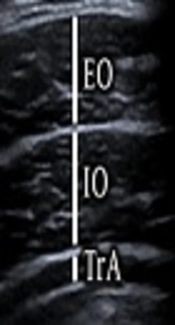
A B-mode ultrasound (JA6; Medicare co. Ltd. Kanagawa, Japan), with a 12-MHz transducer, was used to measure the thickness of the right RA, EO, IO, and TrA. To perform ultrasound imaging of the abdominal muscles at rest, the subject was positioned in the supine position. The RA was measured 4 cm lateral to the umbilicus on the right side of the body (8). The EO, IO, and TrA were measured 2.5 cm anterior to the midaxillary line, and at the midpoint between the inferior rib and the iliac crest (9). Inward pressure caused by the transducer during ultrasound imaging could decrease the measured thickness of the abdominal muscles (10). To minimize this issue, a large quantity of gel was used between the transducer and the skin. In addition, the transducer was adjusted so that the ultrasound wave was approximately perpendicular to the fascia of the abdominal muscles, using the minimum pressure required to achieve a clear image. The thickness of the abdominal muscles increases during expiration (11), thus measurement of abdominal muscle thickness was performed at the end of a relaxed expiration. Images of the abdominal muscles were taken twice. The average value of the 2 images of each abdominal muscle was normalized relative to weight (muscle thickness/weight) and used for statistical analysis (mm/kg). Combined muscle thickness was determined by adding the normalized thickness of various individual muscles together.
3.3. Statistical Analysis
Statistical analysis was done using the IBM SPSS statistical software version 23.0 for Windows. Correlations between normalized PEF and the thickness of normalized individual and combined muscle were determined using Pearson’s correlation coefficient. Values were considered statistically significant at P < 0.05.
4. Results
The absolute and normalized PEF were 285.2 ± 52.6 L/min and 99.1 ± 23.0%, respectively. The absolute and normalized individual muscle thickness values are listed in Table 1. The results of correlation analysis are shown in Table 2. Among individual muscles, the thickness of the IO muscle had the highest correlation with PEF. When combined, the thickness of the EO and IO muscles had the highest correlation with PEF, among individual and combined muscle thicknesses.
Table 1.
Absolute and Normalized Muscle Thickness (Mean ± Standard Deviation)
| Muscle | Absolute Muscle Thickness (mm) | Normalized Muscle Thickness (mm/kg) |
|---|---|---|
| RA | 6.7 ± 1.3 | 0.13 ± 0.03 |
| EO | 4.1 ± 1.3 | 0.08 ± 0.02 |
| IO | 7.0 ± 1.7 | 0.14 ± 0.05 |
| TrA | 2.3 ± 0.9 | 0.05 ± 0.02 |
Abbreviations: EO, external oblique; IO, internal oblique; RA, rectus abdominis; TrA, transverse abdominis.
Table 2.
Correlations Between Peak Expiratory Flow and the Thickness of Individual and Combined Muscle Groups
| Individual and Combined Muscle Thickness | r Value | P Value |
|---|---|---|
| EO + IO | 0.563 | 0.001 |
| RA + EO + IO | 0.555 | 0.001 |
| RA + IO | 0.550 | 0.001 |
| RA + EO + IO + TrA | 0.526 | 0.002 |
| EO + IO + TrA | 0.515 | 0.003 |
| IO | 0.513 | 0.003 |
| RA + IO + TrA | 0.508 | 0.004 |
| IO + TrA | 0.455 | 0.010 |
| RA + EO | 0.388 | 0.031 |
| RA + EO + TrA | 0.383 | 0.033 |
| RA | 0.364 | 0.044 |
| RA + TrA | 0.341 | 0.060 |
| EO | 0.323 | 0.076 |
| EO + TrA | 0.313 | 0.087 |
| TrA | 0.108 | 0.563 |
Abbreviations: EO, external oblique; IO, internal oblique; RA, rectus abdominis; TrA, transverse abdominis.
5. Discussion
To the best of our knowledge, this is the first study to identify the relationships between PEF and the thicknesses of individual and combined abdominal muscles in elderly subjects. The main hypothesis in the present study was that PEF might be related to combined more than individual abdominal muscle thickness. In this study, among individual muscles, the thickness of the IO correlated significantly with PEF. The correlation coefficient for the thickness of the IO muscle in this study (r = 0.513) was similar to that reported previously (r = 0.539) (6). Interestingly, the combined thickness of the EO and IO muscles is most highly correlated with PEF (r = 0.563). The results suggest that in elderly females with thinner EO and IO muscles, lower PEF may be found, when compared to elderly females with thicker EO and IO muscles. Ikezoe et al. (12) reported that among the trunk muscles, age-related atrophy was greater for the EO and IO muscles. The EO and IO muscles have an important role in controlling trunk flexion, rotation, and lateral flexion (3). Decreased opportunity to perform physical activity involving the movement of the trunk may be associated with a greater degree of atrophy of the EO and IO muscles in elderly subjects when compared to younger subjects (12). Not only the action on expiratory flow but the opportunity of the EO and IO to perform physical activity might be the possible reason for the current results. Changes associated with aging could be aggravated by physical inactivity. The effects of physical activity on respiratory muscle strength have been established (13-16). Since improved muscle strength may increase the effectiveness of expiratory flow, regular physical activity could indirectly improve the airway defense mechanisms. However, physical activity was not assessed in this study, and further studies are necessary to assess the relationships among PEF, abdominal muscle thickness, and physical activity.
The present study had a number of limitations. The sample size was small. Since vital capacity and forced expiratory volume in one second was not measured, the subjects may not have a normal pulmonary function. The procedure used to assess PEF is effort-dependent, and requires the full cooperation of the participant; therefore, screening with the Mini-Mental Status Examination could have eliminated cognitively impaired participants. Only female subjects participated in this study, so the influence of gender was not observed. Finally, a cross-sectional design might not allow for cause-effect inferences. A longitudinal study would be needed to define whether the production of PEF is associated with individual and combined abdominal muscle thickness.