
1. Background
Nowadays the study of mental health in different occupational groups, particularly in difficult jobs, is one of the most important issues being paid attention by psychologists and behavioral science researchers (1).
Nurses tolerate an essential part of workforce in the health care system and they are considered as one of the most important groups of service providers. As a powerful factor in the health care system, in fact they play an important role in improving and promoting the health services in the community (2, 3). Nurses are routinely deal with pain, suffering, events, and death of patients in the workplace; consequently, the improper emotional reactions such as stress, anxiety, and depression are the known and integral characteristics of modern nursing that may cause major problems for nurses and patients (4-6).
The results of previous research show that nurses in comparison with people in other jobs are more exposed and vulnerable to stress and mental health problems. Thus, depression, anxiety, and fatigue are common problems among them (7, 8). In addition, Nooryan et al. carried out a study on nurses working in Yasuj’s Hospitals in Iran and showed that the high prevalence of depression, anxiety, and stress symptoms among nurses is alarming (9). Nazari asserts that 30% of the workforce in developed countries suffers from occupational stress and this number is much higher in developing countries (10).
Alighias’s study was conducted on nurses working at Valiasr hospital in Tehran, showing that nurses have a high level of anxiety and they need treatment (11). Anxiety is more prevalent among nurses than in other groups, although it has a various trend in different countries (12). Hence, it has a great significance for managers of hospitals to pay special attention to the mental health of nurses (13). According to the statistics published by Iran’s Nursing Council, 75% of nurses are suffering from some degrees of mental and physical diseases (14). According to epidemiological surveys, one-third of the population is affected by an anxiety disorder during its lifetime and therefore, anxiety is the most important problem in contemporary times (15). Anxiety disorders are consistent with each other as well as with other mental disorders, and it can be the most common psychiatric disorder (16). Since the 1960s, the distinction between state and trait anxiety in psychology texts has been widely accepted. State anxiety refers to a person’s feeling of tension, fear of the future, restlessness, inhibition, arousal, and activation of autonomous sympathetic and parasympathetic systems. Identification of anxiety especially situational anxiety and its related factors can somehow help us to reach a healthy community. One of the most important items related to anxiety in nurses is the relationship between work environment and nursing occupation. Spiel Berger (1966) suggested a distinction between state and trait anxiety and proposed a definition for anxiety that covers various definitions of anxiety. According to Spiel Berger, trait anxiety is created via a personal background to respond to the stimuli; while, state anxiety is a transitory and detectable feeling that is the result of physiological arousal and a mixture of emotions such as fear, distress, and tension. Trait anxiety has at least four different aspects including social evaluation, physical danger, uncertainty, and everyday behaviors; while, state anxiety includes cognitive-distress and autonomous-feeling (Figure 1) (17).
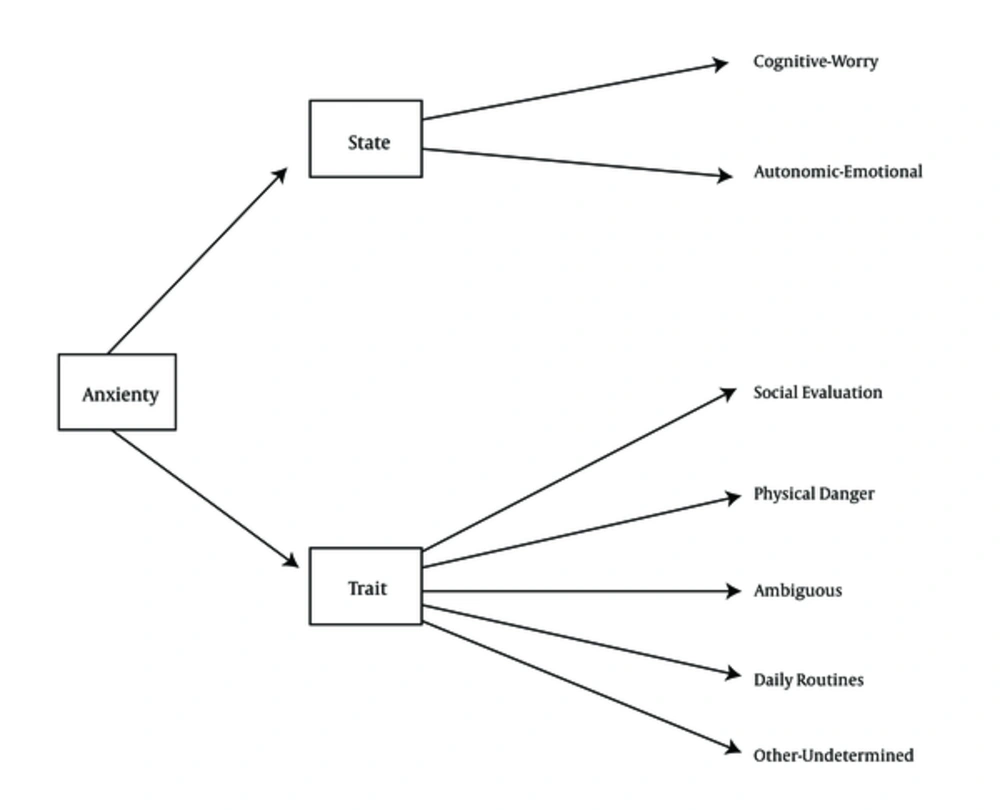
Figure 1.
Multi-Faceted Behavioral and Situational Anxiety
It is of great importance to study the state anxiety among nurses, because in a clinical status, they observe many pains, sufferings, and mourns of people every day; they also experience insomnia that can intensify their tensions. The tensions provide a favorable ground for the emergence of different types of disorders that can be effective in the work efficiency of the whole health system (18). Therefore, since state anxiety has not been studied a lot among nurses in Iran, this study was designed and conducted to evaluate the level and prevalence of state anxiety among nurses working in some hospitals. This study also assessed the relationship between state anxiety and some demographic variables.
2. Methods
This is a descriptive cross-sectional study conducted on 120 nurses working at FayazBakhsh and Imam Reza hospitals affiliated to Tehran social security organization in 2015. Finally, 118 nurses participated in the study. The subjects were selected via convenience sampling method. First, the researchers obtained an approval from the ethics committee and a permission was taken from officials of the selected hospitals affiliated to social security organization. The researchers visited the hospitals on different days of the week and in different shifts to find nurses meeting the inclusion criteria and willing to participate in the study. After explaining the objectives of the study, they were asked to complete the questionnaire within one hour. Inclusion criteria included having at least a bachelor degree in nursing, having tendency to participate in the study, and having at least one year of work experience. The exclusion criteria were experiencing a traumatic event over a month, smoking, and using alcohol and drugs. A questionnaire and a checklist were used as data collection tools. We collected demographic data including age, gender, marital status, having children, ward of work, shift of work, overtime work, and work experience. In order to measure state anxiety of nurses, 20 items from Persian version of Spiel Berger State anxiety inventory were used. State anxiety is an emotional state that is defined as conscious and subjective perception of tension, fear of future, unrest, inhibition, stimulation, and activation of the autonomous nervous system. Depending on the answers provided to each question, every item of the questionnaire was scored 1 to 4. For the ten items of state anxiety, score 4 indicated the presence of a high level of anxiety. For the other items, a higher score indicated the lack of anxiety and they were reversely weighed during scoring; this rule was followed for scoring items 1, 2, 5, 8, 10, 11, 15, 16, 19, and 20. State anxiety inventory scoring was interpreted as follows: scores 20 - 31 indicating mild anxiety, scores 32 - 42 indicating lower than moderate anxiety, scores 43 - 53 indicating higher than moderate anxiety, scores 54 - 64 indicating almost severe anxiety, scores 65 - 75 indicating severe anxiety, and the score 76 or higher indicating very severe anxiety. Spiel Berger state anxiety inventory (STAI) has a high scientific fame and it is regarded as a standard test (17). Mahram translated the inventory into Persian and examined its reliability and validity in 1983. To test the reliability of the inventory, he used Cronbach’s Alpha Test, which gave the value of 94% (19). The Persian version of the inventory was used for different groups and its validity and reliability were assessed several times (20, 21).
Statistical Analysis: In this study, to determine the reliability of the data collection tool, Cronbach'’s Alpha Test was used with an emphasis on the internal consistency; its reliability was 91.6. SPSS- 16 was used for data analysis. In addition, the descriptive statistics including mean, standard deviation, and tables of frequency distribution were used to present the data.
3. Results
The majority of the participants in this study were female (n = 76, 64.4%) and married (n = 97, 82.2%). Of all the married participants, 76 (64.4%) had children. In addition, 88 nurses (74.6%) were working at a rotational shift and 71 cases (60.2%) were working in general wards. The mean age of the participants was 35.75 ± 5.18 years, the mean of overtime work was 88.60 ± 37.51 hours, and the mean of work experience was 11.31 ± 5.02 years. Table 1 shows the frequency and severity of state anxiety among nurses.
Table 1.
Intensity of Situational Anxiety Among Nurses
| Anxiety Levels | No. (%) |
|---|---|
| Low | 21 (17.80) |
| Moderate | 46 (38.98) |
| Higher than moderate | 38 (32.20) |
| Relatively severe | 12 (10.17) |
| Severe | 1 (0.85) |
| Very severe | 0 (0) |
As shown in the above table, 17.8% of the nurses had low anxiety, 71.18% had moderate or higher than moderate anxiety, and 11.02% had relatively severe or severe anxiety. The results also showed that the mean of situational anxiety score of the cases was 41.36 ± 9.47, indicating the moderate level of anxiety among nurses. Table 2 shows the level of anxiety in terms of demographic characteristics of the nurses.
Table 2.
The Anxiety Level According to Demographic Information of the Participants
| Variable | Mean ± SD | P Value | |
|---|---|---|---|
| Sex | Female | 42.46 ± 9.25 | 0.091 |
| Male | 39.38 ± 9.64 | ||
| Marital status | Single | 41.12 ± 9.85 | 0.564 |
| Married | 42.39 ± 7.75 | ||
| Shift of work | daytime work | 41.50 ± 9.56 | 0.297 |
| nighttime work | 47.17 ± 15.30 | ||
| Rotation | 40.93 ± 8.96 | ||
| Ward of work | Internal | 40.83 ± 8.88 | 0.580 |
| Surgery | 40.63 ± 9.69 | ||
| Special | 41.35 ± 9.55 | ||
| Children | 42.82 ± 9.46 | ||
| Office (administrative affairs) | 46.71 ± 6.75 |
As shown in Table 2, although women had a higher level of anxiety, the statistical tests did not show any significant difference between male and female nurses (P = 0.09). The level of anxiety of nurses did not have any significant relationship with marital status (P = 0.56), shift of work (P = 0.29), and ward of work (P = 0.58). In addition, situational anxiety did not have any significant relationship with overtime work (P = 0.56), work experience (P = 0.71), and age (P = 0.58) (Table 3).
Table 3.
The Relationship Between Demographic Characteristics and Situational Anxiety
| Correlation Coefficient | P Value | |
|---|---|---|
| Age | 0.051 | 0.580 |
| Work Experience | 0.035 | 0.710 |
| Overtime work | 0.054 | 0.562 |
4. Discussion
The results of this study showed that most of the nurses working at hospitals had a moderate level of situational anxiety. Hemmati (2005) conducted a study entitled “Evaluation of the level of anxiety in nurses working at the hospital of Urmia”; in line with our study results, their results showed that most of the nurses were affected by a moderate level of anxiety (22). Moreover, the results of Patti et al. (2007) study was in line with the results of our study showing that the prevalence of anxiety disorder among nurses was at a moderate level (23). However, according to the results of a study carried out by Noorbala et al. the prevalence of anxiety among the general population of rural and urban people aged over 15 years was 20% (24). The results of Kessler et al. (1994) study showed that the prevalence of anxiety disorder among the general population varied from 15% to 30% (25). Comparing our results with the findings of other studies, it can be concluded that nurses are more exposed to stress and mental health problems than people working in other professions are; in addition, they suffer from a higher level of anxiety, as compared with the general population. Based on the results of this study, there was no significant relationship between the nurses’ anxiety and gender, marital status, work shift, and ward of work. The results of Hemmati’s study (2005) are in line with the results of this study; it showed that situational anxiety among nurses had no significant relationship with marital status and gender. Moreover, there was no significant difference between nurses working in different hospitals in terms of situational anxiety (22). In line with our findings, the results of the study conducted by Dizaniha et al. in 2014 showed that situational anxiety had no significant relationship with gender, marital status, work shift, and ward of work (26). On the other hand, the results of the study carried out by Khamse et al. in 2012 were inconsistent with our results, because the level of anxiety among nurses had a significant relationship with age and overtime hours (27). It seems that this controversy is because of differences in participants' individual characteristics. Furthermore, management policies, payment system, and work pressure are factors affecting them and even cause situational anxiety. The results of this study showed that situational anxiety had no significant relationship with the nurses’ age, work experience, and the amount of overtime working. Hemmati et al. (2005) reported that situational anxiety of nurses had no significant relationship with age, work experience, and overtime working (22). In Dizaniha et al. (2014) study, no significant relationship was observed between anxiety and work experience of nurses (26). Meshkani et al. (2003) did not observe any relationship between anxiety and age, work experience, and overtime working (28).
Based on our review, we did not find any study evaluating and measuring anxiety disorders among nurses. Hence, this study can be a basis for further studies and it can be used in planning to minimize anxiety among nurses. One of the limitations of this study was the incidence of psychological and mental problems among nurses during the study, which was impossible to be managed by the researchers.
4.1. Conclusions
Given the high prevalence of anxiety disorder among nurses and since this type of disorders may occur in all wards of hospitals among people of any age and work experience, it seems that the nature of the nursing profession is stressful regardless of the type of work or other factors. Therefore, the authorities must design and adopt further measures to improve the health of nurses. Moreover, it is necessary to conduct other studies on anxiety among nurses and investigate the ways to reduce it.