
1. Background
Children spend a considerable portion of their time in the school environment (1). In Iran, children are at school up to five hours a day from Saturday to Wednesday. The health service of school and the learning environment affect health promotion. Also, having access to knowledge, attitudes, skills, and behavioral learning opportunities are necessary for healthy lifestyles (2, 3). Turunen et al. evaluated the impact of the indoor environment quality of Finnish elementary school buildings on the health and academic performance of students (1). Based on the results of many studies, school design standards have an important impact on students’ learning (3, 4). The cleanliness and hygiene of classrooms influence students’ comfort, the odds of illness, and studying concentration (5). Due to the susceptibility of the student to air quality, the indoor air of classrooms is one of the environmental health concerns (6). The contamination of indoor air could result in different health problems both for students and teachers. It can decrease teacher’s productivity and reduce the student’s learning efficiency (6, 7). The results of their study indicated that increasing the ventilation rate using a mechanical system and applying the low-emission furnishings play fundamental roles in the enhancement of indoor air (7). Therefore, the critical components of school infrastructure including lighting, ventilation, temperature, furniture, noise, color, and class size affect students’ comfort, learning, and performance (3, 4). However, many of the public schools in Iran need repair or replacement. The current study aimed at assessing schools environmental health index (SEHI) in all school buildings of Garmsar city, Semnan province, Iran. SEHI includes lighting, ventilation, temperature, furniture, noise, color, class size, standard toilet and washstand, waste disposal, water supply, standard first aid kit, etc. (4, 8).
2. Methods
The current cross sectional, descriptive-analytic study was conducted on 32 public primary schools (both genders) in Garmsar city, located in the east of Semnan province (Iran) in the educational year of 2015 to 2016. The public primary schools were selected based on some factors such as geographical location, the eco-social and cultural position of the students and school officials, and the motive to found and administer the school (6).
2.1. Environmental Health Questionnaire Data
The school environmental health questionnaire was developed using a preliminary library study and a checklist related to the environmental health inspection provided by the Ministry of Health and Ministry of Education and Training. The checklist, coded 140.92031, contains various parts: Personal hygiene, food hygiene, tools and equipment hygiene, building health, occupational safety, and health. General information available about environmental health and safety status of schools and schools health regulations in two parts was adjusted and the data were gathered using a questionnaire (9). The first part was about health state and improvement of buildings, classrooms, schoolyard, hygiene services, schools, state health facilities, safety and welfare of the school, and the state of sewage collection and waste in the intended schools including 37 questions. The second part was about the public health status of the students including 13 questions. The final questionnaire included a total of 50 questions as follows:
Twelve questions about the status of schools hygiene services; 10 questions about the status of the environment and school building; nine questions about the status of school classes; six questions about the status of school welfare and safety; and 13 questions about students’ health and wellbeing.
Conformance response and non-compliance with the standard through the researcher's observation were the methods employed to estimate the status of schools in terms of the mentioned factors. The data were analyzed with SPSS version 18.
3. Results
3.1. The Ratio of the Number of Students to the Number of Drinking Fountains, Toilets, Washstand, and School Area
Figure 1 shows the ratio of students to drinking fountains, toilets, and washstands. After reviewing the status of schools hygiene services, it was observed that 87% of all schools had appropriate toilets and 13% did not. It should be noted that the ratio of students to drinking fountains was 40:1, and 69% of the schools had an appropriate drinking fountain and 31% did not, while the drinking fountain height should be proportional to the age of the students. Furthermore, 63% of the schools lacked enough space in proportion to the number of students. The parameters in the studied schools are compared with the recommended standards by Iran government in Table 1.
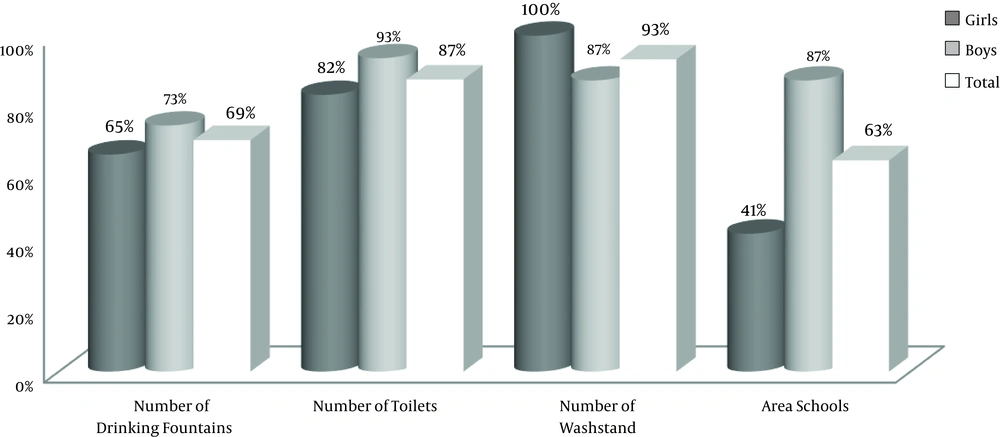
Figure 1.
The desirable conditions of the hygiene services in the schools under study
Table 1.
School Health and Sanitary Regulations
| Variable | Standards Recommended by the Government of Iran |
|---|---|
| The ratio of students to toilets | 40:1 |
| The ratio of students to the washstand | 60:1 |
| The ratio of students to drinking fountains | 45:1 |
| Gross area of classroom per student, m2 | 1.25 |
| The green area of school per student, m2 | 0.5 |
| Distance from the board to front desk position, m | 2.20 |
| Ceiling, wall, and floor features | Without cracks, resistant, flat, washable, and not slippery |
| Providing natural light | Embedding the windows on the left side of the class |
| The height of the windows from the floor, m | 0.8 |
| Class ceiling height, m | 3 |
| Ventilation | Temperature 18 - 21°C, Humidity 50% - 60% |
| Class wall color | Non-shiny green |
| Distance from annoying centers and unsanitary, m | 500 |
| Health and safety officer | At least one person |
| Health care rooms | At least one |
| First aid kit | At least one |
| Fire extinguisher | At least one |
| Hygienic tuck-shops (buffet) | At least one |
3.2. The Sanitary Conditions of Schools Hygiene Services
According to Figure 2, approximately 100% of primary schools hygiene services including drinking fountain, toilets, and washstands were equipped with hot water. Sewage disposal and daily waste collection were in good conditions in 100% and 71.8% of schools, respectively. But not much attention was paid to the lack of doors and pedal trash bins; 37% of the schools used trash bins without lids to collect and transport wastes.
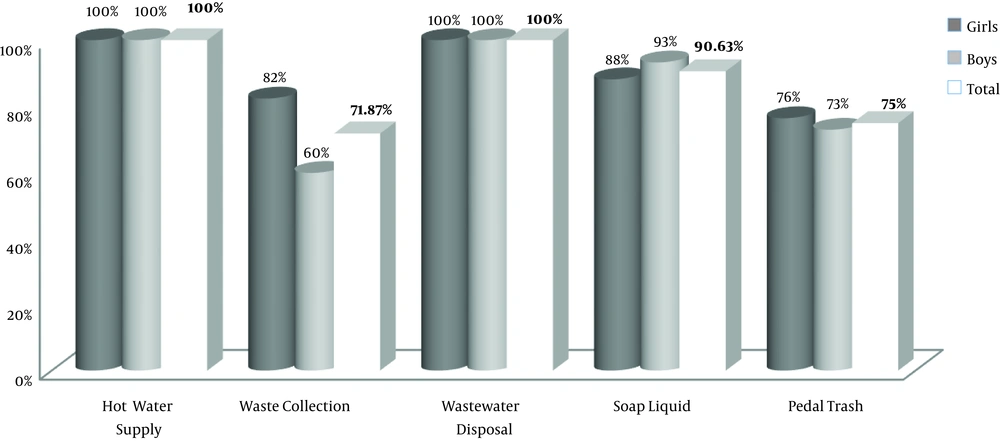
Figure 2.
The desirable condition of sewage disposal and waste collection in the schools under study
3.3. The Sanitary Conditions of Schools Buildings
Construction plans of schools and other related spaces in different educational levels should be designed according to the recommended standards. The safety and sanitary conditions of school buildings include pantry, library, lab, windows height, stairs height, and the distance of noisy centers (airports, movie theatres, etc.). The distance in 47% of the schools was more than 500 m away from annoying centers and unsanitary places. In all schools, there was a pantry, but only 68% of them were safe and hygienic. In the 90% of schools, windows were installed at standard height. Most of the studied schools lacked educational facilities such as a library (28%) and laboratory (35%) (Figure 3).
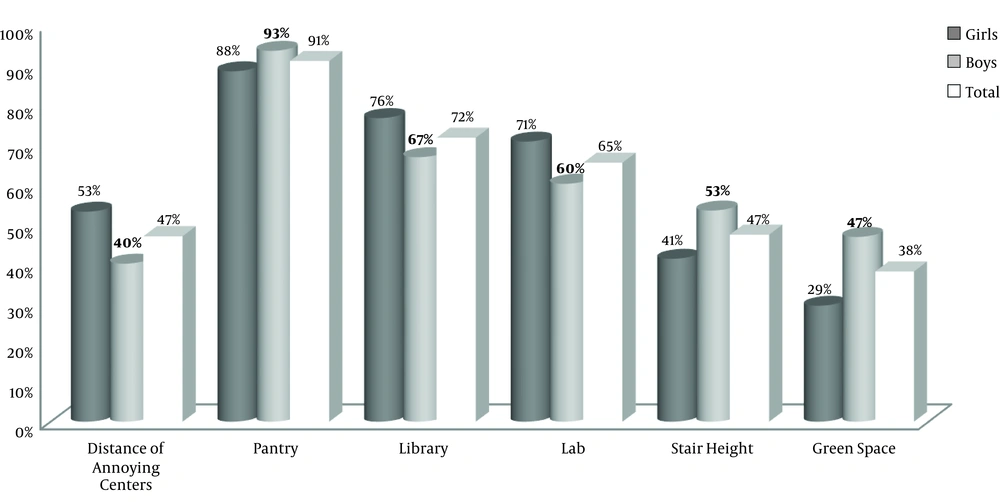
Figure 3.
The desirable sanitary conditions in the building of the schools under study
3.4. The Sanitary Conditions of Classrooms
The information about the light, ceiling, floor, wall, and color variables are shown in Figure 4, which was rather satisfactory, but 67% of males’ school classrooms did not have desirable conditions in terms of air-conditioning and ventilation system. The color should be non-shiny green to avoid light reflection; 54% of the schools had inappropriate wall color. Also, the distance of the board from the first row of students was less than the recommended standard of 2.20 m in 17 schools (53%).
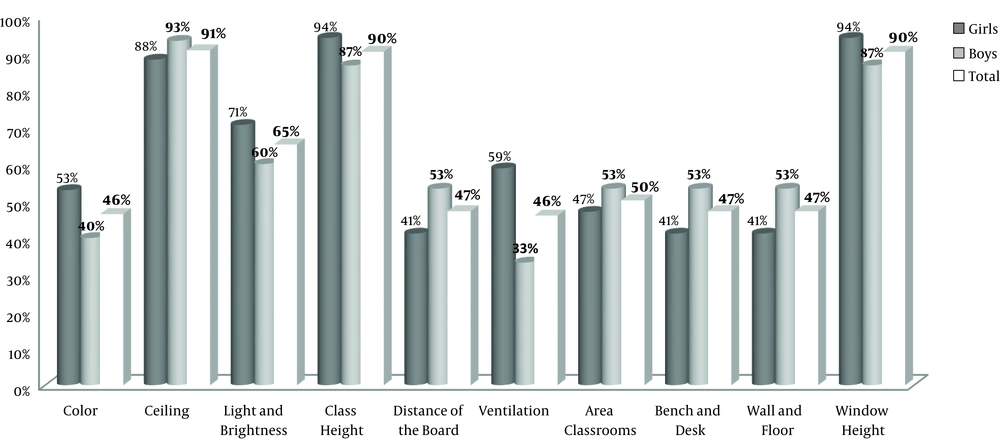
Figure 4.
The desirable sanitary conditions of classrooms in the schools under study
3.5. The Hygiene and Safety Status of Schools
Safety matters in schools include the electrical system, window guards, fire extinguish equipment, emergency stairs, first aid kit, no broken glass, etc.; 43% of the schools had first aid kit and 57% did not; 50% of the schools had hygiene room and 50% did not. All the studied schools were safely and desirably equipped with the heater and fire extinguisher. But in terms of an emergency exit, hygienic tuck-shops, hygiene rooms, and health and safety officer the schools were in different conditions; thus, out of 32 schools, 19 (59%) had no hygienic tuck-shops and in 22 (69%) schools no proper emergency exits were available (Figure 5).
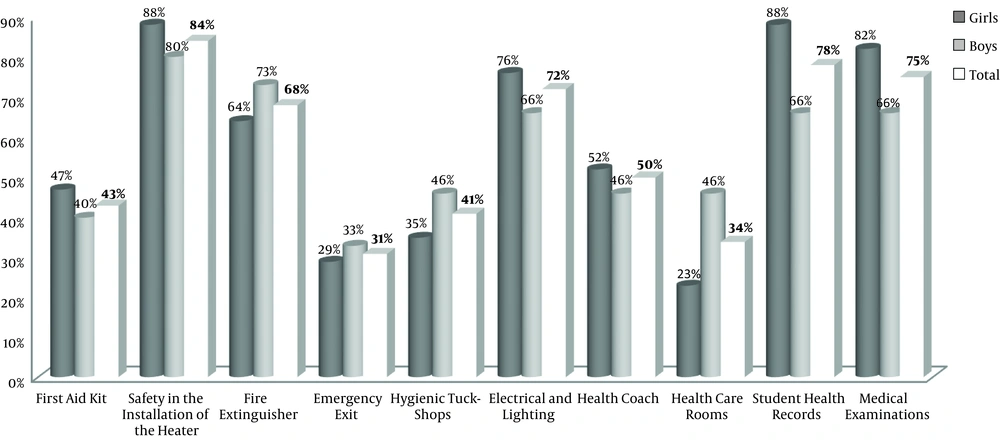
Figure 5.
The desirable safety and hygiene facilities in the schools under study
4. Discussion
Iran, with about 14 million students is considered as a country with relatively young population; hence, it is crucial to address the health issue of children and young students since they are the major capital of the country. It is strongly emphasized in all the studies that attention should be paid to the school buildings since they have a tremendous impact on the health and learning ability of students; for example:
• Not benefiting from natural light, due to architectural mistakes, may result in disruption of children’s melatonin cycles, which probably affects their concentration on lessons (10).
• Poor ventilation below allowed standards (15 CFM [cubic feet per minute] per student) can decrease about 5% - 10% of students’ exam results (indoor air quality scientific findings resource bank [IAQ-SFRB]).
• Recent studies showed that a decrease in ventilation rates from 17 to 10 CFM/person resulted in a 15% increase in the prevalence of sick building syndrome (11).
The current study aimed at investigating the environmental health and safety status of primary schools in Garmsar based on the recommended standards. The results showed that more than 60% of school buildings conformed to environmental safety standards. Zare Jamalabadi et al. reported that no significant difference was observed between female and male schools in Yazd city, Iran (12). In accordance with the standards and regulations of the school hygiene services, the ratio of students to toilets is at least 40:1; the ratio of students to washstand is 60:1 and the ratio of students to drinking fountains is 45:1. Accordingly, 87%, 69%, and 93% of the schools were in accordance with the recommended standards for the number of toilets, washstands, and drinking fountains, respectively. Ganji and Hashemianfar also reported that the total number of drinking fountains in females primary schools in Khomeini-shahr, Iran was in accordance with the available standards (13). While, Raegan et al. (14), reported that only 44.3% of the toilets and washstands in the primary schools of Yasuj were in desirable conditions, and in general, the current status of school hygiene services was not suitable. Although safety status in the studied schools was acceptable, maintaining the status quo and enhancing safety levels should be included in the development programs. Salehpourdehkordi et al. (15), reported that the status of welfare and safety in some of the females (23.7%) and the majority of males (58.98%) schools was inappropriate. According to the current study results, there was a first aid kit and a fire extinguisher in 43% and 84% of the schools, respectively. The results of the study by Lee et al. (3), on nine schools in China showed that increasing the school health and safety levels can lead to healthier behaviors and increased self-esteem among students. Observation of health standards in school hygienic tuck-shops should be in line with Standard 4072 of the Institute of Standards and Industrial Research of Iran. Shahriari et al. (16), reported that in 86.7% of the schools in Birjand had tuck-shops with unfavorable conditions and in 50% of the schools, the equipment used in the tuck-shops was hygienic, and 30% of the health and safety officers had a health card. Shabankhani and Abdollahi also evaluated environmental hygienic indexes (educational spaces) in rural schools of Mazandaran province. They reported that, 81% of the schools had no hygienic tuck-shops, 37% of the schools had not standard conditions in terms of the number of classrooms and in 35% of the classes there was no proper lightning design and power supply (17). Moreover, the results of the current study indicated that the situation of 100% and 71.87% of schools in terms of sewage disposal and daily collection of wastes were in desirable conditions. Since supplying drinking and hot water are among the general principles of public health and hygiene, 100% of schools in the Garmsar had safe drinking and hot water. In the current study, only 59% of schools had hygienic tuck-shops. In a study conducted in Isfahan, only 49.4% of the tuck-shops were in good conditions (18). Therefore, more attention should be paid to the condition of the tuck-shops. To improve the undesirable situations, measures such as continuous monitoring and a constant visit to schools, educating students and school authorities, attracting public participation, and collaboration between the two ministries of health and education are essential. It seems that the health condition was optimal in the primary schools of Garmsar, but it is necessary to improve the conditions of hygienic tuck-shops, hygiene rooms, standard first aid kits, emergency exits, standard bench and desk, favorable ventilation, and the appropriate distance from the board.
4.1. Limitations
At the beginning of the study, there was mistrust and disapproval of the Garmsar Education Department to collaborate in collecting data due to concerns about judgment by the researcher or the public in the event of non-compliance with the standards.
4.2. Conclusion
It is concluded that the physical status of the primary schools in Garmsar was approximately in accordance with the required standards of school health regulations. However, some school buildings need repair; therefore, it should be considered in the government development programs. To guarantee the safety of schools, it is more important to evaluate the defects of the environmental health and safety status of schools.