
1. Background
Learning strategies involve each idea, behavior, belief, or emotion that eases the achievement, perception, or later transfer of new skills or knowledge (1). Similar to other factors, such as knowledge and abilities, they can be assumed to be resources students use to develop their skills (2). Learning and study strategies are considered suitable tools to facilitate the learning process. These strategies are crucial parameters in college student’s perception of academic performance. Previous studies showed an effective relationship between academic success and learning strategies (3). Academic self-regulation in learning has become essential in higher education and is recognized as necessary in continuous learning (4, 5). In online education, self-regulated learning is significantly related to learning outcomes (6).
Medical students must learn self-regulatory strategies during their studies, especially in clinical courses. This set of skills generally includes more specialized aspects, including about the patients, learning meaningfully, critical thinking, self-evaluation of performances, and the need to update personal information (7). There are investigations to measure and evaluate the effectiveness of these skills among medical students. Most of these studies indicated the importance of these skills and their essentiality in the learning development of medical students (8-11). However, medical schools had plans to teach their students related self-learning skills (12). Therefore, understanding the learning strategy in education research and its measurements needs high-reliability and -validity instruments. One high-profile strategic learning scale measurement is the Learning and Study Strategies Inventory (LASSI). It was shown that LASSI scores positively correlated with grade point average (GPA). Therefore, this is considered an efficient tool for anticipating academic performances (13-15). Beyond students’ usage of the LASSI scale to measure their self-learning and study strategies, the instructors and administrators could examine it to identify the extra instruction and support for the students considered to be at risk (16). It can be utilized to diagnostically assess the areas of difficulty, which leads to remedial or prescriptive considerations (17). Due to the coronavirus disease 2019 (COVID-19) pandemic and the need for a higher level of self-regulation in e-learning that alters the future of medical education, a change seemed necessary. In addition, teaching and learning are growing from traditional face-to-face to digital-based learning environments. Therefore, it is especially required to have digital adaptation capabilities (18).
On the other hand, it is essential to determine whether these e-learning technologies effectively engage learners in teaching and learning practices (19). This study was performed to explain the learning and study strategies in virtual education among the medical students of Mashhad University of Medical Sciences (MUMS), Mashhad, Iran.
2. Objectives
This study explored the relationship between the LASSI subscales and the medical curriculum’s academic performance in preclinical disciplines.
3. Methods
3.1. Participants
This cross-sectional study considered all medical students under their preclinical disciplines at MUMS, Mashhad, Iran, in June 2021. In the academic year 2020 - 2021, 1060 medical students (630 students in basic science and 430 in the preclinical curriculum of the doctor of medicine [MD] program) were studying preclinical disciplines under the medical curriculum. Using G*Power 3.1.9.7 software and considering the total population of 1060 subjects, the minimum sample size of 282 individuals was calculated to compare the average of three groups based on GPA. In addition, it was considered to estimate the sample size that the causal-comparative study comparing averages requires more than 50 samples, and each minor subgroup requires 10 to 25 samples. Moreover, in survey studies, 100 samples are assumed to be identified for each major subgroup in the population and between 20 to 50 samples for each minor subgroup (20). Therefore, information was collected from a sample of 441 individuals by simple random sampling.
The individuals were given a numeric code; the participants’ codes were selected via a random number generator. The link address of the electronic questionnaire was sent through the university short messages (SMS) panel and e-mails to participants. Finally, 298 medical students (response rate: 67.57%) filled out the online questionnaire. This study involved two independent samples of medical students at MUMS in basic science (n = 145) and preclinical (n = 153) curriculum phases. Their inclusion in the study was entirely voluntary, and any participating individuals did not have to fill out the questionnaire. Since the implementation of the questionnaire was on the web, the subject could not leave a question unanswered. However, participants who withdrew from the study after being initially included were excluded. The questionnaire consisted of two parts of the LASSI and demographic information, including gender, curriculum phase, marital status, repeat course history, and GPA. The data were collected through individual responses to questions within 2 weeks, from the 10th of June 2021 to the 24th of June 2021.
3.2. Instrument
The original version of the LASSI, with 77 items, was published in 1987, and the second edition, with 80 items, was published in 2002 (17). The 80-item version of the LASSI evaluates the students’ learning and study behaviors to reach their academic goals. The LASSI provides 10 individual scale scores (1 for each of the 10 scales). There is no total score because the LASSI is a diagnostic instrument (14). The ones who stepped forward to be included in the study responded to the questionnaire in the virtual education setting, with a format of a five-point Likert response using anchors of 1: Not typical of me and 5: Nearly typical of me. The items with negative marks were scored reversely. For the LASSI to be completed, approximately 15 - 20 minutes were needed (21).
There were 10 scales in the LASSI with eight items each. Therefore, each scale’s possible score range was from 8 to 40 points. A higher score demonstrated the greater inclusion of the hypothesized construct related to the scale. The anxiety scale was scored reversely, meaning the higher the score, the less the anxiety. The scores of students on this scale show how concerned or intense they were when practicing academic duties. Based on Weinstein and Palmer (21), students with low scores according to this measure (demonstrating a high level of anxiety) require learning methods to cope with anxiety and stress control to concentrate on the duty at hand and nothing else. The method defined by Weinstein et al. (22) was selected based on item presentations, the scoring, and the response scale. Items were dispersed in a counterbalanced order all over the inventory. The LASSI designer originally suggested that it measures three latent factors of self-regulated education: (1) skill (subgroups of choosing core ideas, test strategies, and processing of information); (2) will (anxiety, attitude, and motivation subgroup); and (3) self-regulation (time management, self-testing, study aides, and focus processing). The definition of these subscales is provided in Figure 1 (22).
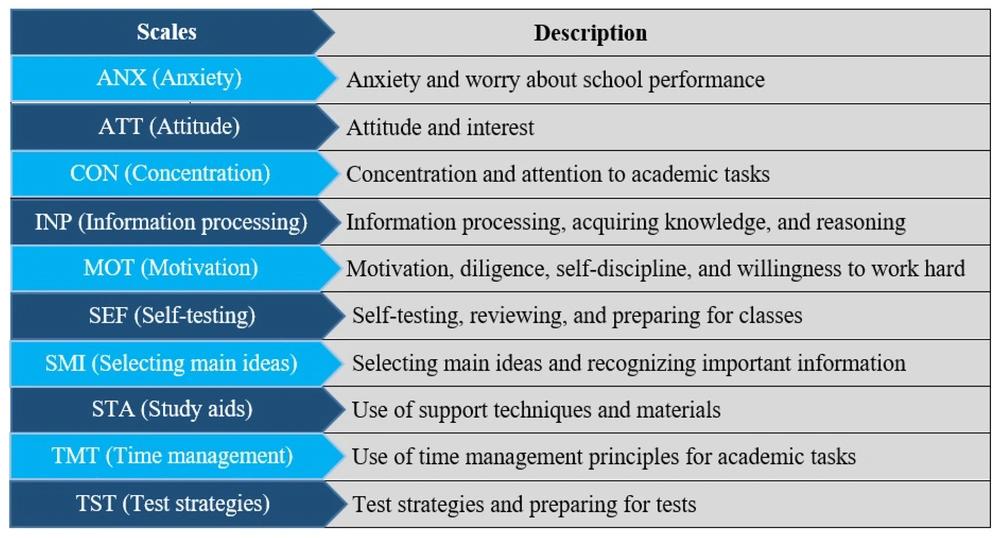
Figure 1.
Scales and their descriptions for the Learning and Study Strategies Inventory (LASSI) (21)
In the 2002 edition of this inventory, Weinstein et al. calculated the reliability of the questionnaire using Cronbach’s alpha 0.71 - 0.86 for 10 areas. In addition, the test-retest correlation of 0.88 was computed for the total instrument (21, 22). In the present study, the Persian version of the questionnaire was used. In a study conducted by Ahmadi et al., the reliability of the questionnaire using Cronbach’s alpha was 0.71 - 0.84 for 10 areas. Additionally, the test-retest reliability with an interval of 3 to 4 weeks was equal to 0.85 for the whole scale method (3, 14). The present study calculated Cronbach’s alpha 0.73 - 0.90 for 10 areas. Moreover, the face validity of the questionnaire was investigated and confirmed by 6 experts in medical education and psychometrics. The reliability of the evaluators in 10 scales was between 0.85 and 0.90.
3.3. Data Collection
The LASSI was applied to the medical students at MUMS. It allowed the students to self-report their ideas, performance, and attitudes regarding strategic learning through an electronic questionnaire implemented using Porsline forms. This platform prevented more than one response with one device and duplicated answers. In virtual education during the COVID-19 pandemic, medical students were informed about the research methodology, inclusion criteria, and assurances related to the confidentiality of all collected data. Information about the academic performance associated with the preclinical disciplines within the medical curriculum was gathered for the included students.
3.4. Data Analysis
IBM Statistical Package for the Social Sciences (SPSS) software (version 23) was used for data analysis (IBM Corporation, Armonk, NY, USA). The mean scores were compared regarding the students’ GPAs for different aspects of the LASSI. The receiver operating characteristic (ROC) curve analysis was used to summarize classifier performance over the range of GPAs (0 to 20). The cutoff point values were 14.85 (the sensitivity and specificity reported as 14.81 and 14.91, respectively) and 17.50 (the sensitivity and specificity reported as 17.40 and 17.61, respectively). The first group score was for a low GPA (below 14.85), the second group score was for the middle GPA range (14.85 to 17.5), and the last group score was for a high GPA (17.5 to 20). Descriptive data analysis was performed using the mean, standard deviation, and frequency. To compare the quantitative data and establish the correlation of factors, independent t-test, correlation, analysis of variance (ANOVA), and Tukey post hoc tests were applied for the study. The p-value of 0.05 was considered the upper limit for determining the significance of the investigated parameters in all statistical analyses.
4. Results
A total of 298 medical students (return rate: 67.57%) filled out the questionnaires. The demographic properties of the included students in this study are shown in Table 1. Most students who participated were female (64.8%), compared to males (35.2%). Additionally, most of the students (96.6%) were single. More students (79.9%) had no repeat course history, and more than half of the participating students (50.7%) had a GPA between 14.85 and 17.50.
Table 1.
Demographic Characteristics of Medical Students Participating in the Study
| Variables | No. (%) |
|---|---|
| Gender | |
| Male | 105 (35.2) |
| Female | 193 (64.8) |
| Marital status | |
| Single | 288 (96.6) |
| Married | 10 (3.4) |
| Curriculum phase | |
| Basic science | 145 (48.7) |
| Preclinical | 153 (51.3) |
| Repeat course history | |
| Yes | 60 (20.1) |
| No | 238 (79.9) |
| Grade point average (GPA) | |
| < 14.85 | 20 (6.7) |
| 14.85 - 17.50 | 151 (50.7) |
| > 17.50 | 127 (42.6) |
The LASSI scores in all 10 scales classified into three main factors are summarized in Table 2. The mean students’ GPA was 17.12 ± 1.52 (minimum = 8.50 and maximum = 19.78). The distribution of students in the two curriculum phases was almost the same (48.7% and 51.3% in basic science and preclinical, respectively). Only 16.77% of the students (n = 50) had self-regulation. Furthermore, 20.13% of the students (n = 60) had skills in learning and study strategies, and 16.77% of the students (n = 50) had a high will to learn. The most considerable mean value was related to information processing (28.54 ± 4.10) and selecting main ideas (28.31 ± 5.26). Nevertheless, the minor means belonged to study aids (22.41 ± 4.07) and self-testing (22.78 ± 4.95).
Table 2.
The Learning and Study Strategies Inventory (LASSI) Scores in All 10 Scales
| Scales | Mean ± Standard Deviation | Minimum | Maximum | Median |
|---|---|---|---|---|
| Skill | ||||
| Selecting main ideas | 28.31 ± 5.26 | 13 | 40 | 29 |
| Test strategies | 26.75 ± 4.37 | 12 | 40 | 27 |
| Information processing | 28.54 ± 4.10 | 19 | 40 | 28 |
| Will | ||||
| Anxiety | 26.96 ± 6.39 | 9 | 40 | 27 |
| Attitude | 27.88 ± 4.39 | 10 | 38 | 28 |
| Motivation | 26.7 ± 5.44 | 9 | 39 | 27 |
| Self-regulation | ||||
| Time management | 26.27 ± 5.67 | 12 | 39 | 28 |
| Self-testing | 22.78 ± 4.95 | 10 | 40 | 23 |
| Study aids | 22.41 ± 4.07 | 9 | 33 | 22 |
| Concentration | 25.34 ± 4.59 | 14 | 36 | 26 |
The LASSI scores in every 10 scales according to the gender and curriculum phase are shown in Table 3. Statistical analysis related to differences between learning and study strategies among students of different genders showed significant differences between female and male students in anxiety, attitude, motivation, time management, and self-testing (P < 0.05). Moreover, the investigation of the mean scores of different curriculum phases showed that there was only a significant difference between the mean scores of attitude between basic science students (28.54 ± 4.36) and preclinical students (27.25 ± 4.35) (P = 0.01).
Table 3.
The Learning and Study Strategies Inventory (LASSI) Scores in All 10 Scales Based on Gender and Curriculum Phase
| Variables | Male a | Female a | T | P-Value | Basic Science a | Preclinical a | T | P-Value |
|---|---|---|---|---|---|---|---|---|
| SMI | 27.59 ± 5.11 | 28.70 ± 5.32 | -1.75 | 0.081 | 28.83 ± 5.06 | 27.82 ± 5.43 | 1.67 | 0.095 |
| TST | 26.43 ± 4.05 | 26.92 ± 4.54 | -0.93 | 0.35 | 27.14 ± 4.28 | 26.37 ± 4.44 | 1.53 | 0.128 |
| INP | 28.65 ± 4.37 | 28.49 ± 3.96 | 0.32 | 0.74 | 28.68 ± 4.14 | 28.41 ± 4.07 | 0.57 | 0.569 |
| ANX | 28.30 ± 6.19 | 26.23 ± 6.40 | 2.69 | 0.008 b | 27.26 ± 6.82 | 26.67 ± 5.97 | 0.79 | 0.43 |
| ATT | 26.69 ± 4.87 | 28.52 ± 3.98 | -3.50 | 0.001 b | 28.54 ± 4.36 | 27.25 ± 4.35 | 2.54 | 0.01 b |
| MOT | 25.79 ± 5.54 | 27.83 ± 5.60 | -2.19 | 0.029 b | 27.00 ± 5.13 | 26.46 ± 5.73 | 0.86 | 0.39 |
| TMT | 26.23 ± 5.69 | 27.83 ± 5.60 | -2.34 | 0.02 b | 27.64 ± 5.79 | 26.91 ± 5.56 | 1.11 | 0.27 |
| SFT | 21.86 ± 4.50 | 23.28 ± 5.13 | -2.39 | 0.018 b | 22.89 ± 5.17 | 22.67 ± 4.75 | 0.38 | 0.71 |
| STA | 21.99 ± 4.16 | 22.64 ± 4.07 | -1.32 | 0.19 | 22.39 ± 4.19 | 22.43 ± 3.95 | -0.08 | 0.94 |
| CON | 25.32 ± 4.83 | 25.35 ± 4.46 | -0.05 | 0.96 | 25.69 ± 4.86 | 25.01 ± 4.30 | 1.27 | 0.20 |
Abbreviations: ANX, anxiety; ATT, attitude; CON, concentration; INP, information processing; MOT, motivation; SFT, self-testing; SMI, selecting main ideas; STA, study aids; TMT, time management; TST, test strategies; SD, standard deviation.
a Values are expressed as mean ± SD.
b A P-value less than 0.05 was considered significant.
The LASSI scores in every 10 scales among levels of different GPAs are summarized in Table 4. The statistical results of the independent one-way ANOVA test indicated a significant difference between the students’ mean scores with GPAs regarding various areas of the LASSI. In all aspects, except for the self-testing and study aids, the mean scores of those with GPAs higher than 17.5 were significantly higher than those with GPAs lower than 14.85 and within the range of 14.85 to 17.50. Table 5 shows the results of the Tukey post hoc test for comparison between three groups in 10 scales of the LASSI.
Table 4.
Statistical Results of Independent One-way Analysis of Variance (ANOVA) Test to Compare the Learning and Study Strategies Inventory (LASSI) Scores in All 10 Scales Between the 3 Groups
| Variables | GPA Groups; Mean (SD) | Sum of Squares | df | Mean Square | F | P-Value a | |||
|---|---|---|---|---|---|---|---|---|---|
| Level 1 (< 14.85) | Level 2 (14.86 - 17.50) | Level 3 (> 17.50) | |||||||
| SMI | 25.40 (5.27) | 27.28 (5.58) | 30.00 (4.31) | Between groups | 692.86 | 2 | 346.43 | 13.56 | 0.0001 b |
| Within groups | 7539.12 | 295 | 25.56 | ||||||
| Total | 8231.98 | 297 | |||||||
| TST | 23.95 (4.67) | 25.95 (4.47) | 28.13 (3.74) | Between groups | 495.77 | 2 | 247.89 | 14.11 | 0.0001 b |
| Within groups | 5182.35 | 295 | 17.57 | ||||||
| Total | 5678.12 | 297 | |||||||
| INP | 26.55 (5.64) | 28.25 (3.72) | 29.20 (4.15) | Between groups | 147.87 | 2 | 73.93 | 4.50 | 0.012 c |
| Within groups | 4848.06 | 295 | 16.43 | ||||||
| Total | 4995.93 | 297 | |||||||
| ANX | 22.20 (5.62) | 26.21 (6.70) | 28.60 (5.58) | Between groups | 878.58 | 2 | 439.29 | 11.51 | 0.0001 b |
| Within groups | 11258.94 | 295 | 38.17 | ||||||
| Total | 12137.52 | 297 | |||||||
| ATT | 25.25 (5.26) | 26.89 (4.14) | 29.46 (4.02) | Between groups | 604.01 | 2 | 302.003 | 17.38 | 0.0001 b |
| Within groups | 5125.65 | 295 | 17.38 | ||||||
| Total | 5729.65 | 297 | |||||||
| MOT | 23.15 (6.37) | 25.68 (5.18) | 28.52 (5.02) | Between groups | 828.89 | 2 | 414.45 | 15.34 | 0.0001 b |
| Within groups | 7970.99 | 295 | 27.02 | ||||||
| Total | 8799.89 | 297 | |||||||
| TMT | 22.50 (5.06) | 26.60 (5.60) | 28.81 (5.30) | Between groups | 825.24 | 2 | 412.62 | 13.93 | 0.0001 b |
| Within groups | 8738.82 | 295 | 29.62 | ||||||
| Total | 9564.06 | 297 | |||||||
| SFT | 21.15 (5.25) | 22.72 (4.81) | 23.10 (5.06) | Between groups | 66.85 | 2 | 33.42 | 1.37 | 0.26 |
| Within groups | 7224.54 | 295 | 24.49 | ||||||
| Total | 7291.38 | 297 | |||||||
| STA | 21.05 (4.22) | 22.68 (3.86) | 22.32 (4.26) | Between groups | 48.78 | 2 | 24.39 | 1.48 | 0.23 |
| Within groups | 4861.45 | 295 | 16.48 | ||||||
| Total | 4910.23 | 297 | |||||||
| CON | 22.65 (5.36) | 24.62 (4.41) | 26.63 (4.31) | Between groups | 435.21 | 2 | 217.61 | 11.05 | 0.0001 b |
| Within groups | 5811.88 | 295 | 19.70 | ||||||
| Total | 6247.087 | 297 | |||||||
Abbreviations: ANX, anxiety; ATT, attitude; CON, concentration; INP, information processing; MOT, motivation; SFT, self-testing; SMI, selecting main ideas; STA, study aids; TMT, time management; TST, test strategies; GPA, grade point average; SD, standard deviation.
a The P-value was calculated by ANOVA test.
b Two-tailed calculated p-value less than 0.01 was considered significant.
c Two-tailed calculated p-value less than 0.05 was considered significant.
Table 5.
Results of Tukey Post Hoc Test
| Dependent Variables | Comparison of Between GPA Groups | Mean Difference | Std. Error | P-Value | |
|---|---|---|---|---|---|
| SMI | < 14.85 | 14.86 - 17.50 | -1.88 | 1.20 | 0.264 |
| < 14.85 | > 17.50 | -4.60 | 1.22 | 0.001 a | |
| 14.86 - 17.50 | > 17.50 | -2.72 | 0.61 | 0.0001 a | |
| TST | < 14.85 | 14.86 - 17.50 | -2.01 | 0.99 | 0.112 |
| < 14.85 | > 17.50 | -4.184 | 1.01 | 0.0001 a | |
| 14.86 - 17.50 | > 17.50 | -2.180 | 0.504 | 0.0001 a | |
| INP | < 14.85 | 14.86 - 17.50 | -1.71 | 0.965 | 0.184 |
| < 14.85 | > 17.50 | -2.65 | 0.975 | 0.019 b | |
| 14.86 - 17.50 | > 17.50 | -0.953 | 0.488 | 0.126 | |
| ANX | < 14.85 | 14.86 - 17.50 | -4.01 | 1.47 | 0.018 b |
| < 14.85 | > 17.50 | -6.39 | 1.49 | 0.0001 a | |
| 14.86 - 17.50 | > 17.50 | -2.39 | 0.744 | 0.004 a | |
| ATT | < 14.85 | 14.86 - 17.50 | -1.64 | 0.99 | 0.223 |
| < 14.85 | > 17.50 | -4.21 | 1.00 | 0.0001 a | |
| 14.86 - 17.50 | > 17.50 | -2.57 | 0.50 | 0.0001 a | |
| MOT | < 14.85 | 14.86 - 17.50 | -2.53 | 1.23 | 0.103 |
| < 14.85 | > 17.50 | -5.37 | 1.25 | 0.0001 a | |
| 14.86 - 17.50 | > 17.50 | -2.84 | 0.63 | 0.0001 a | |
| TMT | < 14.85 | 14.86 - 17.50 | -4.10 | 1.29 | 0.005 a |
| < 14.85 | > 17.50 | -6.31 | 1.31 | 0.0001 a | |
| 14.86 - 17.50 | > 17.50 | -2.22 | 0.65 | 0.002 a | |
| SFT | < 14.85 | 14.86 - 17.50 | -1.57 | 1.17 | 0.377 |
| < 14.85 | > 17.50 | -1.95 | 1.19 | 0.231 | |
| 14.86 - 17.50 | > 17.50 | -0.381 | 0.59 | 0.799 | |
| STA | < 14.85 | 14.86 - 17.50 | -1.62 | 0.96 | 0.214 |
| < 14.85 | > 17.50 | -1.26 | 0.97 | 0.399 | |
| 14.86 - 17.50 | > 17.50 | 0.36 | 0.48 | 0.741 | |
| CON | < 14.85 | 14.86 - 17.50 | -1.96 | 1.05 | 0.152 |
| < 14.85 | > 17.50 | -3.98 | 1.067 | 0.001 a | |
| 14.86 - 17.50 | > 17.50 | -2.02 | 0.53 | 0.001 a | |
Abbreviations: AN, anxiety; ATT, attitude; CON, concentration; INP, information processing; MOT, motivation; SFT, self-testing; SMI, selecting main ideas; STA, study aids; TMT, time management; TST, test strategies.
a The mean difference was considered significant at the 0.01 level.
b The mean difference was considered significant at the 0.05 level.
Furthermore, the results about differences between learning and study strategies among medical students with repeat course history and without (Table 6) showed significant statistical differences between the two groups in all areas (P < 0.05), except for the study aids.
Table 6.
The Learning and Study Strategies Inventory (LASSI) Scores in All 10 Scales Based on Repeat Course History
| Variables | Repeat Course History | t | P-Value | |
|---|---|---|---|---|
| Yes (n = 60); Mean ± SD | No (n = 238); Mean ± SD | |||
| SMI | 24.83 ± 5.74 | 29.19 ± 4.76 | 6.06 | 0.0001 a |
| TST | 24.30 ± 4.82 | 27.37 ± 4.03 | 5.05 | 0.0001 a |
| INP | 27.12 ± 4.28 | 28.90 ± 3.98 | 3.06 | 0.002 a |
| ANX | 23.20 ± 5.81 | 27.91 ± 6.19 | 5.33 | 0.0001 a |
| ATT | 25.73 ± 4.39 | 28.42 ± 4.23 | 4.36 | 0.0001 a |
| MOT | 23.73 ± 5.44 | 27.47 ± 5.19 | 4.94 | 0.0001 a |
| TMT | 24.37 ± 5.80 | 28.00 ± 5.41 | 4.57 | 0.0001 a |
| SFT | 21.23 ± 4.99 | 23.19 ± 4.88 | 2.73 | 0.007 a |
| STA | 21.98 ± 3.91 | 22.52 ± 4.11 | 0.92 | 0.36 |
| CON | 23.08 ± 4.48 | 25.91 ± 4.44 | 4.40 | 0.0001 a |
Abbreviations: ANX, anxiety; ATT, attitude; CON, concentration; INP, information processing; MOT, motivation; SFT, self-testing; SMI, selecting main ideas; STA, study aids; TMT, time management; TST, test strategies; SD, standard deviation.
a In an independent t-test analysis between the two groups, a P-value less than 0.01 was considered significant.
5. Discussion
The COVID-19 pandemic created an educational crisis for medical schools to shift to online distance learning abruptly. These issues caused new challenges in learning and study strategies and teaching-learning protocols (23-25). Therefore, exploring valid processes for analyzing the self-regulated learning skills among medical students might be necessary for an online environment. This study investigated the strategies for learning and study among medical students in an electronic learning environment at MUMS within 2020 and 2021 when training was virtual due to the pandemic. The present study’s results might afford essential information to support virtual education in a post-COVID world.
The present study demonstrated that the highest mean score was shown for the information process and selecting the main ideas. At the same time, the lowest mean scores belonged to study aids and self-testing. According to the tangible and direct outcome of the two fields on academic performances in the related study area, these results might be probable, considering that students spend more time and effort on these two aspects. A previous study of LASSI scores among medical students showed that the highest mean score belonged to test strategies, with the element of choosing the core idea being near the second (14). Most guiding organizations with priority confirmed these similar results, emphasizing these two aspects for academic results (26, 27). Similar to the present study’s results, Jouhari et al. (14) demonstrated that the self-testing and study aids showed the lowest average LASSI scores. Self-testing indicates students’ ability to evaluate their duties. Nevertheless, a study aid helps the students utilize various guides to enhance their level of learning. However, the order of the current study’s results related to the lowest LASSI score was vice versa, comparable to those of the previous study (14). Therefore, these results can be connected to the student’s attitude toward the efficiencies of these aspects of their academic obtained results (16).
Regarding the attempts at self-testing and study aids among medical students, previous investigations revealed that half of the dental students at New York University College of Dentistry, New York, USA, utilized self-testing after reading a chapter in a textbook (28). Another study by the American Association of Colleges of Pharmacy concluded that students with higher self-testing abilities were more prosperous in their final exams (29). However, recent studies on the self-strategy of learning revealed that incorrect study habits of students need to be identified and fixed due to the transfer of many of these bad study habits to higher levels of education (30).
Regarding LASSI scores between male and female students, the results showed that female students had significantly higher time management, motivation, attitude, and self-testing scores than male students (P < 0.05). However, the results declared that male students had a higher anxiety score than female students under the LASSI questionnaire (P < 0.05). Similar to the present study’s findings, a previous study revealed a statistically significant difference between female and male students (14). Another study in Iran showed that female medical and dental students performed the test strategies more than male students (3). Moreover, another investigation indicated that female students were more active users in test preparation and focused on study strategies than male students (31). In addition, another recent study demonstrated that male early-career medical doctors showed better time management than female ones (32). This issue might be due to the application of different instruments for self-online learning assessment, as they applied the Self-regulated Online Learning Questionnaire (SOL-Q). A previous study revealed that gender is a confounding variable that affects how students perceive self-learning (33). Furthermore, investigations concluded that male students scored somewhat higher on the subscale for self-efficacy. In contrast, female students had greater help-seeking strategies, performance anxiety, and beliefs in the value of studying (33, 34).
The present study’s findings emphasized a significant difference in attitude scale among students in different years, with the mean scores lower in later years on the preclinical curriculum than in the basic science curriculum. However, a similar study in Hong Kong, China, reported that the motivation and attitude of students in their later years play the leading role in their strategies of learning usage (35).
The present study about the previous education history of studied participants demonstrated that all scores of 10 scales of the LASSI were higher in students who had repeat course history. Study approaches showed that students with previous related learning and education policies had higher concentration. Similar to the current study’s finding, the last reports indicated that being present in study skill sessions and learning the associated abilities can authorize the students in all scales of the LASSI to contain the areas of study information processing, aids, self-testing, selecting the core idea, and self-test (36, 37). Therefore, students with a previous plan regarding self-regulation teaching can produce opportunities to help accomplish their learning better than others without a prior learning history (38).
The current statistical study comparing the GPA group in aspects of different studied LASSI scales showed that students with higher GPA scores had similar self-testing and study aids. The last reports confirmed the present study’s results to show a significant difference between the students with low and high academic achievements considering using learning strategies (26, 35). Afterward, similar studies confirmed a relationship between the students’ scores related to questionnaires on learning strategy and their abilities in academic responsibilities. Previous investigations expressed the positive role of time management and self-testing or concentration, anxiety, selecting the core idea, and exam strategies as the strong predictors of success among medical students in their initial years of education (10, 39, 40). The present study’s results were corroborated with samples derived from other medical programs to improve the external validity of the study findings. Researchers highlighted that students who applied the learning or active learning strategies achieved better learning results (41, 42). The main limitation of this study is that it relies on LASSI measures, which are self-reported and, therefore, might not accurately reflect the actual study strategies employed by the medical students.
5.1. Conclusion
Even if online learning has been a concern of medical education and implicitly of the management of educational institutions in the past, in the context of the pandemic generated by COVID-19, it has become a challenge. Medical schools were shifting to virtual education to slow the disease’s spread. This study utilized 10 LASSI subscale scores to examine the association between learning and study strategies and medical students’ academic performance. The results showed that students need guidance and consultation in some areas of learning and studying strategies. Once these deficiencies are identified, targeted interventions can be developed to refine learning strategies and improve student academic performance, ultimately promoting medical education.