
1. Background
Information and communication technologies have changed all aspects of today's world. Today's society needs flexibility, dynamism, and creativity. The educational system must provide these needs by creating suitable opportunities for innovating, interacting, thinking, problem-solving, and challenging the complex issues of the current world. The unique characteristics of virtual environments, including the opportunity to use multimedia, meta-media, and connection with global knowledge, demand new pedagogical ideas that are impossible through traditional pedagogy (1). With the commencement of the information technology era, educational systems were one of the first areas that underwent changes and transformations. The policymakers needed to revise the traditional teaching methods and use new and interactive learning approaches (2).
Currently, the sudden outbreak of COVID-19, in addition to challenging the world's healthcare systems, also affected other fields, including education. In this regard, in many countries, face-to-face training in universities has been stopped to reduce the spread of the coronavirus (3, 4). The growing demand for virtual education opportunities has led to a dramatic increase in the number of courses offered by higher education institutions. Students who cannot attend university due to job loss, family refusal, or distance from the university try to find ways to access education despite their limitations (5).
Medical knowledge is not a piece of purely theoretical knowledge, but this theory widely prepares the preparations for life-saving action. If learning this vital knowledge is problematic, one cannot expect a proper performance during a crisis. On the other hand, the knowledge studied in medicine has unique characteristics, such as a high volume and range of contents, difficulty committing to memory and further reminding, or its relevance to new sciences. Suppose the correct study strategies are not used. In that case, we will lose students' time and energy, affecting their academic performance and society's health (6).
The quality of learning is affected by various factors. In addition to being influenced by internal factors, such as psychological characteristics, motivations, emotions, goals, and desires of the individual, learning is also affected by external factors, such as educational facilities, study methods, study hours, and surrounding triggers (7). Some students attribute their academic failures to a lack of talent, facilities, and bad luck. At the same time, one critical factor for academic success is familiarity with study and learning skills. Also, some students' low productivity is due to their bad habits while studying (8). General study skills have a significant impact on student's behavior. Furthermore, the study method and related skills are among the reasons that will cause academic success (9).
Due to the importance of teaching study skills and techniques in many universities, their improvement at the beginning of students' entrance seems essential. York University in Canada, Forum College and the University of Berkeley in California, Counseling Center Cook in Virginia, Dartmouth University, and many other universities have addressed this issue (10, 11). Jafari et al. (12) investigated the relationship between study habits and academic progress in Kermanshah, Iran, medical students. They revealed a significant relationship between study habits and academic progress, and study habits were estimated as appropriate. Renes et al. (13) investigated the study habits and skills related to student's academic performance at the University of Leon, Spain. The results showed that the student's academic performance in different years of study did not differ significantly.
Overall, with the increasing use of virtual education's potential to continue the education path in universities, and if we propose that the study habits of students are effective in the productivity of education and their academic progress, it seems crucial to examine possible dimensions that influence the process of promoting virtual education.
2. Objectives
As a result, considering the importance of this issue, this study was conducted to investigate the scores of study habits of Zahedan University of Medical Sciences (ZAUMS) students during virtual education in 2021.
3. Methods
This descriptive-analytical cross-sectional study was conducted on all ZAUMS students. In this study, 503 students were selected using proportional stratified random sampling. Due to the spread of COVID-19, this study was conducted virtually through the Learning Management System (LMS) platform of ZAUMS. The questionnaires were provided to all students of different faculties through this system. Data were collected using a two-part questionnaire. The first part of the questionnaire was related to demographic characteristics, and the second part included questions on standard study habits. These two had a self-administered guide without reference to any personal identification data. The significance level of the tests (t-test and ANOVA) was considered to be > 0.05. Statistical analyses were conducted through SPSS 20.
3.1. Instruments
Palsane & Sharma Study Habit Inventory (PSSHI) contains 45 questions (14). The questions cover eight areas, including time management (5 questions), physical condition (6 questions), reading ability (8 questions), note-taking (3 questions), motivation to learn (6 questions), memory (4 questions), holding exams (10 questions) and health (3 questions). The answers for options “always” or “most of the time” receive two scores. The option “sometimes” receives one score. The answers for options “rarely” or “never" receive any score. Therefore, the maximum score of the whole questionnaire was 90, and the minimum score was equal to zero, which means that the higher a person's score, the better his/her study habits will be. The maximum score of each area is as follows: Time management area = 10, physical condition = 12, reading ability = 16, note taking = 6, learning motivation = 12, memory = 8, holding exams = 20, and health = 6. Jafarkhani et al. (15) investigated the psychometrics of this scale. The reliability coefficient of the questionnaire was as follows: Time management: r = 0.77, physical condition: r = 0.77, reading ability: r = 0.82, taking exams: r = 0.82, taking notes: r = 0.95, learning motivation: r = 0.90, memory: r = 0.77, and health: r = 0.73. Also, its reliability index as a whole was r = 0.76.
4. Results
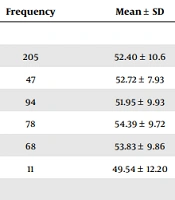
In this study, 503 students (221 males (43.93%) and 282 females (56.07%)) of ZAUMS were examined regarding their study habits during the virtual education period. A total of 205 students (40.75%) from the medical school, 94 students from the nursing school (18.68%), 78 students from the para-medical school (15.5%), 68 students from the health school (13.51%), 47 students from the dentistry school (9.34%), and 11 students from other faculties (2.18%) participated and filled the related questionnaire.
The frequency of students was as follows: Medical field: 177 (35.18%), health: 73 students (14.51%), nursing: 63 students (15.52%), and dentistry: 46 students (9.14%). The frequency of other fields was as follows: Nutrition: 28 students (5.56%), laboratory sciences: 26 students (5.16%), radiology: 18 students (3.57%), health information technology (HIT): 18 students (3.57%), operating room: 17 students (3.37%), emergency medicine: 15 students (2.98%) and midwifery: 9 students (1.78%).
In terms of the academic semester, 406 students (80.71%) were in their 1 - 5 academic semester, 80 students (15.91%) were in their 6 - 10 semester, and 13 students (2.59%) were in their 11 - 15 academic semester. Four students did not report their academic semester.
In terms of grade point average (GPA), 234 students (63.25%) had a GPA of 14 - 17, 108 students (29.18%) had a GPA above 17, and 28 students (7.57%) had a GPA below 14. Also, 133 students (45.26%) did not report their GPA.
Most students were non-native (270 students, 53.68%), and the rest were native (233 students, 46.32%). Also, 194 students (38.56%) had experienced three semesters of virtual education, 132 students (26.25%) had experienced two virtual semesters, and 177 students (35.19%) had experienced one virtual semester, of whom 259 students (51.49%) were interested in virtual education, and the rest (244 students, 48.51%) were not interested in education. The mean score of study habits was 52.87 ± 9.83. The lowest and highest scores on the PSSHI were 25 and 77. In order to find any statistically significant difference among students regarding gender, an independent t-test was conducted, and its results indicated no significant difference regarding gender (P = 0.151) (Table 1).
Table 1.
Students Study Habits Regarding According to Gender
| Study Habits | Frequency | Mean ± SD | P-Value |
|---|---|---|---|
| Man | 221 | 52.07 ± 10.57 | 0.151 |
| Female | 282 | 53.34 ± 9.19 |
Based on the results of the ANOVA, there was no statistically significant difference in the scores of students’ study habits regarding their faculties (P = 0.411) and study field (P = 0.687). On the other hand, there were statistically significant differences in their scores concerning their educational semester (P = 0.049), GPA (P = 0.039), virtual education period (P = 0.025), and interest in education (P = 0.005). Furthermore, by conducting an independent t-test, the researchers found out that their mean scores in terms of being native or non-native did not have any statistically significant difference (P = 0.61) (Table 2).
Table 2.
Students Study Habits Regarding the Related Variables
| Frequency | Mean ± SD | Min | Max | P-Value | |
|---|---|---|---|---|---|
| Faculties | 0.411 | ||||
| Medicine | 205 | 52.40 ± 10.6 | 25 | 76 | |
| Dentistry | 47 | 52.72 ± 7.93 | 39 | 75 | |
| Nursing | 94 | 51.95 ± 9.93 | 34 | 71 | |
| Para-medical | 78 | 54.39 ± 9.72 | 36 | 77 | |
| Health | 68 | 53.83 ± 9.86 | 31 | 70 | |
| Other | 11 | 49.54 ± 12.20 | 28 | 66 | |
| Study fields | 0.687 | ||||
| Medical | 177 | 52.18 ± 10.24 | 25 | 76 | |
| Dental | 46 | 52.47 ± 7.83 | 39 | 75 | |
| Nursing | 63 | 51.92 ± 10.02 | 34 | 71 | |
| Midwifery | 9 | 54.0 ± 9.04 | 42 | 67 | |
| Surgery room | 17 | 51.94 ± 12.91 | 28 | 69 | |
| Anesthesia | 18 | 55.77 ± 10.35 | 40 | 77 | |
| Health information technology | 13 | 51.53 ± 10.30 | 36 | 68 | |
| Health | 73 | 53.60 ± 9.62 | 31 | 70 | |
| Laboratory sciences | 26 | 54.96 ± 9.37 | 37 | 73 | |
| Medical emergency | 15 | 49.46 ± 9.82 | 33 | 66 | |
| Nutrition | 28 | 53.96 ± 8.92 | 35 | 70 | |
| Radiology | 18 | 55.22 ± 9.31 | 41 | 71 | |
| Educational semester | 0.04 a | ||||
| 1 - 5 | 406 | 53.23 ± 9.58 | 26 | 77 | |
| 6 - 10 | 80 | 50.47 ± 10.44 | 25 | 76 | |
| 11 - 15 | 13 | 50.38 ± 11.98 | 32 | 72 | |
| GPA | 0.039 a | ||||
| < 14 | 28 | 51.28 ± 10.08 | 31 | 68 | |
| 14 - 17 | 234 | 51.35 ± 9.58 | 25 | 76 | |
| > 17 more than | 108 | 54.24 ± 10.47 | 32 | 75 | |
| Non-reported | 133 | 54.45 ± 9.34 | 34 | 77 | |
| Virtual education period | 0.025 a | ||||
| 1 Term | 177 | 54.20 ± 9.72 | 26 | 77 | |
| 2 Terms | 132 | 52.87 ± 9.72 | 28 | 71 | |
| 3 Terms | 194 | 51.43 ± 9.87 | 25 | 76 | |
| Interest in virtual education | 0.005 a | ||||
| Yes | 259 | 53.98 ± 9.85 | 25 | 76 | |
| No | 244 | 51.52 ± 9.66 | 26 | 77 | |
| Native/non-native | 0.610 | ||||
| Native | 233 | 53.03 ± 9.52 | 31 | 77 | |
| Non-native | 270 | 52.58 ± 10.10 | 25 | 76 |
a Significant.
5. Discussion
Our findings showed no statistically significant difference in the student's study habits regarding their gender, faculties, study field, and being native or non-native. However, there were significant differences in their study habit scores regarding lower/higher academic semesters, GPAs, virtual education duration, and interest in virtual education.
The fact that the participants in the present study did not differ in terms of variables such as gender, faculty, field, or being non-native may mean that the overall process of the current educational system may not work efficiently to differentiate between learners in different situations. When one cannot detect any statistically significant difference among fe/male learners, it seems that they are trained based on a non-dynamic educational policy that may not be able to promote them and differentiate the gender differences. Alimohamadi et al. (9) also stated that there was no significant relationship between the variables of gender, marital status, academic semester, place of residence, and scores of study habits (9). Torabi et al. (16) reported that age, gender, marital status, place of residence, and student work were not related to the score of study habits (16). Therefore, these findings were consistent with our study. These studies mostly confirm the findings of our study, in which both could not find any differences in the learners' study habits concerning gender and place of residence. In the present study, the researchers could not find meaningful differences among participants regarding their place of residence (non/native) as well. It means that learners from different parts of the country follow mostly the same path, so their study habits and strategies are similar.
The results of our study also indicated no difference in learners’ study habits regarding their faculties and study field. Renes et al. (13) investigated the study habits and skills related to student's academic performance with a Bachelor of Science degree in Food Engineering at the University of Leon, Spain. Similarly, most students in this study had similar study skills and habits. Regardless of the study field /faculty, the participants follow similar study habits that one should be cautious about. Naturally, students must take different learning strategies and study habits depending on their specific study field. In contrast, in the current study and even in the literature (e.g., a study by Renes et al. (13)), students regarding their study fields did not have various study habits and strategies.
Students' academic performance in different years of study did not differ significantly (13). However, in our study, even though at borderline (P = 0.049), there were no significant differences among students concerning their years of study. Learners from semesters 1 to 15 followed almost similar study habits. This result contradicts that of Renes et al. in Spain.
Jafari et al. (12) showed that most students adopt appropriate study habits. Alimohamadi et al. (9) also investigated the relationship between study habits and the academic performance of nursing students in Hamadan. They showed that 86.9% of students had good study habits, 8.6% had favorable study habits, and 4.5% had unfavorable ones. Most students' study habits were evaluated as moderate and relatively favorable. In our study, the students with higher GPAs received higher scores regarding appropriate study habits. If the learners know various study habits and take the necessary ones in suitable situations, it may improve their academic performance. Torabi et al. (16) showed a significant statistical relationship between the students’ GPAs, the average hours of study, and the study before class (16). Çakıroğlu (17) also analyzed the impact of distance learners' learning styles and study habits on learning performance. They showed significant relationships between learning styles, study habits, and learning performance (17).
Interest in virtual education affects the learners’ academic performance. In the present study, learners interested in virtual education act differently than uninterested people. If learners prefer virtual education to face-to-face education, they can take special measures to succeed during virtual education. Getting them aware of the numerous advantages of virtual learning/teaching in diverse situations may happen.
5.1. Conclusions
The state of study skills and habits of ZAUMS students during virtual education was evaluated. However, it is recommended that study habits should be considered and evaluated when entering the university. In addition, special training should be provided to students to help them promote their study habits and strategies. It may improve their academic performance accordingly.