
1. Background
Elite athletes experience repeated physical and psychological demands associated with intensive training, competition, performance expectations, and incomplete recovery. These demands can affect psychological readiness and sleep, both of which are important for effective recovery and coping with competitive demands. Competitive anxiety is multidimensional and includes cognitive concerns about performance and failure, somatic manifestations of arousal, and self-confidence. Recent evidence continues to identify competitive anxiety as an important issue in sport and suggests that psychological interventions can reduce anxiety across different competitive levels and dimensions (1-3).
Elite athletes frequently manage high training loads, competition-related uncertainty, fatigue, and performance expectations. These demands make practical recovery strategies particularly relevant. Sleep is another central component of recovery but may be disrupted by training schedules, competitions, travel, and psychological stress. A 2025 systematic review of sleep interventions in elite sport identified several approaches, including sleep hygiene, supplementation, light therapy, cold-water immersion, and mindfulness, while emphasizing the need for more consistent and methodologically robust evidence (4).
Music listening is a potentially accessible behavioral strategy because it can be incorporated into existing recovery routines without specialized equipment or clinical supervision. A meta-analytic review of 139 studies found that music listening in exercise and sport was associated with more positive affective responses, lower perceived exertion, and beneficial effects on several performance-related outcomes (5). The importance of individual preference has also been emphasized. A 2026 systematic review and meta-analysis of 41 studies found that preferred music was associated with greater motivation, more positive affective responses, and lower perceived exertion than no-music or non-preferred music conditions (6).
The timing of music exposure may also influence its effects. Experimental research has shown that music during passive post-exercise recovery can modify affective arousal and influence subsequent exercise performance (7). Research comparing different periods of music exposure around aerobic exercise has similarly suggested that post-exercise music can influence affective responses (8). Thus, the period immediately following exercise may represent a useful behavioral window for psychological recovery.
Evidence also indicates that music may influence anxiety and sleep. A 2025 multilevel meta-analysis found a medium overall effect of music-therapy interventions on anxiety, although most studies involved clinical rather than athletic populations and therapist-delivered interventions rather than simple music listening (9). A 2024 systematic review and meta-analysis also reported a potential beneficial effect of music listening on subjective sleep quality, while emphasizing methodological limitations and the need for higher-quality studies (10).
Despite these findings, evidence specific to elite athletes remains limited. Previous research has often examined acute responses during exercise, clinical populations, or general psychological outcomes. Few studies have investigated whether repeated post-exercise music listening can simultaneously influence competitive anxiety and subjective sleep quality in elite athletes. From a neuropsychological perspective, competitive anxiety, self-confidence, and sleep are behavioral and psychological outcomes relevant to processes of arousal regulation, emotional control, attentional allocation, and recovery. Music listening has been proposed as a behavioral stimulus capable of influencing affective and arousal states during and after exercise. However, the present study did not directly assess neural activity, autonomic function, neuroendocrine responses, or neurophysiological markers. Accordingly, the findings should be interpreted as evidence regarding self-reported psychological and subjective sleep outcomes rather than as direct evidence of neural or neurophysiological effects. This distinction is important when considering the potential relevance of post-exercise music listening to neuropsychological aspects of athletic recovery. Therefore, the present study focuses on measurable psychological and sleep-related outcomes while avoiding mechanistic claims unsupported by the assessed variables.
2. Objectives
This study aimed to examine the effects of an 8-week post-exercise music-listening program on competitive anxiety and subjective sleep quality among elite athletes. Specifically, it examined between-group differences in cognitive anxiety, somatic anxiety, self-confidence, and PSQI scores after controlling for the corresponding baseline values. It was hypothesized that athletes participating in the music intervention would demonstrate lower anxiety-related scores, higher self-confidence, and better subjective sleep quality than those in the control condition.
3. Methods
3.1. Study Design and Setting
A randomized pretest–posttest design with experimental and control groups was used. The study population comprised elite athletes in Tehran with experience in national or international competitions. The final sample consisted of 40 Iranian male athletes from different sport disciplines, with at least 5 years of professional sports experience and international-level competitive experience. Participants were randomly allocated in equal numbers to a post-exercise music-listening group (n = 20) and a control group (n = 20). The mean age of the participants was 25 ± 1 years.
3.2. Participants and Sampling
Participants were recruited through the National Sports Elites Foundation between April 21, 2026, and June 21, 2026. Eligible participants had not attended any team training camps during the preceding month and agreed to adhere to the study protocol. Of the 53 athletes contacted and assessed for eligibility, 40 met the eligibility criteria and were enrolled. All 40 participants completed the study and were included in the final analysis. No participant reported a sports-related injury or travel that interfered with participation, and no participant withdrew from the study.
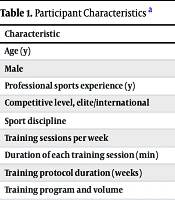
Both groups followed the same training program, consisting of three 90-minute training sessions per week for eight consecutive weeks. Training frequency, session duration, and overall training volume were therefore kept consistent across groups, with post-exercise music listening constituting the planned difference between the groups. Participant characteristics are presented in Table 1.
Table 1.
Participant Characteristics a
| Characteristic | Music Group (n = 20) | Control Group (n = 20) | Total (n = 40) |
|---|---|---|---|
| Age (y) | 24 - 26 | 24 - 26 | 24 - 26 |
| Male | 20 (100) | 20 (100) | 40 (100) |
| Professional sports experience (y) | ≥ 5 | ≥ 5 | ≥ 5 |
| Competitive level, elite/international | 20 (100) | 20 (100) | 40 (100) |
| Sport discipline | Various sports | Various sports | Various sports |
| Training sessions per week | 3 | 3 | 3 |
| Duration of each training session (min) | 90 | 90 | 90 |
| Training protocol duration (weeks) | 8 | 8 | 8 |
| Training program and volume | Identical | Identical | Identical |
a Values are expressed as range, No. (%) or number. All participants were male elite athletes aged 24 - 26 years with at least 5 years of professional sports experience and international-level competitive experience. Participants represented different sport disciplines. The two groups followed the same training program and training volume throughout the 8-week study period; the planned difference between groups was the post-exercise music-listening intervention.
No formal prospective sample-size calculation was performed before recruitment. Accordingly, the study was considered exploratory with respect to the precision of the estimated intervention effects. Therefore, the statistical findings were interpreted cautiously rather than as confirmatory evidence of intervention effectiveness.
3.3. Data Collection and Instruments
3.3.1. Music Selection and Intervention Procedure
The experimental group participated in an 8-week post-exercise music-listening intervention. Before the intervention, each participant identified and provided their personally preferred music. Accordingly, participants listened to individually preferred music rather than a single standardized musical genre, and the selected music was used throughout the intervention.
Immediately after each training session, during the designated post-exercise rest period, participants in the experimental group listened to their individually preferred music for 60 minutes using a mobile phone and earphones. Playback volume was standardized by the researcher for all participants.
The intervention was administered three times per week for eight consecutive weeks, resulting in 24 scheduled sessions per participant. All sessions followed the same schedule, and the end of each music-listening session occurred approximately 5 - 6 hours before the participants' usual nighttime sleep period. Thus, the intervention was delivered during a standardized post-exercise period and was not administered immediately before bedtime.
The researcher supervised the music-listening sessions to ensure adherence to the prescribed protocol. All participants in the experimental group completed the 24 scheduled sessions without any missed sessions. The control group continued its usual post-exercise routine without structured exposure to the study music intervention. Control participants were monitored throughout the study, and no structured exposure to the intervention was reported.
The intervention was conceptualized as music listening rather than music therapy. No therapist-delivered treatment, clinical counseling, or active music-making component was included.
3.3.2. Outcome Assessment Procedure
Before initiation of the 8-week intervention, all participants completed the baseline (pretest) assessment, including the Competitive State Anxiety Inventory-2 (CSAI-2) and the Pittsburgh Sleep Quality Index (PSQI). Following completion of the intervention period, the same questionnaires were administered as the posttest assessment. The same assessment procedure and standardized instructions were used at both time points for all participants. The assessment schedule was identical for the two study groups.
All participants completed the scheduled protocol, and no missing posttest observations or major protocol deviations requiring differential handling were reported.
3.3.3. Competitive Anxiety
Competitive anxiety was assessed using the Competitive State Anxiety Inventory-2, developed within the multidimensional framework of competitive anxiety. The questionnaire contains 27 items rated on a four-point scale and assesses cognitive anxiety, somatic anxiety, and self-confidence. Higher scores indicate greater intensity of the respective construct. The instrument demonstrated acceptable internal consistency, with a Cronbach’s alpha of 0.86. The Persian version has also demonstrated acceptable psychometric properties among Iranian athletes (11).
3.3.4. Sleep Quality
Subjective sleep quality was assessed using the Pittsburgh Sleep Quality Index (12). The PSQI evaluates seven components, including subjective sleep quality, sleep latency, sleep duration, habitual sleep efficiency, sleep disturbances, use of sleep medication, and daytime dysfunction. The global score ranges from 0 to 21, with higher scores indicating poorer subjective sleep quality. The Persian version has demonstrated acceptable validity and reliability (13).
3.4. Statistical Analysis
Data were analyzed using analysis of covariance (ANCOVA) to examine between-group differences in posttest outcomes while controlling for the corresponding baseline scores. Separate ANCOVA models were conducted for cognitive anxiety, somatic anxiety, self-confidence, and the PSQI global score. In each model, the posttest score was the dependent variable, study group (post-exercise music listening vs. control) was the between-subject factor, and the corresponding pretest score was the covariate.
For each model, the group effect was evaluated using the F statistic and P value, with partial eta-squared (ηp2) reported as the effect-size measure. Statistical significance was set at α = 0.05. Because no formal prospective sample-size calculation or prespecified multiplicity-adjustment procedure was established, no adjustment for multiple comparisons was applied, and the findings were interpreted as exploratory rather than confirmatory, particularly given the limited sample size.
All 40 participants who completed the study were included in the analyses. There were no missing posttest observations or withdrawals requiring imputation or other missing-data procedures. Descriptive statistics are presented in Table 2, and the ANCOVA results, including F statistics, P values, and partial eta-squared values, are presented in Table 3. Interpretation of intervention effects was based on adjusted between-group comparisons from the ANCOVA models rather than on the raw posttest means alone.
Table 2.
Descriptive Statistics of Study Outcomes at Pretest and Posttest a
| Outcomes | Control | Music | ||
|---|---|---|---|---|
| Pretest | Posttest | Pretest | Posttest | |
| Somatic anxiety | 28.95 ± 3.43 | 22.24 ± 2.93 | 28.82 ± 3.90 | 22.53 ± 3.35 |
| Cognitive anxiety | 20.92 ± 3.24 | 19.75 ± 3.16 | 20.51 ± 2.83 | 15.24 ± 2.61 |
| Self-confidence | 23.30 ± 8.63 | 24.53 ± 7.46 | 22.13 ± 7.46 | 27.80 ± 7.27 |
| Sleep quality (PSQI) | 2.11 ± 0.95 | 2.08 ± 0.63 | 2.10 ± 0.05 | 0.80 ± 0.46 |
a Values are expressed as mean ± SD. Higher anxiety and self-confidence scores indicate greater intensity of the respective construct. Lower PSQI scores indicate better subjective sleep quality.
Table 3.
ANCOVA Results for Posttest Outcomes After Controlling for Baseline Scores a
| Outcome | Covariate F (1, 37) | Covariate P | Group F (1, 37) | Group P | Partial ηp2 |
|---|---|---|---|---|---|
| Somatic anxiety | 34.331 | < 0.001 | 46.897 | < 0.001 | 0.635 |
| Cognitive anxiety | 34.388 | < 0.001 | 34.293 | < 0.001 | 0.559 |
| Self-confidence | 71.842 | < 0.001 | 48.979 | < 0.001 | 0.645 |
| Sleep quality | 43.478 | < 0.001 | 43.977 | < 0.001 | 0.620 |
a ANCOVA = analysis of covariance; ηp2 = partial eta squared. The corresponding pretest score was entered as the covariate in each analysis. All group effects were statistically significant. The ANCOVA values were verified against the inferential results.
Descriptive statistics were calculated for all study variables. Distributional assumptions were examined using the Shapiro–Wilk test. ANCOVA assumptions, including homogeneity of variance and homogeneity of regression slopes, were also assessed. Levene's tests were nonsignificant for somatic anxiety (P = 0.929), cognitive anxiety (P = 0.821), self-confidence (P = 0.931), and sleep quality (P = 0.087). Tests of homogeneity of regression slopes were also nonsignificant for all outcomes (P > 0.05).
Four separate one-way ANCOVAs were conducted. For each analysis, the posttest score was entered as the dependent variable, the corresponding pretest score as the covariate, and group (music vs. control) as the between-subjects factor. Statistical significance was set at α = 0.05. Partial eta squared (ηp2) was reported as the effect-size measure.
3.5. Ethical Considerations
All participants received information about the study procedures and provided informed consent before participation.
4. Results
4.1. Sample Characteristics and Descriptive Findings
The final analytic sample comprised 40 elite athletes, with 20 participants in each group. Cognitive anxiety decreased in the music group from 20.51 ± 2.83 at pretest to 15.24 ± 2.61 at posttest. Self-confidence increased from 22.13 ± 7.46 to 27.80 ± 7.27, while PSQI scores decreased from 2.10 ± 0.05 to 0.80 ± 0.46, indicating better subjective sleep quality. In the control group, cognitive anxiety changed from 20.92 ± 3.24 to 19.75 ± 3.16, self-confidence from 23.30 ± 8.63 to 24.53 ± 7.46, and PSQI from 2.11 ± 0.95 to 2.08 ± 0.63.
Somatic anxiety decreased in both groups. In the control group, somatic anxiety changed from 28.95 ± 3.43 to 22.24 ± 2.93, whereas in the music group, it changed from 28.82 ± 3.90 to 22.53 ± 3.35. For somatic anxiety, both groups showed lower posttest scores than at baseline; however, the raw posttest mean was slightly lower in the control group than in the music group (22.24 vs. 22.53). Therefore, the significant ANCOVA result should be interpreted as an adjusted between-group effect rather than as evidence that music listening produced a lower raw posttest score. Descriptive statistics for all outcomes at pretest and posttest are presented in Table 2.
4.2. ANCOVA Findings
For somatic anxiety, the pretest score was a significant covariate, F(1, 37) = 34.331, P < 0.001, ηp2 = 0.560. After adjustment for baseline somatic anxiety, a significant between-group effect was observed, F(1, 37) = 46.897, P < 0.001, ηp2 = 0.635. Adjusted group means were not available from the statistical analysis used in the present study; therefore, the direction of the adjusted effect was not interpreted.
For cognitive anxiety, baseline cognitive anxiety significantly predicted posttest scores, F(1, 37) = 34.388, P < 0.001, ηp2 = 0.560. The adjusted group effect was significant, F(1, 37) = 34.293, P < 0.001, ηp2 = 0.559. The descriptive means showed a substantially larger reduction in cognitive anxiety in the music group.
For self-confidence, baseline self-confidence was a significant covariate, F(1, 37) = 71.842, P < 0.001, ηp2 = 0.727. The adjusted group effect was significant, F(1, 37) = 48.979, P < 0.001, ηp2 = 0.645. The music group showed a larger increase in self-confidence than the control group.
For sleep quality, baseline PSQI score significantly predicted posttest scores, F(1, 37) = 43.478, P < 0.001, ηp2 = 0.617. The adjusted group effect was significant, F(1, 37) = 43.977, P < 0.001, ηp2 = 0.620. Because lower PSQI scores indicate better sleep quality, the descriptive findings were consistent with improved subjective sleep quality in the music group. The results of the ANCOVA models are presented in Table 3.
Overall, statistically significant adjusted group effects were observed for all four outcomes. Partial eta-squared values were 0.635 for somatic anxiety, 0.559 for cognitive anxiety, 0.645 for self-confidence, and 0.620 for sleep quality. These values indicate substantial between-group variance explained within the present sample; however, their magnitude should be interpreted cautiously given the small sample size and randomized design.
At baseline, the music group had a PSQI global score of 2.10 ± 0.05, whereas the control group had a score of 2.11 ± 0.95. The very small standard deviation observed in the music group indicates that baseline PSQI scores were highly concentrated near the lower end of the scale, suggesting limited between-participant variability and a potential floor effect. Following the music-listening intervention, the PSQI score decreased to 0.80 ± 0.46 in the music group, while it remained relatively unchanged in the control group (2.08 ± 0.63). These descriptive findings should be interpreted cautiously given the restricted baseline variability in the music group.
5. Discussion
The present study examined whether repeated post-exercise music listening was associated with competitive anxiety and subjective sleep quality in elite athletes. After controlling for baseline values, significant between-group effects were observed for somatic anxiety, cognitive anxiety, self-confidence, and sleep quality. These findings are broadly consistent with evidence that psychological music-listening interventions can reduce competitive anxiety and improve psychological readiness. Meta-analytic research has reported small-to-medium overall effects of psychological music-listening interventions on competitive anxiety, including cognitive anxiety, somatic anxiety, and self-confidence (14). More recent evidence similarly indicates that psychological music-listening interventions can reduce competitive anxiety, although effectiveness varies according to the type of music-listening intervention and competitive level (1, 2).
The finding for cognitive anxiety is particularly notable. Cognitive anxiety involves performance-related worry, negative expectations, and concerns about evaluation. The music group demonstrated a reduction from 20.51 to 15.24, whereas the control group changed from 20.92 to 19.75. This pattern suggests that repeated exposure to preferred music after training was associated with a more favorable psychological state. This finding is compatible with evidence that preferred music can enhance positive affect and motivation in athletic settings (6).
One possible explanation is that preferred music may support attentional and affective regulation during the transition from exercise to recovery. Following strenuous training, athletes may remain psychologically activated and continue to think about performance, fatigue, or upcoming competitions. Music may redirect attention and alter affective state. The meta-analysis by Terry et al. showed that music in exercise and sport is associated with more positive affective valence and lower perceived exertion (5), while recent research on preferred music similarly emphasizes affective and motivational responses (6). However, the present study did not directly measure attentional processes or affective regulation; therefore, this explanation remains tentative.
The finding for somatic anxiety warrants particular caution. Although the ANCOVA indicated a significant adjusted between-group effect, the raw posttest mean was slightly lower in the control group than in the music group. Because adjusted group means were not available, the significant ANCOVA result should not be interpreted as evidence that music listening produced a lower observed posttest level of somatic anxiety. Both groups showed reductions from baseline, suggesting that factors common to the training period may also have contributed to the observed change. Future studies with larger samples and adjusted group means should clarify the magnitude and direction of this effect.
The improvement in self-confidence provides a complementary finding. Self-confidence reflects athletes’ perceived readiness and belief in their ability to perform successfully and is conceptually distinct from simply having low anxiety. In this study, self-confidence increased from 22.13 to 27.80 in the music group, compared with an increase from 23.30 to 24.53 in the control group. This is compatible with evidence that psychological music-listening interventions can improve self-confidence while reducing competitive anxiety (14) and with research supporting the psychological effects of preferred music on affective and motivational states (6).
Nevertheless, self-confidence was measured as one component of the CSAI-2. Therefore, this result should not be generalized to broader constructs such as self-efficacy, self-esteem, or actual competitive performance. The finding indicates a favorable change in competitive-state self-confidence rather than evidence that music necessarily improves objective sporting performance.
The second major finding concerned subjective sleep quality. PSQI scores decreased from 2.10 to 0.80 in the music group, whereas the control group showed virtually no change, from 2.11 to 2.08. The adjusted group effect was statistically significant and associated with a large partial eta squared. This finding is broadly consistent with evidence suggesting that music listening may improve subjective sleep quality. Zhao et al. reported a potential beneficial effect of music-listening interventions on subjective sleep quality while emphasizing methodological limitations and the need for higher-quality evidence (10).
The sleep finding may be related to the psychological changes observed in the study. Anxiety and sleep are closely interconnected: heightened cognitive arousal can interfere with relaxation and sleep initiation, whereas inadequate sleep may increase emotional reactivity. Music may influence both outcomes by supporting emotional down-regulation during recovery. Evidence from music-therapy research also suggests reductions in self-reported anxiety (9), although the present music-listening intervention was not music therapy and should not be interpreted as a clinical treatment.
Timing may represent another relevant mechanism. The music-listening intervention was delivered immediately after regular training rather than during exercise. Previous experimental work has shown that music during passive post-exercise recovery can influence affective arousal and subsequent sporting performance (7), while research comparing different timing conditions has also reported differences in affective responses associated with post-exercise music exposure (8). These findings support the possibility that the post-exercise period represents a useful behavioral window for psychological recovery, although those acute experimental protocols differ from the present 8-week music-listening intervention.
A practical strength of the music-listening intervention is its simplicity. Preferred music listening requires no specialized equipment, extensive training, or therapist involvement and can be incorporated into athletes’ existing recovery routines. This may be particularly useful for elite athletes whose schedules limit the feasibility of complex music-listening interventions. Recent evidence from 41 studies supports the broader psychological potential of preferred music in athletic populations, particularly for motivation and affective responses (6). Nevertheless, music should be considered a complementary strategy rather than a replacement for established psychological and sleep-management approaches.
5.1. Study Limitations
Several limitations should be considered when interpreting these findings. First, the sample was relatively small and consisted exclusively of elite male athletes, which limits the generalizability of the findings to other athletic populations. Accordingly, the statistical findings should be regarded as exploratory and require confirmation in larger samples. Second, although participants were allocated to the study groups, blinding was not feasible, and the outcomes were based primarily on self-reported measures. Third, subjective sleep quality was assessed using the PSQI without objective measures of sleep or sleep architecture. Finally, the study did not include follow-up assessments; therefore, the persistence of the observed effects after the intervention remains unknown.
Future studies should use larger randomized samples and include athletes from different individual and endurance sports. Combining the PSQI with actigraphy, heart-rate variability, or other objective recovery measures could clarify whether subjective improvements correspond to measurable physiological changes. Research should also examine whether music tempo, genre, familiarity, listening volume, and individual preference influence outcomes. Dose-response studies comparing different listening durations would be useful because the present study used a fixed 60-minute protocol. Mediation studies could further test whether changes in affect, arousal, or anxiety account for subsequent improvements in subjective sleep quality.
The potential neuropsychological relevance of post-exercise music listening should be interpreted cautiously. The present study assessed self-reported competitive anxiety, competitive-state self-confidence, and subjective sleep quality rather than neural or neurophysiological variables. Therefore, the observed between-group differences cannot establish changes in brain activity, autonomic regulation, neurotransmitter function, or sleep architecture. Future studies combining psychological measures with electroencephalography, heart-rate variability, objective sleep monitoring, or other neurophysiological measures could provide a more direct examination of the physiological and neuropsychological processes potentially associated with responses to post-exercise music listening.
5.2. Conclusions
Overall, the findings indicate that an 8-week post-exercise music-listening routine was associated with significant adjusted between-group differences in competitive anxiety-related outcomes and subjective sleep quality among elite athletes. The clearest descriptive improvements were observed for cognitive anxiety, self-confidence, and PSQI scores. The somatic-anxiety ANCOVA result should be interpreted more cautiously because the raw posttest mean was slightly lower in the control group and adjusted means were unavailable. Taken together, these findings support post-exercise music listening as a feasible complementary recovery strategy, while larger randomized studies with objective sleep and recovery measures are needed to establish effectiveness and mechanisms.