
1. Background
The university period is a critical transitional phase characterized by substantial intellectual, personal, and social development. For married university students, however, this period is often accompanied by a distinct set of complex challenges (1). These students must navigate the dual and sometimes competing demands of rigorous academic responsibilities and marital life (2). The combination of striving for academic success, managing financial constraints, and maintaining a healthy marital relationship can create a highly demanding environment (3). Consequently, this population may be particularly vulnerable to psychological strain that can affect overall well-being and life satisfaction (4). The chronic pressure of fulfilling multiple demanding roles simultaneously may leave married students with limited resources for self-care, increasing susceptibility to psychological distress and underscoring the need to investigate factors associated with their overall well-being (5).
Quality of life (QoL) is a broad, multidimensional concept encompassing physical health, psychological state, level of independence, social relationships, and relationships with salient features of the environment (6). Among married university students, QoL is an important indicator of how effectively they manage the intersecting demands of academic and personal life (7). Higher QoL is associated with better academic performance, greater marital satisfaction, and greater resilience to psychological distress (8). Conversely, lower QoL in this population may be associated with academic burnout, marital dissatisfaction, and the onset or exacerbation of mental health problems (9). Therefore, identifying psychological and cognitive factors associated with QoL is important for developing targeted support for this population.
One psychological factor that may adversely affect QoL is attention-deficit/hyperactivity disorder (ADHD). Although traditionally considered a childhood disorder, ADHD symptoms, primarily inattention, hyperactivity, and impulsivity, frequently persist into adulthood and may substantially affect university students (10). In adult students, ADHD symptoms can impair executive functioning, contributing to difficulties with time management, academic procrastination, and emotional regulation (11). Among married students, these symptoms may be particularly detrimental because forgetfulness, poor listening, and impulsive behavior can contribute to misunderstandings and persistent marital conflict (12). ADHD symptoms are consistently associated with lower QoL across academic and interpersonal domains (7, 13).
Perceived stress is another important correlate of well-being. It refers to the degree to which situations in a person's life are appraised as unpredictable, uncontrollable, and overwhelming (14). Given their dual roles, married university students may experience elevated perceived stress (15). This burden is not merely a transient emotional response; chronic perceived stress has been associated with cognitive fatigue, emotional exhaustion, and somatic complaints (16). High perceived stress may deplete coping resources and reduce students’ ability to manage academic deadlines and maintain their marital relationships, thereby being negatively associated with overall QoL (17).
Hyperfocus is characterized by intense, sustained concentration on specific tasks, often at the expense of other activities, and has been observed in individuals with ADHD symptoms and in high-stress contexts (18, 19). Although hyperfocus may temporarily support performance on engaging tasks, it is also associated with time blindness, neglect of responsibilities, and withdrawal from interpersonal interactions, which in turn are associated with reduced QoL (20).
Although the associations of ADHD symptoms and perceived stress with student well-being are broadly recognized, cognitive-attentional factors such as hyperfocus require further examination among married university students (18, 20). Examining statistical associations among these variables, including possible indirect pathways, may advance understanding beyond basic models of psychological distress.
2. Objectives
The primary objective of this study was to examine the associations of ADHD symptoms and perceived stress with QoL among married university students. Specifically, the study examined indirect associations involving hyperfocus within these relationships.
3. Methods
3.1. Study Design and Setting
This study employed a cross-sectional correlational design and structural equation modeling (SEM) to examine associations among the study variables. Because all constructs were assessed at a single time point, the analysis was observational and could not establish temporal precedence or causality.
3.2. Participants and Sampling
The target population comprised all married students attending Islamic Azad University of Isfahan during the 2025 academic year. A total of 378 individuals were recruited through convenience sampling via in-person distribution across campus faculties and online dissemination through official university social networks. After 34 participants were excluded because of substantially incomplete questionnaires or failure to meet the inclusion criteria, the final analytic sample comprised 344 married students. Inclusion criteria were being officially married, actively enrolled in a degree program, and willing to participate. Participants were excluded if they had a history of severe psychiatric conditions requiring hospital admission or provided largely incomplete survey responses. No significant differences were observed between in-person and online respondents in key demographic variables (data available upon request). Duplicate responses were prevented using unique survey links and manual verification.
The predominance of female participants (89.8%) and variability in age and marriage duration should be considered when interpreting generalizability. Before data collection, all participants provided written informed consent. The researchers ensured anonymity, confidentiality, and secure handling of personal information. The study was approved by the Ethics Committee of Islamic Azad University, Ahvaz Branch (code: IR.IAU.AHVAZ.REC.1403.400), which covered the research activities at the Isfahan branch.
3.3. Procedure
Data were collected using a hybrid in-person and online approach to maximize reach. After administrative and ethical approvals were obtained, paper questionnaires were distributed across campus faculties, and digital versions were disseminated through official university social networks. All participants received instructions describing the study objectives and procedures for completing the psychological scales.
3.4. Instruments
Quality of life was assessed using the World Health Organization Quality of Life BREF (WHOQOL-BREF) (6). This 26-item questionnaire evaluates four domains: physical health (7 items), psychological health (6 items), social relationships (3 items), and environment (8 items), plus 2 general items. Items are rated on a 5-point Likert scale. In this study, raw domain scores, calculated as the sums of the respective items, were used; higher scores indicated better QoL in each domain. Cronbach alpha was 0.84. In the SEM, QoL was modeled as a latent variable indicated by the 4 domain scores.
ADHD symptoms were measured using the Adult ADHD Self-Report Scale (ASRS) (21, 22), which contains 18 items. Participants rated experiences of inattention and hyperactivity/impulsivity on a 5-point Likert scale from 0 (never) to 4 (very often). The combined total score was calculated by summing all 18 items, yielding a possible range of 0 - 72; higher scores indicated greater overall symptom severity. Separate subscale scores for inattention (9 items) and hyperactivity/impulsivity (9 items) were also calculated for descriptive and correlational analyses only. Cronbach alpha in this sample was 0.87.
Perceived stress was assessed using the 14-item Perceived Stress Scale (PSS-14) (14). Items are rated on a 5-point scale from 0 (never) to 4 (very often). After positively worded items were reverse-scored, total scores ranged from 0 to 56, with higher scores indicating greater perceived stress (23). Cronbach alpha was 0.85.
Hyperfocus was assessed using the 12-item Adult Hyperfocus Questionnaire (1). Items assess the frequency and intensity of immersive concentration on a Likert scale. Total scores range from 12 to 60, or the scaled equivalent, with higher scores indicating a greater tendency toward hyperfocus. Cronbach alpha was 0.81.
All scale scores were treated as continuous variables. No transformations were applied beyond standard reverse-scoring and domain-scaling procedures.
3.5. Statistical Analysis
Descriptive statistics and Pearson correlations were calculated in SPSS. SEM was conducted in AMOS version 24 using maximum likelihood estimation. The measurement model was evaluated separately before testing the structural model. Multivariate normality was assessed using skewness, kurtosis, and Mardia's coefficient; no severe violations were detected. Outliers were examined using Mahalanobis distance, and no influential cases were removed. The sample size was considered adequate for SEM based on the number of estimated parameters. Missing data (< 5% overall) were handled using full information maximum likelihood. Indirect effects were tested with 5,000 bootstrap resamples, and 95% bias-corrected confidence intervals (CIs) are reported. Because the inattention and hyperactivity/impulsivity subscales were highly intercorrelated and both were strongly associated with the combined total score, only the combined ADHD score was used in the SEM to avoid multicollinearity and statistical redundancy; subscale scores were retained only for descriptive and correlational analyses. Age, gender, educational level, and marriage duration were examined as potential covariates but were not retained in the final model because they did not significantly improve model fit or alter the primary paths.
4. Results
4.1. Sample Characteristics and Descriptive Statistics
The sample comprised 344 married university students. The mean age was 31.90 years (SD = 7.41). Age categories were distributed as follows: 88 participants (25.6%) were 25 years or younger, 76 (22.1%) were aged 26 - 30 years, 84 (24.4%) were aged 31 - 35 years, and 96 (27.9%) were older than 35 years. Most participants were female (309 [89.8%]), and 35 (10.2%) were male. Academic enrollment included 14 associate-degree students (4.1%), 185 bachelor's degree students (53.8%), 110 master's degree students (32.0%), and 35 doctoral students (10.2%). The mean marriage duration was 5.58 years (SD = 2.34).
Table 1 presents descriptive statistics for the primary constructs. The mean combined ADHD score was 18.32 (SD = 4.79), calculated as the sum of the 18 ASRS items (possible range, 0 - 72). The mean inattention and hyperactivity/impulsivity subscale scores were 8.57 (SD = 3.48) and 9.75 (SD = 3.59), respectively. The mean perceived stress and hyperfocus scores were 27.10 (SD = 6.15) and 31.15 (SD = 7.76), respectively. Across the QoL domains, the mean scores were 22.97 (SD = 4.49) for physical health, 19.22 (SD = 3.88) for psychological health, 9.86 (SD = 2.98) for social relationships, and 25.80 (SD = 6.13) for environmental health. Skewness and kurtosis ranged from -0.85 to 0.67, supporting the use of parametric analyses and SEM.
Table 1.
Means, Standard Deviations, Skewness, and Kurtosis of the Study Variables
| Variables | Mean | SD | Skewness | Kurtosis |
|---|---|---|---|---|
| ADHD - Inattention | 8.57 | 3.48 | 0.67 | -0.06 |
| ADHD - Hyperactivity/Impulsivity | 9.75 | 3.59 | 0.61 | -0.39 |
| ADHD - Combined (sum of 18 items) | 18.32 | 4.79 | 0.24 | -0.68 |
| Perceived stress | 27.10 | 6.15 | -0.02 | -0.46 |
| Hyperfocus | 31.15 | 7.76 | 0.42 | -0.85 |
| Quality of life (QoL) - Physical health | 22.97 | 4.49 | 0.02 | -0.34 |
| Quality of life (QoL) - Psychological health | 19.22 | 3.88 | -0.15 | 0.08 |
| Quality of life (QoL) - Social relationships | 9.86 | 2.98 | -0.22 | -0.67 |
| Quality of life (QoL) - Environmental health | 25.80 | 6.13 | -0.05 | -0.25 |
4.2. Correlation Analysis
As shown in Table 2, significant positive associations were observed among the ADHD measures (r = 0.60 - 0.68; P < 0.01). Perceived stress was positively correlated with ADHD symptoms (r = 0.40 - 0.51) and hyperfocus (r = 0.55; P < 0.01). Hyperfocus also showed strong positive associations with perceived stress and ADHD traits. In contrast, all 4 QoL dimensions were significantly and inversely associated with ADHD symptoms, perceived stress, and hyperfocus (r = -0.27 to -0.56; P < 0.01).
Table 2.
Pearson Correlations Among Study Variables
| Variables | 1 | 2 | 3 | 4 | 5 | 6 | 7 | 8 | 9 |
|---|---|---|---|---|---|---|---|---|---|
| 1 - ADHD - Inattention | 1 | ||||||||
| 2 - ADHD - Hyperactivity/Impulsivity | 0.60 a | 1 | |||||||
| 3 - ADHD - Combined (sum of 18 items) | 0.68 a | 0.64 a | 1 | ||||||
| 4 - Perceived stress | 0.42 a | 0.40 a | 0.51 a | 1 | |||||
| 5 - Hyperfocus | 0.46 a | 0.52 a | 0.57 a | 0.55 a | 1 | ||||
| 6 - Quality of life (QoL) - Physical health | -0.38 a | -0.27 a | -0.42 a | -0.51 a | -0.50 a | 1 | |||
| 7 - Quality of life (QoL) - Psychological health | -0.37 a | -0.36 a | -0.45 a | -0.39 a | -0.54 a | 0.67 a | 1 | ||
| 8 - Quality of life (QoL) - Social relationships | -0.39 a | -0.33 a | -0.48 a | -0.54 a | -0.43 a | 0.59 a | 0.67 a | 1 | |
| 9 - Quality of life (QoL) - Environmental health | -0.41 a | -0.35 a | -0.50 a | -0.37 a | -0.56 a | 0.54 a | 0.61 a | 0.52 a | 1 |
a P < 0.01 was considered statistically significant.
Because the inattention and hyperactivity/impulsivity subscales were highly intercorrelated (r = 0.60) and both were strongly associated with the combined total score, only the combined ADHD score was entered into the structural equation model to avoid multicollinearity and redundancy. Subscale scores are presented only for descriptive and correlational analyses.
4.3. Structural Equation Model
The final structural model demonstrated excellent fit to the data: χ2 = 72.38, df = 34, χ2/df = 2.13, GFI = 0.96, AGFI = 0.93, CFI = 0.98, and RMSEA = 0.057 (Table 3). Maximum likelihood estimation with 5,000 bootstrap resamples was used. The measurement model showed acceptable fit before testing the structural model.
Table 3.
Goodness-of-Fit Indices for the Final Structural Model
| Fit Indicators | χ2 | df | (χ2/df) | GFI | AGFI | CFI | RMSEA |
|---|---|---|---|---|---|---|---|
| Model | 72.38 | 34 | 2.13 | 0.96 | 0.93 | 0.98 | 0.057 |
| Acceptable range | - | - | < 3 | > 0.95 | > 0.90 | > 0.95 | < 0.08 |
Table 4 presents standardized direct and indirect path coefficients, along with unstandardized estimates, standard errors, P values, and 95% bias-corrected bootstrap CIs. Perceived stress (β = 0.24; P = 0.001; 95% CI, 0.12 - 0.36) and ADHD symptoms (β = 0.31; P = 0.001; 95% CI, 0.19 - 0.43) were significantly and positively associated with hyperfocus. Higher hyperfocus was negatively associated with QoL (β = -0.27; P = 0.001; 95% CI, -0.39 to -0.15). QoL was also directly and negatively associated with perceived stress (β = -0.28; P = 0.001; 95% CI, -0.38 to -0.18) and ADHD symptom severity (β = -0.19; P = 0.009; 95% CI, -0.31 to -0.07). Hyperfocus accounted for significant indirect associations of perceived stress with QoL (β = -0.07; P = 0.001; 95% CI, -0.12 to -0.03) and of ADHD symptoms with QoL (β = -0.09; P = 0.001; 95% CI, -0.15 to -0.04). Age, gender, educational level, and marriage duration were tested as covariates but did not significantly contribute to the model and were therefore not retained in the final solution.
Table 4.
Standardized Direct and Indirect Effects in the Final Structural Model (with 95% Bootstrap Confidence Intervals)
| Path | B | SE | β | P | 95% CI |
|---|---|---|---|---|---|
| Perceived stress → Hyperfocus | 0.54 | 0.11 | 0.24 | 0.001 | [0.12, 0.36] |
| ADHD symptoms → Hyperfocus | 1.03 | 0.21 | 0.31 | 0.001 | [0.19, 0.43] |
| Hyperfocus → Quality of life (QoL) | -0.07 | 0.02 | -0.27 | 0.001 | [-0.39, -0.15] |
| Perceived stress → Quality of life (QoL) | -0.16 | 0.04 | -0.28 | 0.001 | [-0.38, -0.18] |
| ADHD symptoms → Quality of life (QoL) | -0.16 | 0.06 | -0.19 | 0.009 | [-0.31, -0.07] |
| Perceived stress → Quality of life (QoL) through hyperfocus | -0.04 | 0.01 | -0.07 | 0.001 | [-0.12, -0.03] |
| ADHD symptoms → Quality of life (QoL) through hyperfocus | -0.07 | 0.02 | -0.09 | 0.001 | [-0.15, -0.04] |
Figure 1 illustrates the final structural equation model depicting the associations among ADHD symptoms (combined total score), perceived stress, hyperfocus, and QoL. All hypothesized paths were statistically significant.
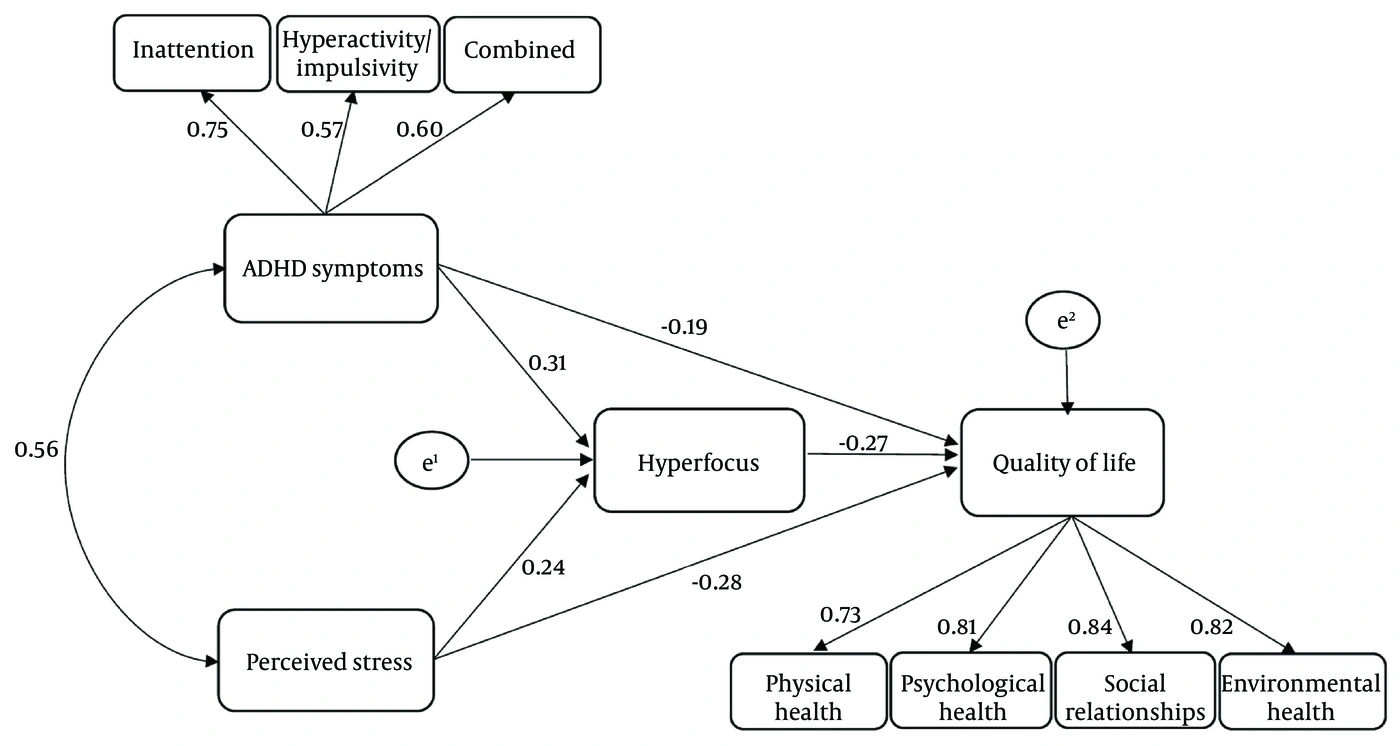
Figure 1.
Final structural model of the study
5. Discussion
The present study examined the associations of ADHD symptoms and perceived stress with QoL among married university students, with a focus on the role of hyperfocus. Structural equation modeling demonstrated excellent fit indices and supported the hypothesized associations. These findings extend previous research by highlighting how attentional and stress-related factors are interrelated with well-being in a population facing concurrent academic and marital demands.
ADHD symptoms were significantly and negatively associated with QoL. Among married university students, core features such as inattention and executive dysfunction are associated with difficulties managing academic and marital responsibilities, including time-management problems, procrastination, and interpersonal conflict (7, 12). These findings are consistent with previous studies showing associations between adult ADHD symptoms and lower QoL (7, 13).
Similarly, perceived stress showed a robust negative association with QoL. Married students often face combined academic, financial, and relational stressors. When perceived stress overwhelms coping resources, it is associated with sustained physiological arousal, emotional exhaustion, and cognitive fatigue, which, in turn, correlate with lower well-being (16, 17, 24).
Hyperfocus was positively associated with ADHD symptoms and perceived stress and negatively associated with QoL. Although intense concentration may temporarily support performance on specific tasks, prolonged hyperfocus is associated with imbalances, such as neglect of sleep, self-care, and interpersonal interactions (18-20). In this population, such patterns may contribute to marital discord and academic difficulties.
Hyperfocus accounted for significant indirect statistical associations among ADHD symptoms, perceived stress, and QoL. This finding indicates that hyperfocus is linked to how these factors relate to QoL; however, the cross-sectional design precludes conclusions about temporal order or causal pathways.
5.1. Study Limitations
Several limitations should be considered. First, the cross-sectional design prevents the establishment of temporal order, and the observed indirect associations represent statistical relationships rather than causal mediation mechanisms. Second, reliance on self-report measures may introduce common method variance and social desirability bias. Third, the convenience sample from a single Iranian university, together with the predominance of female participants (89.8%), limits generalizability. Future studies should use longitudinal designs, more diverse samples, and multimethod assessments.
From a practical perspective, the results suggest that attention-regulation strategies, including mindfulness-based approaches to managing hyperfocus, together with stress-management techniques, may be promising targets for future intervention studies aimed at supporting the well-being of married university students. Future studies should evaluate such programs using randomized controlled trials and examine potential moderators, such as gender, relationship satisfaction, and social support.
5.2. Conclusions
In conclusion, this cross-sectional study found that ADHD symptoms and perceived stress were negatively associated with QoL among married university students, whereas hyperfocus showed significant direct associations with these variables and indirect statistical associations within the examined relationships. These findings highlight the importance of attentional patterns in understanding well-being in this population. Because of the cross-sectional design, the results demonstrate statistical associations rather than temporal or causal mediation and should not be interpreted as evidence of causal pathways. Rather than demonstrating the effectiveness of specific interventions, which was not tested in this study, the findings suggest that clinical and educational approaches focusing on attention regulation and stress management warrant further investigation. Such approaches may help married students better navigate the complex demands of academic and marital life.