


1. Background
Academic engagement — the degree of students’ interest, motivation, and active participation in learning activities — comprises cognitive, behavioral, and emotional components that correlate closely with learning quality, academic performance, and student retention in educational systems (1). Higher levels of academic engagement are associated with greater satisfaction with the learning environment, better mental health, and improved academic outcomes (2). Moreover, positive engagement can reduce dropout intentions and foster self-regulated learning, underscoring the need to identify factors that correlate with it (3).
Sleep quality is one such factor. Adequate, restorative sleep supports cognitive functioning, memory consolidation, and emotional regulation; conversely, poor sleep quality or insufficient sleep correlates with daytime fatigue, reduced concentration, increased irritability, and diminished motivation to engage in academic tasks (4, 5). Anxiety is another important correlate. Elevated anxiety can interfere with attentional processes and working memory, generate intrusive thoughts, and elevate psychological distress, all of which reduce students’ willingness and ability to participate fully in learning activities (1). Social support — from family, peers, and friends — also correlates with academic engagement by buffering stress and promoting psychological well-being. Students with stronger support networks report higher levels of motivation, resilience, and sustained engagement in their studies (6).
Recent research highlights mental health as a key mediator in these relationships. For example, Keshavarzi et al. showed that anxiety correlates with academic burnout and performance via its association with mental health (4). Aydin F and Aydin A found that sleep quality correlates with academic self-efficacy through its link to overall psychological well-being (5). Chen et al. demonstrated that social support correlates with engagement through sequential mediators of life satisfaction and academic motivation — both indicators of mental health (7). These findings suggest that mental health not only correlates directly with engagement but also mediates how sleep, anxiety, and social support relate to academic involvement (3, 8, 9).
2. Objectives
However, most studies to date have been conducted in Western contexts, and little is known about how these variables correlate among Iranian students — particularly in regions like Zahedan, where access to mental health services is limited. This cross-sectional study aims to examine the correlations between sleep quality, anxiety, and social support with academic engagement among university students in Zahedan, and to evaluate the mediating role of mental health in these correlations. The findings are intended to inform targeted psychosocial and educational interventions — such as sleep hygiene programs, stress-reduction strategies, and social support initiatives — to enhance students’ mental health and thereby foster greater academic engagement.
3. Methods
This cross-sectional study investigates the correlations among sleep quality, anxiety, and social support with academic engagement, with mental health considered as a mediating factor in these associations.
3.1. Statistical Population, Sample Size, and Sampling Method
The statistical population of this study consisted of all students enrolled in public universities in Zahedan. A total of 900 students were selected using stratified random sampling to ensure adequate representativeness and enhance the generalizability of the results (10). The sample size was determined with reference to similar correlational studies and guided by practical considerations, including time constraints, accessibility, and available research resources. To implement stratified sampling, the number of students selected from each university was proportionate to its total student population. Then, faculty-level quotas were calculated based on enrollment data obtained from the educational offices of each university (Table 1).
Table 1.Statistical Population and Sample Size by University
| Name of the University | No. (%) of Students | Sample Size |
|---|---|---|
| Zahedan University | 21,217 (83.3) | 750 |
| Farhangian University | 2,800 (11.0) | 99 |
| Medical University | 4,361 (16.7) | 150 |
| Total | 25,478 (100) | 900 |
To conduct the random sampling within each faculty, the researcher personally visited each faculty and obtained the official student list from the education department. The names of students were entered into Microsoft Excel, and a random number was assigned to each student using the RAND function (11). Subsequently, the required number of students for each faculty was selected by choosing those with the lowest assigned random numbers, ensuring an unbiased and systematic random selection process. The selected students were contacted via mobile phone. After explaining the research purpose and ethical considerations and obtaining verbal consent, a link to the online questionnaire was sent to them via SMS.
Data were collected by sending a link to the questionnaire to students’ mobile phones. The data collection period spanned from April to July 2024.
3.2. Inclusion and Exclusion Criteria
Students from public universities in Zahedan were eligible to participate if they provided informed consent and completed the questionnaire in full. Participation was voluntary, and all respondents were assured of the confidentiality of their responses. Exclusion criteria included failure to provide informed consent and submission of incomplete questionnaires. These criteria were applied to ensure the accuracy and reliability of the collected data.
3.3. Ethical Considerations
This study followed the Helsinki Declaration principles, with students providing verbal consent. Participation was voluntary and confidential (12). The researcher distributed and collected questionnaires personally, thanking participants with small gifts. A total of 873 questionnaires were collected.
3.4. Instruments
The Pittsburgh Sleep Quality Index (PSQI), developed in 1989 by Buysse, is a validated tool assessing sleep quality over the past month. It includes 19 self-rated questions grouped into seven components: Subjective sleep quality, sleep latency, sleep duration, habitual sleep efficiency, sleep disturbances, use of sleep medication, and daytime dysfunction. Each component is scored 0 - 3, with higher scores indicating worse sleep, and the total score ranges from 0 to 21. Some items collect raw data (e.g., hours slept), which are converted into ordinal scores using set thresholds. This structure provides a comprehensive, valid measure of sleep quality. Expert evaluation showed strong content validity (CVR 0.60 - 0.93, S-CVI 0.90) (13). The Persian PSQI previously had moderate reliability (α = 0.65), but this study found high internal consistency (α = 0.90).
The Multidimensional Scale of Perceived Social Support (MSPSS), developed by Zimet (1988), consists of 12 items rated on a five-point Likert scale. The total score ranges from 12 to 60. This questionnaire assesses perceived social support across three dimensions: Support from family (items 3, 4, 8, and 11), support from significant others (items 1, 2, 5, and 10), and support from friends (items 6, 7, 9, and 12). The Persian version shows good reliability (α = 0.92) and a confirmed three-factor structure. Subscale alphas were 0.89 (friends), 0.92 (significant others), and 0.87 (family). Content validity indices (CVI, CVR) were not reported (14). In this study, the Cronbach’s alpha for the entire questionnaire was found to be 0.93.
The Beck Anxiety Inventory (BAI) consists of 21 questions designed to measure the severity of anxiety. Each question is scored on a 4-point Likert scale, ranging from 0 (not at all) to 3 (severely), and the total score varies between 0 and 63. This questionnaire is divided into two major dimensions of anxiety: Cognitive symptoms (questions 1, 3, 6, 8, 9, 10, 14, 15, 16, 19, 20) and physical symptoms (questions 2, 4, 5, 7, 11, 12, 13, 17, 18, 21). Its validity and reliability have been reported as satisfactory in various studies. In Iran, although the CVI and CVR for the Persian version of the BAI have not been reported, a study confirmed its reliability (α = 0.88) and validity. The two-factor structure of the inventory was also supported by confirmatory factor analysis with acceptable model fit indices (15). In this study, the Cronbach’s alpha for the entire questionnaire was found to be 0.89.
The Student Academic Engagement Scale by Reeve (2013) consists of 17 questions divided into four dimensions: Behavioral engagement (questions 1 to 4), emotional engagement (questions 5 to 9), cognitive engagement (questions 10 to 13), and emotional engagement (questions 14 to 17). This questionnaire is scored based on a seven-point Likert scale. The CVI and CVR of the Persian version of this instrument have not been reported; however, a study in Iran demonstrated that the questionnaire has high reliability (α = 0.92) and a confirmed four-factor structure (16). In this study, the Cronbach’s alpha for the entire questionnaire was found to be 0.91.
The 12-Item General Health Questionnaire (GHQ-12) is a short and widely used self-report tool designed to screen for psychological problems and assess general health. This questionnaire consists of 12 questions scored on a 4-point Likert scale (0 to 3), with a total score ranging from 0 to 36. The questionnaire is divided into two main dimensions: 1) Somatic and psychological symptoms, which include questions 1, 2, 5, 6, 7, and 9; and 2) social and functional problems, which include questions 3, 4, 8, 10, 11, and 12. The CVI and CVR for the Persian GHQ-12 have not been reported. The latest validation by Rahmati Najarkolaei et al. confirmed its two-factor structure and reliability (α = 0.85) in Iranian students (17). In this study, the Cronbach’s alpha for the entire questionnaire was found to be 0.89.
3.5. Data Analysis Method
Various statistical techniques were used to examine demographic characteristics and analyze measures of central tendency (mean, median, mode) and variability (standard deviation, variance) for the research variables. For categorical data, frequencies and percentages were calculated. Path analysis was conducted to assess the conceptual model, focusing on direct and indirect relationships among variables. Standardized regression coefficients (beta weights) were estimated, with significance determined by P-values (P < 0.05). Model fit was evaluated using several indices: CMIN/DF (values under 3 indicate a good fit), GFI and AGFI (values close to 1 suggest a strong fit), and NFI, CFI, IFI (values near 1 reflect a good fit). A PNFI value close to 1 and an RMSEA below 0.08 also indicated a good fit. These procedures ensured validity and reliability, with results illustrating the effects of sleep quality, anxiety, and social support on academic engagement, with mental health functioning as a mediator.
4. Results
Based on data from 873 participants, most were from humanities (37.3%), followed by basic sciences (18.2%) and engineering (12.7%). Other fields included arts (9.4%), foreign languages (5.6%), paramedical studies (3.1%), nursing and midwifery (3.7%), and medical sciences (2.3%). Of the participants, 61.5% were female, 38.5% male, 46% were pursuing a bachelor’s degree, and 34.2% were at the associate level. Regarding age, 46% were 20 - 25 years old, and 71.2% were single (Table 2).
Table 2.Participants’ Profiles
| Categories and Subcategories | No. (%) |
|---|---|
| Educational level | |
| Associate degree | 299 (34.24) |
| Bachelor’s degree | 402 (46.05) |
| Master’s degree or higher | 172 (19.71) |
| Gender | |
| Female | 537 (61.53) |
| Male | 336 (38.47) |
| Age (y) | |
| Under 20 | 291 (33.34) |
| 20 - 25 | 402 (46.05) |
| Over 25 | 180 (20.62) |
| Academic discipline | |
| Arts | 82 (9.39) |
| Foreign languages | 49 (5.61) |
| Humanities | 326 (37.34) |
| Basic sciences | 159 (18.22) |
| Engineering | 111 (12.72) |
| Medical sciences | 20 (2.29) |
| Nursing and midwifery | 32 (3.67) |
| Public health | 19 (2.18) |
| Paramedical studies | 27 (3.09) |
| Dentistry | 25 (2.86) |
| Rehabilitation | 23 (2.63) |
| Marital status | |
| Single | 622 (71.24) |
| Married | 251 (28.76) |
Table 3 summarizes all study variables: The PSQI component scores are presented as median (IQR), ranging from 0.30 (0.52 - 0.84) for sleep efficiency to 2.00 (1.00 - 3.00) for subjective quality, while the global PSQI mean was 7.35 (3.66). The MSPSS subscales averaged 11.91 - 12.08 (SD 3.95 - 4.06), with total social support at 36.04 (10.62). Anxiety (BAI) scored 30.05 (13.43), split into cognitive 16.48 (7.61) and physical 13.57 (6.39). Academic engagement subscales ranged from 15.89 to 19.98 (SD 5.70 - 6.82), totaling 67.77 (21.23). The GHQ-12 subscale means were 9.02 (4.95) and 9.04 (4.90), for a total mental health score of 18.06 (9.42).
Table 3.Descriptive Statistics of Research Variables a
| Variables | Values |
|---|---|
| PSQI components | |
| Subjective sleep quality (Q9) | 2.00 (1.00 - 3.00) |
| Sleep latency (Q2 and Q5a) | 2.00 (1.00 - 3.00) |
| Sleep duration (Q4) | 2.00 (1.00 - 3.00) |
| Sleep efficiency (calculated) | 0.30 (0.52 - 0.84) |
| Sleep disturbance (Q5b-5j) | 0.75 (0.25 - 1.00) |
| Use of sleep medication (Q6) | 1.00 (0.03 - 1.07) |
| Daytime dysfunction (Q7 and Q8) | 0.97 (0.38 - 1.58) |
| Global PSQI score | 7.35 ± 3.66 |
| MSPSS (social support) | |
| Perceived family support | 12.08 ± 4.06 |
| Perceived significant others’ support | 12.04 ± 4.06 |
| Perceived friends’ support | 11.91 ± 3.95 |
| Total social support | 36.04 ± 10.62 |
| BAI (anxiety) | |
| Cognitive symptoms | 16.48 ± 7.61 |
| Physical symptoms | 13.57 ± 6.39 |
| Total anxiety | 30.05 ± 13.43 |
| Academic engagement | |
| Behavioral engagement | 15.93 ± 5.72 |
| Agentic engagement | 19.98 ± 6.82 |
| Cognitive engagement | 15.89 ± 5.70 |
| Emotional engagement | 15.97 ± 5.72 |
| Total academic engagement | 67.77 ± 21.23 |
| GHQ-12 (general health) | |
| Physical and psychological symptoms | 9.02 ± 4.95 |
| Social and functional problems | 9.04 ± 4.90 |
| Total mental health (GHQ-12) | 18.06 ± 9.42 |
Abbreviations: PSQI, Pittsburgh Sleep Quality Index; MSPSS, Multidimensional Scale of Perceived Social Support; BAI, Beck Anxiety Inventory; GHQ-12, 12-Item General Health Questionnaire.
a Values are expressed as mean ± SD or median (IQR).
In this table, PSQI component scores — being ordinal and based on single or few items — are reported as medians with interquartile ranges, whereas composite questionnaire scores (global PSQI, social support, anxiety, academic engagement, and GHQ 12) are treated as quasi interval data and presented as means with standard deviations. All statistics are based on 873 valid cases.
The model fit indices indicated an excellent alignment with the data. The CMIN/DF ratio was 1.01, which was well below the threshold of 3. The GFI and AGFI values were 0.95, exceeding the 0.90 threshold, and the NFI, CFI, and IFI values were also 0.96. The PNFI was 0.97, above the 0.50 threshold, and the RMSEA was 0.04, well below 0.08, confirming that the model had a satisfactory fit (18).
The findings revealed that sleep quality showed a significant negative direct correlation with academic engagement (β = -0.37), while its correlation with mental health was not statistically significant (β = 0.04, P > 0.05); thus, no indirect correlation via mental health was identified. In contrast, social support demonstrated a significant positive direct correlation with academic engagement (β = 0.22) and a small positive indirect association (β = 0.0464) through mental health. Similarly, anxiety had a significant negative direct correlation with academic engagement (β = -0.23) and a negative indirect association (β = -0.0528) through its positive correlation with mental health (β = 0.33), which itself had a negative correlation with academic engagement (β = –0.16) (Table 4 and Figure 1). These results indicate that mental health acts as a statistical mediator in the correlations of social support and anxiety with academic engagement, but not in the correlation of sleep quality with academic engagement (19).
Table 4.Path Analysis of Direct and Indirect Effects of Independent Variables on Academic Engagement
| Independent Variables | Direct Effect β (95% CI) | Indirect Effect via Mental Health β (95% CI) | Total Effect β (95% CI) |
|---|---|---|---|
| Sleep quality | -0.37 (-0.42 to -0.32) | -0.0064 (-0.010 to -0.003) | -0.3764 (-0.42 to -0.33) |
| Social support | 0.22 (0.17 to 0.27) | +0.0464 (0.030 to 0.061) | 0.2664 (0.22 to 0.31) |
| Anxiety | -0.23 (-0.28 to -0.18) | -0.0528 (-0.072 to -0.033) | -0.2828 (-0.33 to -0.23) |
| Mental health | -0.16 (-0.21 to -0.11) | - | -0.16 (-0.21 to -0.11) |
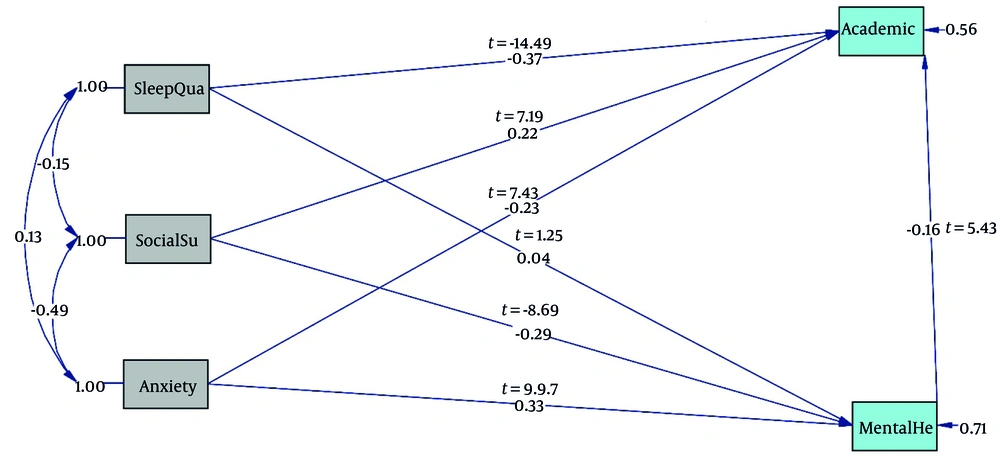
Figure 1.
Standardized estimates and statistical significance of the structural model paths
5. Discussion
This study identified significant correlations showing that better sleep quality was directly correlated with higher academic engagement, consistent with prior reports (5, 20, 21). In prior literature, better sleep quality has been reported as co-occurring with enhanced cognitive functions (e.g., memory, attention) and more adaptive emotional regulation in academic contexts (22), as well as circadian-endocrine patterns involving melatonin and cortisol that are associated with motivational and mental health indicators (23). In the present cross-sectional data, no statistically significant indirect correlation via mental health was observed, which differs from studies reporting that poorer sleep is correlated with lower mental well-being and diminished engagement (24, 25). This discrepancy may reflect contextual, measurement, or sampling differences rather than a definitive absence of such an association.
The findings also indicated that higher anxiety levels were negatively correlated with academic engagement, both directly and indirectly, aligning with earlier studies (1, 26, 27). From a psychological standpoint, anxiety is associated with attentional interference and intrusive worry cognitions that may coincide with reduced academic involvement (28). Physiological correlates (e.g., elevated cortisol noted in prior research) have been described as co-occurring with mental fatigue and diminished motivational indicators (28). Consequently, students reporting higher anxiety tended to show lower concurrent engagement scores (26). Furthermore, anxiety was correlated with poorer mental health, which was in turn negatively correlated with engagement, paralleling findings such as Tang and He and Keshavarzi et al. (3, 4). These patterns represent statistical associations and do not establish temporal ordering.
Similarly, greater social support showed both direct and indirect positive correlations with academic engagement, consistent with prior studies (7, 29, 30). Social support is associated with lower reported stress and anxiety and with more adaptive coping in academic settings (19), as well as enhanced motivation and a sense of belonging fostered through supportive interpersonal networks (31). At the psychobiological level, previous research has described lower cortisol levels co-occurring with stronger perceived support (2), a pattern that may statistically align with higher engagement (7). Additionally, the present data indicated that social support was positively correlated with mental health, potentially reflecting buffering against stress, facilitation of emotional regulation, reduced loneliness, and higher self-confidence (32) — findings also noted by Chen et al. (7). Taken together, social support appears to show both a direct correlation with academic engagement and an indirect statistical association via mental health within this dataset.
5.1. Conclusions
The results of this study indicate that sleep quality, social support, and mental health are significantly correlated with students’ academic engagement. Better sleep quality is associated with higher levels of academic participation and more favorable mental health. Similarly, stronger social support appears to be linked to reduced stress and increased motivation, which correspond with greater academic involvement. In contrast, anxiety shows a significant negative correlation with academic engagement and is also related to lower mental health. Overall, the findings highlight the potential relevance of sleep quality and social support in promoting mental well-being and academic engagement among students.
5.2. Limitations
Despite its strengths, this study has limitations. It relies on self-report measures, which may introduce bias; future research should include objective assessments. The cross-sectional design prevents causal conclusions, so longitudinal studies are needed. Although CVI and CVR were reported for the Persian PSQI, such indices are unavailable for MSPSS, BAI, GHQ-12, and the Student Academic Engagement Scale; this lack of content validity data is a limitation. The sample, drawn from public universities, may limit generalizability to private or vocational institutions and other cultural contexts. Lastly, unmeasured confounders like socioeconomic status and preexisting mental health conditions were not controlled and should be addressed in future research.

