The Role of Health Beliefs Model in Predicting Prostate Cancer Screening in a Group of Men Over Age Fifty in Shiraz

Author(s):
Abdulaziz AflakseirAbdulaziz Aflakseir1,*
1Department of Clinical Psychology, School of Education and Psychology, University of Shiraz, Shiraz, IR Iran

Zahedan Journal of Research in Medical Sciences:Vol. 18, issue 6; e3408
Published online:Jun 29, 2016
Article type:Letter
Received:Jul 05, 2015
Accepted:Jun 28, 2016
How to Cite:Aflakseir A. The Role of Health Beliefs Model in Predicting Prostate Cancer Screening in a Group of Men Over Age Fifty in Shiraz. Zahedan J Res Med Sci. 2016;18(6):e3408. doi: https://doi.org/10.17795/zjrms-3408

Dear Editor,
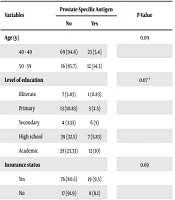
Screening of prostate cancer has been shown to reduce mortality rate [1]. Health belief model has been related to participation in health behaviors such as prostate cancer screening. The Health belief model consists of the following components: (a) perceived seriousness; (b) perceived susceptibility; (c) perceived barriers; (d) perceived benefits; and (e) health motivation [2]. The aim of this study is to predict prostate cancer screening based on the components of health belief model among men over age 50 years. In this correlational study, 150 individuals with mean age 67.3 ± 7 years and ranges of 53 to 80 years were recruited from the public places in Shiraz using convenience sampling. The health belief model scale - prostate cancer screening was used to measure health beliefs regarding prostate screening consisting five components including susceptibility perception, seriousness perception, health motivation, barrier perception, and benefit perception. Data was analyzed by SPSS -16. Findings indicated that about 7.5% of the sample performed prostate examination (DRE and PSA). According to the research data, about 20% of individuals who practiced prostate screening had a history of prostate cancer in family. Seventeen percent of the sample endorsed that they had enough knowledge about examination procedures, 64% of the sample had little knowledge about the examination, and 19% believed that they did not have knowledge on examination. In terms of the components of health belief model, results showed that 35% of sample felt that they were susceptible to prostate cancer, 83% perceived prostate cancer to be a serious disease, 19% believed that there was barriers to perform screening and 78% believed that prostate cancer screening was beneficial. Logistic regression analysis indicated that three of the independent variables predicted prostate cancer screening. Having prostate cancer in family had a significant contribution in predicting prostate cancer screening (β = .35, P < .01). Among dimensions of the HBM, two dimensions including perceived seriousness (β = .21, P <.01) and perceived benefits (β = .19, P < .01) had a significant contribution in prediction of screening performance. In other words, individuals who had prostate cancer in family; felt prostate cancer as a serious illness and perceived prostate cancer screening beneficial were more likely to participate for screening. The proportion of prostate cancer screening in this study was lower than developed countries and a little higher than some developing countries [3]. An explanation for low attendance for screening may be lack of access to health service. This study suggests that health system should provide educational interventions to improve the knowledge of men on prostate cancer screening.

References

  • 1.
    Cookson MM. Prostate cancer: screening and early detection. Cancer Control. 2001;8(2):133-40. [PubMed ID: 11326167].
  • 2.
    Alder B. Psychology of Health: Application of psychology for health professionals. Harwood academic; 1995.
  • 3.
    Woolf SH, Krist AH, Johnson RE, Stenborg PS. Unwanted control: how patients in the primary care setting decide about screening for prostate cancer. Patient Educ Couns. 2005;56(1):116-24. [PubMed ID: 15590232]. https://doi.org/10.1016/j.pec.2003.12.002.

Similar Articles

14
Jun
2016

Psychological Predictors of Prostate Cancer Screening Behaviors Among Men Over 50 Years of Age in Hamadan: Perceived Threat and Efficacy

Majid Barati,
Mohammad Ali Amirzargar,
Saeed Bashirian,
Vahid Kafami,
Amir Abbas Mousali,
Babak Moeini

Barati M, Amirzargar MA, Bashirian S, Kafami V, Mousali AA, et al. Psychological Predictors of Prostate Cancer Screening Behaviors Among Men Over 50 Years of Age in Hamadan: Perceived Threat and Efficacy. Int J Cancer Manag. 2016;9(4):e4144. doi: https://doi.org/10.17795/ijcp-4144

16
Jul
2022
Trends in Med Sci

Prostate Cancer Screening Behavior Based on the Health Belief Model in Men Aged Over 40 Years

Leila Kalani,
Hamidreza Aghababaeian,
Mahnaz Nosratabadi,
Leila Masoudiyekta,
Nastaran Mirsamiyazdi,
Hojat Rezaei-Bayatiyani
,et al.

Kalani L, Aghababaeian H, Nosratabadi M, Masoudiyekta L, Mirsamiyazdi N, et al. Prostate Cancer Screening Behavior Based on the Health Belief Model in Men Aged Over 40 Years. J Adv Immunopharmacol. 2022;2(2):e119524. doi: https://doi.org/10.5812/tms-119524

25
Apr
2016

A Survey of Knowledge About and Perceived Barriers to Prostate Cancer Screening Among Medical Staff

Javad Akbarizadeh,
Mahin Gheibizadeh,
Malek Fereidoonimoghadam,
Simin Jahani,
Amal Saki Malehi

Akbarizadeh J, Gheibizadeh M, Fereidoonimoghadam M, Jahani S, Saki Malehi A. A Survey of Knowledge About and Perceived Barriers to Prostate Cancer Screening Among Medical Staff. Jundishapur J Chronic Dis Care. 2016;5(3):e31744. doi: https://doi.org/10.17795/jjcdc-31744

14
Jul
2018
http://www.dailyherald.com/entlife/20170903/prostate-cancer-advances-in-screening-and-treatment

Knowledge Level About Prostate Cancer Screenings in Turkey

Senay Karadag Arli,
Ayse Berivan Bakan,
Metin Yildiz

Karadag Arli S, Bakan AB, Yildiz M. Knowledge Level About Prostate Cancer Screenings in Turkey. Jundishapur J Chronic Dis Care. 2018;7(3):e80167. doi: https://doi.org/10.5812/jjcdc.80167

30
Sep
2012

Health Beliefs as Predictors of Breast Cancer Screening Behaviour in a Group of Female Employees in Shiraz

Abdulaziz Aflakseir,
Parinaz Abbasi

Aflakseir A, Abbasi P. Health Beliefs as Predictors of Breast Cancer Screening Behaviour in a Group of Female Employees in Shiraz. Int J Cancer Manag. 2012;5(3):e80813. doi:


Crossmark
Crossmark
Checking
Share on
Cited by
Metrics

Ordering Reprints

Articles are published under the Creative Commons license stated on each article. No permission or royalty fee is required for uses permitted by that license. CCC handles optional bulk and customized reprint orders. Any quotation covers production and delivery services only, not copyright permission. > Request Reprints from CCC