
1. Background
Prostate cancer is one of the major health problems in the world (1), has a significant impact on patients’ and their caregivers’ quality of life, and imposes heavy costs on them (2). It is the second most common cancer and the second leading cause of death from cancer among the male population worldwide (3, 4). The peak incidence of disease is in people between the ages of 60 and 70 (2). The incidence of prostate cancer in developed countries is six times higher than in less developed countries (5). Although not many studies on prostate cancer are conducted in Asia, including Iran, it continues to be one of the main causes of death in Iran (6). According to the cancer statistical center of Iran, in 2009 prostate cancer had an age-standardized incidence rate (ASR) of 12.59 per 100,00 people, making it the third most prevalent cancer among men in Iran (7). In Khuzestan province, prostate cancer also ranked as the third most common cancer among men, and accounts for about 8% of all cancers in this region. The reported ASR in this region is 7.64 per 100,000 people (8).
The causes of prostate cancer are not completely understood, but it is believed that aging, positive family history, and race (e.g. African-American race) are among the relevant risk factors (9). The nature of prostate cancer is such that as long as there is no local progression or metastasis to other parts of the body, it usually does not cause any symptoms (10), and on presentation of symptoms, the disease usually has run its course. Therefore, early detection of the disease in its early stages can be an effective measure in reducing its mortality rate in asymptomatic men (11, 12), and creates an opportunity to use effective and inexpensive treatment methods (13). The detection phase is an important factor in the expression of the cancer-related survival rate. The five-year survival rate in men with localized (i.e., without metastasis) prostate cancer is almost 100%, while the rate among men with prostate cancer that has metastasized to other parts of the body is only 31% (11).
Expansion of prostate cancer screening programs will certainly lead to increased diagnosis in the early stages, and therefore to treatment (12). The effectiveness of prostate cancer screening methods to identify the disease and reduce mortality from it has been proven, as various studies have shown reduced mortality from prostate cancer through screening programs (14). Early detection and screening of prostate cancer are done using a prostate antigen serum (PSA) test and a rectal examination (DRE) (12). Prostate antigen is a serine protease that is produced by the prostate epithelial cells and can be found in the blood serum. In a rectal examination, the approximate size of the prostate is determined and any abnormal growths can be detected (15). In an analysis of data collected from seven European countries, a significant reduction in mortality from prostate cancer following a PSA test was observed after a period of about nine years (16); in addition, a study by Hugosson et al. in 2010 (17) suggests a decrease in mortality rate following prostate cancer screening tests.
Despite the importance of early detection in increasing life expectancy, the results of the studies suggest that men are not willing to take screening test procedures. These include studies of Filipino men living in Hawaii, African-American men, and men living in the Caribbean; the results indicate low participation of these groups in screening programs, even though their incidence of prostate cancer is relatively high (11, 18). In addition, men with few symptoms are usually not willing to see a doctor, and see the doctor only when their condition becomes severe (19). The reason for low participation in the screening program is still not quite clear, but it may be associated with low socio-economic status, lack of insurance coverage for screening, lack of knowledge about prostate cancer, and lack of physician recommendations for screening (20-23).
There are differences in the recommended time for prostate cancer screening. The American urological association has recommended prostate cancer screening for men 40 years or older with a life expectancy of at least 10 years (24), while the United States prostate cancer foundation (PCF) has recommended screening for men over 50 years with a life expectancy of at least 10 years (11). The preventive services task force of America (USPSTF) has stated that screening in people 75 years and older should not be performed due to the higher risks and lower benefits of screening (25). Therefore, men aged between 40 and 75 years are the most suitable target group for prostate cancer screening.
According to the above-mentioned studies, understanding people’s knowledge of a disease and why so many at-risk people ignore screening behaviors is very important. Several different models have identified relevant factors. One of these models is the health belief model (HBM), which is designed to understand why people who are at risk of a disease are not willing to take diagnostic procedures (26). The model consists of six constructs affecting health behaviors, including perceived susceptibility, perceived severity, perceived benefits, perceived barriers, self-efficacy, and cues to action (27). In this study, the construct of perceived barriers is used to identify barriers associated with screening behavior.
HBM been used as a predictor of behavior in diseases such as skin cancer (28), colorectal cancer (29), breast cancer (30), and cervical cancer (31) in different countries. This model was used in Iran for some cancers such as breast cancer (32), cervical cancer (33), and colorectal cancer (34), and all the studies emphasized the importance of applying the model in predicting behaviors.
2. Objectives
This study aimed to survey the knowledge of and perceived barriers to prostate cancer screening among the staff of Ahvaz Jundishapur University of Medical Sciences and Shahid Chamran University of Ahvaz.
3. Materials and Methods
This is a cross-sectional descriptive study conducted from January 2015 to June 2015 on male employees over 40 years old working in Ahvaz Jundishapur University of Medical Sciences or Shahid Chamran University of Ahvaz. After obtaining the necessary permits, a list of male employees (including workers, mentors and faculty members) aged over 40 was prepared. The sample size estimate was obtained based on 80% power for detecting a significant relationship of 0.37 with a significance level of α = 0.05. By assuming a 10% loss to the follow-up rate, we would need to randomize 60 participants at each university. The samples were selected using simple random sampling. Inclusion criteria were willingness to participate in the study, completion of the written informed consent, no history of prostate cancer, and being 40 - 75 years old. The exclusion criterion was an incomplete response to the questionnaire. The sample size formula is:
3.1. Data Collection Tools
The data collection tool was a researcher-created questionnaire that was prepared based on studying texts and previous studies. The questionnaire’s content validity was determined using CVI and CVR, considering the cut-off point of CVR > 0.62 and CVI > 0.79 that was approved by 10 professors of the school of nursing and midwifery and school of health sciences in Ahvaz Jundishapur University of Medical Sciences. The reliability of the questionnaire was calculated using Cronbach’s alpha, which was calculated as 0.72 and 0.79 for the questions related to knowledge and perceived barriers, respectively.
The questionnaire consists of three parts. The first part of the questionnaire includes eight questions primarily related to demographic factors (age, marital status, place of work, income, occupation, education, history of prostate cancer in first degree relatives, and history of PSA testing). The second part included 12 questions related to knowledge about prostate cancer, and the third part of the questionnaire had 10 questions related to perceived barriers to screening. To score the knowledge part of the questionnaire, the correct answer was given one point, while the wrong and “I do not know” answers were given a score of zero. Therefore, the part 2 total score ranged between zero and 12. For scoring the perceived barriers questions, a five-option Likert scale (agree = 1 point; somewhat agree = 2 points; I have no opinion = 3 points; somewhat disagree = 4 points; disagree =5 point) was used, with the total score ranging between 10 and 50.
3.2. Data Analysis
The data were analyzed using SPSS statistical software as well as descriptive and inferential statistics indexes. A chi-square test was used to determine the relationship between education level and PSA testing, the relationship between income and PSA testing, and the relationship between knowledge and perceived barriers to performing PSA testing.
3.3. Ethical Considerations
This study was approved by the ethics committee of Ahvaz Jundishapur University of Medical Sciences (ajums.REC.1393.371). In this study, the researchers have been trained on ethical issues such as respect for the right to participate voluntarily, obtaining consent from potential participants to participate in the project, and informing the participants of the purpose of the study.
4. Results
According to the survey results, the average and standard deviation of participants’ age was 49.69 ± 6.88, most of them were married (94.2%), and 38.3% had a diploma certificate. Other demographic data are presented in Table 1.
Table 1.
The Demographics Characteristics of the Participants in the Study
| Demographic Variables | No. (%) |
|---|---|
| Age, y | |
| 40 - 49 | 78 (65) |
| 50 - 59 | 35 (29.7) |
| 60 - 75 | 7 (5.83) |
| Education | |
| Diploma | 46 (38.3) |
| Associate degree | 8 (6.7) |
| BSc | 16 (13.3) |
| MSc | 10 (8.3) |
| PhD | 40 (33) |
| Job | |
| Worker | 18 (15) |
| Employee | 54 (45) |
| Faculty member/lecturer | 34 (2.5) |
| Science committee | 5 (17.5) |
| Income, million | |
| < 1 | 23 (19.16) |
| 1 - 2 | 49 (40.8) |
| 2 - 3.5 | 24 (1.6) |
| > 3.5 | 6 (38.3) |
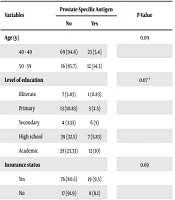
Among the men who participated in the study, 17.5% had a family history of prostate cancer, and 75.8% of them had not done a PSA test at the time of the study. The mean and standard deviation of the knowledge was 6.38 ± 2.5, with only 22.5% of the participants having a high level of knowledge about prostate cancer and screening tests. In regard to the sources of information about prostate cancer, 55.8% and 60.8% of respondents said that they have received information through media and friends, respectively. In addition, 17.6% of them reported that their physician had advised them to do the screening test, while only 19.3% of respondents said that family recommended them to take the test. Results showed that there was no significant relationship between knowledge and PSA testing, but there was a significant relationship between education level and PSA testing (P = 0.046), as well as between income and PSA testing (P = 0.034). There was also a significant relationship between the construct of perceived barriers and PSA testing (P = 0.001).
5. Discussion
The purpose of this study was to evaluate knowledge and perceived barriers to prostate cancer screening among the staff of Ahvaz Jundishapur University of Medical Sciences and Shahid Chamran University of Ahvaz. This study showed that most people did not have good knowledge about prostate cancer screening methods. These results are consistent with the results of Ghodsbin et al. (35) and the results of Gozum and Capik (36). In addition, the study of Ford et al. (37) reveals a low level of knowledge in the field of prostate cancer screening, which indicates a need for training about this disease in order to improve men’s knowledge about the most common type of cancer, so that their participation in screening programs can be improved and the disease’s incidence can be reduced.
Most participants in this study acquired information about prostate cancer through their friends, which is in accordance with the findings of Ferrante et al. (38). More than half of the participants in the study mentioned mass media as their main source of information regarding prostate cancer, which is consistent with the results of the Nakandi et al. study (4). Given the role of mass media, HBM model principles are useful for designing training programs and encouraging health messages through the media, so that a greater percentage of men can be encouraged to practice prostate cancer screening.
The findings of this study suggest that a small percentage of people have done the PSA test, as is consistent with the results of the Ghodsbin et al. study (35). This matter requires further pursuit by the health system in order to increase men’s participation in screening programs. In this study there was a significant relationship between age and PSA testing, so that with increasing age, PSA testing was increased, which is consistent with the Lehto et al. (39) study. Furthermore, there was a significant relationship between income and education level and PSA tests, so that PSA testing in individuals with higher income and education was higher, which is similar to the results of the Ibrayev et al. (40) study.
Similarly, the results indicate that there is no significant relationship between knowledge and doing the PSA test, which is consistent with the results of Oranusi et al. (2). These results suggest that knowledge alone has no decisive role in increasing men’s participation in screening programs, and barriers other than lack of knowledge play a role in low male participation in prostate cancer screening. Indeed, the results show a significant relationship between perceived barriers and the PSA test. As mentioned earlier, perceived barriers is a one of the HBM model constructs that has predictive power for health behaviors, and in this study it is used for determining the effective factors in the prostate cancer screening behaviors. These results are also consistent with the findings of Oliver et al. (41). Participants in the study mentioned a lack of knowledge of where to go and how to do screening tests, a lack of emphasis on the screening tests, and a fear of thinking about the disease as the most common barriers to the prostate cancer screening. These results are consistent with the results of some previous studies (11, 13, 41).
This study implies that knowledge about prostate cancer and participation in cancer screening is not appropriate despite the high prevalence of the disease among the male population. This problem requires taking measures to increase knowledge of prostate cancer among men, so a suitable condition for screening can be created. Since there is a significant relationship between perceived barriers and prostate cancer screening behaviors, some plans can be designed to reduce these barriers and encourage men to do the screening tests.
To our knowledge there was little evidence regarding prostate cancer knowledge and perceived barriers to prostate cancer screening in Iranian society. Therefore, this study revealed valuable evidence in this regard. Selecting a special population (university employees) does limit its generalizability to all men in the community. Thus, large-scale studies with samples selected from all parts of the society are recommended, to obtain more generalizable results for macro-planning in the health sector.