Fulltext
The full text of this article is available on the PDF file.
Zahedan Journal of Research in Medical Sciences
The Official Journal of Zahedan University of Medical Sciences
Image Credit:Zahedan J Res Med Sci
Authors
Background : Preterm infants have respiratory failure and complications because surfactant in alveolus is low. CPAP (Continuous positive airway pressure) is a method for respiratory support in pre-term neonates and is provided by different equipment and methods. This study aims to compare two different routes of CPAP delivery in preterm newborn infants and to determine the need for surfactant replacement therapy in two groups.
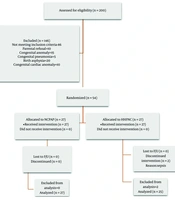
Materials and Methods : This is a randomized controlled clinical trial. Eighty four preterm infants delivered in Al-Zahra Hospital with gestational age 28-32 weeks were enrolled in this study from January 2012 to September 2012. They were randomly allocated in two groups. After initial stabilization in delivery room, forty two infants transferred to neonatal intensive care unit (NICU) with face mask CPAP and 42 infant with nasopharyngeal CPAP and continued nasal CPAP in the NICU in both groups. All infants were followed for developing respiratory distress and need for surfactant replacement therapy and oxygen dependency till discharge.
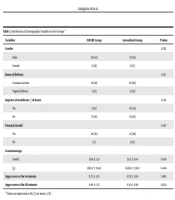
Results : The neonates that treated with two methods of CPAP delivery were similar with respect to gestation age, birth weight and other demographic characteristics. Twenty three neonates (65.5%) in face mask group and 15 neonates (39.5%) in nasopharyngeal CPAP group need surfactant replacement therapy (p=0.08).
Conclusion : Mask CPAP or nasopharyngeal CPAP can used in preterm infants after delivery for neonatal transfer to NICU. This study showed no method of CPAP delivery is preferable to other in decreasing the need for surfactant therapy.
© 2013, Author(s). This open-access article is available under the Creative Commons Attribution 4.0 (CC BY 4.0) International License (https://creativecommons.org/licenses/by/4.0/), which allows for unrestricted use, distribution, and reproduction in any medium, provided that the original work is properly cited.
Bahman-Bijari B, Mahdian R, Niknafs P, Baneshi MR. Nasal Intermittent Positive Pressure Ventilation vs. Nasal Continuous Positive Airway Pressure in Preterm Infants with Respiratory Distress. Zahedan J Res Med Sci. 2014;16(11):9-14. doi:
Mostafa-Gharehbaghi M, Mojabi H. Comparing the Effectiveness of Nasal Continuous Positive Airway Pressure (NCPAP) and High Flow Nasal Cannula (HFNC) in Prevention of Post Extubation Assisted Ventilation. Zahedan J Res Med Sci. 2015;17(6):e984. doi: https://doi.org/10.17795/zjrms984
Esmaeilnia T, Nayeri F, Taheritafti R, Shariat M, Moghimpour-Bijani F. Comparison of Complications and Efficacy of NIPPV and Nasal CPAP in Preterm Infants With RDS. Inn J Pediatr. 2016;26(2):e2352. doi: https://doi.org/10.5812/ijp.2352
Taheritafti R, Hadizadeh A, Taslimi Taleghani N, Khoshnoud Shariati M. Nasal Continuous Positive Airway Pressure Versus Heated Humidified High-Flow Nasal Cannula for Post-Extubation Management in Preterm Neonates with Respiratory Distress Syndrome: A Pilot Randomized Controlled Trial. J Compr Ped. 2026;17(3):e174099. doi: https://doi.org/10.5812/jcp-174099
Sadeghnia AR, Mahjoor Z, Barekatain B. Comparison of Surfactant Administration Efficacy in the Treatment of Respiratory Distress Syndrome in Preterm Neonates: Aerosolization Versus INSURE. Inn J Pediatr. 2022;32(2):e120633. doi: https://doi.org/10.5812/ijp-120633
More by these authors
Last Update: 1 week ago
Last Update: 1 week ago
Last Update: 1 week ago
Last Update: 3 hours ago
Last Update: 7 hours ago
Last Update: 5 days ago