3.1. Case Report No. 1
The first case was a 35-year-old male, classified as ASA physical status 2, with a history of narcolepsy, who required general anesthesia for lumbar herniated disk surgery.
The day before surgery the patient was observed and a pre-operative anesthesia assessment was performed. The patient described episodes of excessive sleepiness and cataplexy since adolescence, as well as occasional occurrence of sleep paralysis. He had been diagnosed with narcolepsy with cataplexy, 2 years before the surgery. He was medicated with modafinil 200 mg daily, remaining asymptomatic ever since. He underwent an appendectomy at the age of 21 under general anesthesia without known complications. At the time of the present surgery, the patient’s weight was 91 kg and body mass index was 27 kg/m2. Both the physical examination and laboratory tests were normal. After a literature search, it was decided that the patient should take his morning dose of modafinil; surgery was scheduled to start at 8 AM.
Intraoperatively, the ASA standard monitoring was used, plus neuromuscular blockade and invasive arterial pressure (using Datex Ohmeda Aisys). Bispectral index (BIS) and entropy were both monitored to guide the anesthesia level and possibly increase the information on the hypnosis in case there was difficulty in awakening from anesthesia. The BIS, muscle tone activity (EMG), state entropy (SE), and response entropy (RE) values were recorded throughout the procedure. Cardiac output was monitored using LiDCO rapid.
Total intravenous anesthesia with remifentanil and propofol by target-controlled infusion (TCI) was performed, using the base primea orchestra from fresenius kabi. Anesthesia was induced with remifentanil to achieve a target cerebral concentration (Ce) of 2.5 ng/mL (Minto’s Pharmacokinetic model), followed by 1% propofol at 200 mL/h until loss of consciousness (LOC), which happened after 148 mg of propofol were infused. At the moment of LOC, the predicted cerebral concentration (Ce) of propofol was 5.9 ug/mL (Schnider’s Pharmacokinetic model). At that moment, the pump was switched to TCI mode and a cerebral target concentration of 3.7 ug/mL was set, according to a previously published formula, aiming at keeping the BIS between 40 and 60 (9, 10). Rocuronium was administered at 0.6 mg/kg. After tracheal intubation, propofol target Ce was reduced to 3.0 ug/mL and remifentanil was reduced to a target Ce of 1.0 ng/mL. The patient was then placed in jack-knife position.
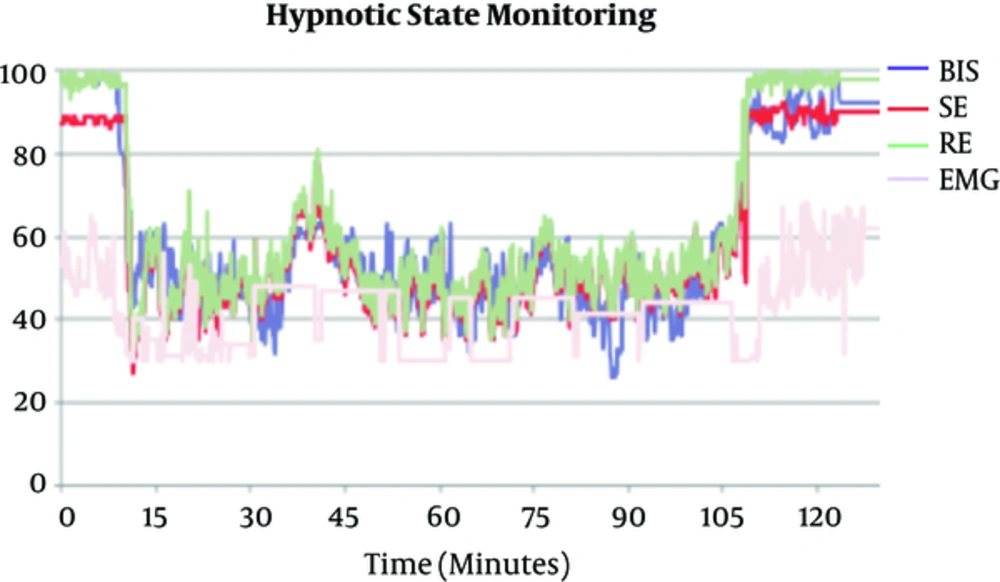
Anesthesia was maintained with remifentanil and propofol by TCI, both titrated to keep BIS between 40 and 60. The BIS and Entropy were slightly above 60 mmHg occasionally and this was associated with the presence of EMG activity (
Figure 1). A total of 924 mg of propofol and 1726 ug of remifentanil were administered. During surgery, propofol Ce varied between 1.5 and 2.5 ug/mL, while remifentanil Ce varied between 0.7 and 4.5 ng/mL. The patient was submitted to mechanical ventilation in controlled volume mode. Ventilation parameters were set in order to obtain a target ETCO2 of 35 mmHg. No additional neuromuscular blockers were given. Intravenous acetaminophen 1 g and parecoxib 40 mg were administered for post-operative analgesia and the surgical wound was infiltrated with ropivacaine 0.375% before skin closure.
Bispectral Index (BIS), State Entropy (SE) and Response Entropy (RE) Monitoring of Patient No. 1
The duration of anesthesia was 104 minutes. At the end of surgery, the TOF had spontaneously recovered to 100%. Propofol infusion was stopped and remifentanil infusion was continued at a Ce 2 ng/mL throughout the recovery phase. After repositioning the patient in supine position, he immediately opened his eyes, followed commands and calmly removed the tracheal tube himself, following the instructions provided by the anesthesiologist.
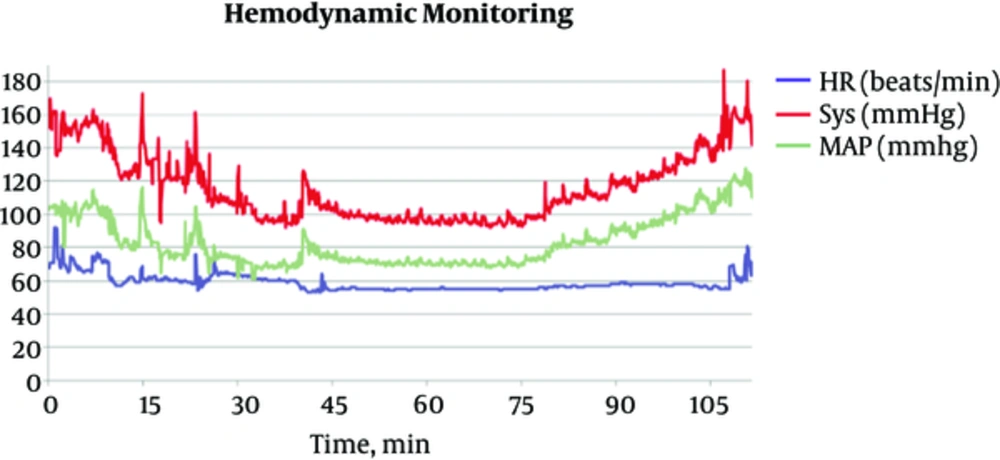
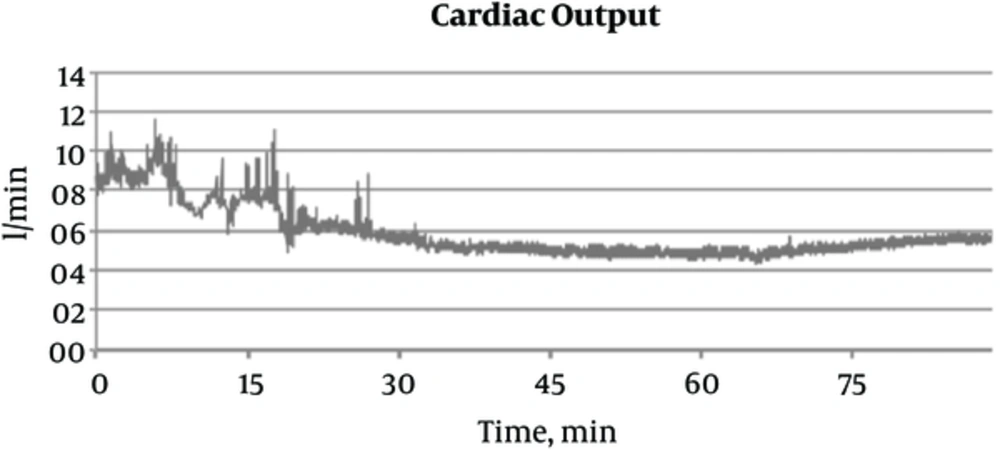
The hemodynamic alterations were recorded throughout the procedure (
Figures 2 and
3). On arrival at the operating room, the patient presented an arterial pressure of 150/75 mmHg, which corresponds to a mean arterial pressure (MAP) of 100 mmHg. After the start of remifentanil and propofol perfusions, his arterial pressure declined, as expected, and the lowest value of MAP was 58 mmHg. The patient presented a hypertensive response to tracheal intubation (173/90 mmHg) and jack-knife positioning (161/72 mmHg). During surgery, the cardiac output varied between 4.4 and 5.9 l/minute (
Figure 3). At the end of the surgery, with the reduction of propofol and remifentanil perfusion, the arterial pressure increased gradually and with supine positioning, awakening, and extubation, the patient presented another hypertensive response (186/91 mmHg).
Key points in the procedure with hemodynamic response are the following: Start of remifentanil - 7 minutes; start of propofol - 9 minutes; tracheal intubation - 15 minutes, Jack-knife positioning - 22 minutes, surgical incision - 40 minutes, end of surgery - 103 minutes, supine position and eye opening - 108 minutes, extubation - 109 minutes.
The last 20 minutes of anesthesia were not recorded due to accidental monitor disconnection.
At the end of surgery, the patient was transferred to the post-anesthesia care unit (PACU), where he remained, alert and oriented for 90 minutes. The remifentanil perfusion was progressively reduced and no additional opioids were needed for pain control. No narcolepsy events occurred at the ward, the patient slept normally that night, and was discharged home the following day. Postoperative interviews were performed and no signs of awareness or recall were detected.
3.2. Case Report No. 2
A 37-year-old-female with a history of narcolepsy was submitted to anterior cervical spinal decompression (C3 - C6) under general anesthesia.
A pre-anesthetic evaluation was performed on the day before surgery. The patient reported episodes of uncontrollable daytime sleepiness, cataplexy, and sleep paralysis since late adolescence. The diagnosis of narcolepsy was made 4 years before surgery and since then she had been prescribed modafinil 100 mg twice daily, at breakfast and after lunch. However, for economical reasons, she was only taking the morning dose of modafinil and had 3 to 5 narcolepsy-cataplexy episodes every week, including on the day of the visit. On that day, she had instantly fallen asleep while she was sitting on her bed, almost falling to the floor. She was awakened by a nurse, who was passing by.
For chronic pain due to the cervical stenosis, the patient was medicated with gabapentin and clomipramine. Her medical history included Raynaud phenomenon, which was being treated with nifedipine, sclerodactyly, and she was being studied for scleroderma. She also had mild aortic valve regurgitation and gastroesophageal reflux disease that was being treated with omeprazole. The patient’s anesthetic and surgical history included only a caesarean section at age 24, under neuraxial anesthesia with no complications. The patient weighed 51 kg, had a body mass index of 19.0 kg/m2, and was classified as ASA physical status 3.
During the pre-anesthetic visit, she was instructed to take 200 mg of modafinil on awakening, approximately 2 hours before surgery, instead of the 100 mg twice a day.
Intraoperatively, in addition to ASA standard monitorization, a neuromuscular blockade monitor, BIS, Entropy, and analgesia nociception index (ANI) were used. This patient was also submitted to total intravenous anesthesia with remifentanil and propofol by TCI. After administration of lignocaine 40 mg and dexamethasone 8 mg, induction was performed as in the the first case, with TCI remifentanil set to achieve Ce 2.5 ng/mL and propofol 1% perfusion 200 mL/h until LOC. The dose of propofol needed for LOC was 89 mg, which corresponded to a Ce 4.2 ug/mL (Schnider pharmacokinetic model). After LOC, propofol TCI was set to Ce 3.1 ug/mL, which was calculated using the same formula as in case no. 1 (
9,
10), and rocuronium was administered at a dose of 0.6 mg/kg. Due to the cervical lesion, videolaryngoscopy (Glidescope) was used for intubation, which was successfully done at the first attempt.
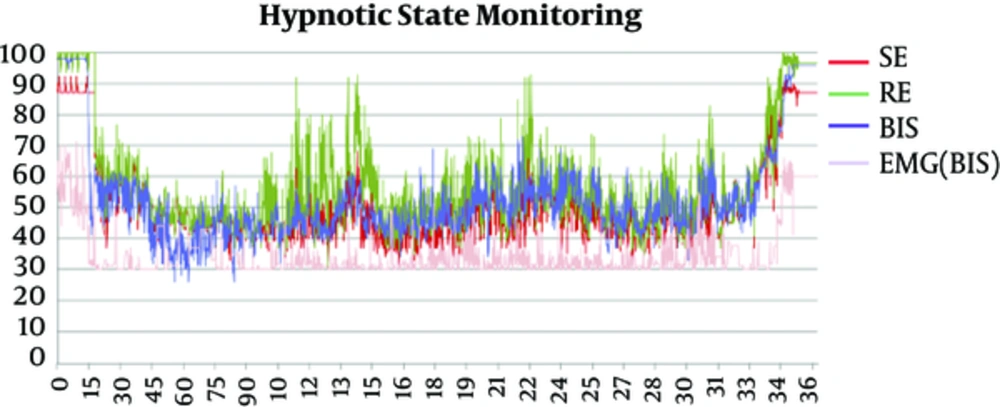
The duration of anesthesia was 5 hours and 35 minutes. During surgery, propofol was titrated according to BIS and Entropy, and remifentanil was titrated according to ANI monitoring, in order to maintain ANI values between 50 and 70. Propofol Ce varied between 1.3 and 3.5 ug/mL and remifentanil Ce between 1.0 and 11.0 ng/mL. A total of 2220 mg of propofol and 4560 ug of remifentanil were administered. The BIS and Entropy varied mostly between 40 and 60 (
Figure 4). A rocuronium perfusion was used to maintain a deep blockade between 1 to 3 post tetanic counts (PTC) and a total of 360 mg was administered during the 290 minutes of perfusion. At the end of surgery, the rocuronium perfusion was stopped and a PTC of 10 was detected by TOF-Watch. Sugammadex was administered at a dose of 4 mg/kg and TOF ratio recovered to 1. The perfusion of propofol was suspended and remifentanil Ce maintained at 2.0 ng/mL. After 4 minutes and 22 seconds, the patient opened her eyes spontaneously, was able to follow commands and was calmly extubated, in less than 1 minute. The remifentanil perfusion was maintained in the PACU (Ce 2.0 ng/mL) and gradually reduced allowing the postoperative analgesia to take effect. In the PACU she received 1 g of acetaminophen and 40 mg of parecoxib. As the remifentanil perfusion was lowered, every 10 minutes, IV morphine was titrated to the patient’s needs, according to a pain visual analogue scale, in a total of 8 mg. The patient remained in the PACU for approximately 2 hours alert, oriented and cooperative. In the remaining 4 days of hospitalization in the Neurosurgical ward, the patient complied to the narcoleptic medication and had no complications or narcolepsy-related events.
Bispectral Index (BIS), State Entropy (SE) and Response Entropy (RE) Monitoring of Patient No 2
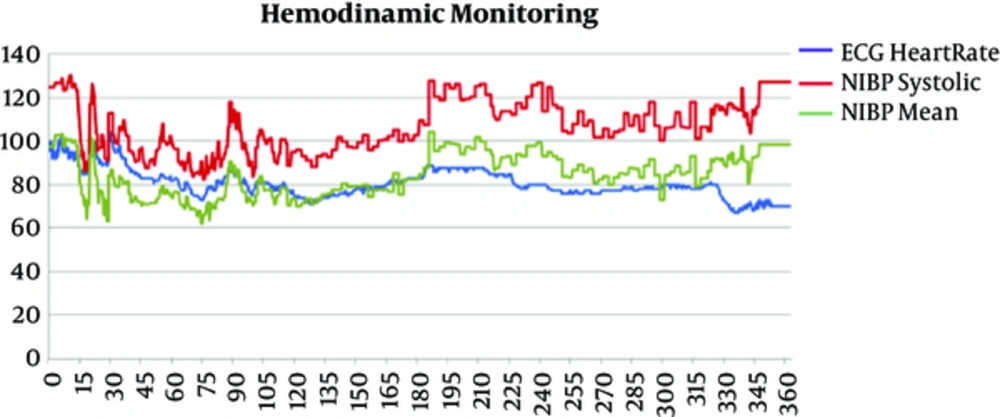
The hemodynamic parameters of this patient are presented in
Figure 5. Following start of propofol and remifentanil perfusions, there was a decrease of arterial pressure from 125/82 mmHg to 86/55 mmHg. With tracheal intubation, the arterial pressure rose to 125/79 mmHg. During surgery, mean arterial pressure varied between 62 and 104 mmHg. After emergence from anesthesia and extubation, the arterial pressure increased to 127/78 mmHg, similar to the initial value.
Key points in the procedure with hemodynamic response are the following: Start of remifentanil - 10 minutes; start of propofol - 14 minutes; tracheal intubation - 21 minutes, surgical incision - 60 minutes, end of surgery - 341 minutes, eye opening - 345 minutes, extubation - 346 minutes.