


1. Background
Multiple sclerosis (MS) is an autoimmune inflammatory disorder of the central nervous system. Evidence suggests that women are two to three times more likely than men to develop MS, and the average age of onset is 30 years (1). About 2.3 million people worldwide are affected by MS (2). The prevalence of this disease has been estimated at 51.9 per 100 000 populations in Iran (3).
Patients with MS experience physical symptoms, cognitive impairment, and psychological symptoms, such as weakness, fatigue, sleep, attention deficit, anxiety, depression, and low self-esteem (4). Fatigue is one of the most common symptoms of MS patients, with a serious impact on their quality of life (5). MS can cause daily fatigue (3) and increase the sympathetic nervous system activity (6). Fatigue may sometimes be accompanied by symptoms of depression and anxiety, in addition to sleep disorders (7). Anxiety severely the onset of MS attacks and exacerbates the symptoms of the disease (8).
All of these symptoms can affect the patient’s normal function and interrupt his/her education, family life, job opportunities, and daily activities. Therefore, it may result in the reduction of a patient’s quality of life (4). Patients with MS had serious disease-related challenges in their daily activities, which can lead to unpleasant changes in their working conditions (8).
Patients with MS tend to actively participate in their treatment, using complementary and alternative medicine (CAM). CAM is popular among MS patients for controlling the symptoms. Previous studies, 80% of MS patients were found to use CAM in search of a strategy with fewer side effects (2). While the prevalence of CAM ranged from 60% to 67% (9). Generally, patients consider CAM to be an effective and successful treatment, with few or no side effects (2). CAM, including relaxation, imagination, reflexology, and music, has been reported to have fruitful effects (10).
Reflexology is one of the methods of massage therapy (11) and the most common types of CAM. It involves the application of appropriate pressure to specific points and areas on the body, especially the feet, to improve relaxation and recovery (12). This technique is used to stimulate specific points of the body in order to improve circulation, energy, and relaxation and maintain homeostasis (13). According to another hypothesis, reflexology stimulates the relevant area of the body to relieve certain symptoms by applying direct pressure on a specific nerve ending of the foot (14). It is used to improve a wide range of signs and symptoms (15). Also, it can provide comfort through positive effects on psychological responses (11). However, reflexology is effective in reducing symptoms, such as pain, fatigue, anxiety, high blood pressure, insomnia, and depression (10, 12), as well as it is recognized as a simple and non-invasive approach in nursing care (16).
2. Objectives
Therefore, the aim of the present study was to indicate the role of reflexology as a complementary therapy on the improvement of fatigue, sleep quality, and anxiety in MS patients.
3. Methods
A double-blind, randomized clinical trial was conducted on patients with MS who had been referred to the multiple sclerosis society of Arak City, Markazi Province, Iran. The study lasted from May 2018 to May 2019.
3.1. Study Design and Selecting Patients
After making an official announcement at the Arak MS Association, patients who were willing to participate in the study, were invited via written letters. 76 patients agreed to participate in the study. Nevertheless, 6 volunteers were excluded according to the initial screening characteristics (e.g., inclusion and exclusion criteria and past medical history). The research methodology and objectives were explained to all the participants, and then, informed consent was obtained. The samples were numbered (1, 2, 3, etc.) and randomly divided into reflexology (n = 35) and control (n = 35) groups by computer-generated random number table. Finally, a total of 63 participants completed the study (Figure 1).
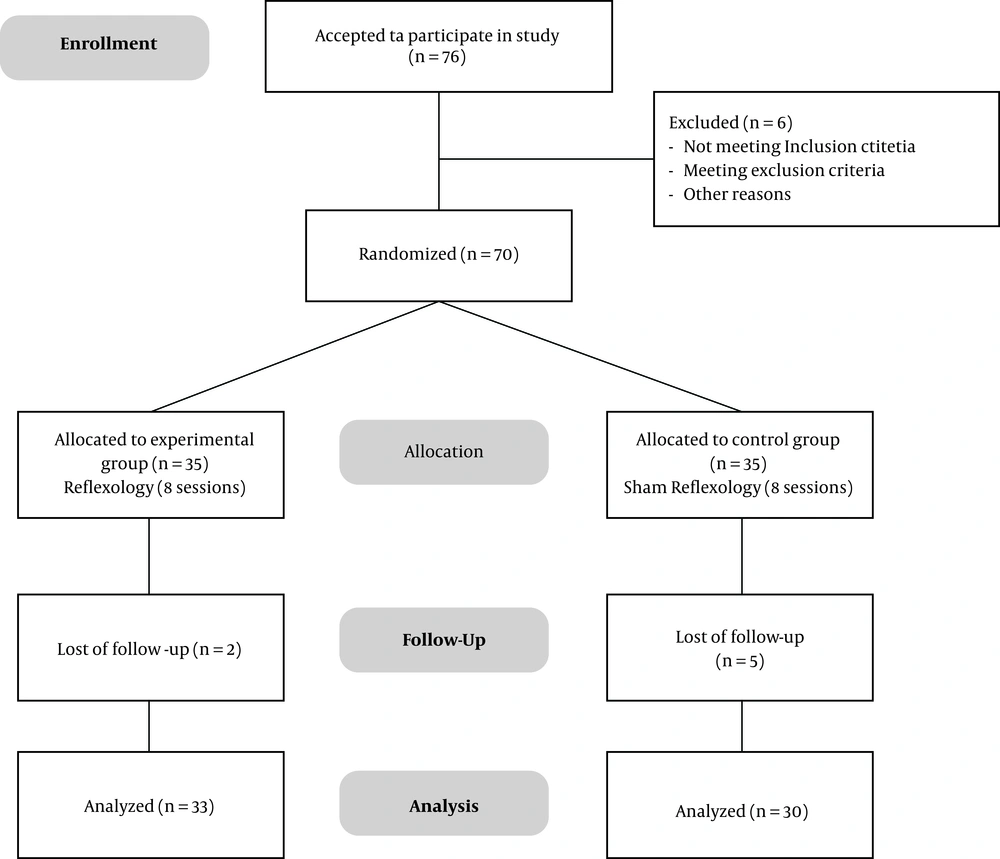
Figure 1.
Study flow chart
The inclusion criteria were as follows: (1) age range of 18 - 50 years; (2) Expanded Disability Status scale (EDSS), the score of ≤ 4 according to the neurologist; and (3) patients with relapsing-remitting MS. On the other hand, the exclusion criteria were as follows: (1) deformities, wounds, or skin diseases of the lower extremity; (2) use of sleep medications and antidepressants; and (3) use of other CAM currently or during the last 6 months.
3.2. Outcome Measures
The data-gathering tool was a four-part questionnaire, including demographic information, Fatigue Impact Scale, Pittsburgh sleep quality index, and state-trait anxiety inventory. The first part included demographic information (including age, sex, education status, job, and BMI) that all of the participants completed this form. Other data were evaluated twice by a researcher’s assistant who was blind to the reflexology and control groups, once at baseline (week 0) and once at the end of the interventions (week 4).
3.3. Fatigue Impact Scale
Fatigue Impact scale (FIS) contains 40 questions, describing the functional limitations of individuals due to fatigue in three cognitive, physical, and social subscales. It includes 40 items, with 10 items related to the cognitive subscale, 10 items related to the physical subscale, and 20 items related to the social subscale. Each question is rated from 1 to 4 (minimum to maximum). The highest score of this scale is 160, with higher scores indicating more fatigue (25). The validity of the Persian version of this questionnaire is 0.85, and its reliability is 0.93; also, its internal consistency, based on Cronbach’s alpha coefficient, is 0.953 (25).
3.4. Pittsburgh Sleep Quality Index
This index consists of nine questions related to the following seven components: subjective sleep quality, sleep duration, sleep latency, sleep efficiency, sleep disorders, use of sleep medications, and daytime dysfunction. The items are scored based on a 0 - 3 scale, and the average score ranges from 0 to 21. Scores ≥ 5 are indicative of poor sleep quality. The Persian version of this questionnaire has a sensitivity of 100%, specificity of 93%, and Cronbach’s alpha coefficient of 89.36 (26).
3.5. State-Trait Anxiety Inventory
State-Trait Anxiety inventory (STAI) consists of 20 items rated on a 4-point Likert scale. Each item is rated 1 (never), 2 (sometimes), 3 (often), and 4 (always). The total score ranges from 20 to 80, with higher scores indicating higher anxiety levels. This standard questionnaire is both reliable and valid and has been used in many studies in Iran (27, 28).
3.6. Blinding
In this study, the participants, the data collector, and the statistician were blinded to the study groups (reflexology and control) until the data analysis and results were complete.
3.7. Reflexology Intervention
The Rwo Shur method of reflexology was used in this study. In the reflexology group, the patients participated in reflexology sessions (n = 8) in the afternoon twice a week for four weeks. The intervention was conducted independently for each participant in a private room with appropriate lighting and temperature. During the intervention, the participant and reflexologist (first author, who is the qualified reflexologist) were alone in the room. Before each session, the feet were washed, and the patient was seated on a comfortable reclining chair; to prevent fatigue, a small pillow was placed under the knees. Also, to decrease friction, scent-free moisturizing oil was used.
First, the general massage of the right foot began for five minutes by applying controlled pressure. Then, specialized massage was applied to the pituitary gland, hypothalamus, pineal gland (the reflex points that help to reduce fatigue, anxiety, and improving sleep quality), and, finally, the solar plexus reflex points for 10 - 15 minutes. The left foot was massaged in the same manner. At the end of the sessions, the patient was asked to take a glass of water to remove toxins from the body. Each session continued for 30 - 40 minutes on average (15, 20, 29).
To eliminate the effects of reflexologist’s presence and other environmental factors on the parameters under measurement, the subjects in the control group also participated in eight sessions of non-specialized foot massage twice a week in the afternoon for four weeks. The control group, under the same conditions as the reflexology group, received sham massage on foot, without applying pressure on any particular reflex points.
3.8. Statistical Analysis
Data were evaluated in SPSS version 16. Qualitative variables are presented as frequency and percentage and quantitative variables as mean and standard deviation. Chi-square and Fisher’s exact tests were used to compare qualitative variables in the two groups. Also, for comparison of quantitative variables, independent t-test and paired t-test or their non-parametric equivalents, Mann-Whitney and Wilcoxon tests, were used. The Kolmogorov-Smirnov test was also used to evaluate the normal distribution of data. The significance level was set at 0.05 for all statistical comparisons.
3.9. Ethical Considerations
The study protocol was approved by the Ethics Committee of Arak University of Medical Sciences (code: IR.ARAKMU.REC.1396.316) and registered in the Iranian Registry of Clinical Trials (code: IRCT20180103038211N3).
4. Results
The sociodemographic information of participants is given in Table 1. There was no statistically significant difference between groups.
Table 1.Patients’ Characteristics of Participants (N = 63)a
| Experimental (N = 33) | Control (N = 30) | P Value | |
|---|---|---|---|
| Age, y | 0.847b | ||
| 20 - 29 | 11 (33.3) | 11 (36.7) | |
| 30 - 39 | 11 (33.3) | 11(36.7) | |
| 40 - 49 | 11 (33.3) | 8 (26.7) | |
| Gender | 0.999c | ||
| Female | 31 (93.3) | 28 (93.3) | |
| Male | 2 (6.1) | 2 (6.7) | |
| Education status | 0.858b | ||
| Primary school | 9 (27.3) | 5 (16.7) | |
| High school | 12 (36.4) | 12 (40) | |
| College education | 12 (36.4) | 13 (43.3) | |
| Marital status | 0.285b | ||
| Married | 24 (72.7) | 18 (60) | |
| Single/widowed | 9 (27.3) | 12 (40) | |
| Job | 0.574c | ||
| Employee | 3 (9.1) | 2 (6.7) | |
| Self-employed | 1 (3) | 3 (10) | |
| Unemployed/housewife | 29 (87.9) | 25 (83.3) | |
| BMI1 | 0.850b | ||
| < 18.5 | 1 (3) | 1 (3.3) | |
| 18.5 - 25 | 13 (39.4) | 15 (50) | |
| 25 - 30 | 16 (48.5) | 11 (36.7) | |
| > 30 | 3 (9.1) | 3 (10) |
Abbreviation: BMI, body mass index.
aValues are expressed as No. (%).
bChi-square.
cFisher’s exact test.
The results of FIS before the interventions showed no significant difference between the groups in terms of fatigue (P = 0.838). After the intervention, the difference between the groups in terms of fatigue was not statistically significant (P = 0.134). Physical fatigue in the reflexology group was significantly lower than that of the control group at the end of the intervention (P = 0.042). Also, the cognitive and social fatigue were lower in the reflexology group in comparison with the controls after the intervention; however, the difference was not statistically significant (Table 2). The sleep quality of both groups is higher than 5 before the intervention, which indicates poor sleep quality in both groups. There is a statistically significant difference between the two groups before the intervention, while in the intervention group, the quality of sleep is poorer than the control group. The difference in sleep quality between the reflexology and control groups was statistically significant after the intervention (P = 0.001). Also, in the reflexology group, the difference in sleep quality measurements before and after the intervention was statistically significant (P = 0.003) (Table 3). The results of this study showed that there was no significant difference in terms of anxiety between the groups (P = 0.705). However, after the interventions, the difference between the groups was statistically significant (P = 0.034). The results of the paired t-test after the intervention indicated that the level of anxiety in the reflexology group was lower than that of the control group (P = 0.038) (Table 4).
Table 2.Comparing Mean Scores of FIS Between Control and Reflexology Groupsa
| Reflexology | Control | P | |
|---|---|---|---|
| Total fatigue | |||
| Pretest | 77.21 ± 35.08 | 75.43 ± 33.29 | 0.838c |
| Posttest | 67.76 ± 32.24 | 81.33 ± 38.56 | 0.134b |
| P value | 0.289b | 0.529b | |
| Cognitive subscale fatigue | |||
| Pretest | 19.52 ± 9.3 | 18.53 ± 9.49 | 0.68c |
| Posttest | 17.55 ± 9.23 | 19.53 ± 11.09 | 0.441b |
| P value | 0.408b | 0.721b | |
| Physical subscale fatigue | |||
| Pretest | 20.79 ± 8.34 | 19.97 ± 7.72 | 0.725b |
| Posttest | 17.24 ± 8.12 | 22.3 ± 11.06 | 0.042b |
| P value | 0.102b | 0.391b | |
| Social subscale fatigue | |||
| Pretest | 39.24 ± 18.2 | 36.6 ± 17.61 | 0.561c |
| Posttest | 33.27± 17.08 | 40.1 ± 20.59 | 0.156b |
| P value | 0.183b | 0.474b |
aValues are expressed as mean ± SD.
bMann-Whitney U-test.
cPaired-samples t-test.
5. Discussion
The aim of this study was to investigate the effect of foot reflexology on fatigue, sleep quality, and anxiety in patients with MS. The present findings showed that reflexology reduces fatigue, as well as its three subscales, in MS patients; however, these changes were not significant in comparison with the baseline. Physical fatigue was significantly lower in the reflexology group in comparison with the controls; this finding indicates the effectiveness of foot reflexology in relieving physical fatigue in MS patients. In addition, the findings of the present study showed that foot reflexology has the least efficacy in improving cognitive fatigue.
The findings of this study showed that sleep quality and anxiety of the reflexology group significantly improved, compared with the control group; these findings indicate the effect of foot reflexology on improving sleep quality and reducing anxiety in MS patients.
In some previous studies, reflexology could significantly decrease fatigue (10, 19, 21, 30), which is contrary to the findings of the current study. Previous studies differed from the present study in terms of the number of reflexology sessions (10, 30), type of disease in the study group (10, 30), and intensity of fatigue before the intervention and type of questionnaire used to measure fatigue (19, 21). Moreover, there are debates about the mechanism of reflexology. The effect of reflexology on fatigue can probably be explained by the lactic acid hypothesis, i.e., massage and pressure can lead to the destruction of lactic acid residues and increase blood flow (10). In other words, fatigue decreases by toxin removal from the body (31).
In a quasi-experimental, pretest-posttest study by Ozdelikara et al. (19), the effect of foot reflexology on anxiety and fatigue was investigated among 15 MS patients; the intervention continued for 60 minutes (30 minutes per foot). The results were contradictory to the current study. It should be noted that these studies were not similar in terms of design, fatigue questionnaire, duration of intervention, and fatigue intensity before the intervention. The results of a study by Nazari et al. (21), are also inconsistent with the present study, as the duration of each session and the used questionnaire were different.
The fatigue questionnaire in the mentioned studies (19, 21) was the Fatigue Severity scale (FSS), which measures the individual’s perceived understanding of fatigue in 9 questions (25, 32). In this questionnaire, people with FSS ≥ 5 are known to have fatigue (33). In the study of Nazari et al. (21), the severity of fatigue in the reflexology group was 4.98 ± 0.98 (mean ± SD) before the intervention. As can be seen, the intensity of fatigue was less than 5 before the intervention, and according to FSS, the participants in the study by Nazari et al. (21), did not have extreme fatigue. On the other hand, in the current study, FIS was used to assess the effect of fatigue on daily activities in three physical, cognitive, and social sections. FIS is an important questionnaire for assessing the effect of fatigue on the quality of life in patients with MS (34). Therefore, it is difficult to compare the results of a different questionnaire regarding fatigue. The difference between the results of these studies may be attributed to the application of different questionnaires.
Poor sleep quality has a negative effect on the remyelination process and influences the patient’s recovery after relapse (35). In addition, oxidative stress related to poor sleep quality is associated with relapse and causes damage to the myelin (36). Oxidative stress plays an important role in anxiety caused by chronic diseases such as MS (37). Stress can affect sleep through different mechanisms (38). Reflexology causes changes in the activity of brain waves and results in a gradual transition from wakefulness into sleep, with relaxing effects (39).
Foot reflexology has various positive outcomes, such as deep breathing, general relaxation, rest, and sleepiness (40). Similar to our findings, improvement of sleep quality with reflexology has been reported in several studies (30, 41-44). In a systematic review of Yeung et al. (45), it was found that reflexology has a positive impact on sleep quality. However, no study was found, investigating the effect of foot reflexology on the sleep quality of MS patients.
Reflexology also reduces the activity of the sympathetic nervous system (10, 46), increases the activity of the parasympathetic nervous system (46), and produces a feeling of relaxation and well-being by increasing endorphin secretion (47). Reflexology can promote deep relaxation, pressure release, and restoration of body balance; consequently, it can be effective in reducing anxiety (16). Similar to our findings, the improvement of anxiety via reflexology has been reported in several studies (16, 19, 20, 46). Stress is often the root cause of sleep problems (44). Also, one of the consequences of sleep deprivation is anxiety (48). Reduction of stress and anxiety is associated with the improvement of sleep quality, which is consistent with the findings of the present study. In addition, according to this study, it was found that the quality of sleep, fatigue, and anxiety are directly related to each other.
We can conclude that reflexology is a safe technique, as none of the participants reported any side effects. The participants reported that the massage was pleasant and relaxing. Also, several studies have examined the effects of reflexology on the symptoms of MS patients. In these studies, it has been reported that foot reflexology influences the severity of paresthesia, urinary symptoms, muscle strength and spasm (17), pain (18, 22), fatigue and anxiety (19), quality of life, general health, systolic and diastolic blood pressure (20) and kidney function (23).
There are several limitations to this study. First, due to the small sample size, the results should be interpreted with caution. Second, since fatigue in MS patients is a multifactorial phenomenon and its pathophysiology is not fully understood, more studies are needed in this area. Finally, in the present study, only the short-term effects of reflexology were evaluated, and no follow-up was conducted to evaluate the long-term effects of the intervention.
5.1. Conclusions
The results of this study showed that reflexology had a significant effect on reducing physical fatigue, anxiety, and improving sleep quality. The results of this study cannot definitely recommend the use of this intervention. However, reflexology seems to be a non-invasive, simple, accessible, low-cost, and uncomplicated nursing intervention, which can be helpful along with other treatments to relieve problems in MS patients. This intervention can be learned by individuals or caregivers and used to improve the quality of life of these patients.



