
1. Background
Electroconvulsive therapy (ECT) is one of the most effective and safe treatments for severe refractory mental diseases, including psychosis, mood disorder, and catatonia. Widespread cognitive complications as unintended consequences of ECT have affected the acceptance of this treatment (1). Despite current evidence supporting short-term cognitive impairment after ECT, long-term cognition consequences are less determined (2). Although the severity and persistence of these cognitive complications are still debated, a proper clinical neuropsychiatric assessment should be used as a part of ECT. However, in different guidelines, the frequency and content of these cognitive assessments are still unclear (3, 4).
Cognitive impairment related to ECT predominantly affects recent memory, executive function, and attention. Cognitive alterations are most severe in the acute phase, significantly a few hours to a few days after ECT, and usually improve partially after the end of treatment (5, 6). Unfortunately, in numerous cases, a comprehensive cognitive assessment is not performed before ECT to determine which patients are at risk of exacerbated cognition problems (7). Moreover, patients’ cognitive function is not evaluated in the follow-up assessment. Furthermore, these cognitive tests are performed in cases of severe cognitive decline, delirious state, and patient’s disruptive function (8, 9).
Cognitive function monitoring after ECT is helpful to detect cognitive impairment. A meta-analysis suggests that the most prevalent domain of impairment is new learning which could return to baseline after 2 weeks. Other cognitive domains could be preserved (10). The selection of the applicable test is still under question. Some studies use instruments with short duration and other tools with longer duration. A battery that lasts less than an hour seems to be more tolerated by patients.
The Delis-Kaplan Executive Function System (D-KEFS) is a standard tool to evaluate executive performance in different age groups and assess different areas of executive function, including flexibility of thought, inhibition, problem-solving, planning, impulse control, conceptualization, abstract thinking, and creativity. The D-KEFS consists of nine completely separate tests that can be used alone or in combination.
The Auditory Verbal Learning Test is one of the most common psychological tests in memory assessment and auditory-verbal learning that assesses the ability of individuals to encode, consolidate, store, and retrieve verbal information and the effect of interfering stimuli, delayed memory, and recognition (11). The Trail Making Test was utilized in a study that was correlated with hippocampal volume (12).
The lack of cognitive assessment can be due to a lack of knowledge about the extent and severity of cognitive complications, lack of expertise in cognitive assessment, and lack of resources and facilities for a complete evaluation, patient intolerance, and the patient’s disability to perform neuropsychological tests (13, 14). Cognitive impairment after ECT could be related to the patient’s performance. Cognitive deficits have a significant influence on the patients’ quality of life and create social isolation (15). The results of these assessments might lead to changes in the ECT method, including the electrodes’ location, electricity dose, treatment frequency, or even its termination. The choice of appropriate time and frequency of cognitive assessment after ECT is still questionable (10, 16). However, using tools with shorter duration alongside more frequent assessments make it more likely to detect probable cognitive decline. Some guidelines, such as American Psychological Association guidelines, suggest cognitive assessment for at least once a week, and some consider an interval of at least once every two ECT sessions (17).
2. Objectives
This study aimed to evaluate the clinical approach of psychiatrists, psychiatry residents, and nurses in psychiatric hospitals to the necessity, method, and frequency of cognitive assessment in the candidate patients for ECT.
3. Methods
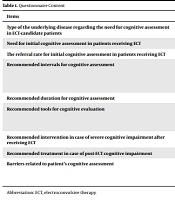
After a comprehensive literature review, a questionnaire was developed to discover experts’ opinions on the necessity of cognitive evaluations in candidate patients for ECT, best batteries, frequency of performing the cognitive assessment, and other probable various requirements (Table 1). The needed time for completing the questionnaire was about 20 minutes. The questionnaires were sent via e-mail to 48 psychiatrists, 21 psychiatry residents, and 20 nurses in the Psychiatry Ward at Roozbeh and Razi Psychiatric hospitals in Tehran, Iran. The paper form of the questionnaire was sent to ensure enough coverage. The data were collected within 2019 - 2020. After close follow-up, 58 out of 89 participants completed the questionnaires. The present study was approved by the Ethics Committee of Tehran University of Medical Sciences (ethics code: IR.TUMS.MEDICINE.REC.1399.671).
Table 1.
Questionnaire Content
| Items | Answers |
|---|---|
| Type of the underlying disease regarding the need for cognitive assessment in ECT-candidate patients | Mood disorder, Psychosis, Catatonia, Other |
| Need for initial cognitive assessment in patients receiving ECT | Yes/No |
| The referral rate for initial cognitive assessment in patients receiving ECT | Yes/No |
| Recommended intervals for cognitive assessment | At the baseline before ECT; After each ECT session; After the end of the second session; After the end of the third session; After the end of the fourth session; After the termination of ECT; 1 month after the termination of ECT; 2 months after the termination of ECT; 3 months after the termination of ECT; 6 months after the termination of ECT; 12 months after the termination of ECT |
| Recommended duration for cognitive assessment | 30 minutes; 60 minutes; 90 minutes; 120 minutes |
| Recommended tools for cognitive evaluation | Trail Making Test; Delis-Kaplan Executive Function System; Rey Auditory Verbal Learning Test; Wechsler Memory Scale-Revised; Color Word Interference Test; Controlled Oral Word Association Test; Kopelman’s Autobiographical; Memory Interview; Montreal Cognitive Assessment Test |
| Recommended intervention in case of severe cognitive impairment after receiving ECT | ECT continuation; ECT cession; Decreased dose and interval of ECT; Depending on the severity and patient’s condition |
| Recommended treatment in case of post-ECT cognitive impairment | Modafinil; Cholinesterase inhibitors; Cognitive rehabilitation |
| Barriers related to patient’s cognitive assessment | Failure to complete the test due to the patient’s psychiatric symptoms; Patient noncooperation due to the duration of the evaluation; Lack of examiner’s expertise; Lack of proper guidelines for cognitive assessment; Lack of sensitive tests for cognitive screening |
Abbreviation: ECT, electroconvulsive therapy.
4. Results
A total of 58 participants completed the designed questionnaire, including 17 psychiatrists (29.3%), 20 nurses (34.5%), and 21 psychiatry residents (36.2%). The results were analyzed and interpreted in detail. The average work experience of respondents in the psychiatry field was 6.89 years, including a minimum of 1 year and a maximum of 25 years.
4.1. Previous Experience of Research Projects and Clinical Observations Related to Cognitive Assessment and ECT
Nearly 97% of the participants did not have any previous experience with ECT and related cognitive disorders, and about 83% of the participants did not have any research about the cognitive assessment. Although the clinicians reported that irreversible cognitive impairment is observed in approximately 28% of patients after receiving ECT, and more than 80% of the respondents believed that cognition evaluation is necessary for ECT-candidate patients, only 15% of the specialists referred patients for cognitive assessment.
4.2. Type of Underlying Disease Regarding the Need for Cognitive Assessment in ECT-Candidate Patients
Nearly 40% of the experts believed that cognitive assessment should be evaluated in patients with mood disorders candidates for ECT; however, 38% of the specialists believed that patients with psychotic disorders candidates for ECT should be referred for cognitive evaluation.
4.3. Preferred Cognitive Tools for Cognitive Assessment
In this study, 43% of the experts recommended the Wechsler Memory Scale-Revised (WMS-R); nevertheless, nearly 26% of the experts recommended the D-KEFS for the cognitive assessment of these patients. The Rey Auditory Verbal Learning Test (RAVLT) was recommended by 20% of the experts (Table 2).
Table 2.
Preferred Cognitive Tools for Cognitive Assessment in Candidate Patients for Electroconvulsive Therapy a
| Recommended Batteries | Professors | Residents | Nurses | Total | P-Value |
|---|---|---|---|---|---|
| Trail Making Test | 1 (7.7) | 7 (41.2) | N-O | 8 (13.8) | 0.002 |
| Delis-Kaplan Executive Function System | 4 (33.3) | 8 (47.1) | 3 (15.8) | 15 (25.9) | 0.128 |
| Rey Auditory Verbal Learning Test | 1 (7.7) | 3 (17.6) | 8 (42.1) | 12 (20.7) | 0.061 |
| Wechsler Memory Scale-Revised | 6 (46.2) | 10 (58.8) | 9 (47.4) | 25 (43.1) | 0.727 |
| Color Word Interference Test | N-O | N-O | 1 (5.3) | 1 (1.7) | 0.447 |
| Controlled Oral Word Association Test | 1 (7.7) | N-O | 1 (5.3) | 2 (3.4) | 0.542 |
| Kopelman’s Autobiographical Memory Interview | 2 (15.4) | 1 (5.9) | 6 (31.6) | 9 (15.5) | 0.132 |
| Montreal Cognitive Assessment Test | 1 (1.7) |
Abbreviation: N-O, none observed.
aValues are expressed as No. (%).
4.4. Recommended Duration for Cognitive Assessment
In this study, 65% of the respondents mentioned that cognitive evaluation in ECT-candidate patients should be carried out in about 30 minutes. Moreover, 26% of the experts utilized a more prolonged duration for the evaluation (Table 3).
Table 3.
Recommended Duration for Cognitive Assessment a
| Professors | Residents | Nurses | Total | P-Value | |
|---|---|---|---|---|---|
| Recommended duration for cognitive assessment | 0.062 | ||||
| 30 minutes | 12 (92.3) | 16 (76.2) | 10 (50.0) | 38 (65.5) | |
| 60 minutes | N-O | 2 (9.5) | 8 (40.0) | 10 (17.2) | |
| 90 minutes | N-O | 2 (9.5) | 1 (5.0) | 3 (5.2) | |
| 120 minutes | 1 (7.7) | 1 (4.8) | N-O | 2 (3.4) | |
| No recommendation | 5 (6.8) |
Abbreviation: N-O, none observed.
aValues are expressed as No. (%).
4.5. Proposed Interval for Cognitive Assessment
More than 60% of the experts believed that patients should be evaluated before receiving the first session of ECT, and nearly one-third of the experts recommended only a post-ECT evaluation. In contrast, less than one-fourth of the experts believed that cognitive assessment should be performed after each session and repeated 6 months after ECT termination.
4.6. Recommended Approach in Case of Severe Cognitive Impairment After Receiving ECT
More than half of the experts believed that ECT should be discontinued in case of severe cognitive impairment after ECT. Alternatively, less than 30% of the experts believed that it is necessary to make changes in the in treatment dose and the interval between sessions (Table 4).
Table 4.
Proposed Interval for Cognitive Assessment
| Cognitive Assessment Interval | Professors | Residents | Nurses | Total | P-Value |
|---|---|---|---|---|---|
| At the baseline | 14 (93.3) | 15 (75) | 7 (35.0) | 36 (62.1) | 0.001 |
| After each electroshock session | 3 (20.0) | 6 (30.0) | 6 (30.0) | 15 (25.9) | 0.760 |
| After the end of the second session | N-O | 3 (15) | 1 (5.0) | 4 (6.9) | 0.212 |
| After the end of the third session | 5 (33.3) | 3 (15) | 3 (15) | 11 (19) | 0.318 |
| After the end of the fourth session | N-O | 3 (15) | 1 (5.0) | 4 (6.9) | 0.212 |
| After the end of the electroshock | 7 (46.7) | 6 (30.0) | 6 (30.0) | 19 (32.8) | 0.512 |
| 1 month after the end of the electroshock | 2 (13.3) | 2 (10.0) | 5 (25) | 9 (15.5) | 0.410 |
| 2 months after the end of the electroshock | 2 (13.3) | 2 (10.0) | 1 (5.0) | 5 (8.6) | 0.687 |
| 3 months after the end of the electroshock | 5 (33.3) | 3 (15.0) | 1 (5.0) | 9 (15.5) | 0.079 |
| 6 months after the end of the electroshock | 6 (40.0) | 9 (45.0) | N-O | 15 (25.9) | 0.003 |
| 12 months after the end of the electroshock | 1 (6.7) | 7 (35.0) | N-O | 8 (13.8) | 0.004 |
Abbreviation: N-O, none observed
aValues are expressed as No. (%).
4.7. Recommended Intervention in Case of Post-ECT Cognitive Impairment
Nearly 80% of the experts recommended cognitive rehabilitation for patients with significant cognitive impairment after ECT; nonetheless, less than 20% of the experts recommended the treatment with a cholinesterase inhibitor.
4.8. Limitations in Patient’s Cognitive Assessment
Nearly 65% of the respondents mentioned the patients’ inadequate cooperation as the most challenging limitation of the evaluation; however, more than 50% of the respondents mentioned the long duration of assessments. About 27% of the respondents mentioned the absence of sensitive tests for the patient’s cognitive assessment; nevertheless, lower than 2% of the respondents stated the lack of physician’s cooperation and proper guideline separately (Table 5).
Table 5.
Limitations in Patient’s Cognitive Assessment a
| Professors | Residents | Nurses | Total | P-Value | |
|---|---|---|---|---|---|
| Failure to complete the test due to patient’s psychiatric problems | 12 (85.7) | 17 (81.0) | 9 (45.0) | 38 (65.5) | 0.013 |
| Lack of sensitive tests | 6 (42.9) | 5 (23.8) | 5 (25.0) | 16 (27.6) | 0.421 |
| Patient noncooperation due to the duration of the evaluation | 7 (50.0) | 14 (66.7) | 9 (45.0) | 30 (51.7) | 0.351 |
| Lack of cooperation of the responsible physician | N-O | 1 (4.8) | N-O | 1 (1.7) | - |
| Lack of proper guidelines | N-O | 1 (4.8) | N-O | 1 (1.7) | - |
Abbreviation: N-O, none observed
aValues are expressed as No. (%).
5. Discussion
Most of the literature suggests that cognitive state is usually affected by ECT (18-20). The results of this study showed that more than 80% of the experts believe that the cognitive assessment is necessary before and after ECT; nonetheless, only 15% of the specialists referred patients for cognitive evaluation. Probably, most of the experts do not pay enough attention to cognitive side effects in clinical practice.
The respondents recommended the assessment of cognitive function before and after ECT. There were significant variations in the recommended tests, frequency, and assessment time. Future studies should focus on the new methods of cognitive assessment and the removal of barriers that affect cognitive evaluation. The inconsistency between knowledge and performing cognitive assessment could be related to sociocultural and financial issues and clinicians’ insights. Most patients and caregivers do not consider cognitive complaints in these patients. Clinicians might neglect the cognitive symptoms leading to the underestimation of the cognitive decline and abandonment of proper referral for cognitive assessment.
A large percentage of patients could not undergo a comprehensive cognitive assessment before and after ECT. Therefore, the post-ECT evaluation of cognition will face different challenges (21). Numerous cognitive batteries were utilized to assist clinicians in screening cognitive decline after ECT. Various commonly used pen and paper instruments are available, which have limitations in comprehensive cognitive assessment. The Montreal Cognitive Assessment (MoCA) test has been recommended in the Netherland clinical guideline for ECT monitoring (22). Alternative batteries, including Addenbrooke’s Cognitive Examination and Modified Mini-Mental State Examination (3MSE), were utilized, although none of which was developed particularly to assess post-ECT cognitive decline (21). The long-term effect of ECT on cognitive domains needs more valuable batteries. Retrograde amnesia for autobiographical memory should be evaluated after ECT to determine the long-term effect on this domain (18).
5.1. Preferred Cognitive Tools for Cognitive Assessment
In this study, 43% of the experts recommended the WMS-R, and nearly 26% of the experts recommended the D-KEFS as an appropriate tool for the cognitive assessment of candidate patients for receiving ECT. Although most clinicians accept the necessity to assess cognitive function before and after ECT prescription, there was no holistic guideline to determine the best sensitive method and battery for the evaluation of these patients (23, 24).
The experts in this study recommended the WMS-R, D-KEFS, and RAVLT for cognitive assessment. Similarly, Obbels et al. assessed the patients’ cognitive state before the initiation of ECT using the comprehensive battery, including the Trail Making Test, D-KEFS, RAVLT, WMS-R, Color-Word Interference Test, and Kopelman’s Autobiographical Memory Interview (14).
In contrast to the results of the present study, Moirand et al. investigated the effectiveness of MoCA battery in post-ECT cognitive impairment and proposed that MoCA test in verbal fluency, visuospatial domain, and executive function could be more sensitive than Mini-Mental State Examination (MMSE) in the assessment of ECT-related cognitive problems (9).
Porter et al. proposed patient assessment 48 hours after ECT and reassessment after 3-6 months with the same battery, along with mood evaluation. They used approximately the one-hour battery, including MMSE, Hopkins Verbal Learning Test, Autobiographical Memory Questionnaire-Short Form, and digit symbol substitution test (4). Benbow and Crentsil suggested that at least orientation and memory should be evaluated before and after the first ECT period. Moreover, evaluations should be continued at regular intervals while receiving the electroshock; however, the aforementioned study did not specify the exact test for evaluation (25).
Porter et al. (2020) suggested using autobiographic memory to screen cognitive impairment related to ECT. As previously mentioned, in the current study, only 15.5% of the participants proposed autobiographic memory as a proper test for screening. It seems that most of the experts in the current study might ignore the critical role of some sensitive and simple tests in screening (10). Some psychiatrists proposed to use simple tests, such as 3MSE. For example, Sobin et al. examined retrograde amnesia in the first week after electroshock and demonstrated that approximately 10% of post-ECT patients scored less than 40 on the test. The 3MSE seems to have enough specificity in the diagnosis of amnesia; however, it is less sensitive (26).
5.2. Recommended Duration for Cognitive Assessment
In this study, 65% of the experts believed that cognitive assessment should be carried out in about 30 minutes. Similar to the results of the current study, Viswanath et al. used a brief battery that lasted 20 minutes. This battery could assess verbal, visual, working, and autobiographic memory, sustained attention, psychomotor speed, and subjective memory domains (27). The method is not similar to the method of the present study, and they did not mention the percentage of expert opinion. They used a brief battery similar to the expert recommendation of the current study. In contrast to the results of the present study and a study by Obbels et al., cognitive evaluation has lasted for 60 - 90 minutes (14). Porter et al. emphasized that an appropriate cognitive assessment test should be short, reliable, and sensitive to cognitive decline. In addition, it should be able to estimate further progression to overt cognitive impairment. This study proposed choosing tools that are more sensitive to dose-dependent ECT effects or the placement of the electrodes in ECT (10).
5.3. Proposed Interval for Cognitive Assessment
In the present study, 60% of the experts believed that cognitive assessment should be performed before ECT initiation. Nearly one-third of the experts proposed cognitive assessment after the termination of ECT sessions. In addition, less than 25% of them suggested performing cognitive assessment after each ECT session. In a similar study performed by Thornton et al., 24 psychiatrists were evaluated for their views on how patients’ cognitive assessment was performed after ECT. Based on the results, 73% of the participants proposed performing a cognitive assessment at least once during ECT treatment, and 27% of the participants proposed once at the baseline, once during the course, and once after the termination of treatment (28).
There is no consensus about the intervals recommended for cognitive assessments. Some strategies are recommended to reduce cognitive impairment, including unilateral ECT. It seems that most experts have arrived at a consensus about the necessity of cognitive assessment before ECT. Some patients are more prone to experience cognitive decline after ECT, such as females, the elderly, patients with a history of brain injury, subjects with concomitant use of lithium carbonate, and cases receiving more than 12 sessions of ECT and bilateral and maintenance ECT. Porter et al. proposed a recommendation for low resource settings and emphasized the role of staff training for cognitive screening by the assessment of autobiographic memory. It is recommended to carry out the cognitive assessment at the baseline, every 2-3 sessions, and 3-4 days after the last session and more frequently in high-risk cases (10).
5.4. Recommended Approach in Case of Severe Cognitive Impairment After Receiving ECT
Cognitive impairment is more prominent in case of using traditional procedures or the bilateral method. When the ultra-brief is provided to the patients, they will experience fewer cognitive deficits. For the reduction of cognitive consequences, some experts recommended avoiding the prescription of more than 12 sessions. In some cases, clinicians might decide to provide maintenance sessions. In these circumstances, the interval between the sessions should be more than one month (10).
The selection of the best placement of ECT electrodes has a challenging effect of improving cognitive outcome after ECT. D. Martin et al. demonstrated some evidence to reach the best cognitive profile in favor of frontal-frontal and frontal-parietal placement relative to the temporoparietal position. Furthermore, this study showed better verbal anterograde memory outcome in the right unilateral placement in comparison to the left unilateral placement (20).
Unfortunately, the new methods in Iran are less frequently used due to the technical limitations in the electrode placement, including frontoparietal placement, right unilateral method, and lack of familiarity with the association between these methods and cognitive profile. Training in this field could help utilize these methods and reduce the development of cognitive disorders after ECT. Designing a rehabilitation program for patients with cognitive impairment after ECT could be the first step in coping with the demands of everyday life in these patients (29).
5.5. Recommended Intervention in Patients with Cognitive Impairment After Receiving ECT
In this study, nearly 80% of the participants proposed cognitive rehabilitation as an effective intervention for severe cases of cognitive impairment after ECT. In addition, less than 20% of the participants proposed using acetylcholinesterase in these cases. The literature proposes two categories of intervention to overcome cognitive impairment after ECT. Some studies examined the role of acetylcholinesterase inhibitors in the treatment of this condition. However, the current evidence for using acetylcholinesterase inhibitors is limited. Some other studies proposed cognitive rehabilitation as a useful intervention that can be provided in an individual or group manner. When clinicians decide to plan for a cognitive rehabilitation program, it is necessary to evaluate the cognitive status at least before and after the termination of ECT sessions. The role of family members and caregivers as team members is highlighted (10).
5.6. Barriers Related to Patient’s Cognitive Assessment
In the present study, nearly 65% of the participants noted patient noncooperation as the main barrier of cognitive assessment, and more than half of the participants suggested the long duration of the assessment process as the main obstacle. In a study conducted by Verwijk et al., 58.4% of elderly patients with depression could complete a pre-ECT cognitive assessment (30). O'Connor et al. demonstrated that only 35% of elderly patients could complete neuropsychiatric tests during ECT. It should be noted that individuals who do not complete cognitive tests are more likely vulnerable to post-ECT cognitive impairment. Patients with more severe diseases, involuntary hospitalization, and lower scores on initial assessment in cognitive tests are more vulnerable to experiencing cognitive deficits. On the other hand, those who are more prone cannot complete the cognitive tests (31).
Experts in this study considered cognitive assessment as an integral part of ECT. Due to the limitations of the above-mentioned tests and the lack of appropriate testing and the cooperation of numerous patients, the patients were not referred for evaluation. The lack of adequate time, necessary facilities, trained specialists, and the large number of patients requiring ECT are other limitations of performing a full cognitive assessment, which is more significant in developing countries. A. Thornton et al. have considered some similar limitations in patients’ cognitive assessment, including the need for more sensible measurement and appropriate time for cognitive evaluation (28).
5.7. Limitations
In the current study, experts’ opinions were assessed using a questionnaire. Due to the limitations in the study method and the utilized questionnaire, the clinicians’ approach to cognitive assessment after ECT could not be evaluated directly. The basic knowledge and performance of the clinicians could be assessable based on the questionnaire design, which is the most important limitation of this study. Interviewing the experts might provide a deeper perception of their points of view. Some clinicians did not approve of filling out the questionnaire. Probably, clinicians who did not consider the necessity of post-ECT cognitive assessment did not participate in the current survey and did not fill out the questionnaire. The heterogeneity of the expert groups, including psychiatrists, residents, and nurses, with different levels of expertise, might cause some challenges.
5.8. Conclusions
The results of this study highlight the necessity of developing a national guideline for cognitive screening in patients who receive ECT in terms of appropriate batteries, recommended intervals, and treatment decisions after cognitive decline detection. The necessity of cognitive assessments in these patients should be considered in the training program and residency curriculum. All team members, including psychiatrists, nurses, and residents, should be aware of the critical role of cognition in these patients. Finally, it is necessary to emphasize the efficient cooperation and coordination for the post-ECT cognitive assessment protocol in the medical team, including psychiatrists, cognitive neurologists, nurses, and especially the patients.