
1. Background
Sexuality is important to people with spinal cord injury (SCI), regardless of their disabilities (1). Studies point out that couples with SCI are often sexually overlooked in rehabilitation centers (2-5). Annually, 20 - 50 per million individuals experience SCI worldwide, but in Iran this rate is higher (40 - 50/million); in other words, more than 3000 people experience SCI every year (6).
All personal aspects including psychological and emotional, as well as sexuality and the sensation of genital organs are seriously affected by SCI. This causes sexual dissatisfaction resulting in lower quality of life and social functioning in patients with SCI (7). No doubt that sexual activity, mobility, and satisfaction are adversely changed after SCI (7, 8). The availability of sexual partner, alteration of their sexual interests, and the changes they experience through their intimate relationships crucially affect couples' sexual satisfaction (9-12).
Sexuality education and marital counseling can be integrated into the existing rehabilitation programs aiming to improve the quality of marital life in couples with one SCI-affected partner (13). Rehabilitation centers that generally support couples with SCI can reduce the negative impacts of SCI on intimate relationships and sexual functioning of couples (4). Obviously, people with SCI need specific sexual rehabilitation programs.
2. Objectives
The current study aimed at examining sexual satisfaction, intimacy, partnership, and the sexual functioning of the couples with one injured partner referring to a sexual health clinic in Tehran, Iran.
3. Methods
The study was conducted in Family and Sexual Health Division in BASIR, Neurosciences Institute affiliated to Tehran University of Medical Sciences from July 2017 to June 2018. Convenience sampling method was employed and 28 couples with one SCI-affected partner referring to BASIR Center in Imam Khomeini Hospital Complex of Tehran were recruited.
Couples were eligible to participate in the study if: they were > 18 years old, had incomplete or complete SCI for more than a year; had no history of chronic psychological and physical illnesses other than SCI; not referred to psychiatric clinics over the past six months; had no history of substance abuse, disorders, or physical aggression; had interest in attending medical sessions; were married at least one year before the occurrence of SCI, and did not attend the couples’ educational programs before the study.
3.1. Larson Sexual Satisfaction Questionnaire
The Larson sexual satisfaction (SS) questionnaire includes 25 items, which are scored based on a five-point Likert scale and measures sexual satisfaction in general. Its internal consistency (IC) based on Cronbach's alpha coefficient was 0.93 (14).
3.2. Sexual Knowledge and Attitude Questionnaire
Sexual knowledge and attitude (SKA) questionnaire has 30 items on sexual knowledge and attitude scored based on a five-point Likert scale. Its IC based on Cronbach’s alpha was 0.72 (15).
3.3. Sexual Expression
Sexual expression (SE) is a five-item questionnaire scored based on a five-point Likert scale from 1 to 5 and measures sexual expression of the couples with each other. Its IC was 0.77 based on Cronbach's alpha coefficient (16).
3.4. Bagarozzi Intimacy Questionnaire
The Bagarozzi intimacy (BI) questionnaire assesses the intimate emotional, psychological, rational, sexual, physical, spiritual, aesthetic, and sociopsychological aspects. It has 41 items, which are scored based on a 10-point Likert scale from 1 (there is no need at all) to 10 (there is a huge need). The reliability of the questionnaire was 0.94 based on Cronbach’s alpha (17, 18).
3.5. ENRICH Marital Satisfaction Questionnaire
ENRICH marital satisfaction (EMS) questionnaire with 47 items evaluates marital relationship issues including marital satisfaction, personality issues, communication, conflict resolution, financial management, leisure activities, sexual relationship, children and parenting, family and friends, egalitarian roles, and religious orientation. Each item is scored based on a five-point Likert scale from 1 to 5. The Cronbach’s alpha coefficient of the questionnaire was 0.68, 0.78, 0.62, and 0.77, respectively (19).
3.6. Marital Adjustment Questionnaire
Marital adjustment (MA) questionnaire contains 32 items and addresses the quality of marital relationship. The total reliability of the scale was 96%, reported by Cronbach's alpha, which had a significant IC. In a study conducted in Iran, researchers achieved a high IC (95%) throughout the questionnaire (20).
3.7. Female Sexual Function Index
Female sexual function index (FSFI) has six domains of desire, arousal, lubrication, orgasm, satisfaction, and pain in a total of 19 items that are scored based on a six-point Likert scale from 0 to 5. The Cronbach’s alpha value of the FSFI was 0.82 and even higher (21).
3.8. International Index Erectile Function
International index erectile function (IIEF) has five areas of erectile function, orgasm, sexual desire, satisfaction with intercourse, and overall satisfaction in a total of 15 items scored based on a six-point Likert scale from 0 to 5. The total Cronbach’s alpha for the IIEF was 0.91 and higher (22).
Since, to the authors’ best knowledge, there was no similar study on couples with SCI, and based on studies conducted on healthy couples and measuring similar variables (23), and using the proper formula, the minimum number of samples required in each group was 13. With the probability of a 10% dropouts in response rate, confidence interval (CI) of 95%, and power of 90%, the sample size was determined 28 couples.
3.9. Statistical Analysis
Chi-square test, the Pearson and Spearman correlation coefficients, and the Student t-test were employed to analyze the data with SPSS version 21.
3.10. Ethical Considerations
All participants were informed about the research objectives by a trained research assistant. The participants were assured about the confidentiality of their information, and verbal and written informed consent was obtained from them. The current study protocol was approved by the Ethics Committee of Tehran University of Medical Sciences (ethical code: IR.TUMS.REC.1394.1963).
4. Results
The couples with one SCI-affected partner (20 males, eight females) were enrolled into the study. Table 1 shows the demographic characteristics of the subjects in SCI and non-SCI groups. The participants were in their middle ages. Length of marriage (LOM) was not long. Living with SCI in the SCI group was not longer than 4 - 5 years.
Table 1.
The Baseline Characteristics of Male and Female Subjects with and Without SCIa
| Characteristics | Male (N = 28) | Female (N = 28) | ||
|---|---|---|---|---|
| SCI = 20 | Non-SCI = 8 | SCI = 8 | Non-SCI = 20 | |
| Age, y | 39.65 ± 9.483 | 37 ± 9.067 | 34.88 ± 10.412 | 41.38 ± 10.155 |
| LOM, y | 13.50 ± 9.703 | 8.25 ± 6.519 | ||
| Duration of living with SCI, y | 5.15 ± 3.815 | 4.63 ± 3.249 | ||
| Mean number of children | 1.75 ± 1.33 | 0.87 ± .991 | ||
| Sample education level | ||||
| Uncompleted diploma | 7 (100) | 0 (0.00) | 0 (0.00) | 5 (100) |
| Diploma | 8 (80) | 6 (37.5) | 2 (20) | 10 (62.5) |
| Bachelors’ degree | 5 (45.5) | 2 (28.6) | 6 (54.5) | 5 (71.4) |
| Occupational status | ||||
| Employed | 6 (54.5) | 4 (33.3) | 5 (45.5) | 8 (66.7) |
| Unemployed | 14 (82.4) | 4 (33.3) | 3 (17.6) | 12 (75) |
Abbreviations: LOM, length of marriage; SCI, spinal cord injury.
aValues are expressed as Mean ± SD or No. (%).
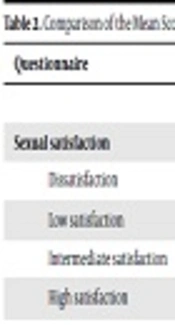
Table 2 separately compares the mean scores of male and female subjects with and without SCI. There was no statistically significant difference between male and female subjects with SCI regarding the mean scores of SS (P = 0.684), EMS (P = 0.779), BI (P = 0.246), SKA (P = 0.540), SE (P = 0.474), and MA (P = 0.378). There was no significant difference between male and female subjects without SCI in the mean scores of SS (P = 0.270), EMS (P = 0.772), BI (P = 0.829), SE (P = 0.242), and MA (P = 0.084), but significant in SKA (P = 0.033). FSFI in female subjects with and without SCI was 17.92 and 17.63, respectively compared with FSFI cutoff point (26.5), and showed that female subjects in both groups had sexual dysfunction. IIEF score of male subjects with SCI was 42.25 that indicated sexual dysfunction in comparison with IIEF cutoff point (40). IIEF in male subjects without SCI was 71.62 that showed no sexual dysfunction in comparison with IIEF cutoff point (40).
Table 2.
Comparison of the Mean Scores of the Questionnaires Between the SCI and Non-SCI Groupsa
| Questionnaire | SCI Group | Non-SCI Group | ||||
|---|---|---|---|---|---|---|
| Male (N = 20) | Female (N = 8) | P Value | Male (N = 8) | Female (N = 20) | P Value | |
| Sexual satisfaction | 0.684 | 0.270 | ||||
| Dissatisfaction | 5 (62.5) | 3 (37.5) | 1 (20) | 4 (80) | ||
| Low satisfaction | 14 (73.7) | 5 (26.3) | 3 (20) | 12 (80) | ||
| Intermediate satisfaction | 1 (100) | 0 (0) | 3 (42.9) | 4 (57.1) | ||
| High satisfaction | 0 (0) | 0 (0) | 1 (100) | 0 (0) | ||
| ENRICH satisfaction | 0.779 | 0.772 | ||||
| High dissatisfaction | 5 (62.5) | 3 (37.5) | 3 (37.5) | 5 (62.5) | ||
| Moderate dissatisfaction | 8 (72.5) | 3 (27.3) | 3 (27.3) | 8 (72.7) | ||
| Moderate satisfaction | 7 (77.8) | 2 (22.2) | 2 (28.6) | 5 (71.4) | ||
| High satisfaction | 0 (0) | 0 (0) | 0 (0) | 2 (100) | ||
| Bagarozzi intimacy | 0.246 | 0.829 | ||||
| Nonintimacy | 2 (100) | 0 (0) | 1 (50) | 1 (50) | ||
| Moderate intimacy | 7 (53.8) | 6 (46.2) | 3 (30) | 7 (70) | ||
| High intimacy | 9 (81.8) | 2 (18.2) | 4 (26.7) | 11 (73.3) | ||
| Very high intimacy | 2 (100) | 0 (0) | 0 (0) | 1 (100) | ||
| Sexual knowledge and attitude | 0.540 | 0.033 | ||||
| Very low | 0 (0) | 0 (0) | 0 (0) | 0 (0) | ||
| Low | 6 (85.7) | 1 (14.3) | 0 (0) | 6 (100) | ||
| Moderate | 7 (58.3) | 5 (41.7) | 5 (38.5) | 8 (61.5) | ||
| Acceptable | 6 (75) | 2 (25) | 1 (14.3) | 6 (85.7) | ||
| High | 1 (100) | 0 (0) | 2 (100) | 0 (0) | ||
| Sexual expression | 0.474 | 0.242 | ||||
| Very low | 1 (50) | 1 (50) | 0 (0) | 3 (100) | ||
| Low | 2 (66.7) | 1 (33.3) | 1 (12.5) | 7 (87.5) | ||
| Intermediate | 6 (60) | 4 (40) | 3 (50) | 3 (50) | ||
| High | 5 (71.4) | 2 (28.6) | 4 (44.4) | 5 (55.6) | ||
| Very high | 6 (100) | 0 (0) | 0 (0) | 2 (100) | ||
| Marital adjustment | 0.378 | 0.084 | ||||
| High unadjustment | 6 (75) | 2 (25) | 1 (20) | 4 (80) | ||
| Moderate unadjustment | 7 (58.3) | 5 (41.7) | 4 (33.3) | 8 (66.7) | ||
| Moderate adjustment | 5 (100) | 0 (0) | 1 (11.1) | 8 (88.9) | ||
| High adjustment | 2 (66.7) | 1 (33.3) | 2 (100) | 0 (0) | ||
| Female sexual function index, cutoff point (26.50) | 17.92 ± 5.21 | 17.63 ± 8.15 | ||||
| International index erectile dysfunction, cutoff point (40) | 42.35 ± 20.06 | 71.62 ± 15.88 | ||||
Abbreviation: SCI, spinal cord injury.
aValues are expressed as No. (%) or Mean ± SD.
Comparison of the mean scores of questionnaires in the groups SCI and non-SCI by chi-square test showed no significant difference in SS (P = 0.936), SKA (P = 0.405), SE (P = 0.695), and FSFI (P = 0.927). There was a significant difference in EMS (P = 0.012), BI (P = 0.035), MA (P = 0.000), and IIEF (P = 0.001) (Table 3).
Table 3.
Comparison of the Mean Scores of the Questionnaires Between the SCI and Non-SCI Groups
| Questionnaire | SCI Group | Non-SCI Group | P Value | ||
|---|---|---|---|---|---|
| Male (N = 20) | Female (N = 8) | Male (N = 8) | Female (N = 20) | ||
| Sexual satisfaction | 1.80 ± 0.523 | 1.63 ± 0.518 | 2.50 ± 0.926 | 2 ± 0.649 | 0.936a |
| ENRICH satisfaction | 2.10 ± 0.788 | 1.88 ± 0.835 | 1.88 ± 0.835 | 2.20 ± 0.951 | 0.02a |
| Bagarozzi intimacy | 2.55 ± 0.825 | 2.25 ± 0.463 | 2.38± 0.744 | 2.60 ± 0.681 | 0.035a |
| Sexual knowledge and attitude | 3.10± 0.912 | 3.13 ± 0.641 | 3.63± 0.916 | 3 ± 0.795 | 0.405a |
| Sexual expression | 3.65 ± 1.182 | 2.88 ± 0.991 | 3.38 ± 0.744 | 2.80 ± 1.28 | 0.685a |
| Marital adjustment | 2.15 ± 0.988 | 2 ± 0.926 | 2.50 ± 1.069 | 2.20 ± 0.768 | 0.000a |
| Female sexual function index, cutoff point (26.50) | 17.92 ± 5.21 | 17.63 ± 8.15 | 0.927b | ||
| International index erectile dysfunction, cutoff point (40) | 42.35 ± 20.06 | 71.62 ± 15.88 | 0.001b | ||
Abbreviation: SCI, spinal cord injury.
aChi-squar.
bt-student.
Results of the Pearson correlation coefficient indicated no significant correlation between the mean scores of FSFI and IIEF and the sociodemographic characteristics including sample age, partner age, LOM, duration of living with SCI, education level of the sample, education level of the partner, mean number of children, and occupational status (P > 0.05). The current study findings based on Spearman correlation coefficients showed a significant negative correlation between SS score and sample age (P < 0.009, r = -0.486), partner age (P < 0.002, r =-0.549), and LOM (P = 0.05, r = -0.374). There was an obvious negative correlation between the scores of SKA and LOM (P = 0.02, r = -0.374). Results of Spearman correlation coefficients showed no significant correlation between sociodemographic characteristics and scores obtained from other questionnaires (P > 0.05) (Table 4).
Table 4.
The Correlation of Sociodemographic Characteristics with Questionnaires Scores
| Questionnaire | Sociodemographic Characteristics | |||||||
|---|---|---|---|---|---|---|---|---|
| Sample Age, y | Partners Age, y | LOM, y | Duration of Living with SCI, y | Sample Education Level | Partner Education Level | Mean No. of Children | Occupational Status | |
| Sexual satisfactiona | 0.009 | 0.002 | 0.005 | 0.651 | 0.072 | 0.063 | 0.978 | 0.153 |
| ENRICH satisfactiona | 0.240 | 0.087 | 0.301 | 0.645 | 0.358 | 0.747 | 0.754 | 0.079 |
| The Bagarozzi intimacya | 0.469 | 0.237 | 0.442 | 0.508 | 625 | 0.977 | 0.943 | 0.764 |
| Sexual knowledge and attitudea | 0.100 | 0.544 | 0.020 | 0.159 | 0.241 | 0.416 | 0.318 | 0.643 |
| Sexual expressiona | 0.707 | 0.998 | 0.338 | 0.619 | 0.732 | 0.241 | 0.481 | 0.552 |
| Marital adjustmenta | 0.602 | 0.526 | 0.539 | 0.818 | 0.583 | 0.252 | 0.205 | 0.645 |
| Female sexual function index, cutoff point (26.50)b | 0.866 | 0.649 | 0.573 | 0.137 | 0.271 | 0.436 | 0.382 | 0.410 |
| International index erectile dysfunction, cutoff point (40)b | 0.427 | 0.994 | 0.281 | 0.546 | 0.457 | 0.837 | 0.477 | 0.096 |
Abbreviations: LOM, length of marriage; SCI, spinal cord injury.
aPearson correlation.
bSpearman correlation.
5. Discussion
The current study compared sexual satisfaction, intimacy, and partnership with sexual functioning of the couples with one SCI-affected partner referring to a sexual health clinic.
The correlation between sexuality and body wellness is documented worldwide. SCI has a significant impact on individuals` sexuality due to the personal feeling of his/her own sexual capability (1, 3, 24), as well as the social labeling of individuals with any form of disability, which may be considered to be synonymous with asexuality (3-5, 25). People with SCI have problems with their marital longevity and each partner has his/her own concern with threatened intimate relationship (4, 5).
Participants in the current study, both genders, got lower scores in SS, although the difference between the study groups was insignificant. There was a significant difference in the means of intimacy and partnership between the groups (P < 0.035); in male sexual functioning (P > 0.001) the difference was significant between the SCI and non-SCI groups. Similarly, there are a vast number of reports pointing out significant changes in sexual life of people with SCI, among the married couples in particular (26, 27). Kreuter argued that intimate partner relationship is adversely affected by SCI, which places the marital relationship at a higher risk of divorce and conflict (26).
Although the current study subjects showed low scores in most aspects of marital interactions, the partners with SCI were significantly different from the ones without SCI in EMS, MA, and BI. Similar to the current study subjects, other people with SCI in the studies worldwide also got lower scores in sexual activity and reported lower satisfaction compared with those of their control groups (2, 5, 28). McCabe and Taleporos reported that people with physical impairment experience lower levels of sexual self-esteem, sexual confidence, poor quality of sexual life, and significantly higher levels of sexual depression (29).
The current study also evaluated the differences between male and female subjects identified as the well partners. Regardless of their wellness, both male and female subjects with a SCI-affected spouse also got lower scores in SS. There is no question that partners of SCI-affected individuals consciously or unconsciously alter their tasks in the course of intimate partnership (3, 4, 25). Reports show that female subjects involved in a partnership after SCI do not consider themselves as a spouse, but more as a caregiver than being a wife or sexual partner (4, 5, 30), and some others believe that after the injury the partner change and is not as she used to be (30).
This alteration is highlighted through the societies in which well body is the essential factor in a successful sexual interaction (29)and the Iranian culture is not an exception (31). Merghati Khoei, an Iranian sexologist, pointed out in a study that marital and sexual life is socially scripted based on the gender-related folk theories. Masculinity means a well body and sexual potency, and femininity means reproduction and child bearing ability (32). She argued that these constructions are jeopardized with any form of disability, SCI in particular (33).
Interestingly, the current study found no significant differences (P > 0.05) in sexual functioning of females with or without SCI, although they reported lower scores of FSFI. It was argued that wives sacrificed their lives as soon as their husbands become injured and not capable to perform sexual intercourse. Their roles change to be a caregiver instead of being intimate sexual lover. In other words, they deny their sexual rights and interests through post-SCI-life (4, 30). Burden of caregiving is clearly shown in couples with one SCI-affected partner; consequences including diminished welfare, increased stress, tiredness, anger, depression, and denying their personal health needs and complications (5, 34).
Sexual relationship power is always male-dominated in some societies (7, 35). This ring of power suffers if a male loses his sexual ability, no matter if his partner is still sexually active (35). Small sample size can be the further explanation of this finding.
5.1. Conclusions
In conclusion, sexuality of people with SCI is far more complex and faces clinical, social, and cultural challenges. Post-SCI sexual life extensively changes. The couples' sexual needs vary compared with their well body counterparts. This means that all the considered conditions and situations should be effusively addressed in all spinal units and recovery centers, along with other aspects of treatment and rehabilitation.