
1. Background
Mother-to-child transmission (MTCT) of human immunodeficiency virus type 1 (HIV-1) infection is the most important cause of HIV-1 infection among children under the age of 15, especially in the first two years of life (1); therefore, there is a need for urgent planning to address the situation of these children (2). Moreover, early diagnosis of HIV infection in young children is crucial for making decisions about medical and social care (3). Recent studies on the management and treatment of HIV-infected infants have revealed that antiretroviral therapy (ART) should be implemented in the first three months of life (4, 5). The initial diagnosis of HIV infection is one of the most important issues in the prevention and treatment process of this infection (6), which can be achieved by screening infants for this infection. Accessibility, however, can be a very restrictive factor because serological tests in newborns cannot be used due to maternal antibody stability up to the age of 18 months (7). Therefore, the diagnosis of HIV infection in infants is based on other tests (7); for example, the viral culture, detection of p24 antigenemia, and determination of the presence of the virus genome in the patient’s samples (8).
The following restrictions have led to the use of molecular techniques to diagnose HIV infection in infants: specific biosafety equipment is needed for viral culture; it is very time-consuming, and its sensitivity is not high (9). Additionally, the sensitivity of P24 antigen (P24 Ag) detection is lower than that of molecular assays (10), and also, this P24 Ag may pass through the placenta and be detected in non-infected HIV newborns (11).
The presence of HIV nucleic acid (RNA in plasma or DNA in peripheral blood mononuclear cell [PBMC] samples) can be detected in the specimens with molecular techniques, and they can be qualitative or quantitative (12). These methods are now widely used all over the world (13). Thus, the necessity of the use of molecular biology techniques to diagnose HIV infection in HIV-positive neonates and infants under 18 months of age should be considered (14). Although in most cases, the antibody-antigen enzyme-linked immunosorbent assay test, HIV-1 RNA detection in plasma specimens, and western blot assay are the mainstay of clinical diagnosis (15), in several studies on HIV-exposed seronegative individuals (HESN) proviral DNA of HIV-1 has been diagnosed in PBMC samples using polymerase chain reaction (PCR). The seronegative infection has been reported in health care personnel accidentally exposed to infected blood, in people who have frequent blood transfusions, sexual partners of HIV-infected people, and also in children of HIV-1 positive mothers (1, 16).
According to the Joint United Nations Program on HIV/AIDS (UNAIDS) and World Health Organization (WHO), at the end of 2005, there were more than 2.3 million children under the age of 15 years infected by HIV, and annually 0.57 million HIV-1-infected children die (17).
According to a global estimate by WHO in 2016, about 36.7 million people were living with HIV infection (Africa: 25.6 million, South-East Asia: 3.5 million, USA: 3.3 million, Europe: 2.4 million, Western Pacific: 1.5 million, and the Eastern Mediterranean: 360,000) (http://www.who.int/hiv/data/en/). In 2016, the number of children (less than 15 years of age) living with HIV infection was approximately 2.1 million, the number of children (less than 15 years of age) newly infected with this virus was about 160,000 million (100,000 - 220,000), and the number of children (less than 15 years of age) who died of AIDS was about 120,000 million (79,000 - 160,000). In addition, about 872,500 million children (less than 15 years of age) received antiretroviral therapy (ART) from 2000 to 2015 worldwide (http://www.who.int/hiv/data/en/).
Most of the neonatal infections that are acquired at the time of delivery, as well as the in-utero viral infections, can be detected through existing tests, but in other cases, the virus remains inactive in the immune cell’s genome for a long time (2). In these children, there are no symptoms related to HIV/AIDS, whereas they never received antiretroviral treatment. Serological tests, viral load (HIV-1 RNA concentration) on plasma samples, and even in some cases, virus culture, are negative in pediatric samples (1).
When HIV infection is not diagnosed early, then without treatment, about half of HIV-positive infants would die before two years of age, and 75% would die within five years of age. These deaths can be prevented by early infant diagnosis (EID), effective care, and ART (18).
Studies have indicated that HIV DNA PCR is significantly more sensitive than co-culture in the detection of HIV-1 in infected infants, and this method is recommended as the gold standard for virologic diagnosis of HIV infection in infants (1, 19).
In Iran, according to the WHO guidelines, the neonates born to HIV-infected mothers have been screened for the detection of HIV-RNA in plasma using real-time PCR since 2014 (20).
2. Objectives
This study is the first study in Iran that evaluated the prevalence of HIV-1 infection in PBMC specimens of infants born to HIV-infected mothers using a DNA PCR assay.
3. Methods
3.1. Subjects
From March 2014 to February 2018, 73 consecutive Iranian infants born to HIV-1-infected mothers were studied in this current follow up study to compare two different diagnostic methods (20). All HIV positive mothers between the ages of 15 to 48 years old were considered eligible for the current research. It is noteworthy that the mothers of the neonates were entered into the prevention of mother-to-child transmission (PMTCT) project for HIV as per the Iranian guidelines (21), the criteria of which were as follows: (1) HIV-infected mothers received antiretroviral drugs; (2) all of them (HIV-infected mothers) had undergone cesarean section; (3) these mothers did not breastfeed their children; and also (4) newborns received zidovudine syrup (20).
Peripheral blood samples were taken from each neonate at two ages (4 - 6 weeks and 4 - 6 months), and HIV-1 infection was tested in plasma and PBMC samples (20). It should be noted that during the present study, 20 children who were born to HIV-1 infected mothers who were not included in the PMTCT project were accidentally found. The mothers of these children were unaware that they were infected with the virus and noticed that they were infected at the time of delivery or several months after the baby was born. The study was also conducted on the children. The current survey was approved by the Iran University of Medical Sciences (IUMS), Tehran, Iran’s local ethics committee, in accordance with the Helsinki Declaration (the ethical code: IR.IUMS.FMD.REC 1396.9411541002). The parents of the neonates were informed about the current investigation, and a written consent form was received from all of them before commencing the study.
3.2. Collection and Preparation of the Specimens
A peripheral blood sample of about 3 ml was taken from each neonate and placed in a vacutainer tube containing EDTA, and then the PBMCs of each specimen were isolated using a standard protocol by Ficoll Hypaque (Lympholyte-H, Cedarlane, Hornby, Canada). After washing the PBMCs with PBS (pH = 7.3 ± 0.1), 250 µL of RNA preservative solution) RNALater: Ambion, Austin, TX) was added to the cells. Afterward, they were kept at -80°C until use.
3.3. RNA Extraction and the HIV-1 Viral Load Determination
The viral RNA of the plasma samples was isolated by a QIAamp DSP Virus Kit (QIAGEN GmbH, Hilden, Germany), in accordance with the manufacturer’s protocols. The HIV-1 viral load level was determined using an Artus HIV-1 RG RT-PCR Kit (QIAGEN GmbH, Hilden, Germany), in accordance with the manufacturer’s guidelines.
3.4. Genomic DNA Extraction and the HIV-1 DNA Detection
Total DNA was isolated from PBMC specimen by a QIAamp® DNA Mini kit (Qiagen GmbH, Hilden, Germany), in accordance with the manufacturer’s protocol guidelines, and the concentration of total DNA was determined by a NanoDrop (Thermo Scientific, Wilmington, MA) spectrophotometer.
The proviral DNA of HIV-1 in the PBMC specimens was detected by the real-time PCR method using the Rotor-Gene Q (QIAGEN, Germany) system, as previously described in detail (22). Briefly, for amplification of the HIV-LTR region, a TaqMan probe (LTR-Probe), and a pair of primers (LTR-F, LTR-R2) that could amplify a conserved region of the HIV-LTR were used (22), and also as internal control, a TaqMan probe and a pair of primers that could amplify a conserved region of the human β-globin gene were used (22).
3.5. The Determination of HIV-1 Surveillance Drug-Resistant Mutations
Drug-resistance mutation of HIV-1 was determined using genotyping, as explained in detail in previous research (23). Sequences acquired from the HIV-1 positive specimens were aligned with the reference sequence of this virus (HXB2 [GenBank accession number: K03455]) using the CLC Main Workbench 5.5 (CLCbio, Boston, MA, USA) software. The list of surveillance drug-resistant mutations (SDRMs) of the WHO was used to determine the presence of transmitted drug resistance mutations in the sequences obtained from the specimens (24). The MEGA software version 7.0.21 was used for the construction of a phylogenetic tree by the neighbor-joining method (Figure 1), using the obtained sequences (1015 bp) from the experiment, and the phylogenetic tree was evaluated by the bootstrap method (1,000 replicates).
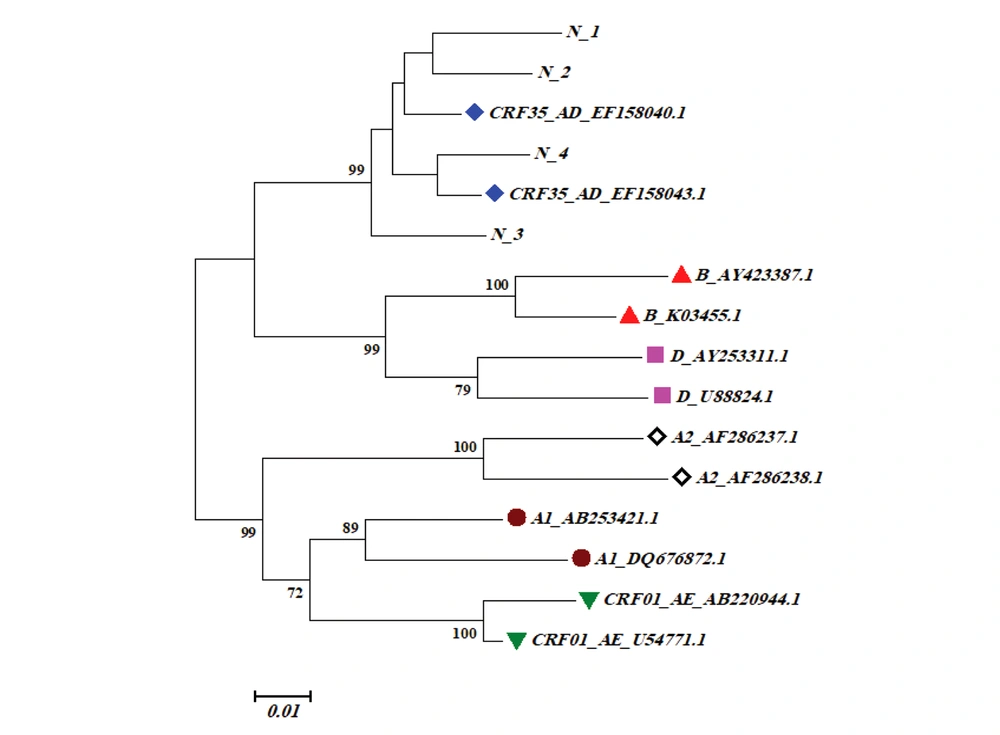
Figure 1.
The phylogenetic tree made based on the pol gene nucleotide sequences (1015 bp) of HIV-1 retrieved from plasma specimens of 4 HIV-1-infected infants and those corresponding to various complete genome sequences of HIV-1 obtained from the GenBank. Closed diamonds (♦) show CRF35-AD, closed triangles (▲) show subtype B, closed squares (■) show subtype D, opened diamonds (◊) show subtype A2, closed circles (●) show subtype A1, and closed inverse triangles (▼) show subtype CRF01-AE. The neighbor-joining technique was used for the construction of this phylogenetic. The bootstrap values equal to or greater than 70 obtained after 1000 replicates have been indicated in the figure.
3.6. Statistical Analysis
Statistical analysis of this assay was performed by SPSS version 20 (SPSS Inc., Chicago, IL, USA) software. The Kolmogorov-Smirnov test was used to assess the normality of the data. The statistical differences between categorical variables were determined by Fisher’s exact test or chi-square test, as appropriate. A P-value less than 0.05 (P < 0.05) was considered statistically significant.
4. Results
4.1. Characteristics of the Subjects
Seventy-three neonates born to Iranian HIV-infected mothers in the PMTCT project for HIV infection were enrolled in this study. Of the 73 studied infants, 41 (56.2%) were male, and the mean age of the HIV infected mothers was 30.7 ± 5.2 years (range: 19 - 47).
The demographic and epidemiological features, as well as laboratory data of the HIV-1 exposed infants and their parents, have been demonstrated in Table 1.
Table 1.
Various Parameters Related to HIV-exposed Infants and Their Parents in Different Yearsa
| Parameters | Years | P-Value | ||
|---|---|---|---|---|
| 2015 | 2016 | 2017 | ||
| Characteristics of the Neonates Born to HIV-Infected Mothers in PMTCT | ||||
| Gender | 0.533 | |||
| Male | 12 (63.2) | 15 (60.0) | 14 (48.3) | |
| Female | 7 (36.8) | 10 (40.0) | 15 (51.7) | |
| Characteristics of the HIV-Infected Mothers in PMTCT | ||||
| Age | 29.8 ± 5.5 (19 - 40) | 31.0 ± 5.2 (22 - 47) | 31.2 ± 5.3 (19 - 39) | 0.404 |
| Age groups, y | 0.516 | |||
| ≤ 25 | 5 (26.3) | 4 (16.0) | 6 (20.7) | |
| 26 - 34 | 10 (52.6) | 18 (72.0) | 15 (51.7) | |
| ≥ 35 | 4 (21.1) | 3 (12.0) | 8 (27.6) | |
| CD4 count | 643.8 ± 282.1 (320 - 1483) | 494.4 ± 174.0 (135 - 859) | 662.1 ± 239.3 (310 - 1471) | 0.831 |
| CD4 count categories | 0.520 | |||
| ≤ 350 | 4 (21.1) | 5 (20.0) | 3 (10.3) | |
| > 350 | 15 (78.9) | 20 (80.0) | 26 (89.7) | |
| Rout of infection | 0.090 | |||
| Unprotected sex | 10 (52.6) | 16 (64.0) | 22 (75.9) | |
| Intravenous drug user | 0 (0.0) | 0 (0.0) | 2 (6.9) | |
| Injection drug user sexual partner | 8 (42.1) | 5 (20.0) | 3 (10.3) | |
| Tattooing | 0 (0.0) | 0 (0.0) | 1 (3.4) | |
| Unknown | 1 (5.3) | 4 (16.0) | 1 (3.4) | |
| Education | 0.502 | |||
| Under diploma | 14 (73.7) | 19 (76.0) | 25 (86.2) | |
| Diploma | 5 (26.3) | 6 (24.0) | 4 (13.8) | |
| Characteristics of the Fathers | ||||
| Rout of infection | 0.483 | |||
| Intravenous drug user | 7 (36.3) | 10 (40.0) | 11 (37.9) | |
| Unprotected sex | 7 (36.8) | 2 (8.0) | 3 (10.3) | |
| Unprotected sex and IDUs | 1 (5.3) | 4 (16.0) | 8 (27.6) | |
| Unknown | 1 (5.3) | 2 (8.0) | 1 (3.4) | |
| Education | 0.352 | |||
| Under diploma | 18 (94.7) | 22 (88.0) | 21 (72.4) | |
| Diploma | 0 (0.0) | 1 (4.0) | 5 (17.2) | |
| Upper diploma | 0 (0.0) | 1 (4.0) | 1 (3.4) | |
| Unknown | 1 (5.3) | 1 (4.0) | 2 (6.9) | |
| HIV-Infected father | 0.761 | |||
| No | 3 (15.8) | 7 (28.0) | 6 (20.7) | |
| Yes | 16 (84.2) | 17 (68.0) | 22 (75.9) | |
| Unknown | 0 (0.0) | 1 (4.0) | 1 (3.4) | |
aValues are expressed as No. (%) or mean ± SD (range).
As shown in Table 1, there is no significant relationship between age, gender, CD4 count, HIV transmission pathway of parental infection, and parents’ education level with various years of the present study. However, it is worth noting that the route of HIV transmission of these mothers was largely through unprotected sex, and most of them were under the level of a high school diploma.
On the other hand, most of the HIV-infected fathers were injecting drug users, and their level of education was mostly under that of the high school diploma. It should be noted that 16 fathers were not infected with the virus. In this study, in PBMC specimens of the neonates born to HIV-infected mothers in the PMTCT project which HIV-1 RNA was not detected in their plasma samples, HIV-1 proviral DNA was also not detected.
It is worth mentioning that, in the current investigation, 20 HIV-infected women were accidentally found. None of these women were included in the PMTCT project, and their babies were born a few months previously. Of the 20 infants born to HIV-infected mothers, four children (20%) were infected with this virus. These four HIV-infected infants were tested for the presence of the proviral DNA of HIV-1, and the experiment found that all of them were positive for the presence of HIV-1 proviral DNA. Table 2 presents a comparison between the demographic, laboratory, and epidemiological characteristics of these infants and their mothers and their infection with HIV.
Table 2.
Various Parameters Related to HIV-Exposed Neonates and Their Mothers Who Were Not in PMTCT Projecta
| HIV-Infected Infants | HIV Negative Infants | Total | P-Value | |
|---|---|---|---|---|
| Characteristics of the Neonates | ||||
| No. (%) | 4 (20.0) | 16 (80.0) | 20 (100) | |
| Male/female sex | 2/2 | 8/8 | 10/10 | 0.709 |
| Characteristics of the Mothers | ||||
| CD4 count | 460.8 ± 379.0 (154 - 983) | 479.0 ± 211.0 (135 - 907) | 475.0 ± 240.0 (135 - 983) | 0.896 |
| Age, y | 31.0 ± 6.4 (25 - 40) | 30.4 ± 5.5 (19 - 38) | 30.5 ± 5.5 (19 - 40) | 0.846 |
| Unprotected sex | 2 (50.0) | 8 (50.0) | 10 (50) | 1.000 |
| Intravenous drug user sexual partner | 2 (50.0) | 7 (43.8) | 9 (45) | 1.000 |
| Unknown | 0 (0.0) | 1 (6.3) | 1 (5) | 1.000 |
| Education | ||||
| Under diploma | 4 (100.0) | 11 (68.8) | 15 (75) | 0.530 |
| Diploma | 0 (0.0) | 5 (31.3) | 5 (25) | |
aValues are expressed as No. (%) or mean ± SD (range).
4.2. Sequence Analysis of the PR-RT Gene Amplification
The phylogenetic analyses showed that all of the four HIV-1 positive children were infected by CRF35-AD, and none of them were infected with HIV-1 variants with SDRMs. The nucleotide sequences of the Pol region of HIV-1 reported in this study (four children with HIV-1 infection) were submitted to the GenBank database with the accession numbers from KY816748 to KY816750, and also MG944243.
5. Discussion
Progression of the disease after infection with HIV in infants is rapid; therefore, early detection and treatment of HIV-1 infection in children can dramatically reduce mortality rates (25). As some researchers believe that detecting the presence of HIV-1 proviral DNA is the gold standard for the diagnosis of this infection in neonates born to HIV-infected mothers (26, 27), we aimed at determining the presence of proviral DNA in PBMC samples of infants born to HIV-infected mothers. The obtained results of this study revealed that in PBMC samples of 73 infants born to HIV-positive mothers where their mothers and the infants had been previously entered into the PMTCT projects, and the genomic HIV-1 RNA was not detected in their plasma samples, no HIV-1 proviral DNA was detected. On the other hand, in this research, we accidentally found 20 infants born to mothers with HIV infection who had not been included in the PMTCT project. Four infants (20%) were infected with HIV, and none of them were infected with HIV-1 variants with surveillance drug-resistance mutations (SDRMs), and the HIV-1 proviral DNA was detected in PBMC samples of these four HIV-1-infected infants.
Several studies have indicated that HIV-1 proviral DNA detection in PBMC specimens is significantly effective in the diagnosis of HIV-1 infection in neonates and is suggested as the gold standard method for molecular diagnosis of HIV infection for this group (1, 28). The WHO recommended HIV-1 diagnosis for all HIV-exposed neonates (4 - 6 weeks of age) using molecular tests, as well as the initiation of ART, immediately after the diagnosis of HIV infection (29). Detection of HIV-1 proviral DNA in PBMC samples and HIV-1 RNA in plasma specimens have been used to diagnose HIV infection in infants (27).
Extracellular RNA of HIV may appear shortly after the infection, and HIV-1 RNA in plasma samples is detectable earlier and is more reliable than HIV-1 proviral DNA in PBMC specimens of neonates with perinatal infection (19, 30). Testing for HIV-1 RNA is more sensitive than the detection of HIV-1 proviral DNA for neonates younger than two months old, receiving prophylaxis with zidovudine syrup (8, 9). However, some reports do not show a difference between the results of these two molecular methods (29, 31). On the other hand, Burgard et al. (29) believed that the specificity of both HIV-1 proviral DNA and HIV-1 RNA PCR was 100% at all ages.
In Iran, the PMTCT project for HIV infection is currently in progress (20); therefore, the outcome of this project should be carefully evaluated. Fortunately, the results of our study revealed that the two molecular methods for the detection of HIV infection (genomic RNA of HIV-1 in plasma and proviral DNA of HIV-1 in PBMC specimens) are in perfect agreement with each other.
Regarding the results of this study, it can be concluded that all neonates who were born to HIV-infected mothers in the PMTCT project were completely negative for this infection (negative for both genomic RNA of HIV-1 in plasma and proviral DNA of HIV-1 in PBMC specimens), and the implementation of this project has prevented the transmission of this infection from mother to child, and consequently, this project has been very successful in Iran.
It has been reported that some individuals who are exposed to HIV repeatedly do not seroconvert. It seems that these people are resistant to being infected with this virus (1, 4). These individuals do not have any detectable anti-HIV-1 Abs in plasma; however, they have strong cell-mediated antiviral responses (9). There have also been rare reports of HIV-exposed seronegative persons with detected proviral DNA of HIV-1 in their PBMC samples (such as persons who have had sexual contact with HIV-infected partners, health care workers with accidental percutaneous exposure to HIV-infected samples, and also neonates born to HIV-1-positive mothers) (4).
In the case of pediatric infections, some infected infants (anti-HIV Ab-negative and HIV-1 proviral DNA-positive) seem to be able to eliminate virus-infected cells, whereas others can harbor HIV-1 proviral DNA in their cells for a long time (2). These children have been called ‘silent pediatric infections’. Fortunately, in the present study, all neonates born to HIV-1 positive mothers covered by the PMTCT project had genomic RNA of HIV-1 in plasma and also were negative for the proviral DNA of HIV-1 in PBMC specimens; therefore, none of them had silent pediatric infections.
It should be noted that in this research, 20 children were accidentally detected who were born to HIV-infected mothers and had not been covered by the PMTCT program, of whom four children (20%) were found infected with HIV. All these children had genomic RNA of HIV-1 in plasma and were also positive for proviral DNA of HIV-1 in their PBMC specimens. The results of the sequencing of the regions of HIV as well as the drug resistance test showed that these four HIV-1-positive neonates were infected with CRF35-AD, and it is noteworthy that none of them were infected with HIV-1 strains with SDRMs.
Also, the frequency of HIV-1 subtypes and CRFs in various HIV-infected populations in Iran is as follows: CRF35-AD: 88%; subtype B: 7.1%; CRF01-AE: 4.7% in individuals with sexually-transmitted infections with HIV (23); injection drug users infected with CRF35-AD: 100% (32); and individuals infected with CRF35-AD: 95.7% (33). A study on the frequency of HIV infection to determine the HIV subtypes or CRFs and also the presence of the SDRMs in Iranian infants born to HIV-positive mothers should be conducted.
5.1. Conclusions
Our results demonstrated that if HIV-infected pregnant women are recognized and included in the PMTCT project, not only will their children become HIV RNA-negative in their plasma, but also they will become HIV proviral DNA-negative in their cells. Therefore, with the full implementation of the PMTCT project, healthy infants will possibly be born to HIV-infected mothers.